AWS Compute Blog

Author: Nathan Taber
Nathan leads product management for Kubernetes and Container Registries at AWS. Nathan and his team are dedicated to help AWS customers, partners, and engineering teams build for Kubernetes in the cloud.
Updates to Amazon EKS Version Lifecycle
Contributed by Nathan Taber and Michael Hausenblas At re:Invent 2017 we introduced the Amazon Elastic Container Service for Kubernetes, or Amazon EKS for short. We consider these tenets as valid today as they were at launch: EKS is a platform to run production-grade workloads. This means that security and reliability are our first priority. After that we […]

Introducing AWS App Mesh – service mesh for microservices on AWS
AWS App Mesh is a service mesh that allows you to easily monitor and control communications across microservices applications on AWS. You can use App Mesh with microservices running on Amazon Elastic Container Service (Amazon ECS), Amazon Elastic Container Service for Kubernetes (Amazon EKS), and Kubernetes running on Amazon EC2. Today, App Mesh is available […]
Running GPU-Accelerated Kubernetes Workloads on P3 and P2 EC2 Instances with Amazon EKS
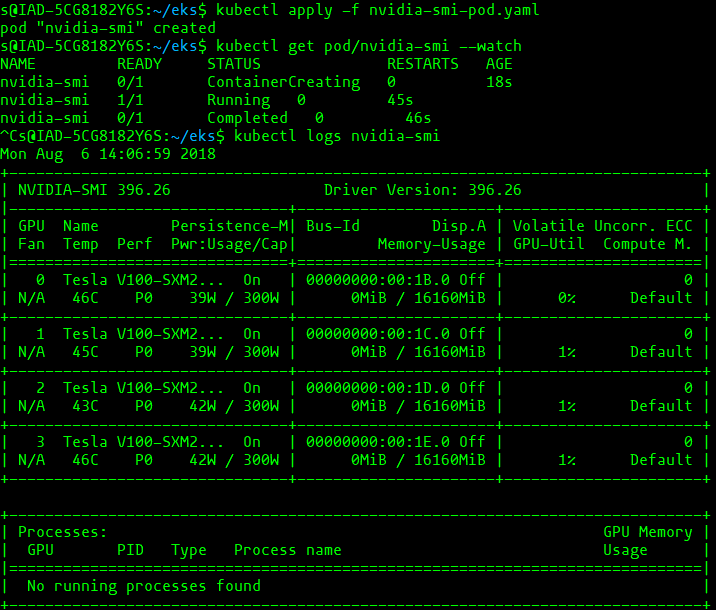
This post contributed by Scott Malkie, AWS Solutions Architect Amazon EC2 P3 and P2 instances, featuring NVIDIA GPUs, power some of the most computationally advanced workloads today, including machine learning (ML), high performance computing (HPC), financial analytics, and video transcoding. Now Amazon Elastic Container Service for Kubernetes (Amazon EKS) supports P3 and P2 instances, making […]
Refreshing an Amazon ECS Container Instance Cluster With a New AMI
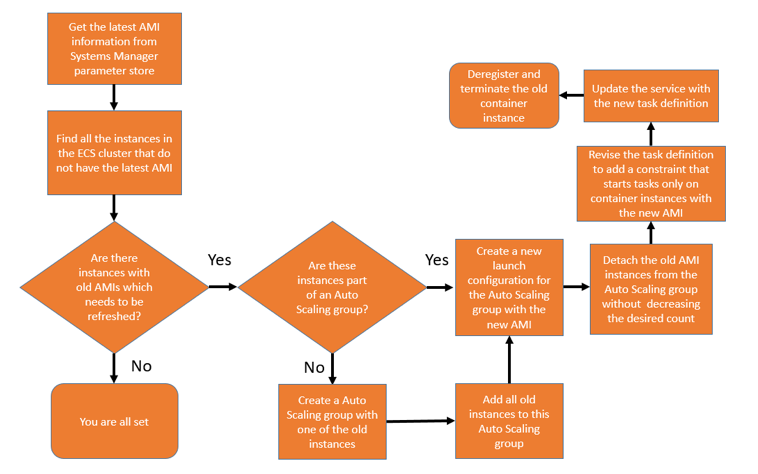
This post contributed by Subhrangshu Kumar Sarkar, Sr. Technical Account Manager at AWS The Amazon ECS–optimized Amazon Machine Image (AMI) comes prepackaged with the Amazon Elastic Container Service (ECS) container agent, Docker, and the ecs-init service. When updates to these components are released, try to integrate them as quickly as possible. Doing so helps you […]
Machine Learning with AWS Fargate and AWS CodePipeline at Corteva Agriscience
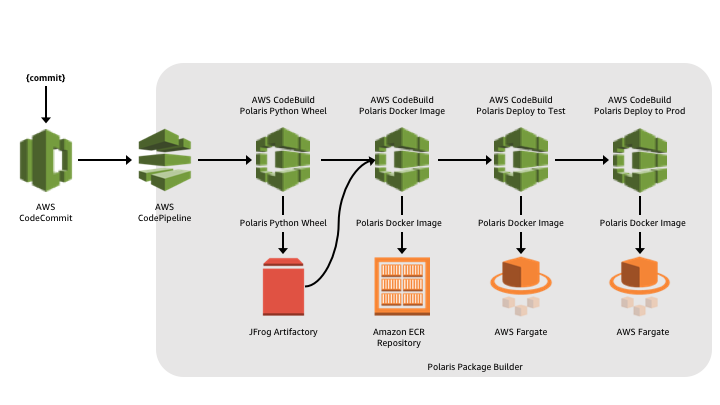
This post contributed by Duke Takle and Kevin Hayes at Corteva Agriscience At Corteva Agriscience, the agricultural division of DowDuPont, our purpose is to enrich the lives of those who produce and those who consume, ensuring progress for generations to come. As a global business, we support a network of research stations to improve agricultural […]

Maintaining Transport Layer Security all the way to your container part 2: Using AWS Certificate Manager Private Certificate Authority
This post contributed by AWS Senior Cloud Infrastructure Architect Anabell St Vincent and AWS Solutions Architect Alex Kimber. The previous post, Maintaining Transport Layer Security All the Way to Your Container, covered how the layer 4 Network Load Balancer can be used to maintain Transport Layer Security (TLS) all the way from the client to […]

Building, deploying, and operating containerized applications with AWS Fargate
This post was contributed by Jason Umiker, AWS Solutions Architect. Whether it’s helping facilitate a journey to microservices or deploying existing tools more easily and repeatably, many customers are moving toward containerized infrastructure and workflows. AWS provides many of the services and mechanisms to help you with that. In this post, I show you how […]
Blue/Green Deployments with Amazon Elastic Container Service
This post and accompanying code was generously contributed by: Jeremy Cowan Solutions Architect Anuj Sharma DevOps Cloud Architect Peter Dalbhanjan Solutions Architect Deploying software updates in traditional non-containerized environments is hard and fraught with risk. When you write your deployment package or script, you have to assume that the target machine is in a particular […]
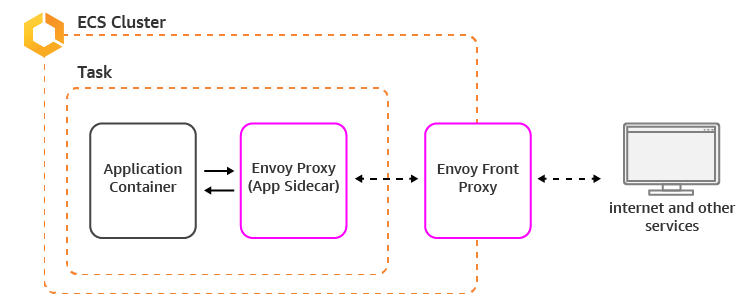
Setting Up an Envoy Front Proxy on Amazon ECS
NOTICE: April 17, 2023 – This post no longer reflects the best guidance for configuring a service mesh with Amazon ECS and its examples no longer work as shown. Please refer to newer content on Amazon ECS Service Connect or AWS App Mesh instead. This post was contributed by Nare Hayrapetyan, Sr. Software Engineer Many customers […]

Application Tracing on Kubernetes with AWS X-Ray
This post was contributed by Christoph Kassen, AWS Solutions Architect With the emergence of microservices architectures, the number of services that are part of a web application has increased a lot. It’s not unusual anymore to build and operate hundreds of separate microservices, all as part of the same application. Think of a typical e-commerce […]