AWS Contact Center
How Siemens handles 90% of calls autonomously with Amazon Connect Customer AI Agents
Introduction
Siemens Global Business Services (GBS) provides shared services and business process support across more than 80 countries, handling finance, procurement, HR, sales operations, and digital services for all Siemens business units. Their inbound contact operations manage a wide range of topics — from order and delivery management to employee lifecycle queries and technical support requests. GBS serves internal stakeholders and external customers at scale.
Before deploying AI agents, Siemens faced a familiar set of contact center challenges: human agents were triaging high volumes of diverse inbound calls, callers waited in queues for simple queries that could be resolved without human intervention, customers seeking specific employees were frequently misrouted, and outbound sales outreach was limited by headcount.
Siemens chose Amazon Connect Customer as their AI agent solution because of its native integration of conversational AI, generative AI, and telephony. This provides Siemens with a unified platform for conversational AI, generative AI, and telephony. The platform’s pay-per-use pricing model and rapid deployment capabilities mean Siemens can start with a single use case and expand incrementally.
In this post, we describe three distinct AI agent use cases that Siemens has built on Amazon Connect Customer:
- Intelligent call routing with AI agents (live in production): autonomously handling 90% of inbound calls
- Employee lookup agent (proof of concept): real-time directory queries with callback orchestration
- Outbound campaign AI agents (proof of concept): personalized sales outreach at scale
Solution overview
The three use cases share a common architectural foundation built on Amazon Connect Customer’s native AI capabilities:
- Connect Customer provides the telephony layer, contact flows, and agent workspace
- Amazon Lex powers natural language understanding for intent detection and conversational flows
- Connect Customer AI Agent provides generative AI for knowledge base queries, dynamic response generation, and personalized dialogue
- AWS Lambda handles real-time integrations with Siemens’ internal systems (customer relationship management (CRM), employee directory, knowledge bases)
- Amazon Bedrock AgentCore Gateway exposes Siemens’ internal APIs (CRM, employee directory) as Model Context Protocol (MCP)-compatible tools. AI agents can then discover and invoke enterprise services through a unified, secure gateway
- Connect Customer outbound campaigns orchestrates predictive dialing and answering machine detection for the outbound use case
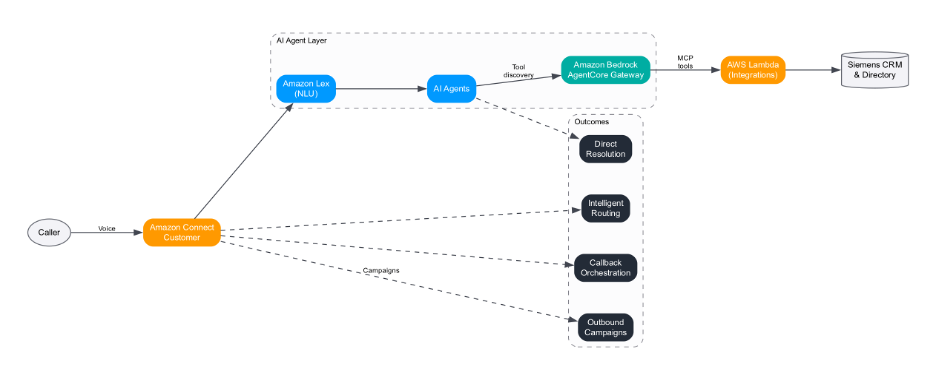
The design follows three core principles:
- Autonomous-first: The AI agent handles the interaction from initial greeting through resolution or routing, without human intervention
- Human escalation as fallback: When the AI agent can’t resolve, it routes to the appropriate human agent with full context
- CRM integration: Every interaction reads from and writes back to Siemens’ systems of record
Use case 1: Intelligent call routing with AI agents (production)
Business context
Siemens’ main hotline receives thousands of calls daily across a broad topic range. Before the AI agent deployment, callers had to navigate an IVR tree with dual-tone multi-frequency (DTMF) menus, such as pressing 1 for sales, 2 for support, and so on. This approach struggled with the sheer diversity of Siemens’ business: callers often didn’t know which menu option matched their need, leading to misroutes, repeated transfers, and frustrated customers.
Architecture walkthrough
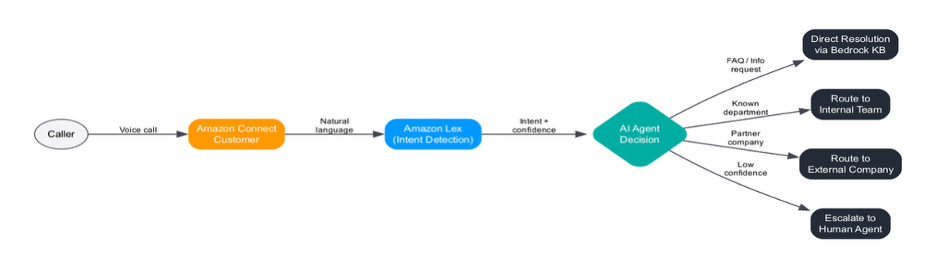
The production AI agent replaces the previous IVR entirely with a natural language interface:
- Intent detection via Amazon Lex: Callers state their reason for calling in natural language. Amazon Lex identifies the intent from a trained model covering Siemens’ comprehensive topic taxonomy. No DTMF menus are required.
- Routing logic: Based on the detected intent, the AI agent routes to internal Siemens teams or external partner companies. Complex routing rules are encoded in Connect Customer contact flows.
- Direct resolution path: For common queries (job enquiries, supply chain status, product information), the AI agent resolves the call directly using a Connect Customer knowledge base. No human agent is required.
- Human escalation fallback: When the AI agent can’t confidently resolve or route, it transfers to a human agent with full conversation context preserved.
Results
Since going live, the AI agent handles 90% of inbound calls autonomously—either resolving them directly or routing them to the correct destination without human intervention. Key outcomes include:
- Elimination of DTMF menu trees, with callers speaking naturally
- Reduced average wait time for callers
- Improved first-contact resolution through direct knowledge base answers
- Human agents freed to focus on complex, high-value interactions
“With AI-driven call routing, we have simplified customer interactions, reduced handling times, and improved resolution rates through intelligent, automated support”
Use case 2: Employee lookup agent (proof of concept)
Business context
Customers and partners frequently call Siemens asking to speak with a specific employee, such as their sales representative, a project manager, or a technical contact. Previously, these calls required a human dispatcher to look up the employee, check availability, and either transfer the call or take a message. This process was slow, error-prone, and consumed significant agent capacity.
Architecture walkthrough
The employee lookup AI agent automates this entire workflow:
- Caller detail collection: The AI agent engages the caller in a natural conversation to collect the name of the person they’re trying to reach, along with context about the inquiry.
- Real-time employee directory query: An AWS Lambda function queries Siemens’ internal employee directory in real time, matching on name, department, and role.
- Callback orchestration: Rather than placing the caller on hold, the AI agent confirms a callback will be arranged, notifies the target employee via their preferred channel, and logs the interaction in the CRM.
Key design decisions
- Privacy guardrails: The AI agent never discloses employee phone numbers or personal details to callers
- Availability handling: If the employee is unavailable, the agent offers alternatives (voicemail, callback scheduling, transfer to team)
- Zero dropped inquiries: Every lookup request is logged and tracked to completion, ensuring no caller falls through the cracks
Scalability validation
“The proof of concept gives us confidence that this architecture scales to additional geographies and authentication scenarios. The integration with Amazon Bedrock AgentCore Gateway validates that we can expose enterprise directories as Model Context Protocol (MCP)-compatible tools securely and at scale.”
Use case 3: Outbound campaign AI agents (proof of concept)
Business context
Siemens’ sales organization wanted to scale personalized outreach to existing customers without proportional headcount growth. Traditional outbound calling required human representatives to manually dial, deliver scripted pitches, and log outcomes, limiting both reach and personalization.
Architecture walkthrough
The outbound campaign AI agent combines Amazon Connect outbound campaigns with conversational AI:
- CRM integration: At call time, the AI agent pulls the customer’s purchase history and product recommendations from Siemens’ CRM via Lambda.
- Amazon Connect outbound campaigns: Predictive dialing handles call pacing, and answering machine detection ensures the AI agent only engages live callers.
- Conversational AI sales agent: Amazon Lex combined with Connect Customer AI Agent delivers personalized outbound dialogue. The AI agent introduces itself, references the customer’s history, presents relevant product recommendations, and assesses purchase intent.
- CRM write-back: Call outcomes, transcripts, and engagement signals are logged back to the CRM automatically.
Key design decisions
- Autonomous initial outreach, human handoff post-qualification: The AI agent handles the initial engagement and qualification. Once a customer expresses genuine interest, the system schedules a follow-up with a human sales representative.
- Compliance-first design: The system respects opt-out preferences, calling time windows, and General Data Protection Regulation (GDPR) consent requirements.
Scalability validation
“The outbound proof of concept validates that multi-turn conversations, CRM integration via Amazon Bedrock AgentCore Gateway, and compliance guardrails including consent management and opt-out handling all work within the same architecture. The foundation is production-ready.“
Lessons learned and best practices
Through building and deploying these three AI agent use cases, Siemens identified several key lessons:
Design for intent diversity from day one. Siemens’ hotline covers an unusually broad range of topics. Rather than trying to build a single monolithic intent model, the team designed a hierarchical approach: a top-level classifier identifies the broad category, then specialized sub-models handle the nuances within each category.
Balancing autonomy with human escalation. Siemens achieved the 90% autonomous handling rate by being deliberate about what the AI agent should and should not attempt. Clear confidence thresholds determine when the agent resolves directly versus when it escalates. Escalation always includes full conversation context so the human agent doesn’t ask the caller to repeat themselves.
CRM integration is essential for personalization. The outbound campaign agent’s effectiveness depends heavily on real-time access to customer data. Investing in production-grade Lambda-based CRM integrations early enabled reuse across all three use cases.
Start with one use case, expand incrementally. Siemens began with intelligent routing (the highest-volume, most impactful use case), validated the architecture, then extended the same solution to employee lookup and outbound campaigns. This approach reduced technical and organizational risk and demonstrated measurable ROI that secured executive buy-in for expansion.
Test with real call recordings. The team used anonymized recordings from the previous IVR to train and validate the AI agent’s intent detection, verifying it handled the full diversity of real-world caller language before going live.
Conclusion
Siemens’ transition from a legacy IVR-based system to an AI-powered agent solution on Connect Customer demonstrates how agentic AI can reduce manual call handling by 90% while improving first-contact resolution. By starting with intelligent call routing and achieving 90% autonomous handling in production, Siemens validated the architecture—then extended it to employee lookup and outbound sales campaigns.
Enterprise contact centers can apply the patterns described in this post (natural language intent detection, generative AI for direct resolution, real-time system integrations via Lambda, and AI-driven outbound campaigns) to reduce operational overhead while improving customer experience, as demonstrated by Siemens’ 90% autonomous handling rate.
“The architecture we’ve built on Amazon Connect Customer gives us confidence that we can scale these AI agents to additional geographies, languages, and use cases. The same patterns that achieved 90% autonomous handling in production apply across our global operations.”
Getting started
To get started building AI agents on Amazon Connect Customer, explore the Amazon Connect Customer AI agents workshop and the Amazon Connect developer documentation. If you’re ready to accelerate your contact center transformation with agentic AI, reach out to your AWS account team to discuss how these patterns can be tailored to your organization’s needs.
Authors bio
 |
Sven Schreier is the IT Service Owner at Siemens based in Erlangen, Germany. As Service Owner and Team Lead for AWS Connect, he drives the strategy, delivery, and continuous evolution of Siemens’ cloud contact center platform. He works with global teams to enhance customer experience, optimize operations, and leverage innovation through AWS services. |
 |
Mahesh Babu S V is a Software Engineer at Siemens, where he builds AI-powered customer experience solutions on Amazon Connect. With over 11 years of experience across testing, automation and conversational AI, he focuses on bringing generative AI into contact center workflows. |
 |
Based in London as a Customer Experience (CXE) Principal Specialist, Georgina Williams supports large global organisations transform their customer experience strategies. Outside of work she enjoys spending time with her 2 young daughters. |
 |
Prabhakar Rajasekar is an Applied AI Solutions Architect at Amazon Web Services for WWSO in Aachen, Germany. Besides helping customers in their digital transformation, you will see him spending time with his kids in the garden or in the woods. |