AWS Database Blog
Category: RDS for SQL Server

Enabling distributed transaction support for domain-joined Amazon RDS for SQL Server instances
Amazon Relational Database Service (RDS) for SQL Server now supports distributed transactions using Microsoft Distributed Transaction Coordinator (MSDTC). With MSDTC, you can run distributed transactions involving RDS for SQL Server DB instances. This post goes over the most common ways to run distributed transactions when using Amazon RDS for SQL Server using AWS Directory Service […]

Configuring Microsoft SQL Server Analysis Services on Amazon RDS for SQL Server
You can now configure Microsoft SQL Server Analysis Services (SSAS) in the Tabular or Multidimensional mode on Amazon RDS for SQL Server. SSAS works in the Single-AZ configuration for both Standard and Enterprise editions using either the 2016, 2017 or 2019 SQL Server Major version.
If you run SSAS on Amazon EC2, you can save on costs by supporting SSAS directly on Amazon RDS for SQL Server and consolidating those workloads to run on the same RDS DB instance as your SQL Server database. However, you must account for a performance impact if you decide to consolidate.

Using in-Region read replicas in Amazon RDS for SQL Server
Amazon RDS for SQL Server now supports in-Region read replicas, which give you the ability to offload your read workloads from your primary database instance to a replica. Read replicas use the built-in distributed availability groups feature and are available for Enterprise Edition. A distributed availability group is an availability group that spans two separate […]
Recap of Amazon RDS and Aurora features launched in 2019
Updated 04/2022 to reflect product changes. Amazon Relational Database Service (Amazon RDS) makes it easy to set up, operate, and scale a relational database in the cloud. It provides cost-efficient and resizable capacity. At the same time, it automates time-consuming administration tasks such as hardware provisioning, database setup, patching, and backups. It frees you to […]
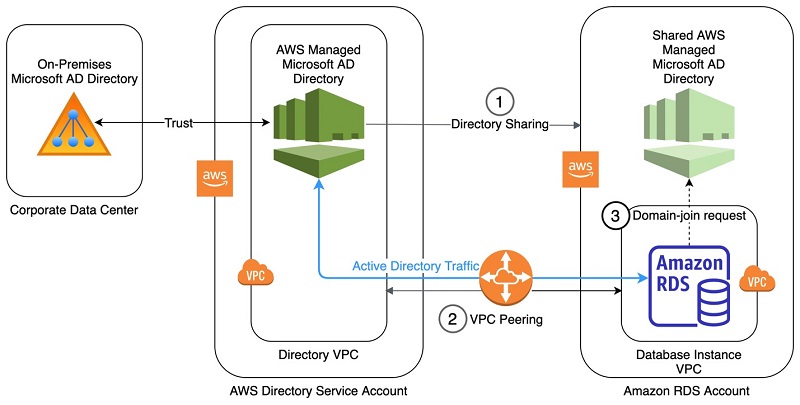
Joining your Amazon RDS DB instances across accounts to a single shared domain
How can you simplify the setup and maintenance and reduce the costs of AWS Managed Microsoft AD directories, while also strengthen the security of your Amazon Relational Database Service (RDS) for SQL Server DB instances? AWS announced that you can now join your Amazon RDS for SQL Server DB instances deployed across multiple AWS accounts […]
Leveraging SQLAgentOperatorRole in RDS SQL Server
This blog post was reviewed and updated May 2022, to improve readability by adding more step-by-step guidance. SQL Server is a relational database management system developed by Microsoft. Amazon RDS for SQL Server makes it easier to setup, operate, and scale SQL Server deployments in the Cloud. One of the RDS SQL Server components is […]

Setting up for cross-account native backup and restore in Amazon RDS for Microsoft SQL Server
Reviewed and updated on June 2022. Amazon Relational Database Service (Amazon RDS) supports native backup and restore for Microsoft SQL Server databases. If you have multiple AWS accounts, you can perform native backup and restore across these accounts, provided that your Amazon RDS instance and the Amazon Simple Storage Service (Amazon S3) bucket are in […]

Powering up Database Mail on Amazon RDS for SQL Server – How Under Armour runs Database Mail on Amazon RDS for SQL Server
Update [11/04/2020]: We’re happy to announce that Amazon RDS for SQL Server now fully supports SQL Server Database Mail. With the release of Database Mail for SQL Server, you can enable Database Mail seamlessly by using database parameter groups. Check this blog post for more information. Database Mail is one of the heavily […]

RDS SQL Server has two new exciting backup and restore enhancements
Amazon Relational Database Service (Amazon RDS) is the primary mechanism for running relational databases in the AWS Cloud. Amazon RDS for SQL Server supports running SQL Server versions from SQL Server 2008 R2 to SQL Server 2017. The RDS for SQL Server team has recently released two key improvements around backup and restore for native […]
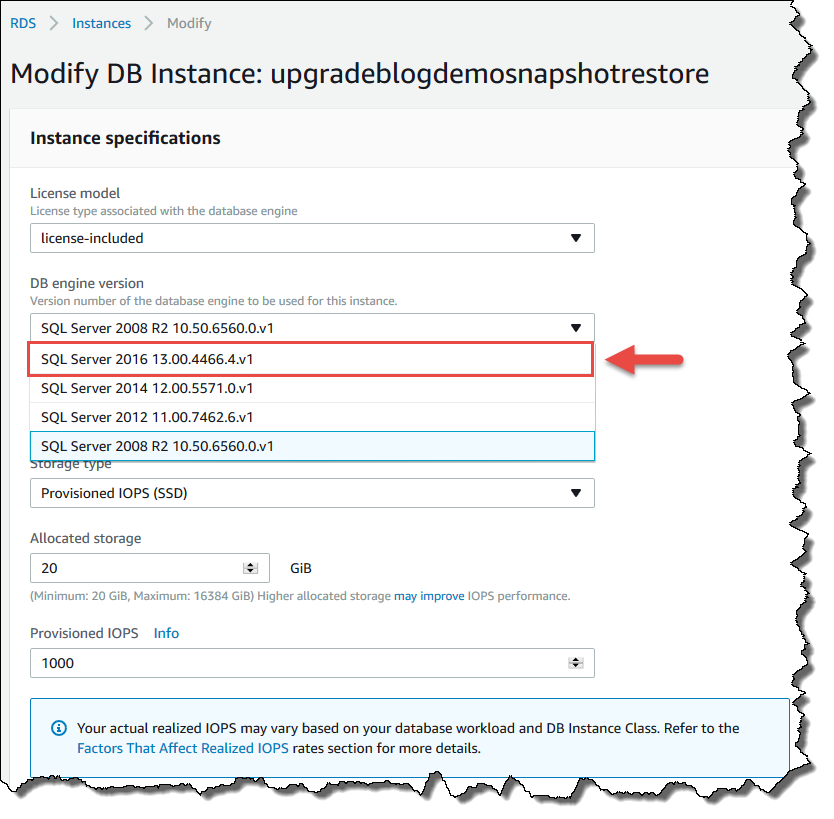
Best practices for upgrading SQL Server 2008 R2 to SQL Server 2016 on Amazon RDS for SQL Server
In preparation for the deprecation of Microsoft SQL Server 2008 R2, this blog post focuses on how to upgrade from SQL Server 2008 R2 to SQL Server 2016 on Amazon RDS for SQL Server. In addition, you can apply many of the practices in this post to all versions of SQL Server or even other […]