AWS Database Blog

Building a cross-account continuous delivery pipeline for database migrations
To increase the speed and quality of development, you may use continuous delivery strategies to manage and deploy your application code changes. However, continuous delivery for database migrations is often a manual process. Adopting continuous integration and continuous delivery (CI/CD) for database migrations has the following benefits: An automated multi-account setup simplifies database migrations. The […]

Performing SQL database client-side encryption for multi-Region high availability
Important Update: On 06/16/2021 AWS Key Management Service (AWS KMS) introduced multi-Region keys, a new capability that lets you replicate keys from one AWS Region into another. With multi-Region keys, you can more easily move encrypted data between Regions without having to decrypt and re-encrypt with different keys in each Region. Multi-Region keys are supported […]

Deploying and configuring Active Directory authentication with SQL Server 2017 on Amazon Linux 2
SQL Server on Windows allows you to configure SQL Server instances to use Windows authentication with Active Directory accounts. This post addresses how to do that with SQL Server 2017 on Amazon Linux 2. This solution allows you to log in with your Active Directory accounts using Windows authentication to manage SQL Server Linux instances […]

Configuring SQL Server Reporting Service 2016 on SQL Server 2012 and 2016
Attempting to connect to SQL Server Reporting Services (SSRS) may sometimes fail with the error “The Reporting Services instance could not be found.” This error can happen when using Amazon Machine Images (AMIs) installed with SSRS, SQL Server Integration Services (SSIS), and SQL Server Analysis Services (SSAS). This post explains the step-by-step procedures on how […]

Refactoring to Amazon DynamoDB
July 2023: This post was reviewed for accuracy. Do you want to move from a relational database to NoSQL? In the following post, I walk you through reading, transforming, and writing SQL Server data from an Amazon EC2 instance to Amazon DynamoDB. I use AWS Glue to transform the source data model of multiple tables […]
Deploying Always On availability groups between Amazon EC2 Windows and Amazon Linux 2 instances
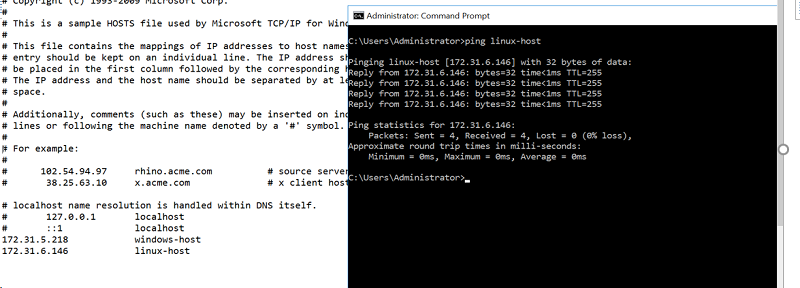
Microsoft SQL Server 2017 supports Always On availability groups between Windows and Linux to create read-scale workloads without high availability (HA). Unfortunately, you cannot achieve HA between Windows and Linux because there is no clustered solution that can manage that cross-platform configuration. To use HA with Always On availability groups, consider using a Windows Server […]

Running AWS Lambda-based applications with Amazon DocumentDB
Microservices-based applications architectures are the norm for building scalable applications. AWS makes creating these types of applications easier with Amazon DocumentDB (with MongoDB compatibility). Just bring your code and deploy an application with this fast, scalable, highly available, and fully managed document database service that supports MongoDB workloads. You can use the same MongoDB application […]

Build highly available MySQL applications using Amazon Aurora Multi-Master
Do you have transactional applications that have high uptime requirements? Do you want a relational database in the cloud to help you meet those requirements? The newly launched Amazon Aurora Multi-Master, is designed for applications that need a relational database resilient to node failures and highly available for both reads and writes. Amazon Aurora is […]

Securing data in Amazon RDS using AWS KMS encryption
This post has been reviewed and/or updated on June 2022. Data privacy is essential for organizations in all industries. Encryption services provide one standard method of protecting data from unauthorized access. However, encryption changes data in a way that makes it unreadable without the correct decryption key. Amazon Relational Database Service (Amazon RDS) can encrypt […]

Best practices for Amazon RDS PostgreSQL replication
September 2023: This post was reviewed and updated for accuracy. Amazon RDS for PostgreSQL enables you to easily configure replicas of your source PostgreSQL instance to clear your read load and to create disaster recovery (DR) resources. You can configure Read Replicas within the same Region as the source or in a different Region. When […]