AWS Database Blog

Best practices for configuring parameters for Amazon RDS for MySQL, part 3: Parameters related to security, operational manageability, and connectivity timeout
August 2025: This post was reviewed for accuracy. In the previous blog post of this series, I discuss MySQL parameters used to optimize replication in Amazon Relational Database Service (Amazon RDS) for MySQL and best practices related to them. In today’s post, I discuss the most important and commonly used MySQL parameters for implementing various […]

How to use Amazon DocumentDB (with MongoDB compatibility) to build and manage applications at scale
This blog post was last reviewed and updated February, 2022. Amazon DocumentDB (with MongoDB compatibility) is a fast, scalable, highly available, and fully managed document database service that supports MongoDB workloads. Data in Amazon DocumentDB is stored as JSON-like documents and maps naturally to how data is modeled in applications. This approach makes the storing, […]

Increase availability for Amazon Elasticsearch Service by deploying in three Availability Zones
September 8, 2021: Amazon Elasticsearch Service has been renamed to Amazon OpenSearch Service. See details. Today, Amazon Elasticsearch Service (Amazon ES) announced support for deploying your domains across three Availability Zones (AZ). This feature is available in all AWS Regions that support at least three Availability Zones. With this new feature, you can spread out your master […]
Best practices for configuring parameters for Amazon RDS for MySQL, part 2: Parameters related to replication
This blog post was last reviewed or updated May, 2022. In the previous blog post of this series, I discuss MySQL parameters used to tune and optimize Amazon Relational Database Service (Amazon RDS) for MySQL performance and best practices related to them. In today’s post, I discuss the most important MySQL parameters used for replication […]

Create AWS CloudFormation templates for AWS DMS tasks using Microsoft Excel
This blog post talks about a tool that automates creation of AWS CloudFormation templates for AWS Database Migration Service (AWS DMS) tasks. If you are looking for how to create CloudFormation templates for your DMS tasks and don’t have knowledge of CloudFormation, read on. Many times during database migration activities where AWS DMS is involved, […]
Best practices for configuring parameters for Amazon RDS for MySQL, part 1: Parameters related to performance
This blog post was last reviewed or updated January, 2025. With Amazon Relational Database Service (Amazon RDS) for MySQL, you can deploy scalable MySQL servers in minutes with cost-efficient and resizable hardware capacity. Amazon RDS frees you up to focus on application development by managing time-consuming database administration tasks including backups, software patching, monitoring, scaling, […]

How to determine if Amazon DynamoDB is appropriate for your needs, and then plan your migration
AWS CTO Werner Vogels often jokes that AWS is in the business of “pain management for enterprises,” which gets to the root of many of the IT challenges AWS customers face. Simply asking “Where can we provide customers the most benefit?” often results in a discussion of databases and related license costs, performance and scalability […]

Happy seventh birthday to Amazon DynamoDB!
Seven years ago today, AWS CTO Werner Vogels announced the release of Amazon DynamoDB. We developed DynamoDB on the core principles from a whitepaper published in October 2007, and over the last seven years, we have continued to build this fast and flexible NoSQL database service for any scale, one of a selection of AWS […]

Introducing AWS Backup, a centralized AWS backup service
AWS Backup was launched yesterday, and it is integrated with Amazon DynamoDB, Amazon EBS, Amazon RDS, Amazon EFS, and AWS Storage Gateway to give you a fully managed AWS backup solution. AWS Backup centralizes and automates the backup and retention of your data across AWS services in the cloud as well as on premises. With […]
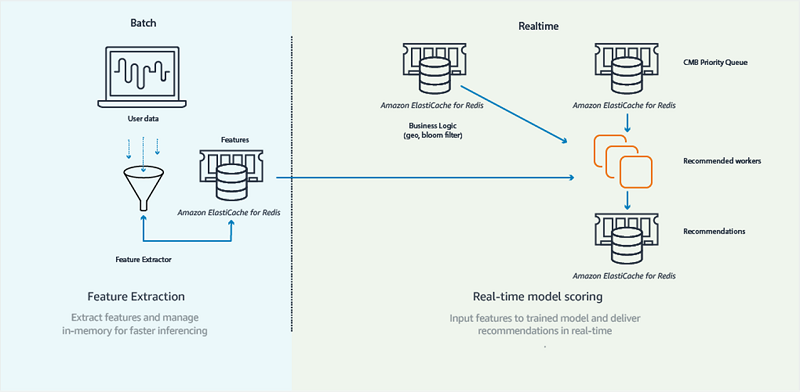
Powering recommendation models using Amazon ElastiCache for Redis at Coffee Meets Bagel
Coffee Meets Bagel (CMB) is a dating application that serves potential matches to over 1.5 million users daily. Our motto is “quality over quantity” because we focus on bringing a fun, safe, and quality dating experience that results in meaningful relationships. To deliver on these promises, every match we serve has to fulfill a strict […]