AWS HPC Blog
Category: Compute
High Burst CPU Compute for Monte Carlo Simulations on AWS
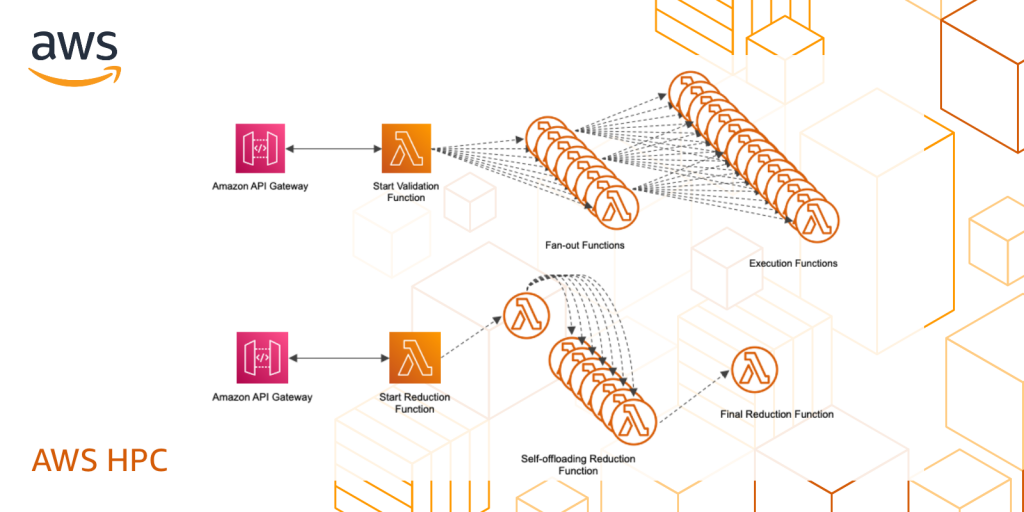
Playtech mathematicians and game designers need accurate, detailed game play simulation results to create fun experiences for players. While software developers have been able to iterate on code in an agile manner for many years, for non-analytical solutions, mathematicians have had to rely on slow CPU-bound Monte-Carlo simulations, waiting, as software engineers once did, many hours or overnight to get the results of their latest changes. These statistics are also required as evidence of game fairness in the highly regulated online gaming business. Playtech has developed an AWS Lambda Serverless based solution that provides massive burst compute performance that allows game simulations in minutes rather than hours. This post goes into the details of the architecture, as well as some examples of using the system in our development and operations.

Bare metal performance with the AWS Nitro System
High Performance Computing (HPC) is known as a domain where applications are well-optimized to get the highest performance possible on a platform. Unsurprisingly, a common question when moving a workload to AWS is what performance difference there may be from an existing on-premises “bare metal” platform. This blog will show the performance differential between “bare metal” instances and instances that use the AWS Nitro hypervisor is negligible for the evaluated HPC workloads.

Scalable and Cost-Effective Batch Processing for ML workloads with AWS Batch and Amazon FSx
Batch processing is a common need across varied machine learning use cases such as video production, financial modeling, drug discovery, or genomic research. The elasticity of the cloud provides efficient ways to scale and simplify batch processing workloads while cutting costs. In this post, you’ll learn a scalable and cost-effective approach to configure AWS Batch Array jobs to process datasets that are stored on Amazon S3 and presented to compute instances with Amazon FSx for Lustre.
Building highly-available HPC infrastructure on AWS
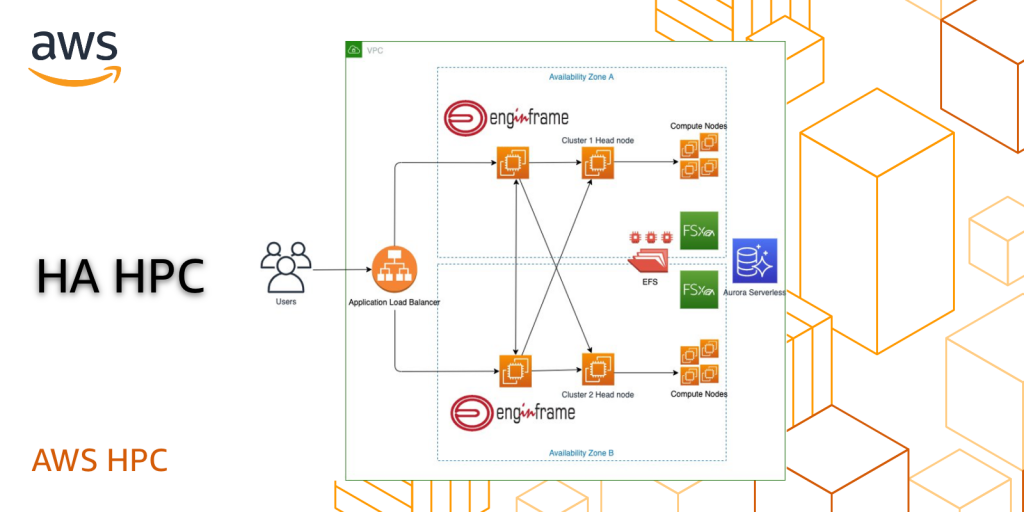
In this blog post, we will explain how to launch highly available HPC clusters across an AWS Region. The solution is deployed using the AWS Cloud Developer Kit (AWS CDK), a software development framework for defining cloud infrastructure in code and provisioning it through AWS CloudFormation, hiding the complexity of integration between the components.

AWS joins Arm to support Arm-HPC hackathon this summer
Arm and AWS are calling all grad students and post-docs who want to gain experience advancing the adoption of the Arm architecture in HPC to join a world-wide community effort lead by the Arm HPC User’s Group (A-HUG).
The event will take the form of a hackathon this summer and is aimed at getting open-source HPC codes to build and run fast on Arm-based processors, specifically AWS Graviton2.
To make it a bit more exciting, A-HUG will be awarding an Apple M1 MacBook to each member of the team (max. 4 people) that contributes the most back to the Arm HPC community.

Numerical weather prediction on AWS Graviton2
The Weather Research and Forecasting (WRF) model is a numerical weather prediction (NWP) system designed to serve both atmospheric research and operational forecasting needs. With the release of Arm-based AWS Graviton2 Amazon Elastic Compute Cloud (EC2) instances, a common question has been how these instances perform on large-scale NWP workloads. In this blog, we will present results from a standard WRF benchmark simulation and compare across three different instance types.

Reader Question: What is the difference between canceling and terminating a job in AWS Batch?
A customer asked us what is the difference between the CancelJob and TerminateJob API calls in AWS Batch. This post provides an overview of AWS Batch job states, and how these two API calls effect the job requests that you have submitted.

Introducing support for per-job Amazon EFS volumes in AWS Batch
Large-scale data analysis usually involves some multi-step process where the output of one job acts as the input of subsequent jobs. Customers using AWS Batch for data analysis want a simple and performant storage solution to share with and between jobs. We are excited to announce that customers can now use Amazon Elastic File System (Amazon […]

GROMACS price-performance optimizations on AWS
Molecular dynamics (MD) is a simulation method for analyzing the movement and tracing trajectories of atoms and molecules where the dynamics of a system evolve over time. MD simulations are used across various domains such as material sciences, biochemistry, biophysics and are typically used in two broad ways to study a system. The importance of […]

Running finite element analysis using Simcenter Nastran on AWS
This post was written by Dnyanesh Digraskar, Sr. Partner Solutions Architect for HPC at AWS and co-authored by Wei Zhang and Ravi Gupta, Sr Software Engineers for Simcenter Nastran at Siemens. Introduction In this blog, we demonstrate the deployment, performance, and price comparisons of Simcenter Nastran for three finite element analysis (FEA) based use cases […]