AWS for Industries
Driving Intelligent Quality in the Software-Defined Vehicle Era
In today’s Software Defined Vehicles (SDVs) era, ensuring vehicle quality and performance is no longer a post-production task—it’s a continuous, data-driven process. Upstream’s Proactive Quality Detection (PQD) solution leverages advanced data analytics to identify vehicle quality issues early. By detecting potential problems before they escalate into costly recalls and warranty claims, PQD empowers automakers to maintain high standards of safety and reliability throughout the vehicle lifecycle.
This blog will cover how PQD enables the transformation of after-sales vehicle quality from a reactive to a proactive, data-driven approach enabled by connected vehicle data, software-defined architectures, and AI/ML services from AWS.
Rethinking Vehicle Quality as a Continuous Process
Historically, after-sales quality in the automotive industry was reactive and event based. Engineers relied heavily on end-of-line testing, controlled lab diagnostics, and it was difficult to obtain customer feedback after vehicles were already in use. These methods often failed to capture intermittent, environment-specific, or software-related issues that only surfaced under real-world conditions. As a result, many defects went undetected until vehicles were already on the road, leading to a decrease in customer satisfaction and costly root cause investigations that can take a long time, resulting in delayed countermeasures.
The emergence of connected vehicles, software-defined architectures (SDVs), and edge-to-cloud telemetry has enabled a continuous and data-driven approach to quality. Modern vehicles can produce terabytes of data each day; from sensors, Electronic Control Units (ECUs), telematics control units, infotainment systems, mobile applications, charging stations, and connectivity platforms.
Rather than waiting for defects to surface through driver complaints or service reports, Original Equipment Manufacturers (OEMs) can now proactively monitor and analyze fleet-wide behavior to identify emerging issues at scale, before they become widespread. This data-driven shift enables a new era of proactive and predictive after-sales quality, where potential faults are caught early, correlated across models or firmware builds, and remediated via the necessary counter measures, such as over-the-air (OTA) software updates, often before the driver is even aware of the issue.
This shift in the automotive software lifecycle introduces continuous streams of high-volume, heterogeneous vehicle data: telematics, OTA update logs, software performance traces, sensor events, and API activity. Conventional quality processes and tools are not designed to ingest, structure, or analyze this type of data in real time. Solutions such as PQD address this gap by providing the data ingestion, normalization, correlation, and most importantly, contextualization, laying the foundation for AI and ML-enhanced detection, investigation, response and monitoring capabilities. PQD applies analytical models and rule logic to surface patterns, anomalies, and emerging defects early in the lifecycle, enabling engineering and quality teams to act before field issues propagate. Rather than replacing existing systems, PQD maintains a live digital twin of every vehicle and component to provide operational, historical and behavioral context for investigation at any stage. This ensures that raw connected-vehicle data is converted into a structured, actionable foundation for AI and ML to begin providing intelligence for quality engineering and product teams.
Ocean AI + Amazon Bedrock: Accelerating Intelligence at Scale
At the core of PQD is Ocean AI, a proprietary AI/ML engine purpose-built for complex mobility telemetry. The Ocean AI suite operates on high-density, time-ordered ECU, OTA, and vehicle-backend signals at fleet scale, performing:
- Temporal sequence modeling across long- and short-horizon windows to capture drift and degradation over time
- Population-level correlation across firmware branches, trims, markets, and duty cycles to isolate patterns that only appear at scale
- Generative reconstruction + residual analysis, including rides inspection, to provider a clearer view of the vehicle’s behavior during a ride and surface weak signal deviations and emergent states that rule engines and dashboards never expose
- Natural language investigation capabilities that allow after-sales quality teams to talk with their data to better understand the issues and reach root cause conclusions faster
Conventional Quality & Business Management Systems (QMS/BMS) as well as analytics frameworks apply batch thresholds or post-hoc key performance indicators without temporal semantics, ECU graph context, or fleet baseline priors. They report outcomes; Ocean AI models the progression leading to those outcomes.
PQD incorporates Ocean AI with a mobility-specific data plane for ingestion and normalization across heterogeneous feeds — OTA telemetry, API logs, backend traces, etc. which enables the detection of field-emergent behaviors absent from lab validation (e.g., environment-conditional regressions, intermittent edge cases, or rare execution paths).
Ocean AI is powered by Amazon Bedrock, which provides the platform for building domain-adapted reasoning and agentic workflows. Ocean AI enables:
- Similarity search over historical signature space (ECU sequences, anomaly profiles, failure clusters)
- Hypothesis generation for causal chains across ECU → firmware → config → environment factors
- Natural-language querying across indexed mobility telemetry graphs for engineering and quality teams
- Continuous adaptation of detection models from new fleet data without static rule maintenance
This is a structural, not cosmetic, differentiation: PQD is not a visualization tier on top of logs it is a domain-adapted inference layer that treats mobility telemetry as a time-series/graph system with fleet priors. That architecture allows PQD to identify and explain degradations that traditional analytics, dashboards, and pre-deployment validation environments never observe or cannot model.
Building a Mobility-Grade AI Stack on AWS: Inside the Upstream Ocean AI + Amazon Bedrock Integration
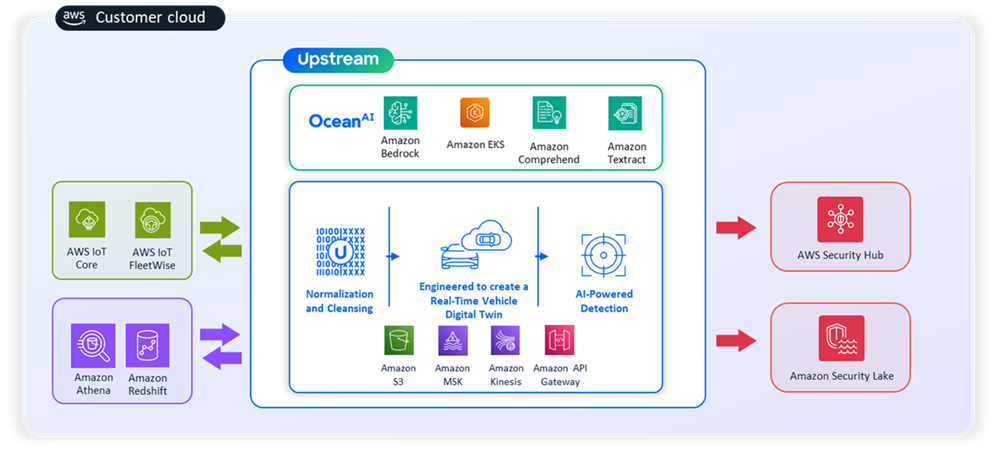
Figure 1. Upstream and Ocean AI Integrations Powered by AWS Services
AWS provides the cloud infrastructure and Services that power Upstream’s PQD engine. Leveraging tools like Amazon S3 and AWS IoT Core, the PQD solution ingests and processes billions of daily telemetry events from global vehicle fleets.
Modern production fleets generate telemetry at a much larger scale than traditional quality systems. These volumes are too large and too unstructured for conventional QMS or analytics tooling to process in real time. PQD is built with the following key components:
1) Ingest — AWS IoT Core and AWS IoT FleetWise
AWS IoT FleetWise and AWS IoT Core receive decoded or raw telemetry from vehicles and forward it to Amazon Kinesis Data Streams and Amazon MSK (Managed Streaming for Apache Kafka) for processing within seconds of data arrival and Amazon S3 for durable storage and replay. This creates a low-latency and high-throughput ingestion path suitable for millions of concurrently active vehicles.
2) Normalization and twin construction on Amazon Elastic Kubernetes Service (EKS)
Processing services on Amazon EKS normalizes, cleans, and joins signals with metadata, then maintains a per-vehicle and component digital twin. The system is engineered to manage event rates and preserve ordering, lineage, and reproducibility.
3) Ocean AI, inference built for mobility
Ocean AI performs temporal sequence modeling, population-wide correlation, and generative residual analysis to detect weak, early-phase patterns well before they surface as visible faults. This is fundamentally different from dashboards and KPIs that only reflect end-state outcomes.
4) Amazon Bedrock, foundational models as a reasoning layer
Powered by Amazon Bedrock, Ocean AI outputs are combined with any available foundation model to enable:
- Similarity search across historical failure signatures
- Automated hypothesis generation for plausible root causes
- Natural-language interrogation of structured mobility data
This allows engineering and reliability teams to interact with fleet-scale telemetry without manually building SQL, rulebooks, or pipelines.
5) Security routing, AWS Security Hub and Amazon Security Lake
When anomalies have safety or security implications, detections are exported to:
- AWS Security Hub in AWS Security Finding Format (ASFF) for SOC workflows
- Amazon Security Lake in Open Cybersecurity Schema Framework (OCSF) format for long-horizon Security Information and Event Management and analytics
By transforming raw connected-vehicle telemetry into structured detections, causal hypotheses, and security-qualified findings, the collaboration between Upstream and AWS architecture elevates fleet data from a passive archive to an active operational signal.
From Noise to Insight: How PQD Works
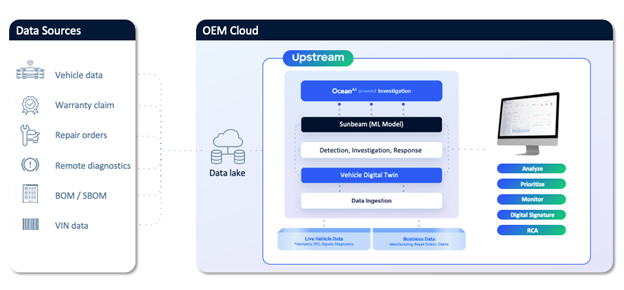
Figure 2. PQD integration with outside data sources into the OEM’s AWS Environment.
This end-to-end pipeline from ingestion to insight transforms raw, noisy telemetry into actionable intelligence. It begins with secure ingestion of high-volume data streams from vehicles, telematics, and mobility services. The data is then normalized, cleansed, and enriched with contextual metadata, ensuring consistency across diverse sources. Advanced analytics, anomaly detection, and machine learning models continuously process the information to uncover patterns, risks, and early indicators of failure or misuse. The result is not just visibility, but meaningful, decision-ready intelligence that enables engineering, security, and operations teams to act with confidence. Teams can identify issues earlier, potentially even before a warranty claim, accelerate root cause analysis, and continuously monitor countermeasure effectiveness. Together, these capabilities support more informed decisions within the production lifecycle that may help reduce warranty and recall costs and improve customer experience. Upstream enforces strong encryption, role-based access controls, data anonymization, and audit-ready visibility thereby offering OEMs and fleet operators the confidence to operate in highly regulated and critical environments. By leveraging AWS Services like AWS Key Management Service (KMS) and AWS Certificate Manager for encryption, as well as AWS Identity and Access Management (IAM) Center for robust, role-based access controls, Upstream ensures data protection, allowing PQD to deliver valuable quality insights.
Business Impact for Automotive OEMs
- Reduce Recalls and Warranty Exposure – Recalls and warranty events can be costly, impacting budgets, brand equity, and customer trust. PQD helps OEM teams identify potential software bugs, hardware faults, and system degradations earlier in the lifecycle by surfacing patterns across vehicles and components. With earlier, clearer signals, teams can prioritize investigations and corrective actions sooner, before issues scale into broader field impact.
- Accelerate Countermeasures – Time is critical when resolving vehicle issues. By identifying and fixing problems before they impact the user experience, PQD helps OEMs boost satisfaction and reduce customer churn. Early resolution also reinforces a brand’s reputation for safety, innovation, and responsibility.
- Foster Cross-Team Collaboration – PQD is a tool for after-sales quality, customer satisfaction and field investigation teams, with lifecycle impact across engineering and production teams. By centralizing connected vehicle quality indicators in one platform, PQD creates a shared foundation of insight, enabling faster decision-making and better product validation, throughout the product lifecycle.
Looking Ahead: Building a Predictive and Secure Future for OEMs
The collaboration between Upstream and AWS operationalizes large-scale mobility data as an analytical base for after-sales quality teams. Upstream’s PQD provides domain-specific ingestion, normalization, correlation, and detection logic, while AWS provides the scalable compute, storage, orchestration, and infrastructure to run these workloads at fleet scale and under strict governance.
Running PQD and Ocean AI on AWS enables OEMs to move from episodic, reactive assessment to continuous, data-driven after-sales quality, backed by cloud-native primitives rather than bespoke on-prem pipelines. AWS Services handle durable storage, streaming, security boundaries, and model deployment — allowing PQD to focus on mobility-specific inference rather than generic tasks.
As vehicles evolve toward higher levels of autonomy, connectivity, and software-dependence, the Upstream and AWS collaboration enables quality management in real data under real operating conditions. PQD sits at the intersection of security, fleet analytics, and lifecycle engineering — and with AWS as the execution substrate, the system can scale, govern, and adapt in step with modern automotive software complexity.
For more information and to see PQD in action please reach out to schedule a demo of Upstream PQD