AWS for Industries
Prior authorization for medical claims using Strands Agents
Every day, healthcare organizations navigate a complex web of administrative requirements, including prior authorizations, that pull providers away from patient care. Strands Agents are a solution to these challenges by providing an open-source SDK that builder organizations and system integrators can use to create specialized AI agents. These agents can transform healthcare workflows from sources of frustration into models of efficiency.
Developers can use Strands Agents to build sophisticated agents that understand medical terminology, navigate payor requirements, and integrate seamlessly with existing healthcare systems. These agents can dramatically reduce administrative burden, while improving patient experiences.
The healthcare administrative crisis
Healthcare practices complete an average of 39 prior authorizations for each physician weekly, with staff dedicating 13 hours to this single task. The impact reaches beyond administrative burden: 93% of physicians report care delays due to prior authorizations, with 29% linking these delays to serious adverse events for patients in their care, including preventable hospitalizations. The US healthcare system spends $35 billion annually on prior authorization administrative costs alone.
The manual process exemplifies healthcare inefficiency. Staff navigate multiple payor websites with inconsistent interfaces, compile documentation scattered across EHR systems and paper files, and re-enter information that already exists digitally. After submission, routine requests average two days for decisions, while complex cases stretch beyond a week. Medicare Advantage plans alone denied 3.2 million requests in 2023, yet appeals overturn 81.7% of these denials, revealing a system where initial rejections often lack legitimate clinical justification.
Strands Agents
Strands Agents represents a fundamental shift in how developers approach building AI agents. Traditional agent frameworks demand complex orchestration logic and rigid workflow definitions, often constraining rather than enabling innovation. Strands Agents takes a radically different approach by embracing the advanced reasoning capabilities of modern language models, providing developers with tools to build sophisticated agents with only a few lines of code.
The SDK operates on a principle that combines three core components:
- Developers select a model with reasoning and tool-use capabilities from providers such as Anthropic or Meta on Amazon Bedrock.
- They define tools that enable their agents to interact with external systems and perform specific tasks.
- The system prompts are written for the agent. They guide the agent’s behavior to achieve clear pre-defined objectives.
This model-driven approach means agents can dynamically adapt to different scenarios without predetermined workflow paths. The SDK handles execution complexity through an intelligent loop. The agent uses its model to plan steps, select tools, and process results iteratively until tasks are complete.
What makes Strands Agents particularly valuable for healthcare applications is their flexibility in both development and deployment, combined with proven production readiness. Builder organizations can prototype agents locally, test them with real healthcare data, and deploy them to production environments that meet stringent security and compliance requirements. For healthcare builders, this means access to a proven foundation for creating agents that can understand medical terminology and navigate complex payor requirements. They can also maintain context across patient interactions and integrate seamlessly with existing healthcare systems. This is all done while maintaining the observability and reliability that production healthcare applications demand.
Prior authorization using Strands Agents
Prior authorization complexity makes it an ideal candidate for AI agent automation, and Strands Agents provides the perfect foundation for builders to create sophisticated solutions. Insurance companies require approval for an ever-expanding list of services, with requirements varying by payor, plan, geographic region, and even individual patient circumstances. Builder organizations can leverage Strands Agents to create agents that navigate this complexity, while maintaining accuracy and compliance.
Architecture overview
The prior authorization agent operates through a streamlined process:
- FHIR bundle processing: The agent receives standardized healthcare data in FHIR format, containing patient information, clinical encounters and procedure codes.
- Guideline retrieval: It automatically downloads current billing guidance and fee schedules from relevant healthcare authorities.
- Code analysis: The system examines current procedural terminology (CPT) codes to understand what procedures are being requested.
- Decision generation: Using AI reasoning, it determines approval likelihood and generates supporting rationale.
- Cost calculation: The agent calculates patient costs based on current fee schedules and coverage rules.
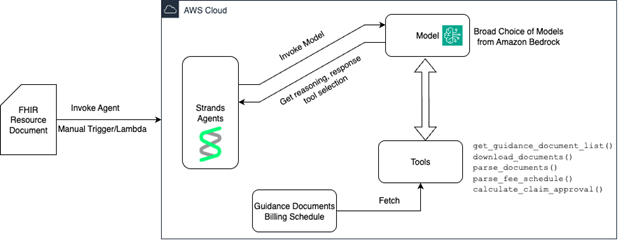
Figure 1. Strands based agent for clinical prior authorization.
The main execution script, run_prior_auth.py, orchestrates these tools through the Strands Agents framework, allowing the AI to determine which tools to use and when, based on the specific requirements of each case.
When denials occur, the agent analyzes rejection reasons against available clinical documentation and published payor policies. They identify missing information and suggest additional documentation that might support approval.
Real-world demonstration: Washington State Medicaid
For this demonstration, we will build a system that fetches information about claim approval guidelines from a single source of truth. We use guidance from the insurance provider. Our example uses Washington State Medicaid Guidelines for the claim approval and denial process. The webpage lists all guidelines for claim approval for different disease conditions and fee schedules.
Automated resource discovery
The agent begins by accessing a centralized resource file. This file contains authoritative URLs for healthcare guidelines and fee schedules. The system leverages advanced language model capabilities to analyze document titles and metadata. It identifies the most relevant guidance materials through the get_guidance_document_list() tool. This intelligent filtering confirms the agent works with current, applicable documentation and avoids processing irrelevant materials.
Dynamic document retrieval
Once the system identifies relevant documents, the agent employs the download_documents() tool. This tool automatically retrieves the latest billing guidance and fee schedules. It pulls information directly from authoritative sources, such as the Washington State Health Care Authority. This real-time approach verifies decisions are based on current policies and pricing structures.
FHIR bundle analysis and CPT code processing
The system processes incoming FHIR bundles to extract critical clinical and procedural information. It systematically examines CPT codes within the bundle. The system cross-references these codes against the retrieved billing guidance. This process helps it understand the clinical context and coverage requirements for each requested procedure.
Intelligent decision generation
The agent uses combined clinical data and policy guidance to generate evidence-based rationales for claim decisions. For approved claims, it automatically references current fee schedules. The system calculates precise patient cost responsibilities associated with specific CPT codes. This provides transparent cost breakdowns.
When claims require denial, the system provides clear, policy-based explanations. These explanations reference specific guideline violations or coverage limitations. Providers can then understand and potentially address issues for resubmission.
An example system prompt for the agent is as follows:
In our example, the use of specialties in the beginning denotes the system is to use the list of titles in the resource guidance mentioned on the Washington State Healthcare Authority website.
- Step 1: Confirm your account has access to Amazon Bedrock models, particularly Anthropic Claude 3.5 Sonnet (claude-3-5-sonnet-20241022-v2:0).
- Step 2: Clone the amazon-bedrock-agents-healthcare-lifesciences repository from GitHub and execute the following command:
git clone https://github.com/aws-samples/amazon-bedrock-agents-healthcare-lifesciences.git
Go to the 29-Clinical-prior-auth folder by executing the following command: cd agents_catalog/29-Clinical-prior-auth
- Step 3: Install the python packages:
pip install -r requirements.txt - Step 4: Execute the agent:
python run_prior_auth.py sample_patient_data/epsdt_patient_encounter_fhir.json
Several sample FHIR repositories are available in the sample_patient_data directory. We encourage you to try the other FHIR bundles as well.
Following in Figure 2 is the output of our example prior authorization agent. All the steps involved in the execution of the agent are shown. The orange box highlights the costs corresponding to the specific CPT codes as provided in the billing schedule.

Figure 2 – Example agent results output
The example encounter relates to an early and periodic screening encounter. The agent is able to look up the related documents on the Washington State HCA Billing guides and fee schedules page. By doing so, it streamlines healthcare cost calculations by automatically processing medical documentation. The system matches CPT codes on the billing schedule to generate accurate itemized bills.
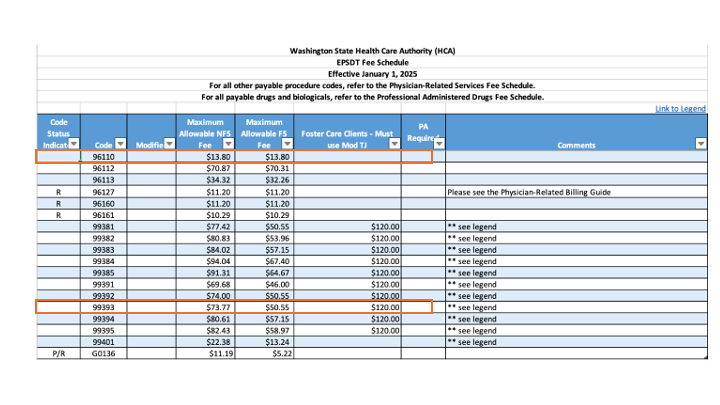
Figure 3 Fee schedule for early period screening, diagnostic and treatment (EPSDT)
Figure 3 is a billing schedule for early period screening, diagnostic and treatment (EPSDT) used by the agent. The oranges boxes indicate the CPT code used by the agent and the corresponding fee associated with the code. By referencing Figure 3 for the CPT codes and Figure 2 for pricing, you can understand how the codes align with their respective costs.
The examples mentioned in this blog and the resource document the agent uses are based on Washington State’s Health Care Authority website. However, you can use this setup for any other healthcare system as well. The core building blocks of the agent remain the same. How the agent accesses the guidance documents will vary on a case-by-case basis.
The future of healthcare administration
The prior authorization use case demonstrates the transformative potential of AI agents in healthcare administration. Organizations can automate complex processes that previously required extensive human intervention. This is possible by combining the reasoning capabilities of large language models with specialized healthcare tools and current regulatory knowledge.
This approach extends beyond prior authorization to other administrative challenges in healthcare:
- Claims processing and denial management
- Eligibility verification and benefits determination
- Clinical documentation and coding assistance
- Regulatory compliance monitoring and reporting
As healthcare continues its digital transformation, AI agents powered by AWS services like Strands Agents and Amazon Bedrock will play an increasingly important role. They can help reduce administrative burden and improve operational efficiency. They can ultimately provide healthcare providers with a way to focus on what matters most, delivering exceptional patient care.
Conclusion
The combination of AWS Strands Agents and Amazon Bedrock offer healthcare organizations a powerful solution to one of their most persistent challenges. By automating prior authorization processes through intelligent AI agents, healthcare providers can reclaim valuable time, reduce costs, and improve patient satisfaction.
The model-driven approach of Strands Agents makes it possible to build sophisticated automation solutions without extensive custom development, while the integration with Amazon Bedrock facilitates access to state-of-the-art AI capabilities. For healthcare organizations ready to embrace AI-powered automation, the prior authorization use case provides a compelling starting point with measurable benefits and clear return on investment.
Ready to transform your healthcare administrative processes? Explore the AWS Strands Agents SDK documentation and discover how AI can revolutionize your organization’s approach to prior authorization and beyond. Contact an AWS Representative to find out how we can help accelerate your business.
Further reading
- Amazon Bedrock Documentation – Learn how to build generative AI applications using foundation models through a fully managed service
- AWS Healthcare & Life Sciences Solutions – Explore comprehensive cloud solutions designed specifically for healthcare organizations
- HIPAA Compliance on AWS – Understand how to build secure, compliant healthcare applications on AWS
- Strands Agents – Build production-ready multi-agent AI systems in a few lines of code