AWS for Industries
Reduce P&ID analysis time by 80% with hybrid AI maintenance planning
Every major industrial facility relies on thousands of highly complex technical drawings called Piping and Instrumentation Diagrams (P&IDs) that serve as the DNA of industrial operations. These diagrams show how equipment connects, materials flow, and safety systems protect workers and assets. These diagrams are complex. For example, where 511 industrial P&ID documents may mean 1,397,710 distinct visual patterns requiring accurate identification, 457,861 circular symbols representing valves, instruments, and gauges, 320,583 dense connections showing complex pipe intersections, 181,265 horizontal lines indicating primary process flows, and 64,314 specialized patterns representing equipment symbols and annotations.
Despite their critical importance, most P&IDs remain trapped as static PDFs requiring 3 to 8 hours of manual analysis per diagram, tracing system dependencies, confirming valve types, navigating instrument loops, and reconciling documentation against as-built conditions. At large facilities managing thousands of P&IDs, this analysis occurs hundreds of times per year, consuming thousands of engineering hours annually.
This blog describes how Hybrid AI, a purposeful combination of computer vision, graph databases, and generative AI, transforms maintenance planning. While each technology on its own is powerful for specific tasks, attempts to apply them individually to complex industrial planning based on Piping and Instrumentation Diagrams (P&IDs) revealed technical limitations. A hybrid approach combining multiple AI technologies enables engineers to upload highly complex P&ID diagrams and gain engineer-level insights, recommendations, and maintenance plans within minutes. It replaces time-consuming manual tasks done by highly skilled engineers while retaining control through a human-above-the-loop process.
Business impact opportunity in maintenance planning
AI can significantly impact manufacturing. According to McKinsey, 80% of manufacturers reported cost reductions of up to 10% from AI usage, with the remaining 20% of manufacturers seeing improvements of 10-19% or higher. For maintenance planning specifically, McKinsey states AI has the potential to:
- Increase workforce productivity by up to 2x by automating nearly 70% of routine tasks
- Improve accessibility of maintenance documentation by scaling through thousands of P&ID documents with advanced search and automated generation of fault diagnosis procedures
- Embed institutional knowledge into processes and tools to ensure consistent, accurate maintenance planning regardless of workforce experience level
Combining multiple technologies for complex requirements with agentic AI
The complex requirements of industrial maintenance planning, such as pixel-level coordinate accuracy of equipment positioning, dimensional analysis, and database integration, requires a new approach that combines multiple AI technologies. Large Language Models (LLMs) provide qualitative descriptions but cannot deliver the quantitative measurements required in P&ID diagrams. Their probabilistic nature creates variability incompatible with engineering standards and quality assurance requirements.
To address this, we combine four different AI technologies into one AI Agent that manages:
- A computer vision layer to identify equipment
- A graph database to contextualize relationships
- An AI analysis layer to provide engineering analysis and optimization recommendations
A generative AI layer to reason about maintenance implications as demonstrated in Video 1, the AI Agent operates autonomously following a multi-step orchestration, accepting a P&ID as input and pursuing the goal of generating a maintenance plan through a chain of reasoning. Engineers interact with outcomes, not processes.
Video 1: AI Agent for P&ID-based maintenance planning
Component 1: Computer Vision Layer Provides Precision and Reliability
Computer vision excels at precise detection and measurement tasks, providing the geometric accuracy and deterministic behavior that industrial applications require. As depicted in image 1, after an engineer uploads a P&ID diagram, the computer vision layer employs multiple specialized Amazon SageMaker YOLO models that detect and classify equipment like valves, pumps, tanks, and instruments with high precision.
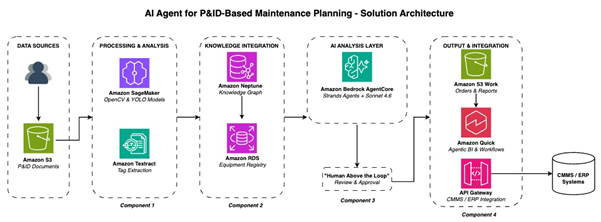
Figure 1: Overall Solution Architecture and schematic workflow for AI agent for P&ID Maintenance Planning
Next, Amazon Textract extracts all text elements and handles equipment tag recognition, specifications, and annotations. It converts visual text elements in P&IDs into structured data that can be searched, analyzed, and integrated with existing engineering systems. Legacy equipment models handle older diagram formats from different decades, ensuring the system processes historical documentation that may use different symbols or drawing conventions. This multi-model approach delivers better overall accuracy than single-model approaches while maintaining processing speeds suitable for production use.
OpenCV algorithms provide geometric analysis and precise measurement capabilities that complement pattern recognition. Hough Transform is a technique in feature extraction technology in computer vision and image processing that detects circles and lines with sub-pixel accuracy needed for dimensional analysis, while morphological operations trace connection paths through complex networks with deterministic reliability. Template matching identifies standardized symbols with perfect consistency, providing repeatability required for regulatory compliance and quality assurance.
Component 2: Graph Databases Integrate Findings by Understanding Equipment Relationships
Amazon Neptune constructs knowledge graphs that capture complex interdependencies between equipment, processes, and safety systems, enabling sophisticated queries and analysis impossible with traditional database approaches. The graph structure represents equipment as nodes (with attributes like tag, type, specifications, location, pressure rating) and connections as edges (inlet, outlet, control_signal, isolated_by, protects), as shown in image 2.
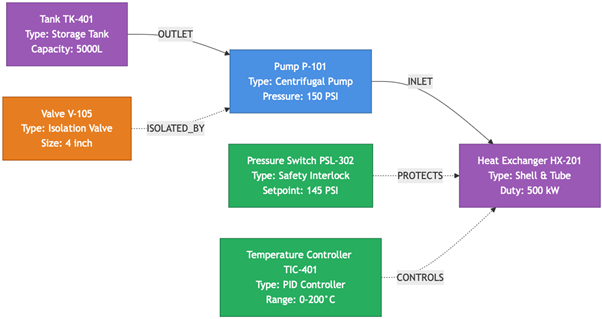
Figure 2: Knowledge graphs that capture interdependencies between equipment, processes, and safety systems
Natural language interfaces allow engineers to query technical data efficiently using familiar terminology. Engineers can ask questions like “What safety systems protect the main reactor?” or “What isolation valves must close to depressurize Pump P-101?” and receive comprehensive answers that trace through actual equipment connections and safety interlocks. This topology understanding becomes the foundation for generating accurate maintenance procedures.
Component 3: AI Analysis Layer Provides Engineering Analysis and Optimization Recommendations
Large language models such as Claude Sonnet 4.5 available through Amazon Bedrock provide engineering analysis and optimization recommendations based on structured data extracted by the computer vision layer. The AI analyzes both individual component recognition and engineering relationships between equipment to generate actionable insights. The AI Analysis layer possesses 6 capabilities:
- Topology Verification: The AI validates that detected connections match engineering standards. For example, after identifying Pump P-101, the system verifies that suction and discharge lines follow expected flow patterns, pressure relief valves are positioned correctly, and control instrumentation provides adequate monitoring. Discrepancies between expected topology and actual diagram layout trigger warnings for engineer review.
- Maintenance Sequence Optimization: The AI reasons about optimal maintenance sequences by analyzing equipment dependencies. When planning work on a heat exchanger, the system identifies which upstream pumps must stop, which isolation valves must close first, and which downstream processes will be affected. It generates step-by-step procedures that minimize downtime and prevent unsafe conditions like trapped pressure or unexpected backflow.
- Safety Interlock Analysis: The AI identifies control system interlocks that depend on specific equipment. For instance, if maintenance requires depressurizing a vessel, the system flags that pressure switches (PSL-302) and temperature controllers (TIC-401) will trigger alarms, recommending that operators receive advance notification. This prevents unexpected shutdowns or safety system activations.
- Critical Path Identification: The AI determines which equipment affects multiple process units, allowing maintenance planners to prioritize critical components. Equipment serving multiple downstream processes receives higher priority scheduling, and the system automatically generates contingency plans for potential delays.
- Specification Cross-Reference: The AI validates that maintenance procedures account for equipment specifications. Pressure ratings, material compatibility, temperature limits, and flow capacities from the Equipment Registry are automatically included in work orders, ensuring technicians have complete information before starting work.
- Agentic Orchestration Layer: Amazon Bedrock AgentCore provides the fully managed runtime for Amazon Bedrock Agents to coordinate the entire reasoning process. The agent decides which tools to invoke, interprets results with confidence scoring, validates topology against known standards, and synthesizes findings into maintenance deliverables. Amazon Bedrock AgentCore’s enables production deployment at industrial scale with session isolation for secure processing of proprietary P&ID documents, extended runtime supports up to 8 hours for complex multi-page diagram analysis, and comprehensive observability for monitoring agent performance.
Component 4: Generative AI Supports Maintenance Planning with Automated Maintenance Plans
The application generates comprehensive maintenance plans for Work Order creation, including P&ID Engineering CSV files with line tags, component types, and connection points matching professional engineering documentation standards. These outputs integrate directly into Computerized Maintenance Management Systems (CMMS) like SAP or Maximo, eliminating manual data entry.
Equipment relationship mapping enables maintenance planners to optimize work sequences and minimize downtime by understanding how maintenance activities on one piece of equipment affect connected systems. Critical path equipment affecting multiple process units is automatically identified, allowing planners to prioritize these items and develop contingency plans for potential delays or complications.
Work Order generation for planned maintenance activities becomes more efficient when precise equipment locations and access requirements are automatically extracted from P&ID data. Maintenance teams receive detailed information about equipment positioning, connection points, and spatial relationships that help them plan tool requirements, estimate labor needs, and identify potential safety hazards before work begins.
Scaffolding and isolation requirements can be planned based on spatial relationships extracted from P&ID analysis, reducing time required for turnaround preparation and minimizing risk of discovering access problems during execution. This planning capability directly translates to shorter shutdown durations and reduced costs for major maintenance events. Users can download findings as detailed JSON reports, Excel workbooks, and AI-generated analysis summaries.
Domain-Specific Training and Optimization for P&ID Analysis
Successful P&ID analysis requires treating the problem as domain adaptation rather than generic object detection, recognizing that industrial diagrams have unique characteristics that generic models cannot handle effectively. Industrial maintenance-specific optimization is achieved by six key activities to increase the accuracy of the P&ID AI Agent:
- P&ID-Specific Training Data: The computer vision models are trained on datasets containing thousands of actual industrial P&IDs spanning multiple decades and drawing standards. Training data includes variations in symbol styles (ANSI, ISA, ISO), document conditions (clean CAD exports, faded photocopies, hand-marked prints), and equipment types (petrochemical, pharmaceutical, water treatment, offshore platforms). This ensures the models recognize equipment regardless of drawing convention or document age.
- Pattern Frequency Analysis for Model Optimization: Statistical analysis of pattern frequency distributions across hundreds of industrial diagrams reveals which equipment types appear most often, and which symbol variations are critical for accurate detection. For example, if valve symbols account for 32% of all detected patterns, with 18 distinct valve type variations (gate, globe, check, ball, butterfly, relief). The system prioritizes detection accuracy for high-frequency patterns while maintaining adequate coverage for rare equipment types. This analysis informs model architecture decisions using ensemble approaches for common equipment and specialized detectors for rare, safety-critical components like pressure relief systems.
- Multi-Model Strategy for Equipment Diversity: Different equipment types and diagram styles require different detection approaches. Rather than seeking one perfect model, the system employs a portfolio of specialized models: one optimized for rotating equipment (pumps, compressors), another for static equipment (tanks, vessels, heat exchangers), a third for instrumentation (gauges, sensors, controllers), and a fourth for valves and fittings. Each model is fine-tuned on domain-specific datasets, and confidence scores determine which model’s prediction to trust. Ensemble voting resolves conflicts when multiple models detect the same region with different classifications.
- Smart Data Augmentation Respecting Engineering Semantics: Training augmentation techniques respect the semantic meaning of industrial drawings. Rotations are limited to 90-degree increments (standard engineering orientations) rather than arbitrary angles that would violate drafting conventions. Scaling preserves aspect ratios that engineers rely on for spatial analysis. A pump symbol scaled incorrectly might be misinterpreted as a different pump type. Noise injection simulates real-world document conditions (scanner artifacts, faded lines, coffee stains) without changing semantic meaning. Color variations account for different print qualities and photocopy generations.
- Maintenance-Specific Output Formatting: The system generates outputs in formats that maintenance planners use. CSV exports match CMMS import templates with specific column headers (Equipment_Tag, Type, Pressure_Rating, Material_Grade, Maintenance_Interval). PDF isolation procedures follow OSHA Process Safety Management (PSM) documentation standards with required sections: Pre-Work Safety Checklist, Isolation Sequence, LOTO (Lockout/Tagout) Points, Verification Steps, Re-energization Procedures. JSON outputs provide structured data for custom integrations with enterprise systems like ERP (SAP, Oracle) and Control Systems (DCS, SCADA).
- Integration with Maintenance Planning Workflows: The system integrates with existing engineering software through robust APIs. Computer Aided Design (CAD) systems like AutoCAD Plant 3D can push P&ID updates directly to the AI system, ensuring the knowledge graph stays synchronized with design changes. CMMS integrations enable automatic Work Order creation. When the AI generates a maintenance plan for Pump P-101, it populates work order fields, attaches isolation procedures, and assigns labor/parts estimates. ERP integrations verify spare parts availability before scheduling maintenance, preventing delays from missing inventory.
This domain-specific optimization ensures the AI system handles the unique challenges of industrial P&ID analysis while producing outputs that integrate seamlessly into existing maintenance planning workflows.
Human Above the Loop in AI-Driven Maintenance Planning
The P&ID AI Agent does not eliminate human involvement, it transforms how engineers engage by enhancing and extending human expertise rather than replacing it. Process integration involves incorporating AI analysis into existing engineering procedures, freeing engineers from tactical tasks so they have more time for strategic implications.
As industrial organizations adopt AI to automate maintenance planning and Work Order creation, maintaining human oversight through a “Human Above the Loop” approach is critical for change management and regulatory compliance. This framework positions human experts as strategic supervisors who define guardrails, validate AI-generated recommendations, and intervene when anomalies or high-risk scenarios emerge, rather than approving every individual decision.
Engineers need to understand how to effectively use AI-generated results while maintaining appropriate skepticism and validation practices. Developing and implementing quality assurance processes for AI-generated outputs will help confirm automated results are meeting the same standards as manual analysis.
For regulated industries, this approach ensures AI-driven maintenance schedules and CMMS integrations remain compliant with safety standards and audit requirements while capturing institutional knowledge of experienced maintenance planners. By establishing clear escalation protocols and exception handling rules, organizations can accelerate adoption while maintaining accountability and building workforce trust in AI-augmented systems. This balanced approach allows teams to realize efficiency gains from automation while preserving critical human judgment needed for complex operational decisions and regulatory attestation.
Real-World Impact: Engineering Company Case Study
AWS worked together with a leading global provider of engineering solutions to offshore, marine, and energy industries to automate P&ID-based maintenance planning Engineers routinely navigated multiple P&ID drawings to trace instrument loops, confirm valve types, and reconcile discrepancies between documentation and as-built conditions. These manual interpretation challenges often led to delays during troubleshooting, walk-downs, and commissioning activities, especially given the scale and complexity of offshore operations. Additionally, knowledge retention was a challenge due to an aging workforce.
The manufacturer successfully piloted the AI Agent for P&ID on complex engineering drawings. It saw gains of up to 80% reduction in planning time and majority of the Agent’s recommendations did not require reworking. For a facility analyzing 1,000 P&IDs annually, reducing average analysis from 5.5 hours to approximately 1 hour per diagram saves roughly 4,500 engineering hours per year, the equivalent to more than two full-time engineers. Beyond time savings, institutional knowledge is preserved, safety risks from missed relationships are reduced, and teams shift from reactive interpretation to proactive planning.
Their Digital Transformation team shared:
“When we reviewed the AI-driven P&ID extraction prototype, it became clear how transformative the technology could be. Tasks that previously required deep manual effort could be completed in seconds, with the system automatically surfacing the relevant tags, symbols, and relationships. Though still in pre-deployment stage, the potential impact is clear—the solution shows strong promise in reducing interpretation time, improving engineering accuracy, and eliminating long-standing bottlenecks. We see it as a meaningful enabler for greater efficiency and digital transformation across our engineering workflows.”
Conclusion: From Static Documents to Intelligent Automation
Agentic AI capabilities are transforming maintenance planning by automating routine tasks. As industrial manufacturers face increasing complexity, cost pressure, and workforce transitions, AI-driven maintenance planning represents not just an efficiency gain, but a strategic capability for operational resilience.
The AI Agent for P&ID-based maintenance planning allows engineers to upload highly complex P&ID diagrams and gain engineer-level insights, recommendations, and maintenance plans within minutes. It replaces time-consuming manual tasks done by highly skilled engineers while retaining control through a human-above-the-loop process. As industry leaders have started to adopt these technologies, for many organizations the question is no longer whether to adopt these technologies, but how quickly organizations can integrate them into their engineering workflows.
AWS and AWS Partners offer a wide range of solutions for Smart Manufacturing including maintenance planning and execution. Please visit AWS for Manufacturing to learn more. If you want help expediting your journey, please reach out to your AWS Account Manager to set up a discovery workshop with our Manufacturing and AI/ML experts.