The Internet of Things on AWS – Official Blog
How Stratasys built an IoT platform for industrial 3D printers with AWS IoT
Stratasys, a provider of industrial 3D printing solutions serving various industries, including aerospace, automotive, healthcare, and consumer goods, partnered with AWS to build the GrabCAD IoT Platform, a cloud-connected digital backbone that turns fragmented operational data into actionable insights. Stratasys customers operating industrial 3D printer fleets across multiple sites encounter four critical operational barriers: fragmented data collection, limited visibility for proactive support, complex OT/IT security and connectivity requirements, and limited enterprise system connectivity.
Using AWS IoT Core and AWS IoT Greengrass as its backbone, the platform allows Stratasys customers to monitor printer health, optimize equipment effectiveness, and prepare for a future of self-optimizing manufacturing powered by artificial intelligence (AI). These insights are accessible through GrabCAD Streamline Pro.
In this post, you will learn how Stratasys built an edge-to-cloud IoT platform using AWS IoT Core and AWS IoT Greengrass to address industrial 3D printing challenges, how the architecture delivers measurable OEE improvements, and what AI-powered capabilities this data foundation will support next.
The challenge: Scaling industrial 3D printing operations
Additive manufacturing has evolved significantly since its origins in the 1980s. What began as a niche technology for rapid prototyping has grown into a critical manufacturing capability, with industries now using 3D printing to produce end-use parts that require rigorous standards for repeatability, traceability, and quality control.
Stratasys customers operate printer fleets across multiple distributed sites or manage heavy printing loads. They face critical operational challenges that limit their ability to scale effectively:
- Limited visibility across operations: Fragmented data collection made it difficult to monitor printer health, job status, and utilization across sites in near real-time. Without standardized insights, manufacturers struggled to identify trends, pinpoint downtime causes, or optimize utilization effectively.
- Reactive support model: Support teams lacked clear visibility into printer performance and health status. This resulted in longer resolution times and increased unplanned downtime, directly impacting Overall Equipment Effectiveness (OEE) and productivity.
- Complex OT/IT integration requirements: Industrial environments demand strict network segmentation between operational technology (OT) and information technology (IT) networks. Manufacturers need rigorous security and data protection policies, controlled data flows, and the flexibility to deploy solutions on-premises or hybrid configurations to meet data sovereignty requirements.
- Barriers to enterprise integration: Without normalized, standardized data, connecting printer fleets to Manufacturing Execution Systems (MES) and Enterprise Resource Planning (ERP) systems remained challenging, limiting manufacturers from achieving true end-to-end visibility.
To address these challenges, Stratasys needed a secure, resilient IoT platform that could operate reliably at the edge while connecting to the cloud and supporting both immediate operational improvements and a foundation for future AI capabilities.
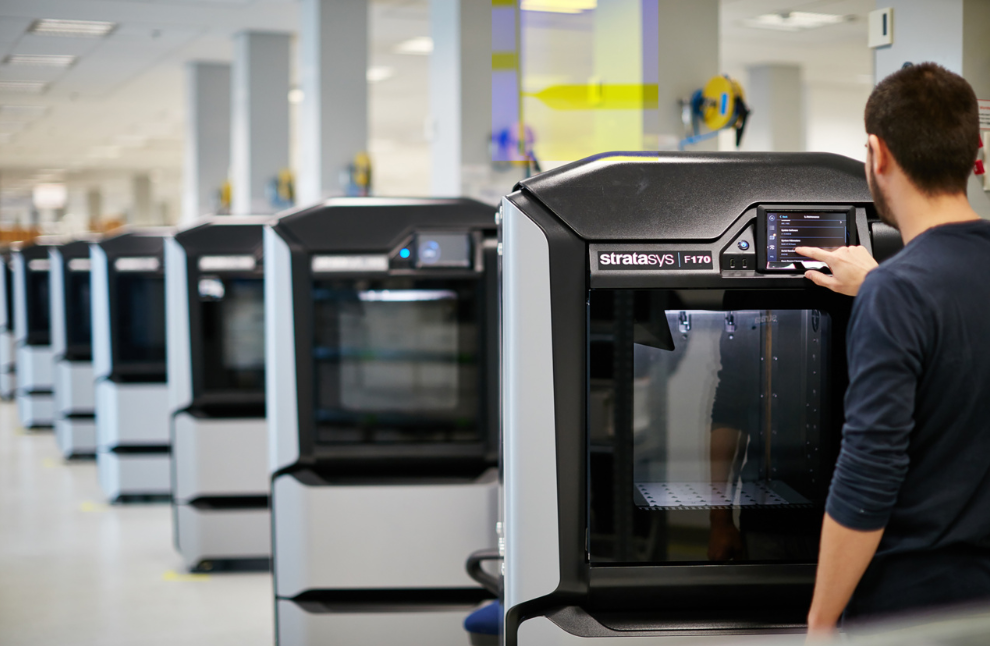
Solution: Edge-to-cloud architecture with AWS IoT
The GrabCAD IoT Platform uses the MTConnect industry standard to normalize sensor data, status information, usage metrics, and error codes from Stratasys printers. This standardized approach supports consistent data structure across connected equipment, supporting enterprise-wide integration and analytics. The data flows through a carefully designed multi-layered architecture built for industrial resilience and scalability.
Edge computing with AWS IoT Greengrass
AWS IoT Greengrass runs on gateway devices deployed alongside printers, bringing cloud capabilities to the edge. This architecture delivers several critical benefits for industrial environments:
- Local processing and resilience: Code executes locally at the edge, so that data processing, filtering, and aggregation happen before transmission to the cloud. The result is lower bandwidth requirements and costs, while supporting uninterrupted operations even during cloud disconnections. This is a critical requirement for manufacturing environments.
- Multi-layered data persistence: The platform implements protection at both the printer and gateway levels, designed to reduce the risk of data loss even during network interruptions or system failures.
- Flexible workload deployment: Stratasys can deploy and update edge logic remotely through AWS IoT Greengrass, supporting existing and future features such as pairing procedure, automated job scheduling and real-time process control.
Secure cloud connectivity with AWS IoT Core
AWS IoT Core serves as the secured cloud gateway, providing the foundation for reliable, bidirectional communication:
- Real-time MQTT communication: Bidirectional messaging supports both monitoring and control, with high availability and real-time responsiveness critical for manufacturing operations.
- Device state management: Device Shadows maintain a digital representation of each printer’s state, creating a single source of truth accessible even when devices are offline.
- Remote management capabilities: Over-the-air (OTA) software updates allow remote configuration management and swift deployment of features, security patches, and bug fixes. This eliminates the need for manual site visits and accelerates innovation.
Data pipeline and analytics
The GrabCAD IoT Platform uses AWS IoT Core rules engine combined with Amazon Data Firehose to manage digital twin data in real-time. This data flows into an Amazon Simple Storage Service (Amazon S3) data lake, where it becomes available for multiple purposes: powering the GrabCAD Analyze application, supporting audit and compliance requirements, and providing the foundation for machine learning model training.
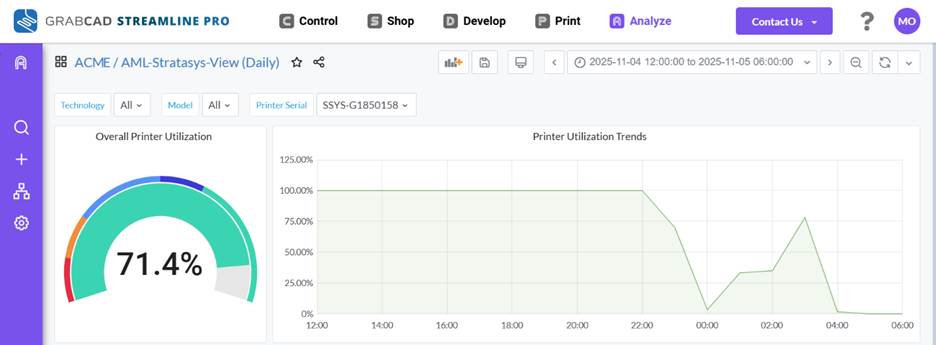
GrabCAD Analyze. GrabCAD Streamline Pro’s analytics solution
Flexible deployment for compliance
The GrabCAD IoT Platform architecture supports a deployment model that allows sensitive data to remain on premises while maintaining reliable cloud connectivity. This flexibility is essential for manufacturers with strict data sovereignty requirements or regulatory compliance needs, allowing them to adopt cloud-connected solutions without compromising their security posture.
To help provide secure printer and gateway onboarding with continuous system health monitoring, Stratasys partnered with GreenCustard, an AWS Partner specializing in AWS IoT solutions.
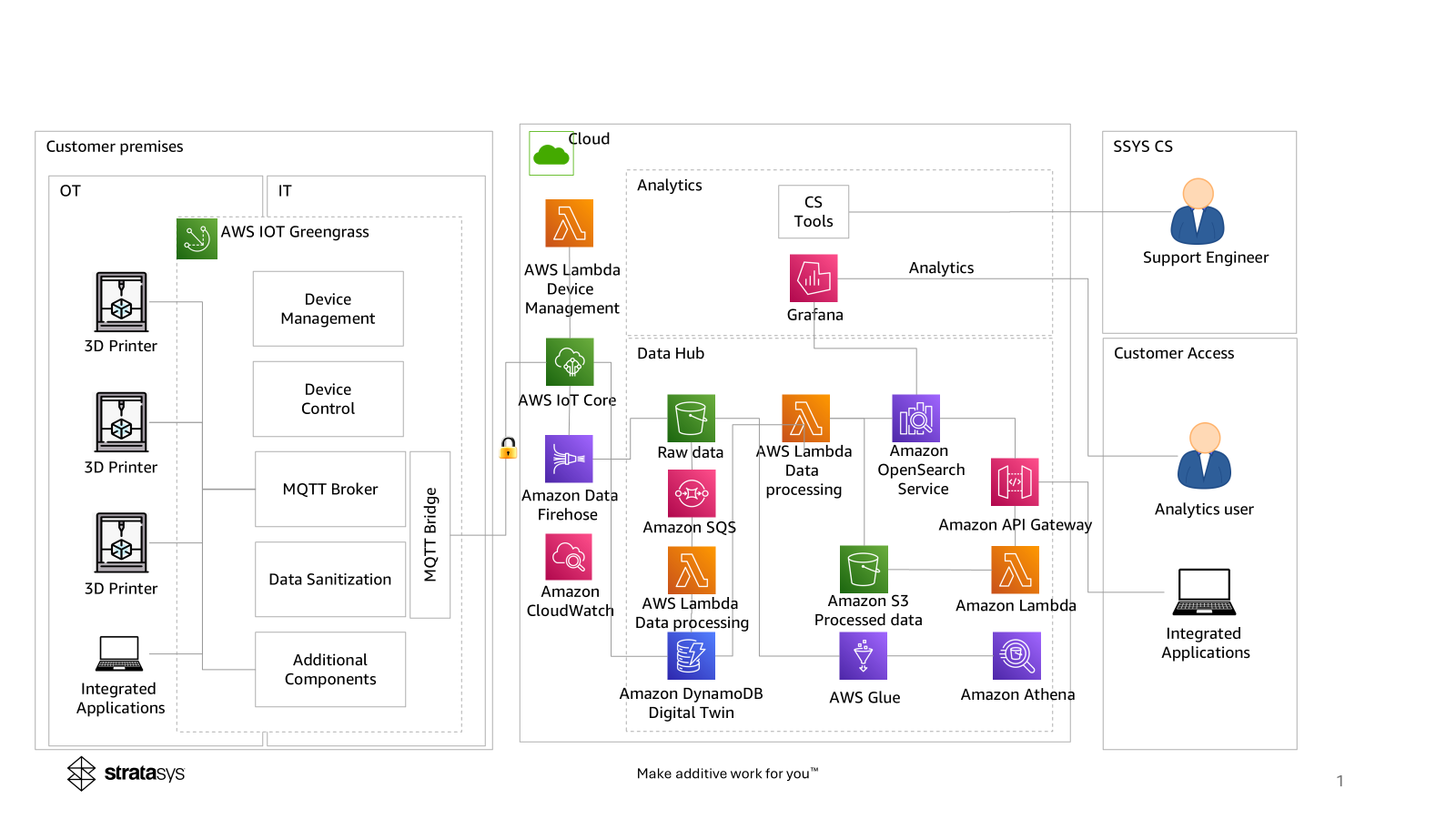
The following diagram shows the key elements of GrabCAD IoT Platform’s architecture.
Benefits: OEE gains, proactive operations, and visibility
The GrabCAD IoT Platform delivers measurable value to both Stratasys customers and Stratasys itself.
For manufacturing customers
With the platform, manufacturing customers can achieve tangible operational improvements across their 3D printing operations.
- Enhanced Overall Equipment Effectiveness (OEE): Standardized insights from MTConnect data provide near real-time visibility into printer health, usage, and job status across connected sites. Proactive operational control replaces reactive troubleshooting, directly improving OEE through better utilization, reduced downtime, and faster issue resolution.
- Proactive support through ARMS: The Advanced Remote Monitoring Service (ARMS) monitors machine health proactively, identifying potential issues before they cause failures. Faster resolution times and minimized unplanned downtime directly boost OEE and overall productivity for the customer. Proactive support reduces the average time to resolution by 38% compared to a reactive support model.
- Secure OT/IT integration: The platform’s hybrid deployment model maintains compliance with security and data sovereignty requirements while providing connections to existing MES and ERP systems. Normalized MTConnect data integrates with enterprise systems, providing end-to-end visibility.
- Standardized operations at scale: By using the MTConnect standard, the platform processes vast amounts of machine data, allowing manufacturers to use GrabCAD Analyze to gain insights into their production. Unified data helps teams spot trends, pinpoint the root causes of downtime, and optimize utilization rates, moving organizations from reactive troubleshooting to proactive operational control.
For Stratasys
Beyond direct customer value, the platform generates strategic benefits for Stratasys as an organization.
- Customer success optimization: Fleet performance insights reveal utilization patterns and demand signals, supporting proactive customer engagement. By identifying over-utilization or underperformance patterns, Stratasys can tailor solutions that directly impact customer success and business growth.
- Operational efficiency: Improved remote troubleshooting capabilities reduce the need to dispatch field engineers for onsite visits. This data-driven approach has improved remote resolution rates by approximately 8%, while simultaneously increasing customer success and reducing ongoing costs, such as unnecessary part replacements.
- Product innovation feedback loop: Aggregated, anonymized fleet performance data provides continuous feedback to engineering and R&D teams. Real-world validation of hardware and software performance in diverse production environments accelerates product improvement and innovation.
By connecting printers and unifying the data stream on an industrial standard, the GrabCAD IoT Platform provides the digital infrastructure necessary to turn additive manufacturing from a tool for innovation into a reliable, scalable source of industrial production.
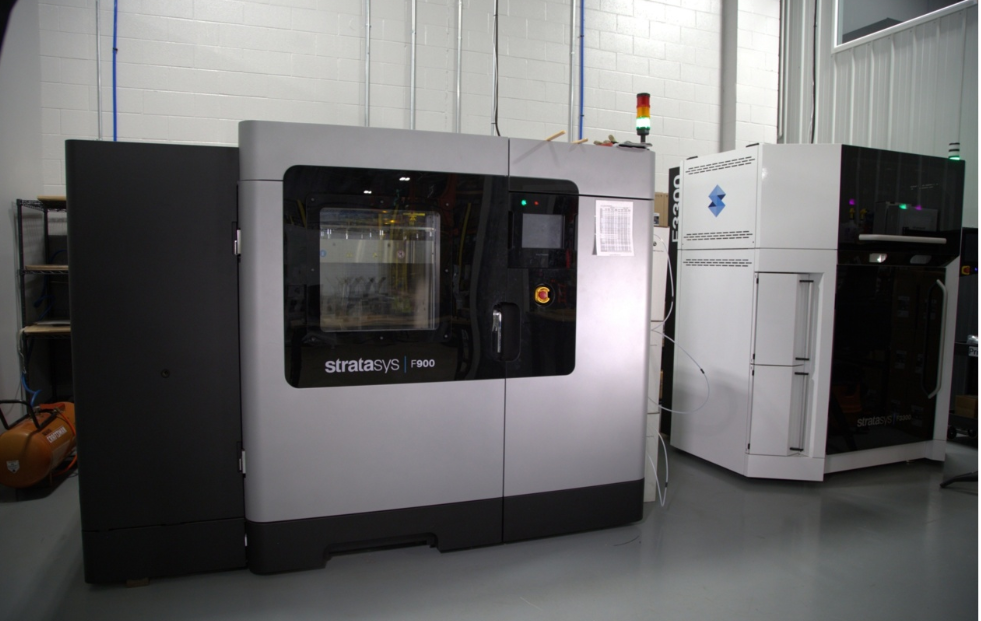
The future: self-optimized autonomous machines
Consistent and reliable data collection is the essential foundation for introducing valuable solutions and intelligent capabilities. The comprehensive data infrastructure built on AWS IoT services positions Stratasys to develop features that will turn additive manufacturing into a self-optimizing environment.
- Intelligent scheduler: One major capability, planned for release later in 2026, is an intelligent job queue across printer fleets. Using AWS IoT Greengrass for flexible workload deployment, the IoT platform can dynamically match jobs based on printer availability, material status, and maintenance windows. Automated scheduling will increase fleet utilization and OEE by supporting efficient resource allocation without manual intervention.
- AI Vision for quality control: High-resolution cameras integrated with machine learning will analyze print processes in real-time, detecting anomalies and defects before they impact production quality. This visual inspection capability, once ready, is designed to allow immediate corrective action and continuous quality improvement.
- Predictive maintenance: AI models trained on historical performance data can anticipate equipment failures before they occur, so that maintenance can be scheduled during maintenance windows that minimize production disruption. This shift from reactive to predictive maintenance can significantly reduce unplanned downtime.
- Automated root cause analysis: When issues arise, AI will automatically diagnose problems by analyzing symptoms, historical patterns, and equipment state. The system is designed to propose specific action plans, accelerating resolution times and reducing the expertise required for troubleshooting.
- Automated ordering for spare parts and material: Automated agents can manage material inventory across facilities, monitoring consumption patterns and automatically initiating purchase orders to help maintain production continuity. This extends to both intra-plant logistics and extra-plant supply chain coordination, optimizing inventory levels while helping to reduce the risk of stockouts.
- Closed-loop process control: The long-term vision is real-time micro-adjustments to print parameters based on continuous monitoring and feedback. This creates self-optimizing systems that help maintain quality through automated corrections, merging physical and digital processes into manufacturing systems that continuously refine output quality based on real-time feedback. The system can learn from each print job, continuously improving parameters and processes without human intervention.
These future AI features represent a fundamental shift: from connected equipment to intelligent, autonomous manufacturing systems that optimize themselves in real-time.
Conclusion
Ultimately, the successful transition of 3D printing from a niche tool to a foundation of industrial production rests on solving the challenges of data reliability, scale, security, and efficiency. The GrabCAD IoT Platform represents Stratasys’ commitment to bridging this gap. By using the rigor of industrial standards like MTConnect, architecting for security and resilience with AWS IoT Greengrass and AWS IoT Core, and establishing a unified data foundation, the platform turns fragmented operational data into a strategic asset. This industrial digital backbone not only solves immediate customer pain points, such as securing OT/IT connectivity and improving OEE, but also provides the foundation for a new generation of intelligent features. This dependable data pipeline represents the essential first steps for customers. It guides them toward the next phase of autonomy, where capabilities like smart scheduling, predictive analytics, and closed-loop process control move closer to becoming the industry standard.
Next steps
To learn more about the AWS services and resources mentioned in this post, see the following:
To explore how Stratasys can help with your additive manufacturing needs, visit Stratasys or GrabCAD.
Forward-Looking Statements and General Disclaimer: This blog may contain forward-looking statements, including statements regarding planned, expected, or potential future product features, capabilities, services, performance improvements, timing, benefits, and customer outcomes. These statements are based on current expectations and assumptions and are subject to risks, uncertainties, customer-specific configurations, operating conditions, validation requirements, technical feasibility, market conditions, third-party dependencies, and other factors that may cause actual results, availability, timing, functionality, performance, savings, uptime, OEE improvements, or other outcomes to differ materially. Nothing in this blog constitutes, or should be interpreted as, a commitment, promise, warranty, representation, guarantee, contractual obligation, product specification, roadmap commitment, or amendment to any customer agreement. Any future features, functionality, services, or capabilities described are illustrative only and may be changed, delayed, limited, or discontinued at Stratasys’ discretion. Customer results may vary and depend on, among other things, printer fleet composition, deployment model, usage, configuration, maintenance practices, data quality, network environment, security settings, and other customer-controlled factors. Any use of customer data remains subject to applicable customer agreements, permissions, privacy commitments, and data-use limitations. Stratasys undertakes no obligation to update or revise any forward-looking statements contained in this blog.