AWS for M&E Blog
Inside the AWS NBA Draft Combine Hub: How AWS turned decades of prospect data into a new fan experience
Each spring, the Amazon Web Services (AWS) NBA Draft Combine gives teams one of their first concentrated looks at the next generation of NBA talent. Over several days, prospects undergo a wide range of basketball activities and evaluation. The results can help explain why a player is rising or how a particular skill may translate to the court.
For fans, that context has historically been harder to access. NBA Combine data has existed across tables, articles, broadcasts, and team-by-team analysis, but the experience has rarely felt connected. A fan could see a player’s wingspan, vertical leap, shooting results, or lane agility time, but understanding how those numbers compare across positions, draft classes, or the broader history of the Combine required extra work.
The AWS NBA Draft Combine Hub, powered by Amazon Quick was designed to change that. Built in collaboration with West Loop Strategy, an Advanced Tier AWS Partner that specializes in Amazon Quick, AI and data, the experience brings more than 25 years of NBA Draft Combine data into a single interactive destination, giving fans a way to explore player results for measurements and strength and agility testing with historical context.
The goal was not simply to build a dashboard. It was to create a system that helps fans understand why the Combine matters.
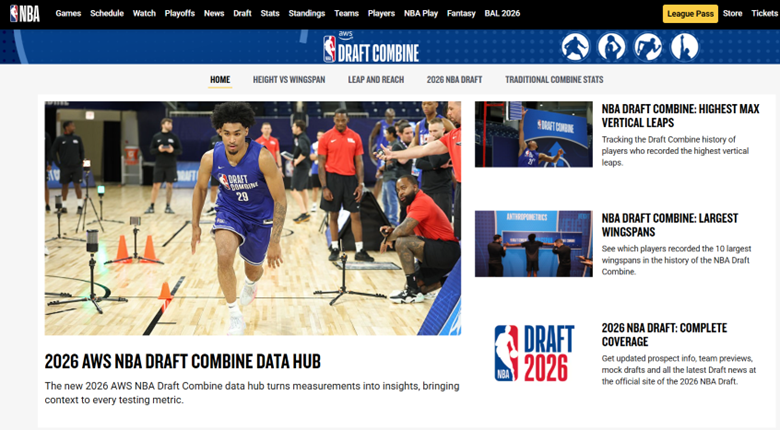
Figure 1: 2026 AWS NBA Draft Combine Data Hub: Analyzing Elite Prospect Measurements
Powering interactive analytics at league scale
The project began with a deceptively simple question: what would a fan want to know before they knew how to ask for it?
For the NBA, that meant starting with the viewer experience and working backward into the data model. The team focused less on how much data could be displayed and more on which combinations of data might actually help explain what makes a prospect unique.
“We started by putting ourselves in the fan’s eyes,” said Julie de Jesus, VP of Design, NBA. “What would be interesting before we even knew to ask the question? That led us to think about which data points could sit together and how to surface the smaller skill sets that may not always be obvious.”
The underlying dataset spans 25 years of data on participating players across measurements, strength and agility testing, and roughly 20 skill areas. But scale alone was not the challenge. The challenge was transforming a historically broad, table-based dataset into something navigable and meaningful.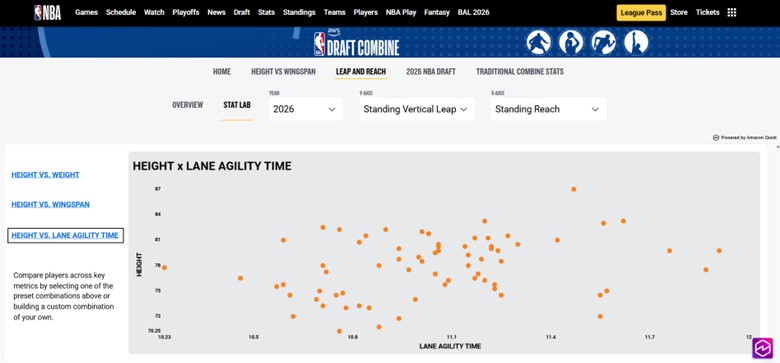
Figure 2: Height vs. Lane Agility Time: Scatter Plot Analysis of 2026 Draft Combine Measurements
“There is a limit to what a human being can really focus on,” de Jesus noted. “The goal is not to show everything. It is to surface the information someone can actually use to try to understand how players fit into the historical mold of the NBA.”
That approach led to a product where relationships matter more than raw outputs. Instead of presenting isolated metrics, the Hub surfaces how measurements, drills, and performance indicators connect to each other and to historical benchmarks.
From prototype to production
Turning that concept into a production-ready product required tight iteration across AWS, West Loop Strategy, and the NBA.
The teams worked through rapid cycles of building, testing, and refining, with constant input from the NBA’s product, design, and stats groups. West Loop Strategy brought development and visualization expertise, AWS handled the analytics and launch build, while the NBA provided creative direction and statistical guidelines for league consistency.
“We have found the single most important factor in a successful project is to get something in front of users, get feedback, and iterate,” said Alex Gottemoller, Founding Partner, West Loop Strategy. “All feedback is good feedback. Reducing the length of those cycles is critical, and the tools from AWS make that possible.”
That process allowed the team to explore different ways of structuring the experience, validating which approaches helped users understand the data more intuitively. Ideas were tested quickly, refined, and either incorporated or discarded without friction.
The result is a product that reflects both technical capability and league authenticity. It is grounded in how the NBA evaluates players, while still being accessible to fans who are exploring the Combine for the first time.
Serverless infrastructure for fan-facing analytics
The Combine Hub is a public-facing experience designed for moments of high fan interest, including Combine coverage, player announcements, and the NBA Draft. That requires infrastructure that can scale quickly without introducing operational complexity.
Amazon Quick provides a serverless foundation that allows the experience to handle large volumes of concurrent users without manual provisioning or infrastructure management.
“Because Quick is serverless, it is one of the easiest ways to manage scaling up a public-facing experience like this,” said Brett Hafstad, Cloud Engineer, West Loop Strategy. “You do not have to think about scaling infrastructure or managing load. It is handled behind the scenes.”
This model allows the NBA to deliver a consistent experience regardless of traffic spikes. It also reduces the need for dedicated operational resources, enabling teams to focus on improving the product rather than maintaining the underlying systems.
From a development perspective, that simplicity accelerates deployment and iteration. From a fan perspective, it ensures the experience is always available when demand is highest.
From Combine data to fan intelligence
One of the most important shifts in the Combine Hub is how data is presented. Instead of treating each measurement or drill result as a standalone number, the product builds context directly into the interface.
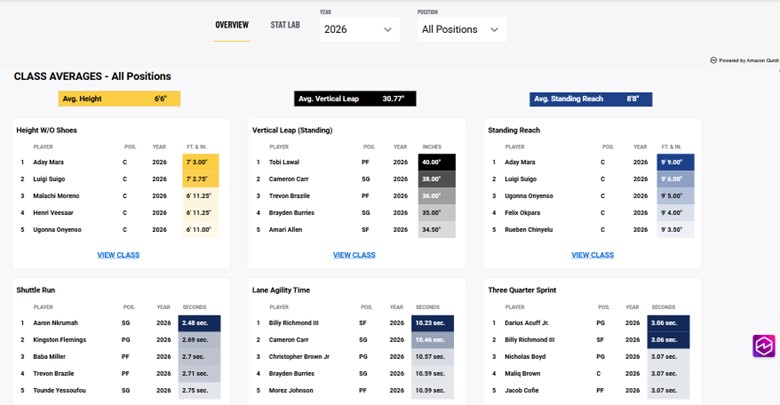
The Combine Hub provides data not only on individual draft classes, but also across positions and across historical Combine data. These contextual comparisons help explain why a result is meaningful.
“In the past, Combine data could feel like a broad table view,” said de Jesus. “What we wanted to do was show why a score or measurement may actually be significant, not just within a class, but overall.”
This turns passive data into an interactive experience. Fans are no longer just looking up information. They are exploring how players compare, how different attributes interact, and how a prospect may fit into the broader landscape of the league.
The AWS NBA Draft Combine Hub reflects a broader shift in how sports leagues think about data. The focus is moving from publishing information to building intelligence products that make that information usable.
By combining historical depth, interactive analytics, and a scalable AWS foundation, the Hub gives fans a more complete view of player evaluation. It helps explain not just what happened at the Combine, but why it matters and how it connects to what comes next.
For the NBA, that means a more informed fan experience. For AWS, it demonstrates how services like Amazon Quick can move beyond traditional dashboards and power dynamic, large-scale analytics experiences.