AWS Messaging Blog
Navigating messaging requirements in betting and gaming technology applications (Part 1: Understanding the landscape and preparing your application)
Global betting and gaming technology operators face a distinct challenge. Despite operating as fully licensed and regulated businesses in their respective jurisdictions, they consistently encounter messaging service registration challenges when registering their phone numbers for SMS messaging with telecommunication carriers.
Carriers and messaging providers classify betting and gaming technology operators as “high-risk” or gambling. This classification subjects their applications to heightened scrutiny, stricter content filtering, and rejection rates that far exceed those seen in other industries. A betting and gaming operator that follows the same registration steps that might work for a retail or software as a service (SaaS) company will often find that their application requires additional documentation or revision. These revisions can span multiple review cycles, often without clear guidance on what to change.
This post is written for developers and technical teams at betting and gaming operators who need to submit an SMS messaging registration for multi-factor authentication (MFA) and account verification use cases through AWS End User Messaging. The guidance below represents suggested best practices that can help betting and gaming operators give their application a stronger foundation when seeking SMS messaging approval from carriers. We cover the specific challenges such operators may face, how to prepare before submitting a registration application, what to do during the registration process, what happens if the application is denied by the telecommunications carrier, and the ongoing practices that help keep operator MFA messaging active and deliverable after approval.
Important note: This guidance applies exclusively to transactional and MFA messaging (for example, one-time passcodes, account verification, and security alerts). AWS End User Messaging does not support marketing or promotional messages for the betting and gaming industry.
How registration works: AWS and telecommunication carrier roles
Understanding the registration flow helps set expectations. Your application is submitted through AWS, but the carrier or aggregator decides whether to approve it.
Registration through AWS End User Messaging includes the following steps:
- You submit a registration request through the AWS End User Messaging console that includes your business details, use case descriptions, and relevant compliance documentation.
- AWS forwards your registration to the downstream carrier or aggregator (based on the origination identity type you selected, such as 10DLC, toll-free, or short code).
- The carrier or aggregator reviews your application and makes an approval or denial decision. An aggregator is the application-to-person (A2P) messaging provider that routes traffic to carriers such as T-Mobile and AT&T. AWS does not control this decision.
- AWS communicates the approval or denial to you through the AWS End User Messaging console. You can also configure event notifications to be alerted automatically.
The key takeaway: AWS facilitates the submission and relays the outcome, but the aggregator or carrier holds the approval authority.
The challenges: Why betting and gaming technology is different
Betting and gaming technology operators face two primary obstacles that generic messaging registration guides may not address. First, messages from this industry historically generate higher complaint rates. For that reason, The Campaign Registry (TCR) classifies gambling as a Special Use Case that requires enhanced vetting, which makes carriers more cautious about approving new betting and gaming registrations. Second, certain words or phrases can trigger content filters at the carriers, which can cause service disruption and increased scrutiny for future applications. Even legitimate one-time password (OTP) messages can get blocked if your company name contains gambling-related keywords. For example, a message such as “exampleGames: here is your OTP 1234 to start betting” may be filtered because “betting” triggers automated content rules, even though the message is a valid security code. This contributes to higher rejection rates by carriers during number registration. To reduce registration approval delays, provide as detailed and accurate a description of your use case as possible in your application.
Pre-registration preparation
Carriers and aggregators want to see that you’re a legitimate business operating legally before they approve your registration. To help do so, you should:
Establish a clear business identity
- Use a legitimate business domain email – Registration applications submitted with Gmail or other personal email addresses signal a lack of organizational legitimacy. Use a duly registered email address on your company’s registered domain.
- Make your website transparent – Your website should clearly describe your services, the jurisdictions where you’re licensed to operate, and links to your active gaming licenses or regulatory approvals. Carriers will review it. Include links to your applicable licenses, terms of service, and privacy policy in accessible locations.
Plan your messaging content strategically
- Develop message templates before you apply – Your registration application will ask for sample messages. Your samples should focus exclusively on:
- One-time passcodes for account login.
- Multi-factor authentication (MFA) verification codes.
- Account security alerts (new device login, password changes, and suspicious activity).
- Avoid promotional gambling language in your samples – Use clear language, accurately describe your use case, and provide all the necessary details.
- Prepare examples of your message types – For each template, document who receives it, what triggers it, what the message contains, and how the recipient opted in. The more specific and operational your use case descriptions, the more confidence you give reviewers that this is a well-governed program.
- Assemble your applicable compliance documentation
Before submitting any registration through AWS End User Messaging, gather:
- Your business registration and tax identification documents.
- Your opt-in consent process documentation.
- Your Telephone Consumer Protection Act (TCPA) compliance policy or equivalent.
- Your data retention and privacy policy.
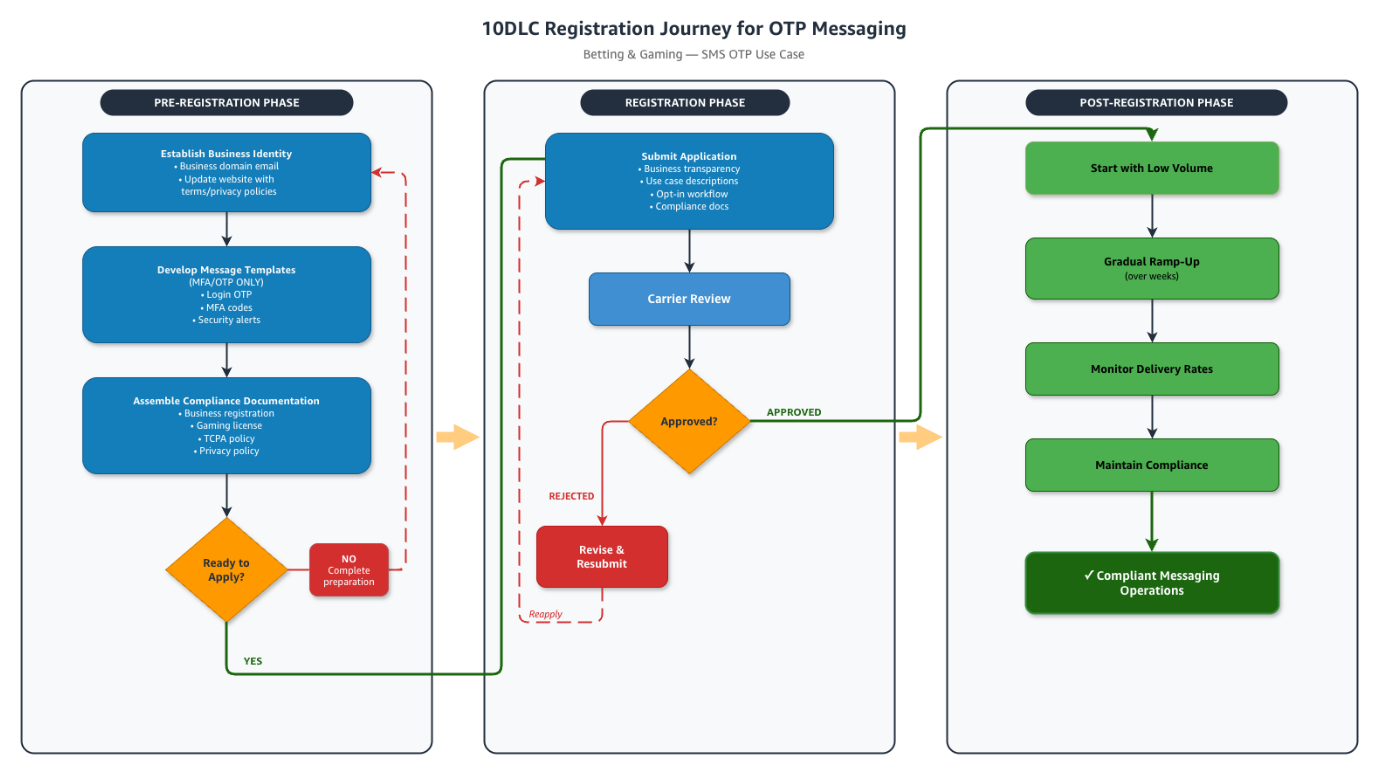
Figure 1: The 10DLC registration journey for OTP messaging, from pre-registration preparation through carrier review to post-registration compliance
Coming up in Part 2
You now understand why betting and gaming operators face heightened scrutiny, how the AWS and carrier registration roles work, and how to prepare a strong application before you submit. In Part 2, we cover the registration process itself: how to write use-case descriptions and opt-in documentation that get approved, how to maintain compliance and deliverability after approval, and what to do if your registration is denied.