AWS Physical AI Blog
AWS & RLWRLD: Building the Workforce of Tomorrow with Physical AI
The second in a series exploring how AWS and RLWRLD are advancing Physical AI from research to real-world deployment, and why dexterous robotics isn’t about replacing workers but sustaining economies that are running out of them.
Building on a Foundation
In June 2026, we published Putting Dexterous Robots to Work: How RLWRLD Builds Physical AI with AWS, introducing how RLWRLD, a Physical AI company founded in 2024, trains robots to perform complex, contact-rich manipulation tasks using AWS infrastructure at scale. That post told the story of how their technology works. This one tells the story of why it matters, and what’s changed since.
Since then, RLWRLD has hit several milestones that deepen its work with AWS and bring enterprise customers closer towards commercial deployment.
RLWRLD is now an AWS Validated Partner, with two offerings available on the AWS Marketplace. That designation, along with the co-sell and technical validation pathways it unlocks, makes it significantly easier for enterprise customers to evaluate and procure Physical AI solutions built on AWS.
The first offering is RLDX-1, a robotics foundation model that fuses vision, language, touch, force, and memory to perform advanced dexterous manipulation. The second is RX (Robotics Transformation), a consulting and data service that assesses human jobs for technology readiness and delivers deployment roadmaps with ROI metrics. One is the intelligence layer. The other is the business case.
Together, AWS and RLWRLD can now support customers through a structured path from exploration to production. It starts with assessing opportunities for dexterous manipulation through RX. From there, customers can pilot solutions that combine robot foundation models, hardware, AWS infrastructure, and field engineering in real-world environments. When a use case is validated, they can move towards scaled deployment using RLDX-1, with integration and ongoing support built in.
Most recently, RLWRLD brought this work to a global stage. Ahead of Summer Davos in June 2026, the company published “Hand dexterity remains a barrier to automation. Here’s why a common benchmark could help” on the World Economic Forum platform. The piece also introduces DexBench, a standardized framework for measuring real-world robotic dexterity, to a policy and industry audience that increasingly sees automation not as a research topic but as an economic one.
None of these milestones are incremental. Together, they mark the shift from research breakthroughs towards commercial deployment, built on AWS.
RLDX-1: State-of-the-Art Dexterity at a Fraction of the Compute
At the heart of RLWRLD’s operation is RLDX-1, an 8.1-billion-parameter, publicly available and open-weight robotics foundation model launched in May 2026. What makes RLDX-1 distinctive isn’t just its size; it’s what it unifies: vision, language, touch, force, and memory in a single architecture, enabling five-finger dexterous manipulation across single-arm, dual-arm, and humanoid embodiments.
The results speak for themselves. According to RLWRLD’s published results, RLDX-1 demonstrates strong performance across major robotics benchmarks including RoboCasa, LIBERO, and SIMPLER. On the RoboCasa GR-1 Tabletop benchmark, RLDX-1 achieved 58.7%, a 10.7 percentage-point improvement over the next-best reported result of 48.0% (RLDX-1 Technical Report). RLWRLD reports that RLDX-1 reached these results using approximately 20% of the training compute compared to leading frontier models (RLWRLD Technical Blog, Section 6-2). RLDX-1 is also recognized on the Tektonian VLA Benchmark, a third-party benchmark platform, among its top-ranked models.
This efficiency isn’t accidental. It’s the product of architecture design and a purpose built data engine powered by AWS. RLWRLD pre-trains on a curated mix of multi-embodiment robot data, scaled with synthetic trajectories generated on AWS, then specializes the model with in-house tactile and torque-rich data from its target robots, all on Amazon Elastic Compute Cloud (Amazon EC2) p5e and p5en instances (NVIDIA H200 GPUs), orchestrated through AWS ParallelCluster with Slurm-based HPC clusters. Data flows through Amazon Simple Storage Service (Amazon S3) and Amazon FSx for Lustre, keeping storage and high-speed compute in continuous sync. The result: a training pipeline that scales elastically across pre-training, mid-training, and post-training stages without infrastructure bottlenecks.
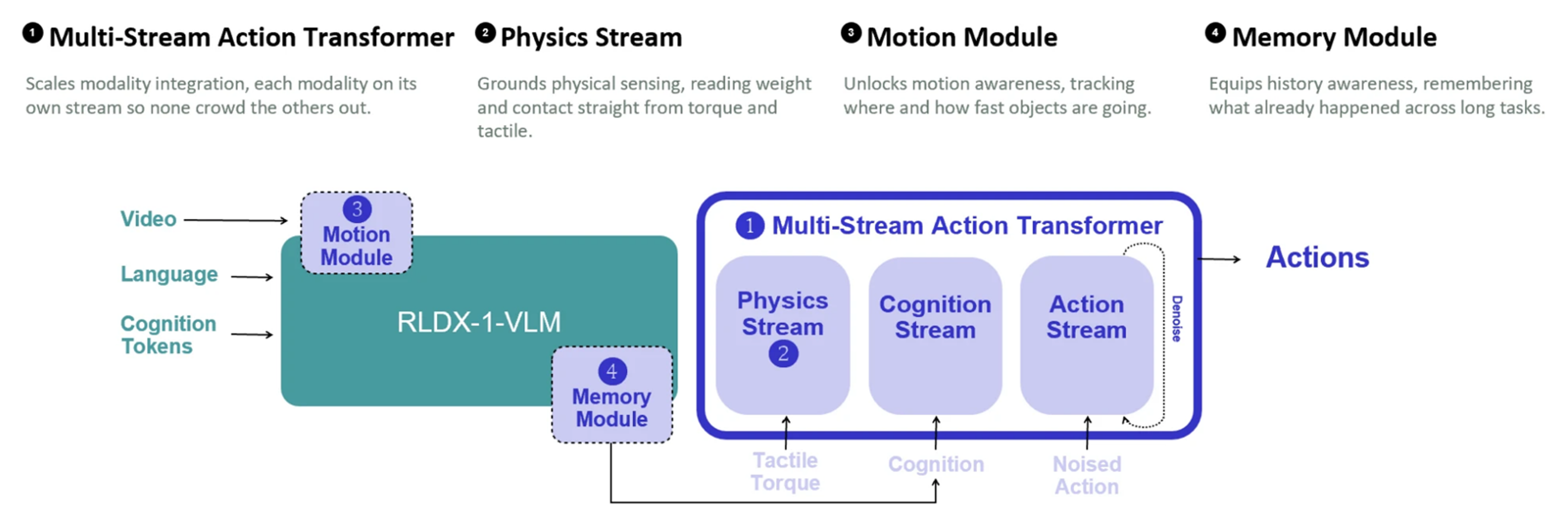
Figure 1: Inside RLDX-1 : separate streams for sight, touch and action
Setting the Standard for the Robotics Landscape
Beyond building models, RLWRLD is leading the effort to give robotics what it has long lacked: shared standards. DexBench defines what deployable dexterity means at the task level; All Hands Up establishes the empirical reference for the hardware capable of reaching it. Together, they form the measurement foundation an entire network can build on.
DexBench: A common language for robotic dexterity
One of RLWRLD’s most significant contributions to the broader robotics landscape, in collaboration with Nvidia, is DexBench, a standardized benchmarking framework introduced at the World Economic Forum in June 2026.
The problem it addresses is fundamental: today, there is no shared measurement standard for dexterity. Labs publish incomparable demo reels. Buyers can’t verify whether a robot can actually perform the tasks their operations depend on. Investors compare companies on marketing, not capability.
DexBench changes this. Built from real customer needs across manufacturing, logistics, and service, it defines 18 atomic manipulation tasks, the recurring primitives that appear across all industries, organized along two axes: Object State Complexity (from rigid to deformable) and Dexterity Regime (from coarse grasping to force-modulated, multi-step manipulation).
As RLWRLD’s WEF article argues that robotics needs a shared benchmark, much as ImageNet helped advance computer vision and MMLU helped shape language model evaluation. Industry endorsers already include LOTTE, SK Telecom, Hyosung, HL Mando, CJ Logistics, Fuji, ANA, and Mitsui Chemicals, including major companies across Korea and Japan.
All Hands Up: Mapping the Hardware Behind Deployable Dexterity
If DexBench defines what deployable dexterity looks like, All Hands Up asks the next question: what hardware can get us there?
Today, the robotic hand landscape is fragmented. New hands are emerging rapidly across research labs, startups, and established manufacturers, each with different degrees of freedom, actuation mechanisms, sensing capabilities, form factors, and price points, yet there is no common reference for understanding how these design choices translate into real manipulation capability.
All Hands Up is RLWRLD’s answer: a structured, continuously evolving atlas of robotic hands, mapping the hardware landscape against the capabilities required for real-world deployment. Rather than comparing hands purely by specifications, it provides a common lens for understanding where each hand sits on the path toward deployable dexterity.
As dexterous hardware improves and costs fall, All Hands Up helps robot developers, researchers, and end users make clearer decisions about which hands are ready for which real-world tasks.
The Real Story: Physical AI as an Economic Lifeline
In Western media, the dominant robotics narrative centers on job displacement and the fear that machines will replace human workers. In Korea and Japan, the reality is inverted. They cannot find enough workers to sustain operations.
South Korea crossed the “super-aged” threshold in 2024[1], with more than 20% of its population aged 65 or older. Its working-age population is actively contracting. Japan’s population has declined for 14 consecutive years[2]; its working-age cohort is projected to shrink by nearly 15 million over the next two decades[3].
These aren’t abstract projections. They represent hotel floors that can’t be staffed, logistics centers that can’t fulfill orders, and manufacturing lines that can’t run full shifts. By the numbers, 9.6% of global manufacturing value added[4] efforts across manufacturing, logistics, automotive, and retail comes from Korea and Japan alone, contributing 13.8% of global industrial robot installations, collectively accounted for approximately 75,000 of 542,076 industrial robots newly installed worldwide in 2024, according to IFR World[5].
As RLWRLD’s WEF article states: “The world is running short of hands. Across Korea, Japan, much of Europe, and increasingly China’s manufacturing base, the working-age population is shrinking, even as demand for physical goods and services holds steady.”
McKinsey estimates a $100 billion opportunity in general-purpose robotics in Japan alone[6]. Japan’s Ministry of Economy, Trade and Industry (METI) has set an ambition to capture 30% of the global Physical AI market by 2040[7]. The driver isn’t efficiency optimization; it’s industrial survival[8].
Physical AI in these markets isn’t a luxury. It’s infrastructure.
From Benchmarks to Bottlenecks: Physical AI in the field
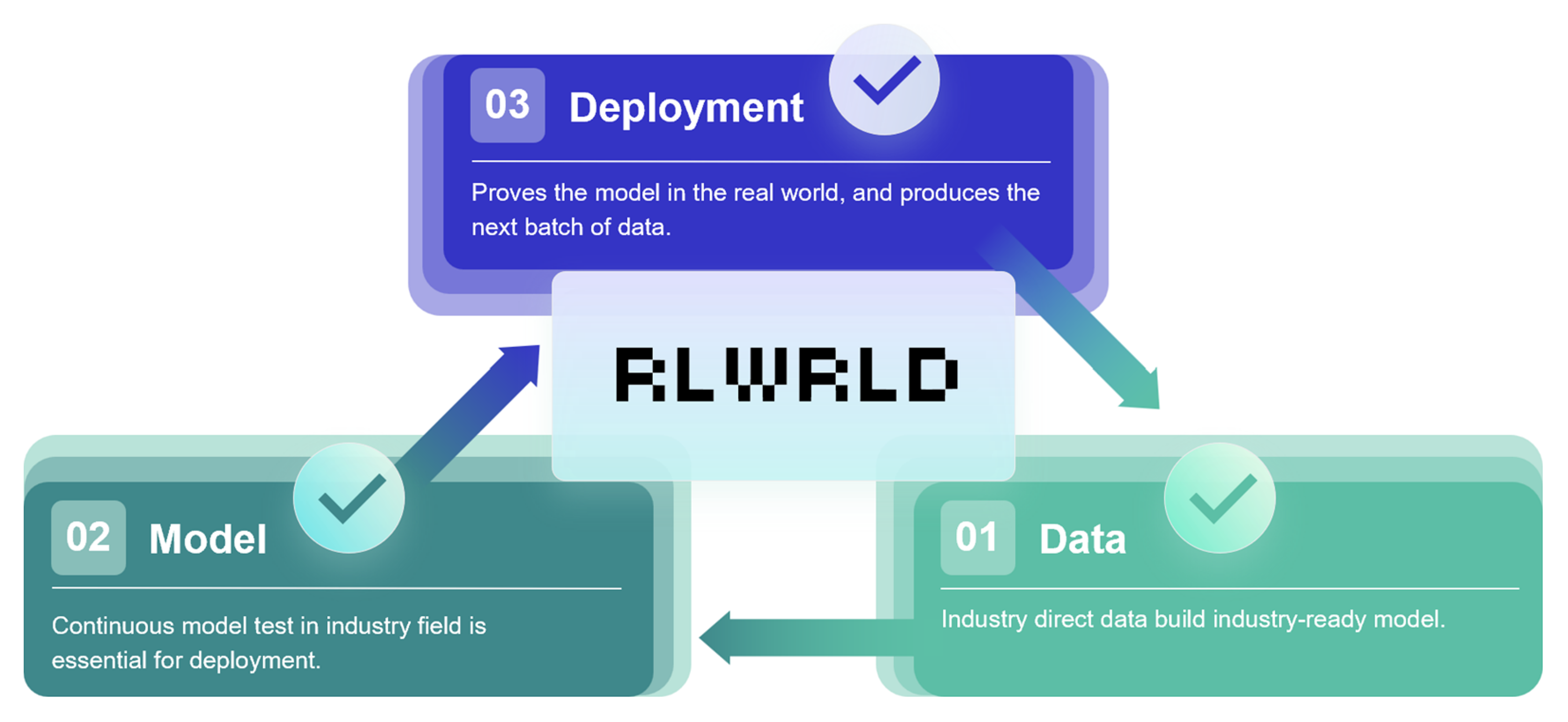
Figure 2: The RLWRLD flywheel: data builds the model, deployment builds the data.
For RLWRLD, deployment is part of building the model. Every proof of concept (PoC) deployment generates operational data that sharpens model capabilities, and every one teaches the team more about what it takes to succeed in brownfield environments. As this cycle repeats across customers, it shortens lead times and moves engagements faster toward production-grade deployments tied to customer KPIs. RLWRLD has been deployment-first since day one, because that is what spins the data–model flywheel. The examples below from Korea and Japan show it in action, and similar initiatives are now underway in the US and Europe.
LOTTE HOTEL & RESORT: South Korea’s largest hotel group underwent a full Robotics Transformation (RX) assessment that decomposed operations into 40+ job groups, 400+ tasks, and 4,500+ atomic actions, pinpointing housekeeping, food & beverage, and banquet work where five-finger dexterity is the true bottleneck. Hotel staff now periodically become “teachers,” wearing body cameras on the service floor to feed RLWRLD’s 4D+ data pipeline. A dedicated on-site space has been assigned, a multi-year data partnership is in discussion, and the target is live deployments by 2030, with humanoids absorbing 30–40% of repetitive, physically demanding work.
CJ Logistics: RLWRLD is working with one of Asia’s largest parcel carriers to target the human only links in high-speed sortation: handling parcels of unpredictable form, from rigid to deformable, in dynamic, moving, line environments where the robot must keep pace with the flow rather than pause it. In Japan, a government-supported on-site PoC at a working warehouse is fine-tuning RLDX-1 for small, hard-to-grasp items in real operating conditions, the class of picking work that has resisted conventional automation.
KDDI: RLWRLD is working with a convenience-store business in KDDI’s portfolio, with a vision to scale automation across thousands of stores globally. An initial assessment identified shared opportunities across store and fulfillment operations. The planned proof of concept focuses on box handling, product picking, and shelf replenishment to help address labor shortages and free staff to focus on customers. The collaboration aims to combine real-world operational data with robotics development to build reusable capabilities across distribution and retail, with advanced tool use explored as a longer-term R&D track.
Across all three verticals, the bottleneck was identical: contact-rich, dexterous manipulation that no conveyor, no robotic arm, and no position, controlled machine has been able to solve. And because RLDX-1 is hardware-agnostic, dexterity learned in any one of these environments doesn’t stay there. Every deployment feeds one model, and every deployment makes the next one smarter. That’s the flywheel.
A Global Momentum Shift: From Asia to the US and Europe
The labor crisis driving Physical AI adoption in Asia is not confined to Asia. Across the United States and Europe, RLWRLD is hearing a consistent message from customers and partners: labor shortages, rising wages, and persistent gaps in skilled industrial work are accelerating demand for Physical AI at a pace that mirrors what Korea and Japan faced a decade earlier.
The scale is hard to overstate. Nearly 500,000[1] warehouse and logistics positions remain open in the US, with 69% of facilities reporting significant difficulty hiring and retaining qualified staff[2]. US manufacturing lines carry nearly 400,000 unfilled roles[3], with openings posting at nearly twice the rate they are filled. In Europe, stagnant labor mobility and rapid population aging have compounded the gap, with 80% of top manufacturers reporting massive talent shortfalls[4]. These are not cyclical hiring dips. These are structural workforce deficits that conventional recruitment cannot solve.
Why AWS
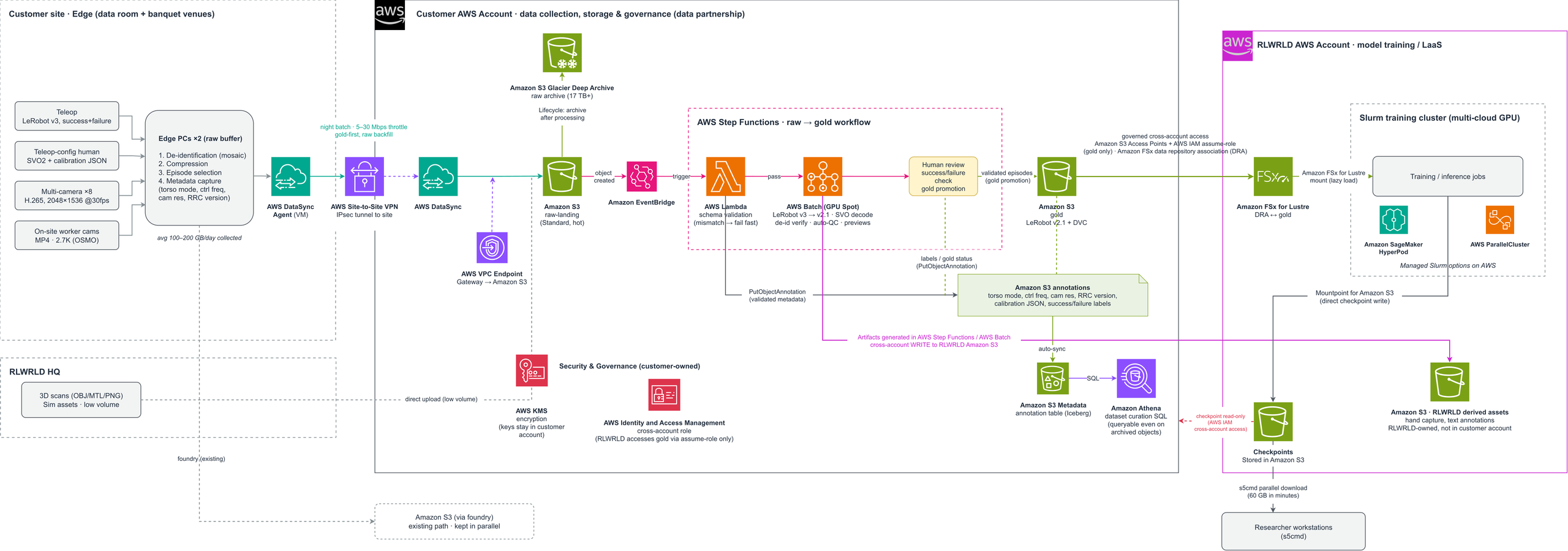
Figure 3: The data pipeline RLWRLD is co-designing with AWS
RLWRLD has deployed a partnership led expansion strategy to meet this growing global demand. AWS supports joint go-to-market engagement with enterprise customers along with continued technical support for model optimization across various deployment environments and NVIDIA enables joint research to advance robotics foundation models from pilot to production. The approach is already generating momentum: RLWRLD’s participation in AWS Physical AI roadshows worldwide is building a customer pipeline that is converting into PoC deployments, prototyping engagements, and strategic partnerships. In parallel, RLWRLD is expanding its hardware partnerships and building a systems-integrator model that complements its Robotics Transformation (RX) team, providing the integration, deployment, and operational support required to scale Physical AI across global enterprises.
The thesis is the same one proven in Asia: where the hands aren’t coming back, the robots must arrive.
RLWRLD chose AWS not just for compute, but for the full stack architecture that Physical AI demands:
- Amazon EC2 P5 instances — NVIDIA H200 GPUs for distributed training at scale
- AWS ParallelCluster — Slurm-based HPC orchestration with minimal migration friction
- Amazon Simple Storage Service (Amazon S3) + Amazon FSx for Lustre — Hundreds of terabytes in continuous sync between durable storage and high-speed training access
- Amazon Elastic Compute Cloud (Amazon EC2) Capacity Blocks for ML — Consistent GPU access on planned schedules
- Amazon EC2 g6e instances— NVIDIA L40S GPUs for simulation evaluation
Furthermore, with its added support program of Forward Deployed Engineering, the AWS Generative AI Innovation Center will continue to tackle the most challenging real-world problems together with RLWRLD and its customers.
This infrastructure enables RLWRLD to achieve frontier-level performance at 20% of the compute cost, a critical advantage when training on real-world robot data at the scale required for production deployment.
What Comes Next
With AWS Validated Partner status, completed FTR for RLDX-1, and both RLDX-1 and RX listed on AWS Marketplace, enterprise customers can move more efficiently from use-case discovery and prototyping to production deployment. This foundation supports RLWRLD’s continued growth in South Korea and Japan while accelerating expansion across the United States and Europe through joint go-to-market activities, customer engagements, and industry partnerships.
AWS and RLWRLD are working to bring dexterous robotics from research environments to hotel floors, logistics centers, and production lines. Not to replace available workers, but to perform essential work that employers increasingly struggle to staff. The future of work is not human versus machine. It is human with machine, and AWS and RLWRLD are working to make that future deployable at global scale.
To explore RLWRLD’s Physical AI solutions, visit the AWS Marketplace listing. If you’re building in Physical AI or thinking about dexterity in your operations, reach out to partnerships@rlwrld.ai. For the first post in this series, read Putting Dexterous Robots to Work: How RLWRLD Builds Physical AI with AWS. For RLWRLD’s World Economic Forum article on DexBench, read Hand dexterity remains a barrier to automation. Here’s why a common benchmark could help.