AWS Public Sector Blog
Accelerate regulatory package processing with agentic AI on AWS and Databricks
Federal agencies process millions of conformity packages annually—documentation that verifies products, services, and federal actions meet specific regulatory standards. Whether it’s certifying a vehicle is safe to drive or confirming a project meets environmental standards, these packages play a vital role. They’re the gatekeepers making sure the public stays safe, the environment is protected, and regulations are followed. Yet the manual processes used to review them have barely evolved in decades. With AI enabled conformity package processing the time to approve the package improved significantly.
The result is predictable: mounting backlogs, extended review timelines, inconsistent determinations, and overburdened staff. Submission volumes continue to grow while staffing remains flat. The complexity and variety of conformity requirements across regulatory domains—spanning certificates of conformance for contract supplies, general certificates of conformity for consumer product safety, environmental compliance documentation, import/export declarations, and technical test reports—compound these challenges further.
Solving this is as much a data and governance challenge as an AI challenge: the intelligence to reason over a package is only useful if it can reach decades of compliance records locked in legacy systems—and do so under the access controls and audit a federal environment demands. That is why this solution pairs two platforms, each owning a different half of the problem: Amazon Web Services (AWS) for the agent runtime, and [Databricks on AWS](https://www.databricks.com/product/aws) for the data and governance runtime. By deploying agentic AI—specialized agents that work collaboratively to analyze, validate, and route documentation—federal agencies can dramatically accelerate conformity processing while maintaining or improving quality and compliance. The goal isn’t to replace human expertise; it’s to make better use of it.
Rethinking regulatory processing from the ground up
Traditional conformity processing is linear and labor-intensive. A package arrives, sits in a queue, gets assigned to a reviewer, and moves through a series of manual checks. Each check requires the reviewer to locate relevant standards, cross-reference databases, verify completeness, and document their determination. The process works—but it doesn’t scale.
Agentic AI reimagines this workflow as a collaborative system of specialized agents, each responsible for a distinct aspect of the review. Built on Amazon Bedrock and Amazon Bedrock AgentCore, and integrated with Databricks on AWS, the system operates like a well-coordinated review team rather than a single overloaded examiner—AWS orchestrating the agents, Databricks providing the data platform backbone, connected through the Model Context Protocol (MCP).
Architecture overview
The solution follows a gateway pattern: AgentCore handles agent orchestration, authentication, and memory, and Databricks provides the data processing, extraction, governance, and custom tooling layer.
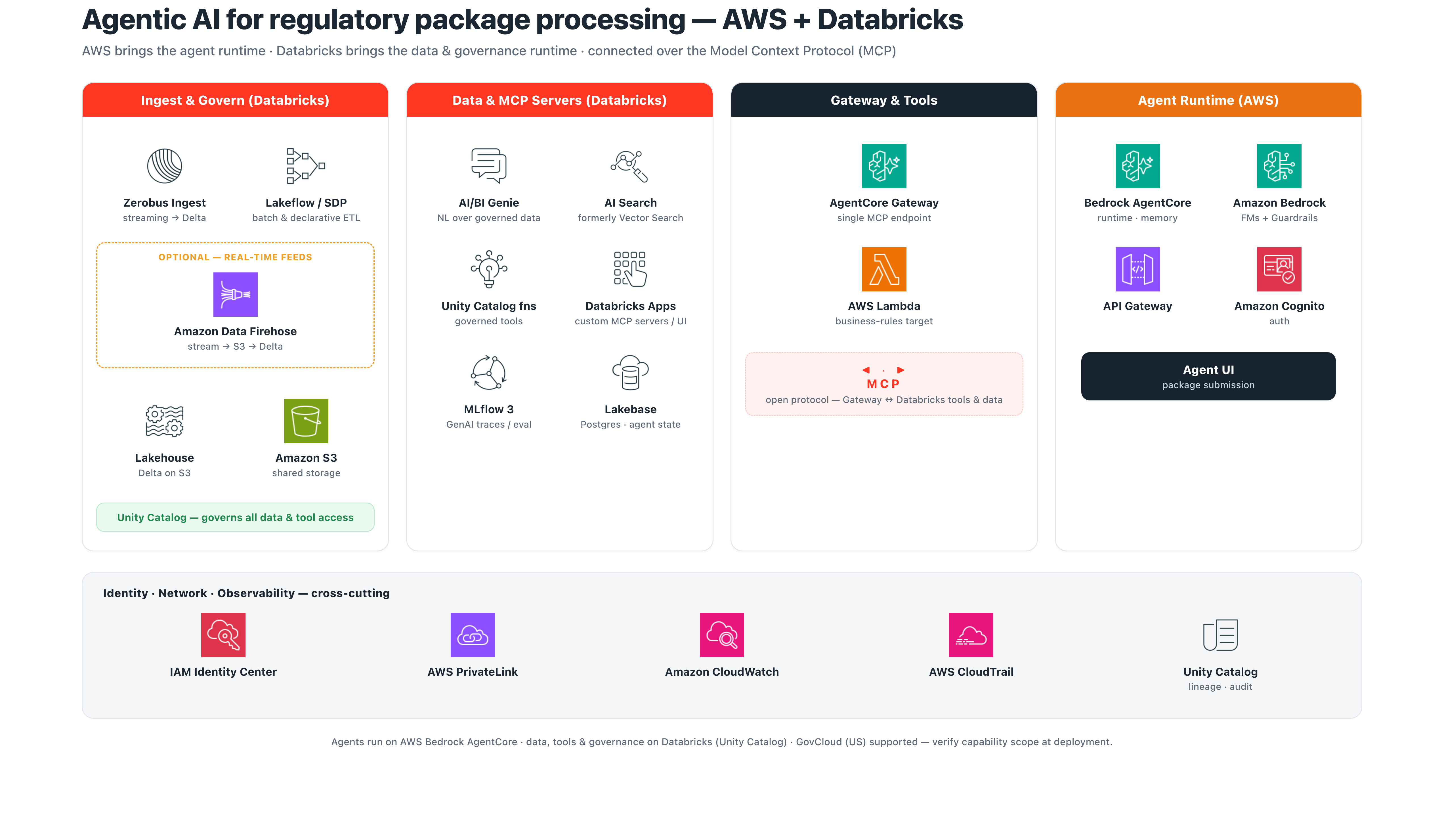
Figure 1: Agentic AI architecture — AWS agent runtime + Databricks data and governance runtime, connected over MCP
The flow begins when a user submits a regulatory package through the Agent UI, authenticated using Amazon Cognito. The agent running on AgentCore Runtime performs orchestration, reasoning, and validation. To reach external capabilities, it calls AgentCore Gateway—a managed MCP endpoint that aggregates multiple backend targets and exposes them as a unified set of MCP tools.
AgentCore Gateway routes tool invocations to two target categories:
- Lambda target – AWS Lambda functions execute business processing rules: the regulatory logic that determines which standards apply, which validation checks are required, and how to route edge cases. Independently, the agent uses AgentCore Memory to maintain short-term conversational context and long-term processing knowledge, so determinations stay consistent across reviews.
- MCP target – Databricks-managed MCP servers, with tool and data access enforced by Unity Catalog, provide the heavy-lifting data capabilities regulatory processing demands: AI/BI Genie for natural-language querying over governed data, AI Search (formerly Vector Search), and Unity Catalog functions—plus custom MCP servers hosted as Databricks Apps for agency-specific tools. Databricks Apps can also serve as the front-end UI layer, integrated with AgentCore Gateway.
On the ingestion side, agencies have options for landing legacy and streaming data in the governed lakehouse: Lakeflow Connect and Spark Declarative Pipelines for batch and declarative ETL, and Zerobus Ingest for high-volume, direct-write streaming into Unity Catalog–governed tables. Where real-time feeds are involved, Amazon Data Firehose can also deliver streaming data into Amazon S3 for Databricks to land in Unity Catalog–governed tables. Together these aggregate data from legacy systems without a rip-and-replace, enabling analytics over historical compliance records and exposing custom tools that agents invoke on demand. Unity Catalog governs this entire call path—visibility, access policy, and audit logging across every MCP interaction—with defense-in-depth safety across the stack (Amazon Bedrock Guardrails for content safety at model input and output, and operational guardrails such as rate limits and spend caps on model traffic), so governance is native, not bolted on. Amazon Simple Storage Service (Amazon S3) serves as the shared storage layer, holding submitted packages, extracted data, and artifacts accessible to both the AgentCore pipeline and Databricks workloads.
Why AWS and Databricks, together
This works because each platform carries the half of the problem it is built for. Agencies maintain decades of compliance records in legacy systems, structured databases, and document repositories, and making that data accessible to intelligent agents requires a platform that can handle extraction, transformation, and real-time querying at scale.
AWS supplies the agent runtime: managed infrastructure to deploy, secure, and scale AI agents with built-in authentication, memory, and tool integration. Databricks supplies the data and governance runtime: a unified platform to process massive datasets, connect to legacy sources, and serve results through open protocols—all under one governance model in Unity Catalog. MCP joins them: rather than point-to-point integrations between each agent and each data source, AgentCore Gateway aggregates the Databricks-managed MCP servers and Lambda business rules into a single, standards-based endpoint. Agents can query compliance databases, extract legacy data, invoke custom validation tools, and retrieve historical precedents through one protocol—simplifying the architecture while keeping the flexibility to add data sources and tools without changing agent logic.
The MCP integration between them makes the solution comprehensive. Rather than building point-to-point integrations between each agent and each data source, AgentCore Gateway aggregates the Databricks managed MCP servers and Lambda business rules into a single MCP endpoint. Agents running on AgentCore Runtime can query compliance databases, extract data from legacy objects, invoke custom validation tools, and retrieve historical precedents—all through a single, standards-based protocol. This dramatically simplifies the architecture while maintaining the flexibility to add new data sources and tools without modifying the agent logic.
What the system delivers
At its core, the solution delivers capabilities that transform how agencies handle conformity packages:
- Intelligent document classification – Automatically categorizes incoming documents—certificates, test reports, technical drawings, correspondence—and identifies the applicable regulatory framework.
- Multi-source data validation – Agents to cross-reference submissions against internal compliance databases, historical approval records, industry standards repositories, requirement catalogs simultaneously, powered by Databricks querying disparate sources in real time. Hours of manual lookup become seconds
- Automated compliance checking – Lambda business rules validate completeness, accuracy, and adherence to specifications with consistency human reviewers can’t match across thousands of submissions.
- Legacy data extraction through Databricks MCP servers – gents reach existing databases, file stores, and legacy applications without requiring them to be rebuilt or migrated.
- Governed, auditable access — Unity Catalog enforces who can see and invoke what, and records it, so every automated determination is traceable.
- Custom tool integration — agency-specific validation logic and external calls are exposed as tools the agents invoke autonomously, extending the system without changing the core.
- Agent-quality tracing and evaluation — AgentCore Runtime emits OpenTelemetry (OTEL) traces that MLflow 3 on Databricks ingests natively through the Zerobus OTLP endpoint, giving teams evaluation and tracing across both the application and interactive paths.
- Durable agent state (optional) — Lakebase, Databricks-managed serverless Postgres, complements AgentCore Memory when teams want agent or application state co-located with governed data under Unity Catalog, with data branching, point-in-time recovery, and scale-to-zero.
Putting it into practice: Vehicle import conformity
Consider a federal agency that processes thousands of vehicle import applications annually, verifying that imported vehicles conform to Federal Motor Vehicle Safety Standards (FMVSS). The manual process involves reviewing Vehicle Identification Number (VIN) structures, validating manufacturer certifications against approved lists, cross-referencing crash test data and recall databases, and verifying emissions compliance documentation—all before a determination.
With the AgentCore and Databricks solution, a submission comes in through the Agent UI, authenticated via Amazon Cognito. The agent on AgentCore Runtime calls AgentCore Gateway, which routes to a Lambda function that applies business rules to determine the relevant FMVSS standards for the vehicle class. Through the same gateway, the agent invokes the Databricks MCP servers to extract historical data from legacy compliance databases—prior approvals for the manufacturer, recall history for similar vehicle types, and cross-references against known non-conforming patterns—all governed by Unity Catalog.
The agent synthesizes these inputs: VIN validation against the manufacturer database, completeness checks against required documentation, and anomaly detection against historical patterns. Clean applications are flagged for expedited approval; anomalies—an inconsistent VIN structure, missing crash-test documentation—escalate to a human expert with a focused summary of exactly what needs attention and why.
Agencies positioned to benefit
The pattern applies broadly across the federal government:
- The Environmental Protection Agency can accelerate General Conformity determinations for federal actions affecting air quality, using Databricks to analyze emissions data across State Implementation Plans.
- The Consumer Product Safety Commission can process General Certificates of Conformity more efficiently by validating testing laboratory accreditation against historical databases.
- The Federal Aviation Administration can enhance aircraft conformity inspections by cross-referencing configuration documentation against type certificate databases spanning decades of certifications.
- The Food and Drug Administration can accelerate product registration packages for food, drugs, and medical devices—domains where legacy data in older systems is particularly valuable for pattern detection.
- Customs and Border Protection can expedite import declarations by validating certificates against product classifications and trade agreement requirements in real time.
- The Department of Defense can strengthen supply chain security by cross-referencing contractor certificates against known counterfeit patterns across the defense industrial base.
Each shares the same profile: high submission volumes, complex requirements, constrained resources, and critical data locked in legacy systems—exactly what the joint AWS + Databricks architecture addresses.
What agencies can expect
Agencies implementing this architecture can expect meaningful improvements: substantially reduced initial review times to help clear backlogs and meet statutory deadlines, fewer processing errors and less rework as automated validation catches inconsistencies human reviewers might miss during high-volume periods, and materially higher throughput without proportional staffing increases.
Just as important, the system delivers consistency—standardized application of regulatory requirements across reviewers, regions, and time periods—along with complete transparency through audit trails, anchored by Unity Catalog, that show exactly how each determination was reached. Human experts spend their time where it matters most: complex cases, policy interpretation, high-risk determinations, and nuanced judgment.
Implementation considerations
Government deployments require careful attention to several dimensions. Security and privacy are foundational—implementations must use FedRAMP-certified cloud services, encryption of sensitive data and full compliance with federal information security requirements. AWS GovCloud (US) provides the isolation and compliance controls these workloads need, and Databricks on AWS supports deployment within these boundaries. Capability availability differs by boundary, so teams should verify current scope at deployment time.
Human oversight remains essential. Critical decisions, precedent-setting cases, and enforcement actions must involve human review and approval—AI serves as a decision support tool, not a replacement for human judgment. Systems must also accommodate frequent regulatory updates without extensive reprogramming, and AI-generated assessments must be explainable to regulated entities with clear supporting reasoning
Data quality is foundational. The Databricks layer requires clean, well-structured connections to legacy data sources across the full range of conformity package types. Agencies should plan for an initial data-integration phase to map existing systems into the Unity Catalog–governed, MCP-accessible layer.
Conclusion
The future of regulatory compliance is collaborative intelligence, built on a genuine AWS + Databricks partnership: AI agents on AWS handling high-volume, rules-based processing, and Databricks on AWS providing governed, comprehensive data access—so human experts focus on the work that truly needs them.
To learn more, explore Amazon Bedrock and Amazon Bedrock AgentCore, and Databricks on AWS. The partnership extends across the developer experience too—see how Databricks brings the platform into the Kiro agentic IDE, grounded in Unity Catalog. To explore this architecture for your agency, contact your AWS and Databricks account teams.