AWS Quantum Technologies Blog
Amazon Braket launches Rigetti Cepheus™-1-108Q superconducting device
This post was contributed to by Zia Mohammad, Scott Smart, Yuvraj Mohan, Mike Piech, and Rebecca Malamud
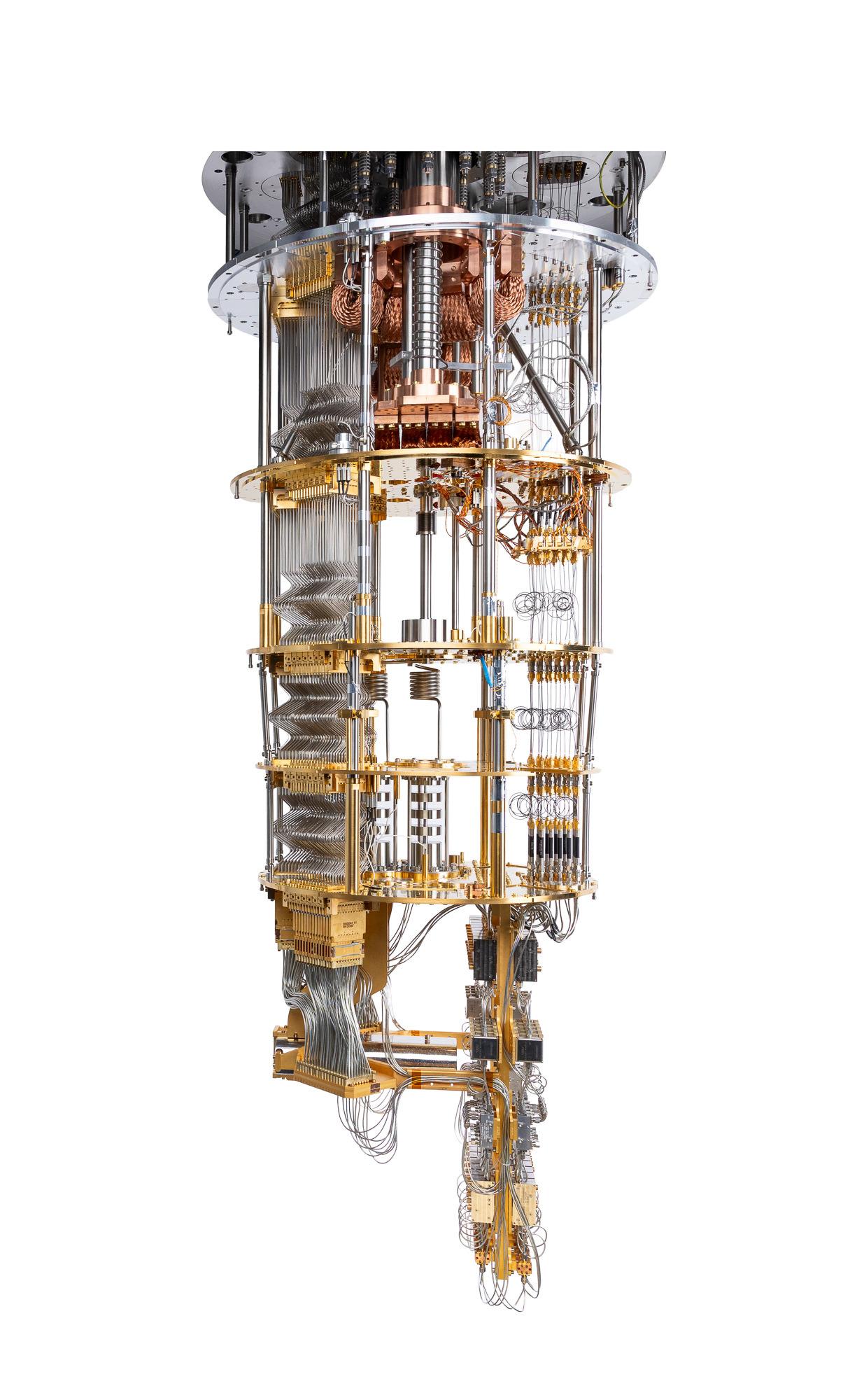
Figure 1: A Rigetti quantum processing unit (QPU) inside a dilution refrigerator. Photo by Drew Bird.
Amazon Braket enables customers to design and run quantum algorithms on a broad selection of quantum hardware through a unified interface. On April 7, 2026, we expanded the hardware available on Braket with the general availability of Rigetti Computing’s Cepheus-1-108Q, a 108-qubit superconducting quantum processing unit (QPU). Cepheus-1-108Q is the first gate-based quantum device with more than 100 qubits available on Amazon Braket. It replaces the Ankaa-3 system and represents the third generation of Rigetti hardware on the service.
The device is built using Rigetti’s proprietary multi-chip architecture that tiles twelve 9-qubit chiplets into a single processor. It is physically located in the United States and available through the US West (N. California) Region.
Device overview
Cepheus-1-108Q joins Amazon Braket’s quantum hardware portfolio, giving customers access to a 108-qubit superconducting system for workflows in quantum computing applications. Customers worldwide can run experiments using on-demand access for quantum tasks, priority access through Amazon Braket Hybrid Jobs for variational quantum algorithms, or dedicated reservations through Braket Direct on a per-hour basis.
The device provides 20 hours of quantum task processing availability every day of the week.
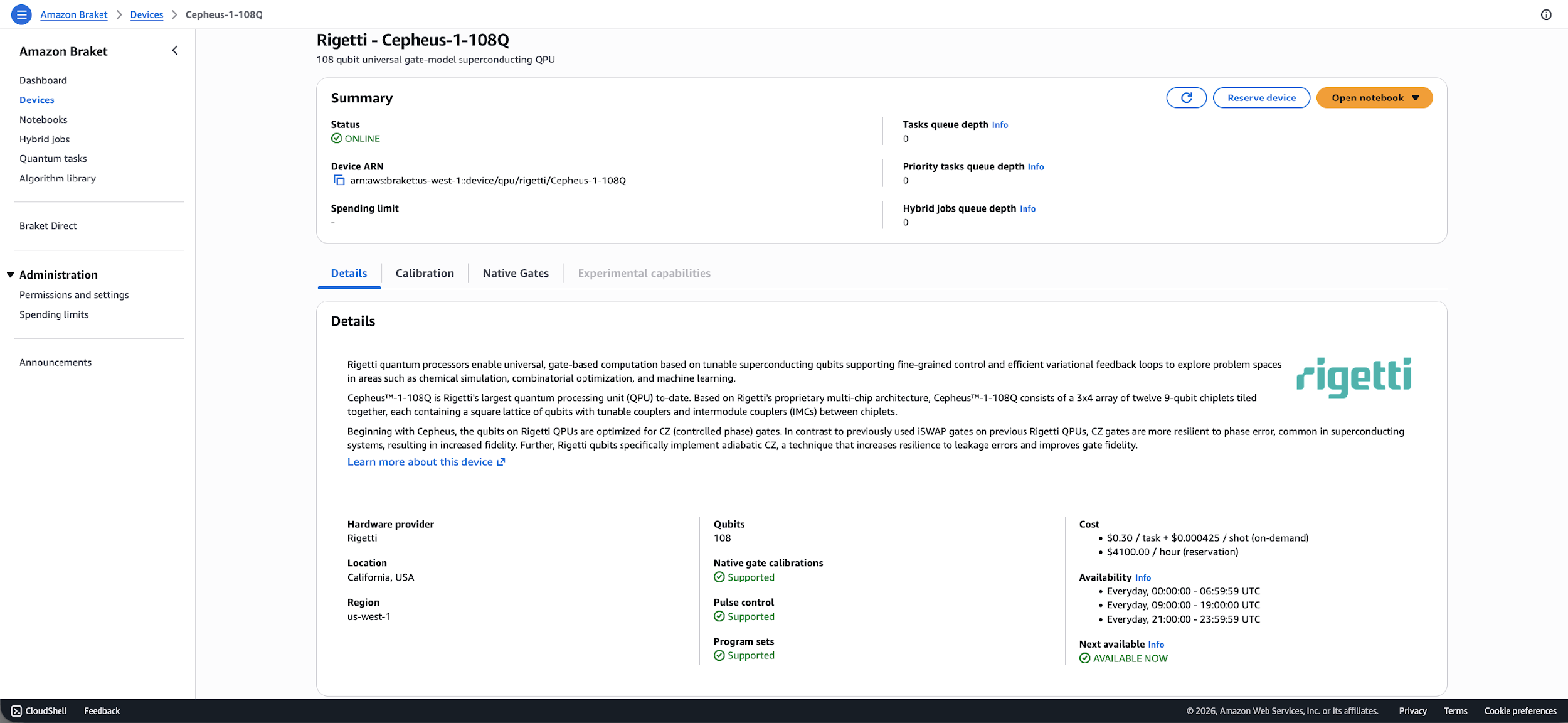
Figure 2: The Cepheus-1-108Q device page in the Amazon Braket Management Console.
Technical architecture
Cepheus-1-108Q uses Rigetti’s modular multi-chip architecture. The processor consists of a 3×4 array of twelve superconducting 9-qubit chiplets tiled together, with qubits connected via tunable couplers and intermodule couplers (IMCs). This approach builds on Rigetti’s Cepheus-1-36Q system, tripling the number of chiplets and total qubit count.
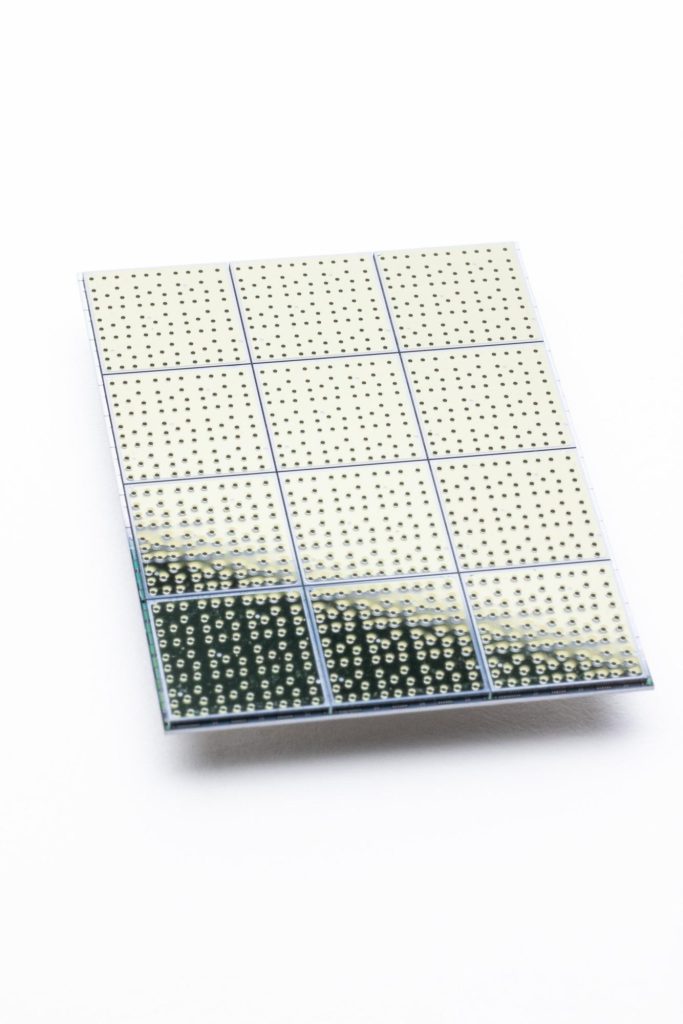
Figure 3: The Cepheus-1-108Q multi-chip processor, showing twelve 9-qubit chiplets tiled in a 3×4 array. Photo by Drew Bird.
Each chiplet is based on superconducting transmon qubits arranged in a square lattice, where each qubit connects to up to four nearest neighbors. The native gate set includes single-qubit rotations (RX, RY) and a two-qubit entangling gate (CZ).
A key change in the Cepheus generation is the move to CZ (controlled-phase) gates, replacing the iSWAP gates used on previous Rigetti QPUs such as Ankaa™-2 and Ankaa-3. While iSWAP gates have strong expressivity for NISQ-era applications, CZ gates are the more natural native gate for parity-check circuits used in error correction. Another enhancement with Cepheus systems is the introduction of an adiabatic CZ gate scheme. The adiabatic CZ gate implementation can reduce incoherent and leakage errors, enabling customers to run deeper circuits with lower accumulated error. At launch, the device achieved a median two-qubit gate fidelity of 99.1% with gate speeds of ~ 60 nanoseconds.. For up-to-date characterization data, including gate fidelities, coherence times, and connectivity information, visit the Cepheus-1-108Q device page in the Amazon Braket Management Console or query the device properties using the Braket Python SDK.
Getting started with Cepheus-1-108Q on Braket
Customers can build, test, and run quantum programs on Cepheus-1-108Q with the Braket SDK, CUDA-Q, PennyLane, and Qiskit. To run programs on the device, specify the Amazon Resource Name (ARN) in the device definition before running your circuit:
from braket.aws import AwsDevice

device = AwsDevice("arn:aws:braket:us-west-1::device/qpu/rigetti/Cepheus-1-108Q")
You can run a circuit with a few lines of code:
from braket.circuits import Circuit

bell = Circuit().h(0).cnot(control=0, target=1)

result = device.run(bell, shots=1000).result()
Researchers with advanced workloads can also access the Cepheus-1-108Q device at the pulse level using Braket Pulse. Pulse-level control lets you customize the analog control signals applied to qubits, which is useful for studying noise characteristics, developing custom gates, and building error mitigation schemes.
Selecting high-fidelity qubits
Superconducting quantum devices exhibit varying performance across qubits and qubit pairs due to fabrication variations and environmental factors. On a 108-qubit system, selecting the highest-fidelity subset of qubits for a given algorithm requires careful analysis of calibration data and layout optimization.
Amazon Braket provides up-to-date calibration data for all qubits and qubit pairs on Cepheus-1-108Q, including single-qubit gate fidelities, two-qubit gate fidelities, and readout errors. Customers can analyze this data to find the qubits that offer the best performance for their specific workloads. The following figure shows an example: a high-fidelity 50-qubit chain selected using a subgraph isomorphism routine applied to the device’s calibration data.
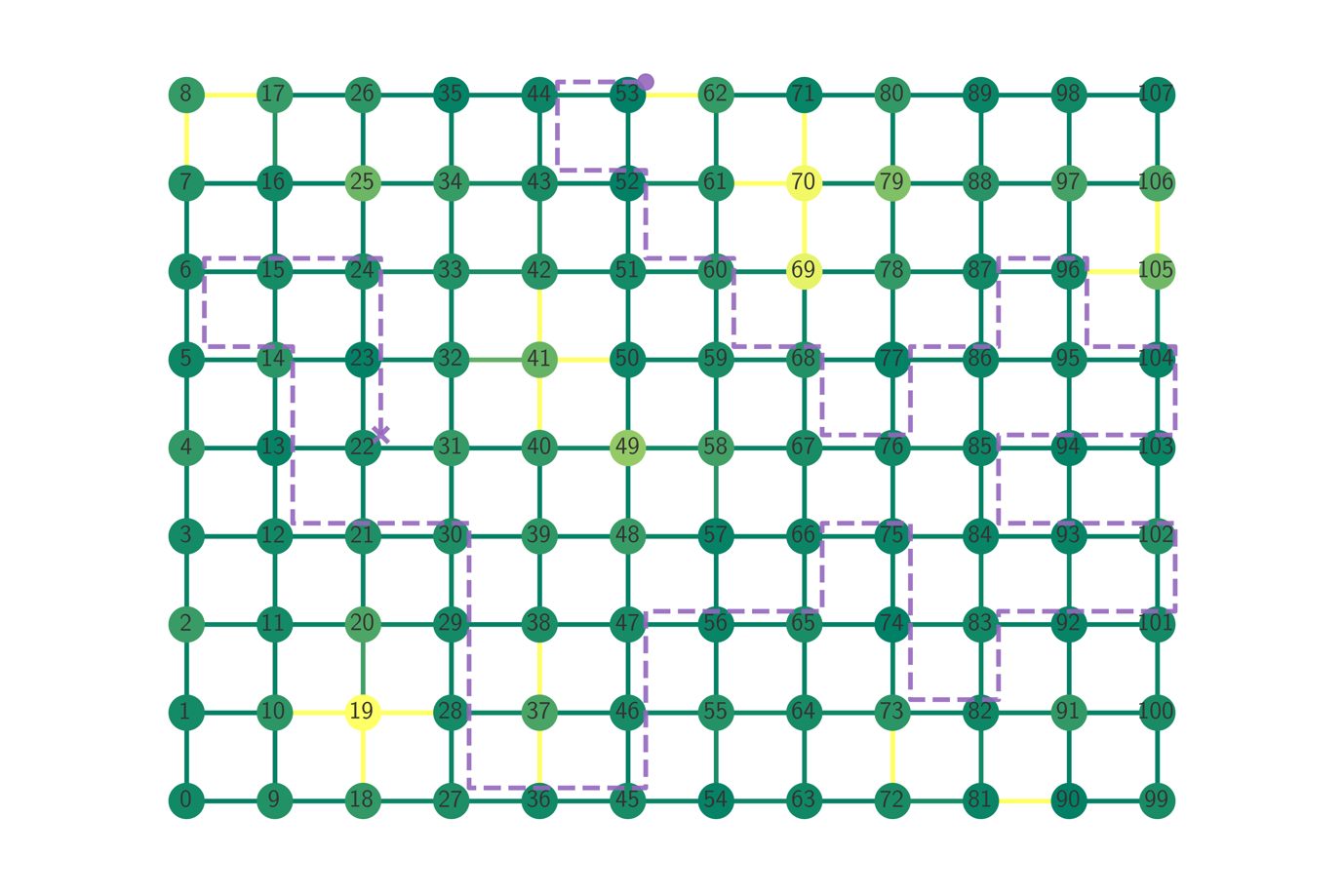
Figure 4: A selected high-fidelity 50-qubit chain on Cepheus-1-108Q. The node and edge color from dark green to yellow denotes decreasing, corresponding with CZ errors on edges and readout errors on each qubit.
By plotting the error distributions for the selected region, we can compare against the median device statistics. The following figure shows that the selected qubits have meaningfully lower error rates than the device median.
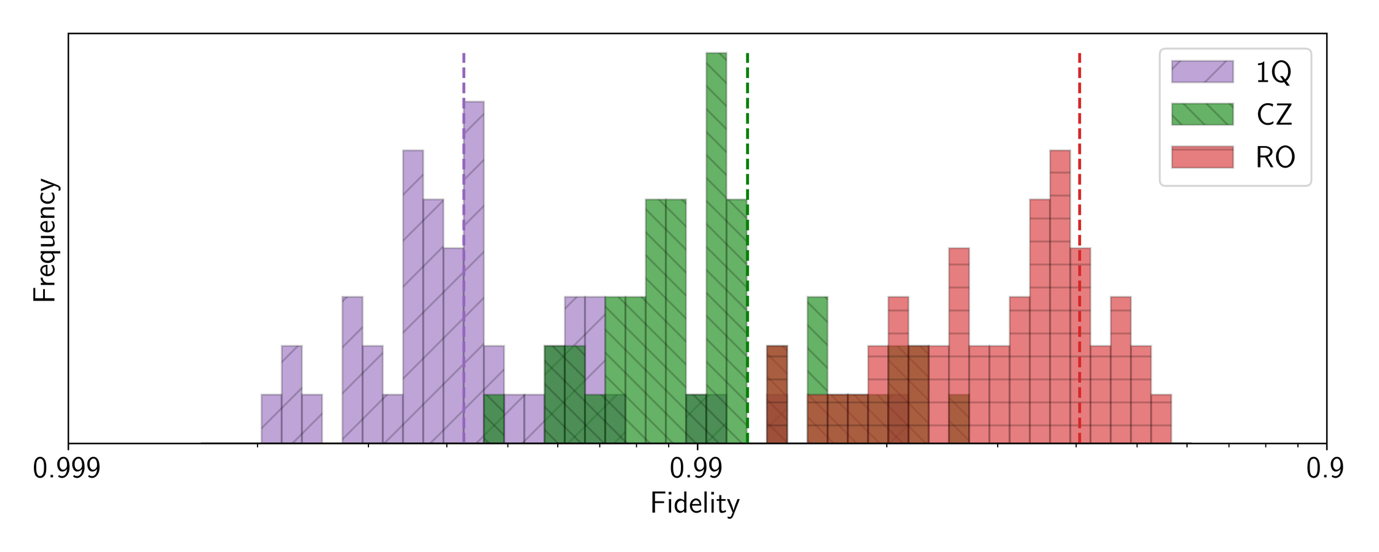
Figure 5: Distribution of single-qubit (randomized benchmarking), CZ (interleaved randomized benchmarking), and averaged readout fidelities for the selected 50-qubit region on Cepheus-1-108Q. Vertical dashed lines show median error rates for the full device.
To get started with qubit selection strategies and circuit optimization techniques, explore the following example notebooks:
- 1-D quantum workflows for advanced QPU workflow patterns
- Noise models on Rigetti for analyzing calibration data
- Allocating qubits on QPU devices for selecting optimal qubit pairs
Get started today
Visit the Rigetti provider page or the Cepheus-1-108Q device page in the Amazon Braket Management Console to view the device topology, availability windows, and real-time calibration data. To run your own quantum programs on the Cepheus-1-108Q processor, visit our GitHub repository for example notebooks and tutorials. You can run these using a managed Jupyter notebook or from your local development environment.
Researchers at accredited institutions can apply for AWS credits through the AWS Cloud Credits for Research program to support experiments on Amazon Braket.