AWS Security Blog
Category: Intermediate (200)

Privacy conscious cloud migrations: mapping the AWS Cloud Adoption Framework to the NIST Privacy Framework
This post will help you make privacy-conscious cloud migration decisions by mapping the National Institute of Standards and Technology (NIST) Privacy Framework: A Tool for Improving Privacy Through Enterprise Risk Management (NIST Privacy Framework) to the AWS Cloud Adoption Framework (AWS CAF). AWS Professional Services created the AWS CAF to help organizations successfully migrate to […]

Securing resource tags used for authorization using a service control policy in AWS Organizations
In this post, I explain how you can use attribute-based access controls (ABAC) in Amazon Web Services (AWS) to help provision simple, maintainable access controls to different projects, teams, and workloads as your organization grows. ABAC gives you access to granular permissions and employee-attribute based authorization. By using ABAC, you need fewer AWS Identity and […]

How to use AWS RAM to share your ACM Private CA cross-account
In this post, I use the new Cross-Account feature of AWS Certificate Manager (ACM) Private Certificate Authority (CA) to create a CA in one account and then use ACM in a second account to issue a private certificate that automatically renews the following year. This newly available workflow expands the usability of ACM Private CA […]

Quickly build STIG-compliant Amazon Machine Images using Amazon EC2 Image Builder
In this post, we discuss how to implement the operating system security requirements defined by the Defence Information Systems Agency (DISA) Security Technical Implementation Guides (STIGs). As an Amazon Web Services (AWS) customer, you can use Amazon Machine Images (AMIs) published by AWS or APN partners. These AMIs, which are owned and published by AWS, […]

Migrating your rules from AWS WAF Classic to the new AWS WAF
December 2, 2024: This post has been updated to reflect the transition to WAFV2, with aligned 1:1 mapping from Classic partner-managed rules to partner-managed rules. AWS WAF Classic support will end on September 30, 2025. In November 2019, Amazon launched a new version of AWS Web Application Firewall (WAF) that offers a richer and easier […]

Cyber hygiene and MAS Notice 655
August 31, 2021: AWS KMS is replacing the term customer master key (CMK) with AWS KMS key and KMS key. The concept has not changed. To prevent breaking changes, AWS KMS is keeping some variations of this term. More info. In this post, I will provide guidance and resources that will help you align to […]

How to use AWS Organizations to simplify security at enormous scale
AWS Organizations provides central governance and management across AWS accounts. In this post, we explain how AWS Organizations can make the lives of your Information Security engineers easier, based on our experience in the Information Security team at Amazon. The service control policies (SCPs) feature in AWS Organizations offers you central control over permissions for […]

Using ACM Private Certificate Authority in a multi-account environment by using IAM roles
In this post, we show you how you can use AWS Certificate Manager (ACM) Private Certificate Authority (CA) to request or issue private certificates across a multi-account environment by using IAM roles. This solution allows you to centralize your ACM Private CA inside your AWS Organization, which reduces the complexity and the cost of having […]

How to lower costs by automatically deleting and recreating HSMs
You can use AWS CloudHSM to help manage your encryption keys on FIPS 140-2 Level 3 validated hardware security modules (HSMs). AWS recommends running a high-availability production architecture with at least two CloudHSM HSMs in different Availability Zones. Although many workloads must be available 24/7, quality assurance or development environments typically do not have this […]
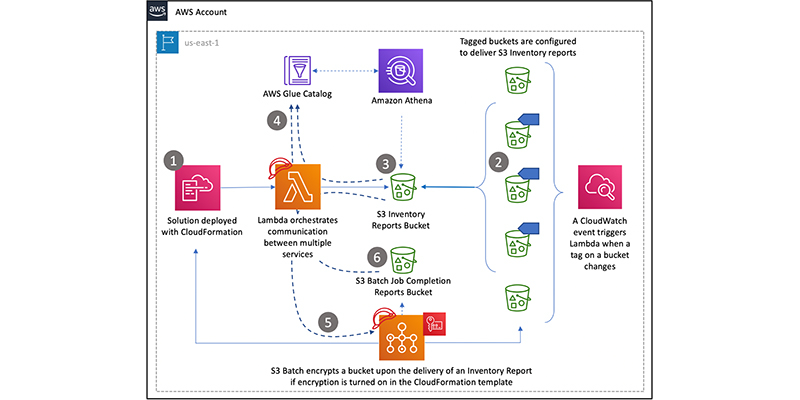
How to retroactively encrypt existing objects in Amazon S3 using S3 Inventory, Amazon Athena, and S3 Batch Operations
November 1, 2021: AWS KMS is replacing the term customer master key (CMK) with AWS KMS key and KMS key. The concept has not changed. To prevent breaking changes, AWS KMS is keeping some variations of this term. More info. Amazon Simple Storage Service (S3) is an object storage service that offers industry-leading scalability, performance, […]