AWS Security Blog
Category: Technical How-to
How to detect security issues in Amazon EKS clusters using Amazon GuardDuty – Part 1
In this two-part blog post, we’ll discuss how to detect and investigate security issues in an Amazon Elastic Kubernetes Service (Amazon EKS) cluster with Amazon GuardDuty and Amazon Detective. Amazon Elastic Kubernetes Service (Amazon EKS) is a managed service that you can use to run and scale container workloads by using Kubernetes in the AWS […]
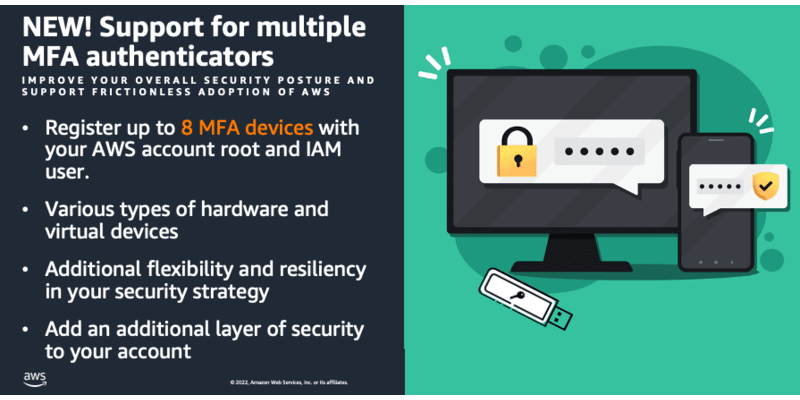
You can now assign multiple MFA devices in IAM
November 17, 2025: The MFA Security Key program, which provided eligible customers with free MFA devices, has been discontinued effective November 6th, 2025. While existing devices will continue to function normally, no new orders for MFA security keys will be accepted after the program closure date. At Amazon Web Services (AWS), security is our top […]

Detect and block advanced bot traffic
Automated scripts, known as bots, can generate significant volumes of traffic to your mobile applications, websites, and APIs. Targeted bots take this a step further by targeting website content, such as product availability or pricing. Traffic from targeted bots can result in a poor user experience by competing against legitimate user traffic for website access […]

How to evaluate and use ECDSA certificates in AWS Certificate Manager
AWS Certificate Manager (ACM) is a managed service that enables you to provision, manage, and deploy public and private SSL/TLS certificates that you can use to securely encrypt network traffic. You can now use ACM to request Elliptic Curve Digital Signature Algorithm (ECDSA) certificates and associate the certificates with AWS services like Application Load Balancer (ALB) […]

Use Amazon Inspector to manage your build and deploy pipelines for containerized applications
Amazon Inspector is an automated vulnerability management service that continually scans Amazon Web Services (AWS) workloads for software vulnerabilities and unintended network exposure. Amazon Inspector currently supports vulnerability reporting for Amazon Elastic Compute Cloud (Amazon EC2) instances and container images stored in Amazon Elastic Container Registry (Amazon ECR). With the emergence of Docker in 2013, […]
How to control non-HTTP and non-HTTPS traffic to a DNS domain with AWS Network Firewall and AWS Lambda
December 7, 2022: We added a caveat to the solution, for those using a traffic steering mechanism, in this post. Security and network administrators can control outbound access from a virtual private cloud (VPC) to specific destinations by using a service like AWS Network Firewall. You can use stateful rule groups to control outbound access […]

Export historical Security Hub findings to an S3 bucket to enable complex analytics
AWS Security Hub is a cloud security posture management service that you can use to perform security best practice checks, aggregate alerts, and automate remediation. Security Hub has out-of-the-box integrations with many AWS services and over 60 partner products. Security Hub centralizes findings across your AWS accounts and supported AWS Regions into a single delegated […]

Use IAM Access Analyzer policy generation to grant fine-grained permissions for your AWS CloudFormation service roles
AWS Identity and Access Management (IAM) Access Analyzer provides tools to simplify permissions management by making it simpler for you to set, verify, and refine permissions. One such tool is IAM Access Analyzer policy generation, which creates fine-grained policies based on your AWS CloudTrail access activity—for example, the actions you use with Amazon Elastic Compute […]

IAM Access Analyzer makes it simpler to author and validate role trust policies
AWS Identity and Access Management (IAM) Access Analyzer provides many tools to help you set, verify, and refine permissions. One part of IAM Access Analyzer—policy validation—helps you author secure and functional policies that grant the intended permissions. Now, I’m excited to announce that AWS has updated the IAM console experience for role trust policies to […]

Use AWS Network Firewall to filter outbound HTTPS traffic from applications hosted on Amazon EKS and collect hostnames provided by SNI
October 13, 2022: This post had been updated with diagram of Figure 1: Outbound internet access through Network Firewall from Amazon EKS worker nodes modified. This blog post shows how to set up an Amazon Elastic Kubernetes Service (Amazon EKS) cluster such that the applications hosted on the cluster can have their outbound internet access […]