AWS Skilling and Social Impact
From savanna to reef: How AI helps create science lessons rooted in a child’s own world
This post is by Miriam Chickering, CEO of The Frank Foundation, which delivers free health and STEM education to 600,000+ learners worldwide via AWS-powered platforms. It’s the first post in a blog series by our Now Go Build CTO Fellows, a cohort of inspiring tech leaders led by Dr. Werner Vogels, VP and CTO at Amazon, who are building social impact solutions that support underserved populations worldwide.
 Across the world, hundreds of millions of children attend school without mastering foundational skills. Many cannot read simple passages or do basic arithmetic, let alone reason through science. One fixable reason is that textbooks and other learning materials were made for somewhere else. The language is not quite theirs. The examples and pictures show a world they have never seen.
A child in the tropical Comoros, for example, should not have to learn the water cycle from a lesson built around melting snow. The World Bank and its partners documented the scale of learning poverty in a 2022 report.
Making materials for a specific place is expensive. A full national textbook program may cost a million dollars or more per subject and take years. Smaller language communities and poorer regions are often left without materials made for them.
At The Frank Foundation, we set out to change those economics. Originally, we developed science and mathematics materials country by country using a manually managed, AI-assisted process. Producing materials this way cost roughly $100,000 per country.
I believed we could reduce those costs even further, so I conceptualized the Intelligent Textbook Machine (ITM). Drawing on my experience developing educational programs, I designed its workflows and directed its architecture. Engineers and technical partners built the system, while curriculum specialists, teachers, and subject matter experts developed and reviewed the educational content.
With support and guidance from Amazon Web Services (AWS) and experts at the AWS Social Entrepreneur Accelerator (SEA), the ITM uses Amazon Simple Storage Service (Amazon S3) to store its working materials and AWS Step Functions to coordinate the production stages and human approval points.
The Intelligent Textbook Machine’s process depends on several parts, and only one is AI:
- Curriculum matrix that maps what children should learn and when, and each approved lesson is linked to the objectives it addresses.
- Library that holds those same lessons and source material behind them, so the system can retrieve what a given objective needs.
- Controlled workflow that names the person responsible at every stage.
The last part of the ITM process is whichever off-the-shelf general-purpose model we are using at the time. We first used our original AI-assisted process to create 52 books in two languages for projects in Benin, Cameroon, and the Democratic Republic of the Congo. The process was used again to produce more than 300 lessons in 16 languages, which reached over 100,000 frontline humanitarian responders in one-tenth of the time and budget.
We needed to know who chose the evidence, who understood the local context, and who would take responsibility for a finished lesson. I call this “AI in the Human Loop.” People decide what the lesson needs to do and which sources it can use. The model prepares a draft. People review and approve it before anyone releases it.
It takes more than an AI prompt to produce a textbook
When most people imagine AI writing a science textbook, they picture someone typing “write a fifth-grade lesson on living things” and accepting whatever magically comes back. Reliable outputs depend on tremendous, often unseen human effort.
Long before ITM, our team worked through a country’s curriculum requirements and assembled a set of inputs for every lesson. Only after that preparation did we ask a model to draft anything. Those inputs included:
- Template that fixes the structure every lesson must follow.
- Source material, vetted and specific, open-licensed, public-domain, or otherwise authorized, from which the lesson must be built.
- Prompt that carries the objective, grade level, pedagogy, and guardrails into the model.
- An example, a finished lesson that shows the exact format, depth, and tone to match.
Those inputs sit within a larger structure called the Universal Science Curriculum Matrix. It contains more than 1,600 learning objectives across a few dozen science topics from kindergarten through grade 6. We built it by comparing national curricula from the countries we serve with major international science frameworks, existing textbooks, and open educational resources. It shows when each idea should appear and how it should deepen over time.
When a national curriculum gives little guidance on an objective, the team consults a recognized international source and records the choice. For instance, an objective may draw on standards from Singapore and England, checked against Core Knowledge and Siyavula. Reviewers can then see where the decisions came from.
For each lesson, ITM provides the objective, its place in the progression, and approved source materials. A separate AI agent, which we call the judge, checks the draft against the specified science and teaching requirements. A person then reviews it and decides whether it can proceed. Without that progession, a lesson could sound convincing but leave gaps between one grade and the next.
Approved lessons enter the library that ITM uses for each country. The system prepares the content for retrieval, using embeddings to find sources relevant to a learning objective and moving related lessons through the production process together.
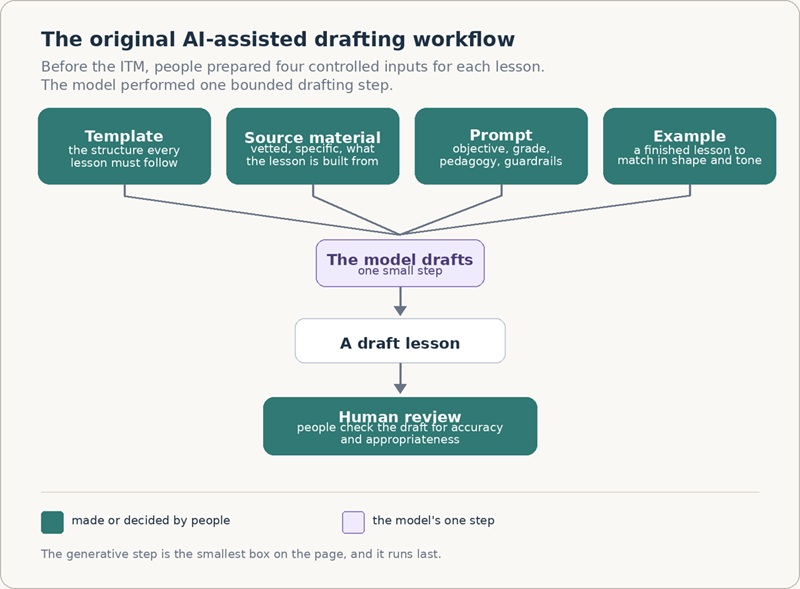
Figure 1 – The original manually managed, AI-assisted drafting workflow. People prepared the inputs before the model produced a draft, which was then reviewed by a person.
ITM now handles much of the matching between learning objectives and approved sources, but it cannot approve its own output.
AI drafts, but it does not decide
Within those limits, AI can draft lessons from approved sources, adjust material for different grades and formats, help with translation, and assemble supporting resources. Automating that work reduces the time spent preparing each lesson.
When we first used this approach in the STEM Teacher/student Education for Primary Schools (STEPS) program, we were cautious about relying on AI-generated drafts. Across the three countries, a human mediator screened drafts, and national experts and teachers reviewed the materials. Teachers then used selected lessons in their classrooms and provided feedback on their accuracy, relevance, and usability. We used that feedback to revise the materials before finalizing them.
The reviewers were practicing teachers, physicians, engineers, and university faculty. Dr. Atanga, a mathematician who contributed to both the science and mathematics work, traveled across Cameroon training teachers. He knew that giving a school textbooks was not enough.
Some of the materials teachers had been given in the past ended up in storage, gathering dust and mold, because teachers lacked the support to use them. Working with the research team, he adapted the training as they learned what teachers needed.
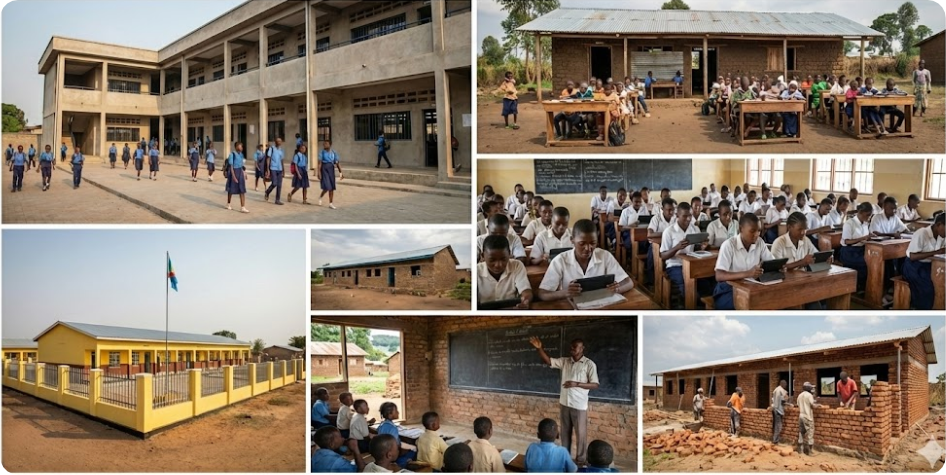
Figure 2 – With the ITM, AI drafts the lessons but teachers still decide what’s classroom-ready.
The materials reached about 160 teachers and more than 6,000 students across 18 schools. In a survey of participating teachers, more than 90 percent reported feeling confident using them, and many felt ready to develop lessons in the same style. Teachers continued using the materials after the funding ended. These figures describe program reach and teacher feedback, not evidence of gains in student achievement.
One teacher in Cameroon said, “For the first time, I feel equipped to teach science in a way that makes students curious instead of confused.” The textbooks are available on the STEPS Science Curriculum page, and you can explore more insights on scaling STEM education in Africa.
Built so the machine cannot pretend
A language model asked to cover 100 learning objectives may return 100 lessons even when the source library cannot support them all. The list looks complete, but some of the lessons would be built on weak evidence.
We designed ITM to flag objectives without enough approved source material. Someone has to resolve the gap before the lesson continues. The reviewer might add a source, change the objective, commission new material, or decide not to produce the lesson. Our design notes describe a system that silently matches every objective to the nearest source, however weak, as “silent and corrosive.”
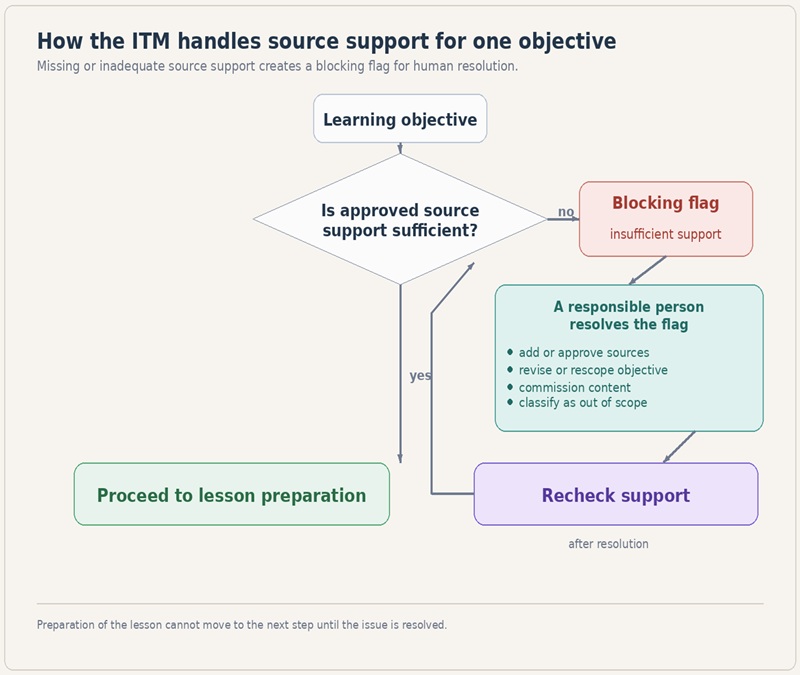
Figure 3 – How ITM handles insufficient source support. A blocking flag must be resolved by a person before preparation of the lesson can continue.
What “localized” actually means
“Localized” is one of those words worn smooth from overuse. It often means translating the text and changing Tom to Toihiri. Real localization begins with a contextualization record built by people who know the place, people, flora, fauna, and culture, and it rests on published evidence rather than recollection.
The Ministry of Education defines the requirements that shape it, and for the Comoros the record spans dozens of fields. It knows that “the rainy season” is not enough for children who live by Kashkazi, the hot wet monsoon, and Kusi, the cool dry one. It insists on those names because those are the words the weather actually has there. It knows the islands are not interchangeable.
Ngazidja has no permanent rivers because rain sinks into porous volcanic rock, and people rely on rainwater cisterns and springs. Anjouan and Mohéli have seasonal streams and standing surface water. A cheerful water-cycle diagram with a babbling brook may be plausible on Anjouan or Mohéli, but it would be science fiction on Ngazidja.
The contextualization record also knows the staples are cassava, rice, and breadfruit; that the economy smells of ylang-ylang, cloves, and vanilla; that Livingstone’s flying fox roosts in the forests of Anjouan and Mohéli and lives nowhere else on earth; and that the coelacanth, once thought extinct, became a national icon after a second living specimen was found in Comorian waters in 1952.
The record is equally specific about what to leave out. It flags the entire safari’s worth of animals that crowd into generic “African” textbooks but do not belong to the local environment, among them lions, elephants, and giraffes. It notes there are no crocodiles, that bears and squirrels belong to someone else’s ecosystem, and that pork should not be the default example of food or farming in an overwhelmingly Muslim setting.
The record then supplies a food chain that is true to the place. Algae to parrotfish to reef shark, right there on a Comorian coral reef, instead of a savanna food web smuggled in. The local setting changes how a child first encounters the science, even when the scientific concept stays the same.
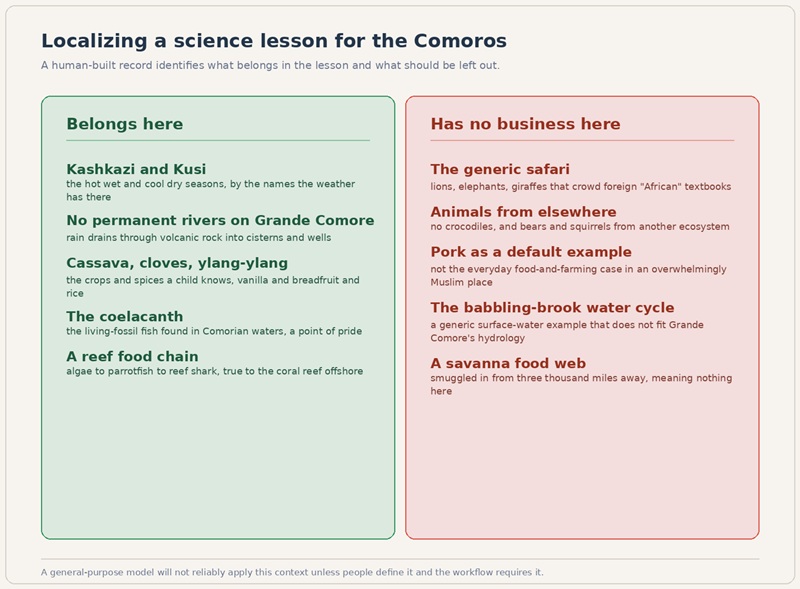
Figure 4 – Localizing a science lesson for the Comoros. What a human-built contextualization record includes and what it excludes.
A general-purpose model will not reliably account for Comorian geography, ecology, culture, and everyday life. For each lesson, ITM pulls the relevant local facts from the contextualization record. The judge and a human reviewer then check whether the draft uses them correctly.
Because the record is a human-made asset that local partners can audit, it survives any change of model or vendor. The knowledge of the islands remains theirs.
The workflow is the real asset
We can replace a model without losing the curriculum matrix, approved sources, local records, review history, or completed lessons. Those took years to assemble.
Most of the effort went into the work around the model:
- Spine: An agreed structure of what is correct and in what order. Ours is a curriculum matrix; in another field it might be a set of clinical protocols, body of regulation, or technical standard.
- Source library: Vetted material every output must be built from. Ours holds more than 1,100 approved lessons.
- Contextual record: What is true about the place or population the work is for. Ours drew on requirements from education authorities in participating countries and published research, which the team synthesized into localization spreadsheets.
- Review capacity: The project needs qualified people who can approve the content. Finding and supporting the right reviewers takes time and funding.
- Upkeep: Sources need to be checked and updated, and that work needs a budget.
STEPS used several models over the course of the project, and ITM currently uses two.
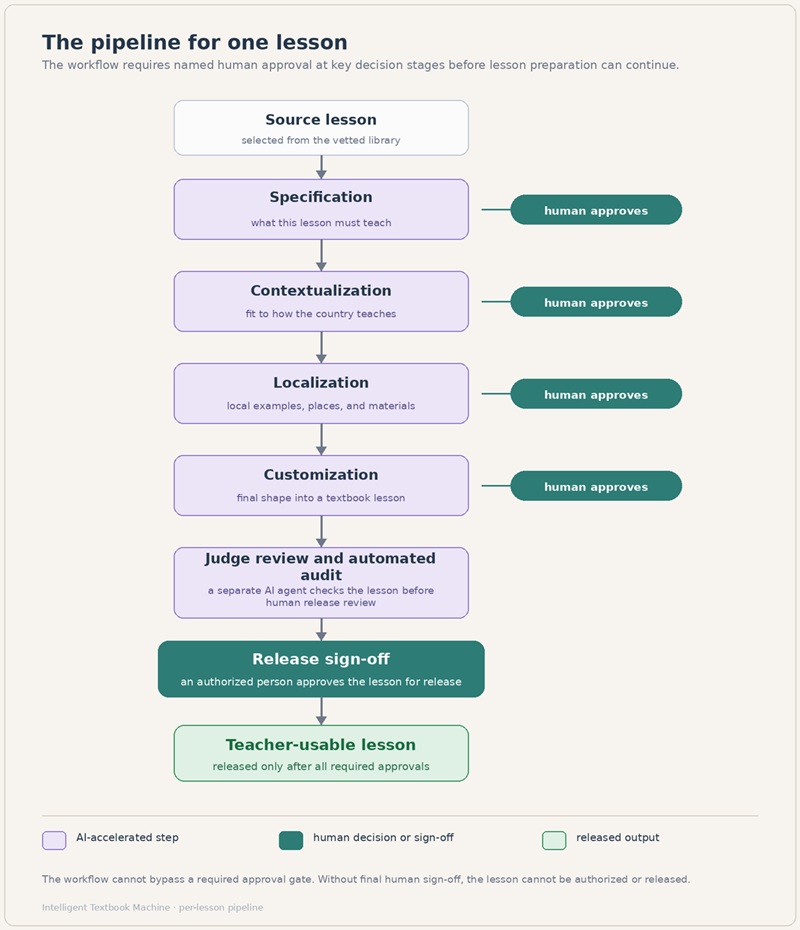
Figure 5 – The pipeline for one lesson. Named human approval is required at key decision stages, and final human sign-off is required before release.
Where else could this work?
This approach works best where experts can agree on the sources, map a sequence of learning, and review each output. Foundational health and hygiene may fit. Basic literacy may also fit, although each language and writing system needs its own learning sequence and reviewers.
History and civics are different. Their disagreements are part of the subject, not missing facts for a model to fill in. Law and emerging technology create another problem: approved sources can become outdated quickly. Anyone adopting this process needs to decide who has the authority to approve content and who will pay to keep it current.
Even a well-stocked source library can tell only one side of a disputed story. A gap check finds missing sources; it cannot tell us whether the collection leaves out a competing account. That needs human judgment and an open record of the choice.
Why demystifying it is the whole point
A prompt can produce a fluent lesson in seconds. It cannot tell us whether the sources are appropriate, whether the example fits the place, or who will take responsibility for errors. Those decisions happen before and after drafting, with teachers, curriculum specialists, reviewers, and local partners doing the work.
Science textbooks teach children about the subject matter and about whose world counts and where science happens. When a child in the Comoros opens a lesson and finds the reef, Kashkazi and Kusi, and a flying fox that lives nowhere else on earth, they will learn that their world is part of science and that the scientific community is open to them, too.
Acknowledgments: Development of the curriculum library has been supported by the Global Partnership for Education and Canada’s International Development Research Centre. AWS social impact credits and an AWS Partner-funded proof of concept with RevStar supported the work to automate appropriate parts of the process.
.

Miriam Chickering
Miriam leads the Ulrich and Ruth Frank Foundation for International Health and its flagship initiative, NextGenU.org, whose mission is to make quality education a global public good. She is also the Founder and President of Nurses International, an open-access nursing education nonprofit that supports the development and dissemination of high-quality nursing education resources globally. Miriam joined the Now Go Build CTO Fellowship in 2025.
.