AWS Skilling and Social Impact
The 83% problem: Why clinical trials fail the Global South and how we can close the equity gap
 Over a seven-year period, the majority (83 percent) of more than 780,000 clinical trials sites concentrated in just 25 high-income countries. Only five percent were in the 91 lower-middle and low-income nations where much of the global disease burden falls.
The reality is this: therapies that become standard of care across the world are overwhelmingly tested in higher-income settings. While trials may account for ethnic factors, they rarely reflect the disease burdens and care contexts of the populations in other settings.
This imbalance is not new; what’s changed is that disruptive technologies have introduced a convergence of forces that could finally shift the center of gravity for clinical trials. This includes digital health infrastructure reaching new geographies; regulatory frameworks built for cross-border evidence; and AI and cloud technology that can accelerate trial design, patient matching, and analysis for a generation of researchers building capacity where it hasn’t existed before.
By uniting these efforts, patients, communities, product developers, clinical trialists, and regulators should be able to get innovative, safe, and effective medicines to people faster, thus increasing access and reducing inequity.
At the World Health Summit 2026 in Berlin, Amazon Web Services (AWS) brought together leaders working across this spectrum to explore why clinical trials still fail the Global South, home to much of the world’s disease burden, and examine the problem from complementary angles. These experts described progress that is real but incomplete. Each is solving one part of the problem but none claims the hard work is done.
What makes this moment different is that researchers and institutions are now equipped to act and have started building real solutions: Hospital Sírio-Libanês and PATH on the research and policy side; BIO Ventures for Global Health across Sub-Saharan Africa; Konvergenz Network Solutions on Kenya’s national health-data backbone; and the European Medicines Agency on a regulatory system being reshaped to receive evidence from everywhere.
Still, progress is not the same as arrival. Many of the barriers that slow clinical trials, such as lengthy startup timelines, fragmented regulatory systems, and gaps in the trained workforce, are challenges that technology alone cannot resolve. They call for institutional commitment, policy alignment, and long-term investment in people.
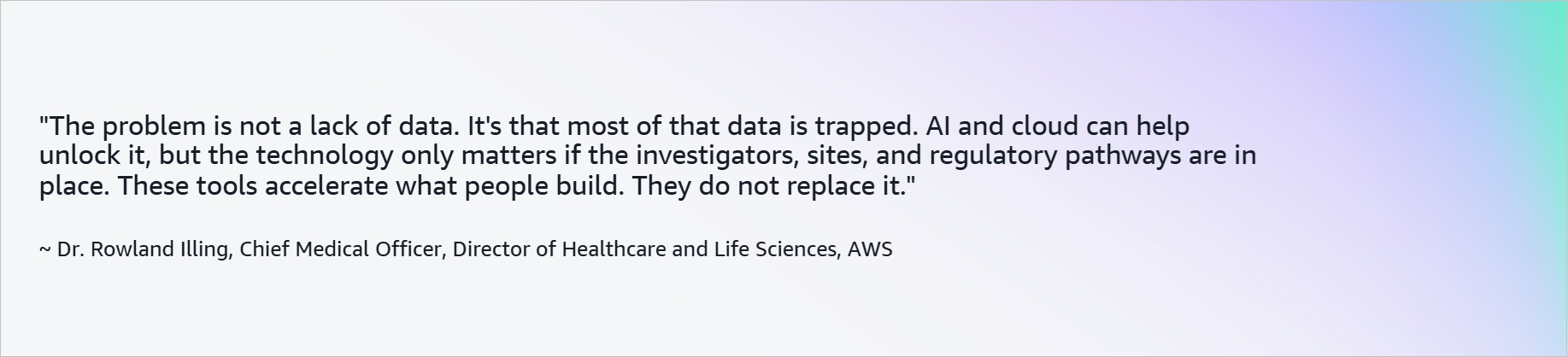
Where that groundwork exists, AWS AI and cloud technology can accelerate what comes next — unlocking trapped data, reaching dispersed patients, and connecting fragmented systems across borders. Together, a new generation of leaders isn’t waiting for the rest of the system to catch up. They are already rebuilding it one barrier at a time, starting with the structures that have held the old system in place.
The challenge no one has fixed
Professor Sir Jeremy Farrar has spent more than three decades at the intersection of global health research and policy, shaping global responses to malaria, tuberculosis, dengue, Ebola, Zika, COVID-19, and non-communicable diseases. He now leads the Asia, Europe, and Middle East regional division for PATH, an international global health nonprofit that develops medical technologies for low-resource settings, and continues his push for systemic reform.
Sir Jeremy traces the problem not to patients or researchers, but to institutions. Clinical trial site networks lack permanent support, and the organizations that set research priorities haven’t built governance structures to sustain them.
Too often, clinical trials are built from scratch for a single project instead of running on permanent platforms that support many trials over time. This stop-start approach adds complexity, delays access to medicines, and erodes trust. The examples are numerous: the average time from a trial concept to the first patient being recruited is 611 days; regulatory and ethics review processes in many countries take over a year; and site selection defaults to familiar institutions in familiar geographies. The result is a system optimized for convenience instead of the populations carrying the greatest disease burden.
“We have spent decades acknowledging this problem,” said Sir Jeremy. “The question is no longer whether the system is broken, but whether we have the institutional courage to redesign it. The barriers are not technical. They are structural, and they are choices we continue to make when we design protocols, select sites, build and sustain networks, and exclude regions from the evidence base.”
The WHO Global Action Plan for Clinical Trial Ecosystem Strengthening (GAP-CTS) was published by the World Health Organization (WHO) in April 2025 while Sir Jeremy was Assistant Director-General and Chief Scientist at WHO. It provides the most comprehensive framework to date for addressing these barriers. It identifies nine priority actions, including national governance, workforce training, innovative trial designs, and regulatory efficiency. But Sir Jeremy reminds us that frameworks require execution, and execution requires confronting the real barriers and incentive structures that have protected the status quo.
The gap between protocol and patient
The global statistics tell one story, but the country trying to close the equity gap tells another. Although Brazil ranks fourth in the world in patient availability for clinical trials, its participation in global trials persists at just two percent. That gap is primarily structural, with the system itself standing between patients and trials.
In Brazil, 75 percent of the population relies exclusively on SUS (Sistema Único de Saúde), the public health system which averages only two physicians for every 1,000 people, unevenly distributed, with panels of up to 3,000 people per primary care team. This leaves little time to screen patients for trial eligibility, much less educating patients on the value of participation. Specific to oncology trials, SUS offers minimal molecular testing for precision oncology.
Dr. Anamaria Aranha Camargo has spent more than 15 years building the research ecosystem at Hospital Sirio-Libanes in São Paulo. Her team’s response to these challenges is BRIDGE (Brazilian Referral Initiative for Data-driven Genomic Enrollment), a clinical trial referral network supported by Memorial Sloan Kettering Cancer Center and leading pharmaceutical companies.
Screening began in July 2026 with a simple process: a BRIDGE nurse navigator collects clinical data and a blood sample. They send samples to a central hub at Hospital Sírio-Libanês for sequencing and matching against national open trials. This approach provides a working model for transforming patient availability into actual participation from a large, genetically diverse population that will inform global medicine. The next phase involves the use of AI to automate patient matching.
“You cannot close an access gap with a protocol alone. You must remove the barriers that lie between an overloaded public system and the clinical trials that benefit patients,” said Dr. Camargo, Research Superintendent, Hospital Sírio-Libanês. “That’s what BRIDGE is: infrastructure for trust, testing, and access.”
Building trial capacity where it never existed
Although Africa bears approximately 25 percent of the global disease burden, only two percent of clinical trials worldwide operate in Africa. The barriers are operational: missing national cancer policies, inadequate infrastructure, shortages of trained investigators and coordinators, and financial toxicity that prevents patients from reaching trial sites.
Jennifer Dent leads the response from BIO Ventures for Global Health (BVGH) to these challenges through the African Access Initiative and the African Consortium for Cancer Clinical Trials. These programs work with pharmaceutical companies, ministries of health, and African oncologists to train investigators, strengthen sites, and build the conditions for clinical research to operate where it has never been systematically supported.
BVGH also co-established the Clinical Trials Community Africa Network (CTCAN), a platform designed to support and evaluate clinical trial capabilities. CTCAN hopes to develop a self-sustaining research ecosystem where African institutions lead their own trials and set their own priorities.
“You cannot run a clinical trial without the required infrastructure, principal investigator, prepared research team, and patients who can participate in the study. In much of Sub-Saharan Africa, these foundations are still taking shape,” said Dent, President and CEO, BVGH. “Technology has the potential to rapidly transform the clinical research landscape and possibilities in Africa, but people come first.”
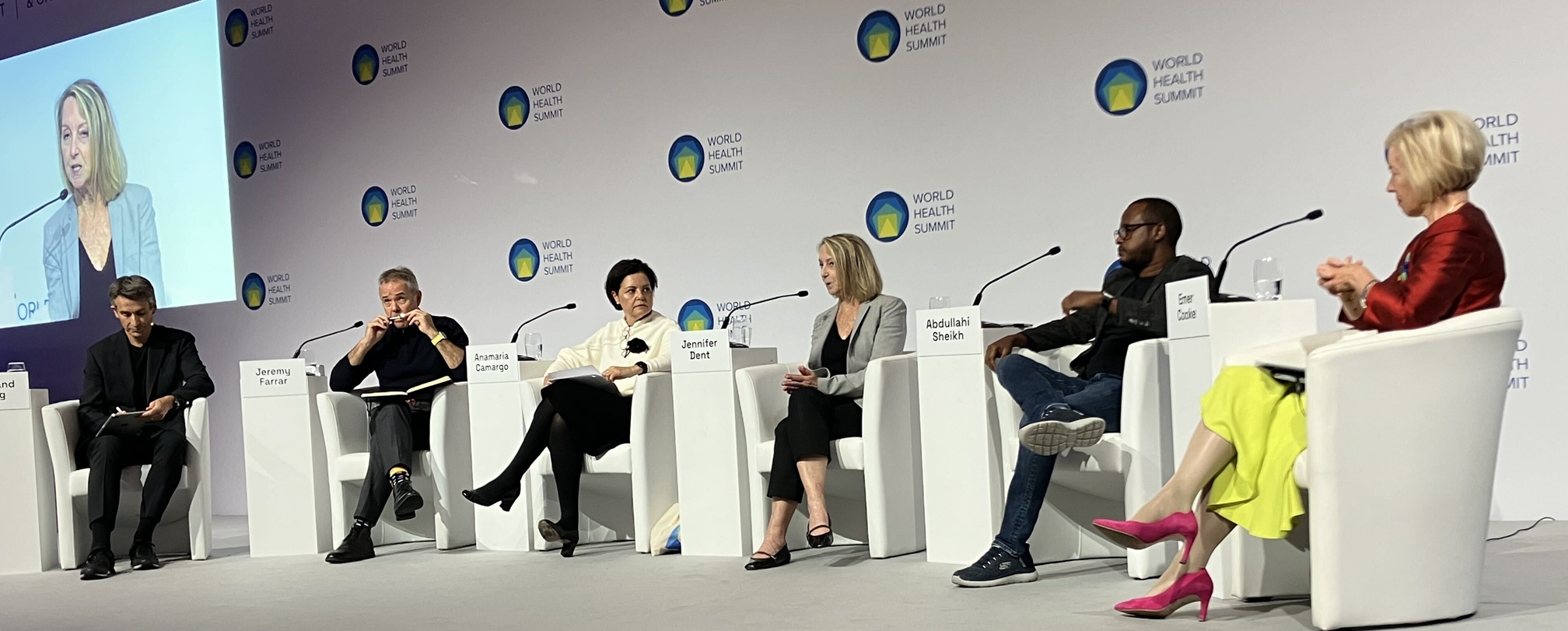
Panelists at the World Health Summit 2026 in Berlin join Dr. Rowland Illing, left, to discuss why clinical trials still fail the Global South and chart a path forward. The frameworks and tools exist; what’s needed now is institutional commitment and collaborative action.
The digital backbone to support clinical research
Clinical trials depend on data infrastructure that simply has not existed in most of the Global South: patient registries, electronic health records, health information exchanges, and interoperability standards. Without them, even well-funded studies face enrollment bottlenecks and data-quality gaps. With them, we can improve access to clinical trials and drive improved health outcomes, health equity, and economic opportunity.
Abdullahi Sheikh leads Konvergenz Network Solutions, part of the consortium that was awarded Kenya’s national Integrated Healthcare Information Technology System (IHTS) contract. IHTS is a 10-year, approximately $812 million initiative to digitize the country’s health facilities and establish a unified interoperability infrastructure. By connecting hospitals, clinics, practitioners, and community health workers through a single digital platform, IHTS will create the health data backbone needed to support clinical research.
Dubbed the Kenya Digital Health Superhighway, IHTS will provide a comprehensive view of an individual’s health journey. Today, patients can share their blood type and location and opt in to be contacted for blood donations when their blood type is running low at a facility near them. The functionality of this IHTS consent manager could, in the future, allow patients to receive information when they match clinical trial eligibility criteria. Government-endorsed and publicly governed, IHTS reflects a deliberate commitment to health data sovereignty, ensuring that national digital health infrastructure serves the needs of patients and providers.
“The question of who owns, governs, and benefits from health data is crucial. Sustainable, client-centric digital health infrastructure is only possible if the government owns and governs the architecture,” said Sheikh, CEO, Konvergenz Network Solutions. “Data must belong to the patient, and be protected and used with the patient’s explicit consent. Data sovereignty is not a political statement; it is a design principle. Without it, the infrastructure serves the builder, not the population.”
For clinical trials, the implications are direct. A country with a functioning health information exchange can identify eligible patient populations faster, track outcomes more reliably, and generate the kind of real-world evidence that regulators increasingly value. Sheikh’s work represents the infrastructure layer that connects the capacity Dent is building at BVGH to the evolving regulatory frameworks.
Can regulation keep pace?
Progress in clinical trial capacity and digital infrastructure only improves medicines when regulators can use the resulting evidence across borders. For Emer Cooke, Executive Director of the European Medicines Agency (EMA), the central challenge is ensuring that regulators can use high-quality clinical trial data generated around the world.
Confidence in global evidence begins with shared ethical and scientific standards. Working through the International Council for Harmonisation, regulators modernized Good Clinical Practice to accommodate decentralized trials, digital technologies, and real-world data. EMA also works with international partners on inspections and data integrity so that evidence generated from different settings is robust enough for regulatory decisions.
Cooperation must begin before a trial starts. Through scientific advice and collaboration with the WHO and regulators in the countries where medicines will be used, EMA aligns evidence requirements early so trial designs reflect local disease burdens, public health needs, and the populations most affected. The Accelerating Clinical Trials in the EU (ACT EU) initiative is a collaboration with the European Commission and the Heads of Medicines Agencies; it further promotes harmonized standards, innovative trial designs, and more efficient study delivery.
This cooperation can turn regulatory science into access. Through EU-Medicines for all (EU-M4all), EMA works with WHO and regulators from target countries to support medicines for public health needs beyond the EU. Nineteen products targeting 108 countries have gone through this procedure, covering areas including HIV, malaria, tuberculosis, vaccines, insulin, and reproductive health. In 2025, eight national regulatory authorities joined WHO experts in the assessment of lenacapavir, a breakthrough long-acting HIV medication.
EMA’s OPEN framework was established in 2020 and extends this by allowing regulators from Australia, Brazil, Canada, Japan, and Switzerland, along with the WHO, to run near-concurrent reviews of certain new medicines and exchange their views and reports on the product assessments. What began as a response to COVID-19 vaccines and therapeutics now covers other types of medicine, strengthening regulatory capacity across jurisdictions.
Collaboration matters most in emergencies. EMA’s Emergency Task Force is working with the African Medicines Agency, African national regulators, and the WHO-hosted African Vaccines Regulatory Forum on trial designs and regulatory requirements for vaccines against the Bundibugyo Ebola virus. This early engagement will support rapid regulatory decisions without sacrificing scientific rigor.
Emer Cooke summarized the goal: “Clinical trial and regulatory capacity need to grow together so that globally generated evidence can support sound decisions and benefit the communities whose health needs it is intended to address. Regulators must help shape that evidence through common standards, early dialogue, and shared expertise.”
AWS technology as an enabler
Each challenge, from the 611-day trial startup to fragmented health records and cross-border regulatory gaps, is compounded by the same underlying constraint: the tools and infrastructure needed to run modern clinical trials have historically been available only to well-resourced institutions in high-income countries. AI and cloud technology are changing that equation.
Scalable compute and storage now allow research sites in low- and middle-income countries to participate in data-intensive work that was previously out of reach. Research environments on AWS enable genomic studies across large, diverse ancestry populations, and when datasets expand beyond European and Asian cohorts, clinically significant variants emerge that would otherwise be missed.
In one cross-cohort analysis of the All of Us and UK Biobank datasets, roughly 20 percent of uniquely significant variants were most prevalent in non-European, non-Asian ancestry individuals, a finding that only became visible when cloud-based research environments made federated analysis across populations possible. Meanwhile, AI-based data transformation is speeding access to standardized clinical data, and cloud-based repositories that harmonize multimodal records into interoperable formats are helping researchers identify rare disease patients across fragmented health systems, match them to trials, and analyze multimodal data. This would be impossible to assemble without scalable infrastructure.
The perspectives of these leaders we convened at the World Health Summit 2026 trace a complete circuit: structural diagnosis, ground-level evidence, human infrastructure, national-scale digital systems, and regulatory modernization. The common thread is that the problem is no longer one of awareness. What remains is execution.
The frameworks exist, the evidence is in, and the tools are increasingly available. The question is whether the institutions, funders, regulators, and researchers who shape clinical trial ecosystems will choose to act collaboratively and with the urgency the health inequities demand.
Learn more about:
- AWS healthcare and life sciences services, including health AI services
- From lab to bedside: Five years of AI-powered health breakthroughs at AWS
- AWS social impact
.

Dr. Rowland Illing
Dr. Rowland Illing serves as Chief Medical Officer and Director of Healthcare and Life Sciences, AWS. He oversees strategy and engagement for healthcare customers worldwide, encompassing providers, payors, and health technology companies. His work centers on leveraging AI and cloud to drive innovation in health equity and sustainability, while enabling healthcare organizations to optimize their data utilization for improved efficiency and patient outcomes.
.