AWS Physical AI Blog
Physical AI in Healthcare: Redefining Care Delivery at the Edge
From Hospital Walls to the Home — A New Era of Intelligent Care
Healthcare has long been defined by a fundamental constraint: the best care requires physical presence — patients travel to hospitals, clinicians are bound to facilities, and monitoring depends on proximity. But what if AWS-powered intelligence could follow the patient — anywhere, anytime?
That is the promise of Physical AI in healthcare — and at Mobile World Congress 2026, AWS, NVIDIA, and partner AI-SENSE demonstrated that this promise is now a reality.
What Is Physical AI?
Physical AI refers to the convergence of artificial intelligence with the physical world — where AI systems don’t just process data, but perceive, reason, and act within real environments. In healthcare, this means AI-powered systems that monitor patients in their homes, coordinate care proactively within established clinical guidelines, and adapt in real time to changing clinical conditions. In all cases, Physical AI systems operate within clinician-defined care protocols, augmenting — not replacing — clinical judgment.
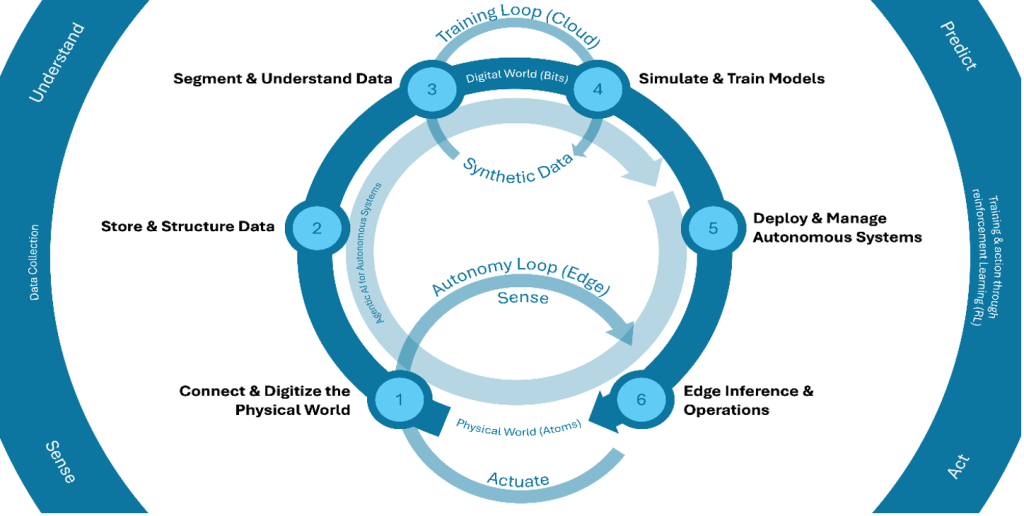
Figure 1: Diagram showing the Physical AI continuous learning loop with the training loop, autonomy loop, and 6 key capabilities identified.
Three foundational pillars enable Physical AI in healthcare:
- AI-native Network connectivity — ultra-low latency, high-bandwidth networks that make real-time edge inference possible
- Agentic AI — intelligent AI agents capable of closed-loop decision-making, reducing manual clinical overhead while operating within defined care protocols
- Digital Twin simulation — high-fidelity virtual environments where care protocols are validated before real-world deployment
Together, these pillars form the backbone of a new model of care delivery.
The Healthcare Use Cases: Virtual Ward and Health Buddy
AI-SENSE, in collaboration with AWS, built the Healthcare applications that power the two flagship use cases demonstrated at MWC 2026 — combining Agentic Network Framework built with AWS’s cloud-scale AI infrastructure, Amazon Bedrock, and the Large Language Model (LLM) to deliver production-ready, intelligent care solutions.
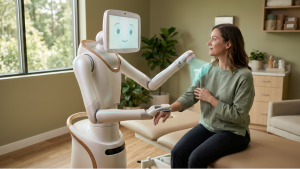
Figure 2: Imagining delivered AI-powered care in a home environment
Virtual Ward — Hospital-Level Care at Home
The Virtual Ward brings the monitoring capabilities of a hospital ward directly into the patient’s home. Through a network of intelligent sensors, wearables, and connected devices, patients receive continuous vitals tracking — heart rate, oxygen saturation, blood pressure, respiratory rate — with the same clinical rigor as an in-patient setting.
What makes Virtual Ward transformative is not just the data collection — it is the intelligence layer on top of it. Powered by Agentic AI, the system:
- Continuously analyzes patient vitals against personalized clinical baselines
- Generates proactive care recommendations for both patients and clinicians
- Executes closed-loop actions within clinician-defined protocols — adjusting environmental controls, alerting care teams, or escalating to emergency services — in real time and under continuous clinical oversight
- Adapts the physical environment through robotic doors, robotic beds, and smart home integrations, creating a care-optimized living space
The result: patients receive hospital-quality care in the comfort of their homes, while clinical teams are freed to focus on the cases that truly require their presence.
Health Buddy — Your AI-Powered Virtual Nurse
Health Buddy acts as a home-based virtual nurse — always present, always attentive, and always connected to the broader care ecosystem. Built by AI-SENSE on AWS, Health Buddy leverages a healthcare-customized LLM developed using Amazon Bedrock and fine-tuned with Amazon SageMaker:
- Engage patients in natural, conversational interactions to assess symptoms and wellbeing
- Connect to patient history, care plans, and sensor networks for contextually aware guidance
- Guide patients through daily care activities — medication adherence, physiotherapy exercises, dietary recommendations
- Escalate to healthcare professionals in real time when clinical thresholds are crossed
Health Buddy is particularly impactful for patients with chronic conditions, post-surgical recovery needs, or cognitive challenges such as dementia — where consistent, compassionate, and intelligent support makes a measurable difference in outcomes.

Figure 3: Imagining the Intelligent AI driven personalized healthcare of the future
The Intelligence Engine: Agentic Application Maturity Flywheel
Underpinning both Virtual Ward and Health Buddy is the Agentic Application Maturity Flywheel — a continuous improvement framework that ensures the system learns, adapts, and improves with every patient interaction.
The flywheel operates in five stages:
- Train — Healthcare-customized LLMs are co-built on AWS, incorporating clinical knowledge, patient population data, and care pathway intelligence — giving the system a deep understanding of real-world care scenarios from day one.
- Simulate — Before any solution is deployed in a real home, it is validated across patient scenarios in a high-fidelity digital twin environment. From dementia care routines to post-surgical recovery pathways, every edge case is tested virtually first.
- Deploy — Validated Agentic Applications are deployed at the edge with sub-10ms inference latency — ensuring time-sensitive alerts and clinician-approved care actions are delivered in real time, wherever the patient is.
- Iterate — Real-world performance data flows back into the system, identifying gaps, anomalies, and improvement opportunities across the patient population.
- Retrain — Models are continuously refined, incorporating new clinical evidence, patient feedback, and operational learnings — driving 10–30%+ performance improvements per cycle.
This flywheel transforms healthcare AI from a static deployment into a living, learning system — one that gets better the more it is used.
AWS Solution Architecture
This architecture enables real-time clinical decision-making while maintaining data security and compliance.
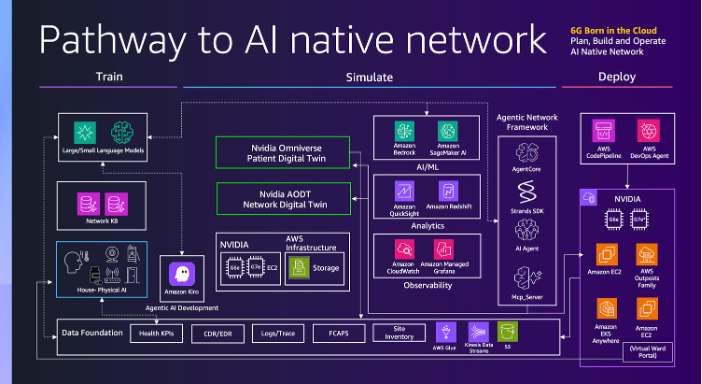
Figure 4: AWS Solution Architecture
In the cloud, healthcare-customized Large and Small Language Models are developed using Amazon Bedrock and Amazon SageMaker, alongside a Network Knowledge Base that encodes clinical protocols and care pathway intelligence. Agentic AI development is orchestrated through Amazon Kiro, producing the intelligent models that power Virtual Ward and Health Buddy.
In the simulation layer, every care scenario is validated in NVIDIA Omniverse — a high-fidelity digital twin environment — running on AWS GPU infrastructure (G6e, G7e EC2 instances). Analytics and observability services including Amazon QuickSight, Amazon Redshift, Amazon CloudWatch, and Amazon Managed Grafana provide continuous insight throughout the simulation process, ensuring models are production-ready before they ever reach a patient.
At the edge, the Agentic Network Framework — powered by Amazon Bedrock AgentCore and Strands SDK — is deployed via AWS Outposts and Amazon EKS Anywhere, delivering sub-10ms inference latency directly at the point of care. AWS CodePipeline and the AWS DevOps Agent orchestrate continuous deployment, enabling the system to evolve without disruption.
Underpinning all three layers is a unified data foundation — Health KPIs, telemetry traces, logs, and CDR/EDR records — integrated through AWS Glue, ensuring every patient interaction feeds back into the next training cycle.
The Role of AI-SENSE: Building Healthcare Applications
AI-SENSE built the Healthcare applications — Virtual Ward and Health Buddy — in close collaboration with AWS, combining AI-SENSE’s Agentic Network Framework with AWS’s foundational AI services. The Agentic Network Framework provides the intelligence fabric that orchestrates the flow of data, decisions, and actions across the care ecosystem — from patient sensors to clinical systems to edge infrastructure — ensuring that every component operates as a unified, intelligent whole.
This partnership exemplifies the collaborative model at the heart of Physical AI: AWS providing the cloud-scale AI foundation and LLM framework, NVIDIA providing the simulation and GPU compute layer, and AI-SENSE providing the agentic orchestration intelligence and application development.
Why AI Native Network is the Foundation
Physical AI in healthcare is not possible without the connectivity infrastructure to support it. AI Native Network is the next-generation connectivity layer — powered by ML and AI agents that continuously self-optimize and evolve the network — enabling real-time intelligence from cloud to edge to patient. It provides:
- Ultra-low latency — sub-10ms response times enabling real-time clinical interventions
- High reliability — carrier-grade connectivity ensuring continuous monitoring without gaps
- Edge AI integration — distributed intelligence that processes data at the point of care, reducing dependency on centralized cloud infrastructure
- Massive device density — supporting the full ecosystem of sensors, wearables, and robotic devices in a patient’s home
Looking ahead, 6G will serve as the foundational “AI Fabric” — transforming wireless networks from passive communication pipes into active, intelligent nervous systems for Physical AI. The 6G vision centers on the Agent-Model-Tools-Environment pattern, where intelligent agents operate through Sense → Understand → Reason → Act → Learn loops, enabling networks to self-optimize across the device-edge-cloud-space continuum.
To validate these next-generation network designs, NVIDIA Aerial Omniverse Digital Twin (AODT) creates physics-compliant virtual environments that test 6G implementations across thousands of scenarios in parallel — compressing validation timelines from months to days through high-fidelity ray tracing and propagation modeling.
As demonstrated at MWC 2026: Pathway to AI Native Networks – Born in the cloud. Designed in the cloud. Continuously evolved through cloud-scale intelligence.
Real-World Impact: What This Means for Healthcare
The implications of Physical AI in healthcare extend far beyond technological innovation:
- Reduced hospital burden — Virtual Ward enables earlier discharge and prevents unnecessary admissions, freeing hospital capacity for acute care
- Improved patient outcomes — Continuous monitoring and proactive intervention catch deterioration earlier, reducing adverse events
- Expanded access to care — Hospital-quality monitoring becomes available to patients in rural, underserved, or mobility-limited settings
- Empowered clinical teams — Clinicians receive AI-curated insights rather than raw data streams, enabling faster, more confident decision-making
- Lower cost of care — Home-based monitoring at scale is significantly more cost-effective than in-patient care for appropriate patient populations
Looking Ahead
The MWC 2026 demonstration was not a proof of concept. It was a proof of production — a live demonstration of Physical AI healthcare use cases, built by AI-SENSE with AWS, running on real infrastructure, with real Agentic AI, validated in NVIDIA Omniverse, and powered by AI-native Network.
In this post, you learned how Physical AI combines AI-native networks, Agentic AI, and digital twin simulation to deliver hospital-quality care in home environments. The Virtual Ward and Health Buddy use cases demonstrate production-ready applications built on AWS infrastructure including Amazon Bedrock, AWS IoT Core, and Amazon SageMaker.
The pathway to AI-native healthcare is emerging. The question is no longer whether Physical AI can transform care delivery — it is how quickly healthcare organizations, network operators, and technology partners can come together to scale it.
Connect with an AWS Solutions Architect to explore Physical AI for your organization. Have questions about Physical AI in healthcare or want to share how you’re using AI at the edge? Leave a comment below or connect with us on the AWS Health AI community.
The hospital of the future doesn’t have walls. It has intelligence.