AWS Storage Blog
How Halliburton Landmark enhanced seismic interpretation performance and data management using Amazon FSx for NetApp ONTAP
Halliburton Landmark provides exploration and production software solutions through their iEnergy® cloud platform. Landmark™ Geosciences Suite, a DecisionSpace® 365 solution, helps energy customers characterize the subsurface with clarity. Landmark delivers Geosciences Suite to users around the world as a cloud service through the Amazon Web Services (AWS) cloud platform. For oil and gas operators engaged in exploration and development, seismic data, and its associated subsurface interpretations, wells, and reservoir data represent critical business assets. Exploration teams across the industry rely heavily on rapid, uninterrupted access to these datasets across multiple software platforms to maintain efficient workflows. Industry demands for higher performance, along with rising seismic data volumes, presented a challenge for Landmark’s subsurface storage systems. Furthermore, self-managed storage infrastructure requires substantial capital investment, ongoing maintenance costs, and dedicated IT personnel.
The need for higher throughput to process complex large seismic datasets, well logs, geological models, and simulations in near real-time puts added pressure on storage systems. Moreover, the increasing demand for low-latency access to vast historical datasets for machine learning (ML) applications in seismic interpretation, reservoir characterization, and production optimization highlighted opportunities to enhance storage solutions. The industry also works on integrating other diverse data types that enhance seismic interpretation workflow, from well logs to production data, which adds complexity to data management strategies. As exploration and production activities expanded into more challenging environments, the ability to efficiently handle and analyze new, high-resolution data became increasingly important for decision-making processes and operational efficiency. These considerations included managing increasing data volumes, maintaining consistent performance for users, and providing robust disaster recovery capabilities, all while seeking to reduce operational overhead.
In this post, we explore how Landmark transformed their storage infrastructure by adopting a modern, cloud-based solution through Amazon FSx for NetApp ONTAP. NetApp has achieved AWS Energy Competency. This modernization effort resulted in significant improvements across three critical areas:
- Accelerated application performance for geoscientists and reservoir engineers:
-
- Reduce 3D seismic data loading times.
- Improve UI functions such as scrolling/panning in data read heavy interactive seismic workflows.
- Streamlined operational efficiency through managed services:
-
- Achieve cost reductions of approximately 15% when compared to the previous solution.
- Target a decrease in server maintenance time of approximately 30%.
- Enhanced backup and disaster recovery capabilities with minimal overhead:
-
- Target Recovery Time Objectives (RTO) of less than 10 minutes.
- Target disaster recovery storage cost reductions of up to 50%.
Halliburton Landmark’s approach offers insights for organizations that want to modernize their storage infrastructure while maintaining business continuity and improving service delivery to their customers.
Solution overview
Along with the challenges previously described, one of the important requirements was a managed multi-protocol file system that supports NFS (Linux) and SMB (Windows) clients with clear migration. FSx for ONTAP was selected as it provides native capabilities out of the box and offers seamless migration options. The iEnergy development team evaluated the implementation across multiple subsurface domain use cases with a focus on security, performance, operations, and cost efficiency. Some of the key features evaluated included the following:
- Improve performance for large seismic and reservoir datasets.
- Reduce visualization latency and improve user experience.
- Reduce management overhead.
- Minimize downtime during maintenance.
- Scale out and up with business demands.
Traditional highly interactive and iterative subsurface characterization workflow crosses multiple systems such as seismic interpretation and reservoir modeling requiring high throughput and low latency from storage systems.
In this section we review which I/O patterns are exhibited by the subsurface applications, such as Landmark Geosciences Suite, when a team of engineers is working on a typical project.
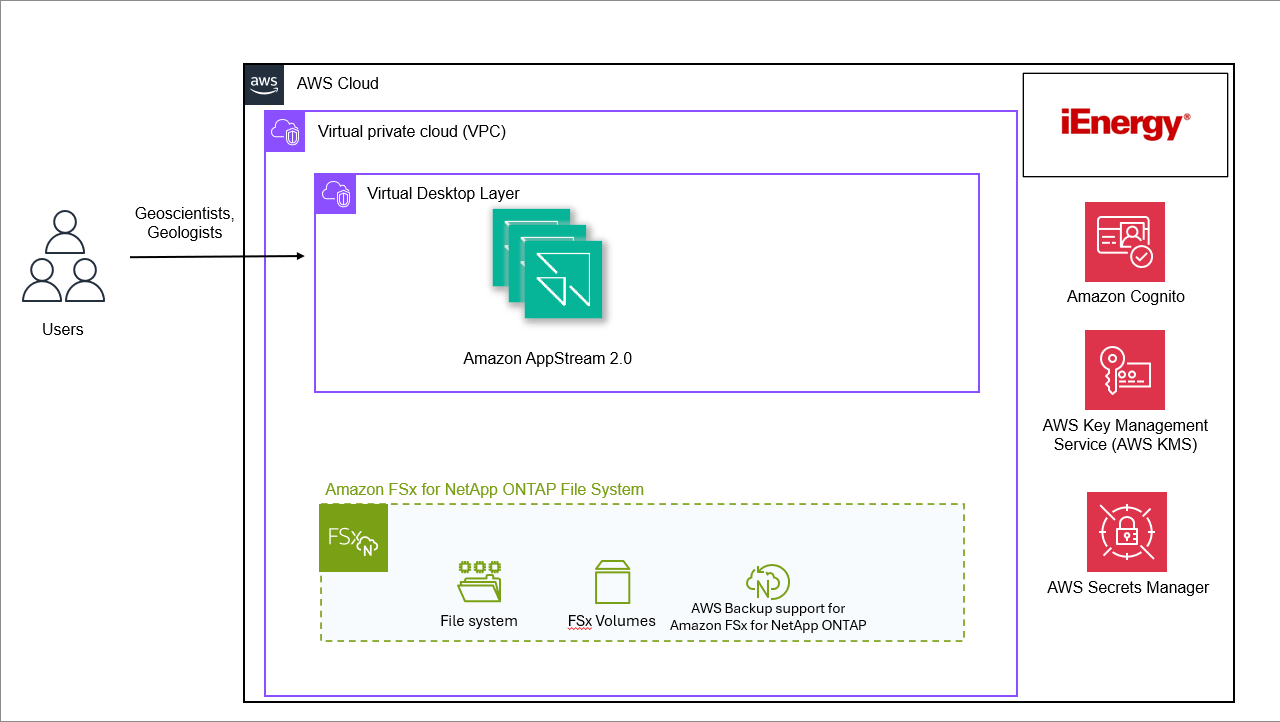
Figure 1: Architecture with FSx for ONTAP
We begin by breaking down the seismic interpretation workflow into unique sub-workflows, each of which presents their own demands to the file system. For example, Seismic Data loading and QC (quality control) require large sequential reads with heavy I/O bursts during quality control and data formatting. Horizon and Fault Picking demands frequent random reads of small to medium sized data blocks, because a geoscientist navigates seismic cube inlines, crosslines, and time slices. Attribute Computation is driving high throughput sequential I/O patterns, which often creates multiple derived sub volumes. Seismic data visualization is a mixed random and sequential read with high concurrency when multiple geoscientists load and slice through the seismic volume in an interactive mode. When it is time to do well-seismic ties, applications demonstrate moderate random-access patterns, because small seismic windows around the well locations are continuously loaded and cross-referenced. Integration with reservoir modeling is sequential data export to simulation applications with random reads for updates and model calibration. FSx for ONTAP is a fully managed service that provides shared storage with ONTAP’s data management capabilities. Landmark adopted FSx for ONTAP, modernized their self-managed Network Attached Storage (NAS) solution, and helped accelerate customer business decisions by addressing the preceding technical considerations. Furthermore, they used it to handle mixed I/O workloads with low latency, maintain throughput under concurrency, and seamlessly transit through large seismic datasets for high-performance and cost-efficient storage. Figure 1 shows the Architecture deployed with FSx for ONTAP.
Key benefits achieved
This section outlines the following key benefits achieved:
- Performance enhancement.
- Operational efficiency.
- Cost-effective storage optimization.
- Enhanced disaster recovery.
Performance enhancement
In testing and deployment scenarios, Landmark observed an overall performance gain of approximately 45% across operations. 3D seismic data load times were reduced by approximately five times, enabling users to spend more time interpreting data rather than waiting for it to load. The system can handle tens of GB/s of throughput, which means that performance remained consistent when multiple geoscientists worked concurrently. The millions of Input/Output Operations Per Second (IOPS) capabilities helped address a previous operational bottleneck by accelerating daily workflows. Visualization, UI response, and interactive seismic 3D workflows, such as seismic scrolling/panning and stepping, became approximately ten times faster, seismic QC processes ran smoother, and Horizon and Faults picking critical tasks became more efficient. The system’s scale-out performance through multiple file server pairs improved the multi-user environment. These performance improvements not only save time but also support more efficient collaboration and data sharing among project teams, fostering faster interpretation validations and shared insights. The migration to FSx for ONTAP helped customers focus on what they do best: interpreting seismic data to make informed decisions about energy exploration.
Operational efficiency
Landmark engineers use this streamlined infrastructure management overhead to focus on what they do the best, developing new features and improving existing ones. The streamlined storage management, powered by AWS and NetApp tools, was an efficiency driver that reduced time spent on server maintenance, patching, and updates. Overall, it resulted in the Landmark team moving faster, thereby supporting a more consistent customer experience.
Cost-effective storage optimization
In the data-intensive energy sector, managing storage costs while maintaining performance is important. Landmark realized storage cost efficiencies relative to its previous environment, achieving approximately 15-20% cost reduction when compared to the previous storage solution. This solution addresses this challenge through a multi-tiered approach. At its core, the system employs intelligent automatic data tiering, moving data between high-performance SSD (solid state disk) storage and more cost-effective capacity storage based on access patterns. This movement happens transparently, providing performance while supporting cost efficiency. Furthermore, the solution enhances storage efficiency through data compression and deduplication technologies, thereby reducing the overall storage footprint without compromising accessibility. What makes this system valuable to Landmark is how it can perform these optimizations transparently in the background, maintaining performance levels while actively managing costs. The integration with the iEnergy Suite means that these benefits are available to customers without disruption to their existing workflows. This provides a practical solution for energy companies seeking to balance performance with cost-effectiveness.
Improved resilience and recovery
Seismic data and its derivatives are valuable assets, and ensuring data durability to help prevent loss is important. Recognizing this, Landmark implemented a resilience strategy designed to enhance data protection. At the heart of this strategy is the deployment of NetApp SnapMirror technology for cross-Availability Zone (AZ) backups. This system creates space-efficient replicas of data across different Availability Zones, providing a safety net against localized failures. Complementing this, Landmark implemented asynchronous replication, providing continuous data protection with minimal impact on the performance of primary storage systems. This approach allows for real-time data mirroring without impacting critical operations, balancing security and efficiency. Landmark achieved this level of protection while maintaining cost-effectiveness, using the multi-AZ infrastructure of AWS to create a geographically distributed disaster recovery solution. The result is a disaster recovery solution that not only helps protect customers’ valuable data assets, but also does so in a way that is operationally efficient and cost-conscious.
“Our focus is to advance the performance, reliability, and functionality of our seismic interpretation solutions. Amazon FSx for NetApp ONTAP supports that objective by improving application performance and allowing our engineering teams to dedicate more time to innovation and customer-focused development.” — Robert Kellogg, Director of Innovation and Marketing, Halliburton Landmark.
Summary
Halliburton Landmark adopted Amazon FSx for NetApp ONTAP and achieved significant improvements in their application performance and operational efficiency. The solution provides:
- Enhanced end-user experience through improved performance.
- Reduced operational overhead through managed services.
- Robust disaster recovery capabilities.
- Streamlined storage management.
- Cost-effective data tiering.
Landmark uses these improvements to focus on delivering innovative features to their customers in the energy industry while maintaining high performance and reliability.
About Halliburton
Halliburton is one of the world’s leading providers of products and services to the energy industry. Founded in 1919, we create innovative technologies, products, and services that help our customers maximize their value throughout the life cycle of an asset and advance a sustainable energy future. Visit us at www.halliburton.com; connect with us on LinkedIn, YouTube, Instagram, and Facebook.