AWS News Blog
Build reliable AI agents for UI workflow automation with Amazon Nova Act, now generally available

|
Earlier this year, we released a research preview of Nova Act, demonstrating the potential of AI agents to interact with user interfaces and automate complex workflows. Developers experimented with Nova Act and told us they wanted to bring these automation agents to production.
But bringing agents to production required much more than just model access. Developers were spending significant time orchestrating workflows, refining prompts, choosing the right tools, and stitching together disparate components to achieve reliable automation. The challenge wasn’t just intelligence—it was reliability, integration, and speed to production. So we built a fully integrated solution for production-ready browser automation.
Today, we’re announcing the general availability of Amazon Nova Act, a new Amazon Web Services (AWS) service that helps developers build, deploy, and manage fleets of reliable AI agents for automating production UI workflows. Nova Act delivers over 90% task reliability at scale while offering the fastest time to value and ease of implementation compared to other AI frameworks.
Here’s a quick look at the Nova Act console.
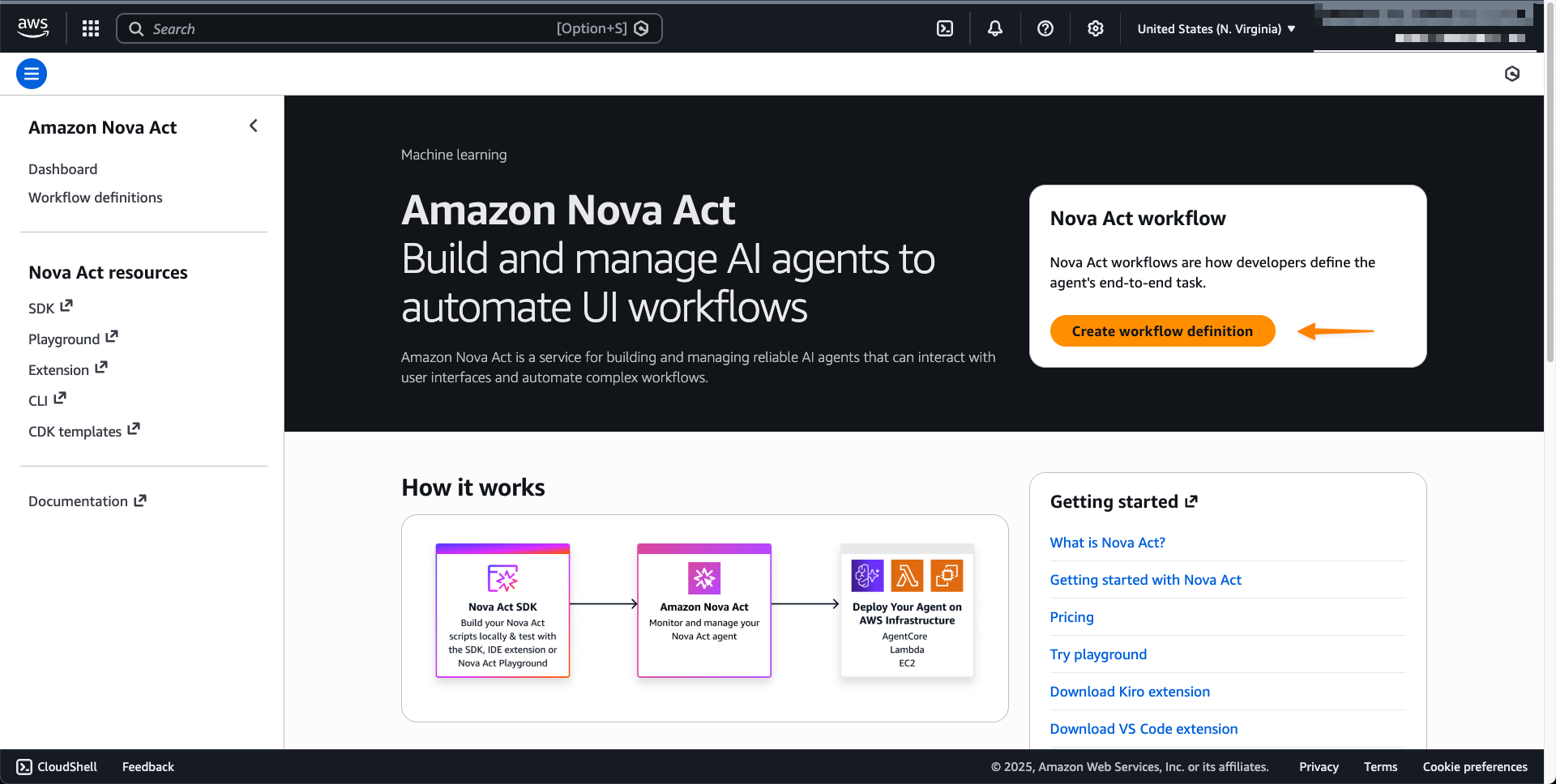
Nova Act addresses the challenge of building reliable browser automation at enterprise scale. Powered by a custom Amazon Nova 2 Lite model, Nova Act excels at driving browsers, support calling APIs, and escalating to humans when needed. The service has core capabilities for web quality assurance (QA) testing, data entry, data extraction, and checkout flows.
Most models today are trained in isolation, separate from the orchestrator and actuators that execute tasks, which reduces reliability. Nova Act approaches this differently by using reinforcement learning while the agents run inside custom synthetic environments (“web gyms”) that simulate real-world UIs. This vertical integration across the model, orchestrator, tools, and SDK, all trained together, unlocks higher completion rates at scale. The result is an agentic system that doesn’t merely work occasionally but is reliable at scale, with reasoning and adaptability to handle changes.
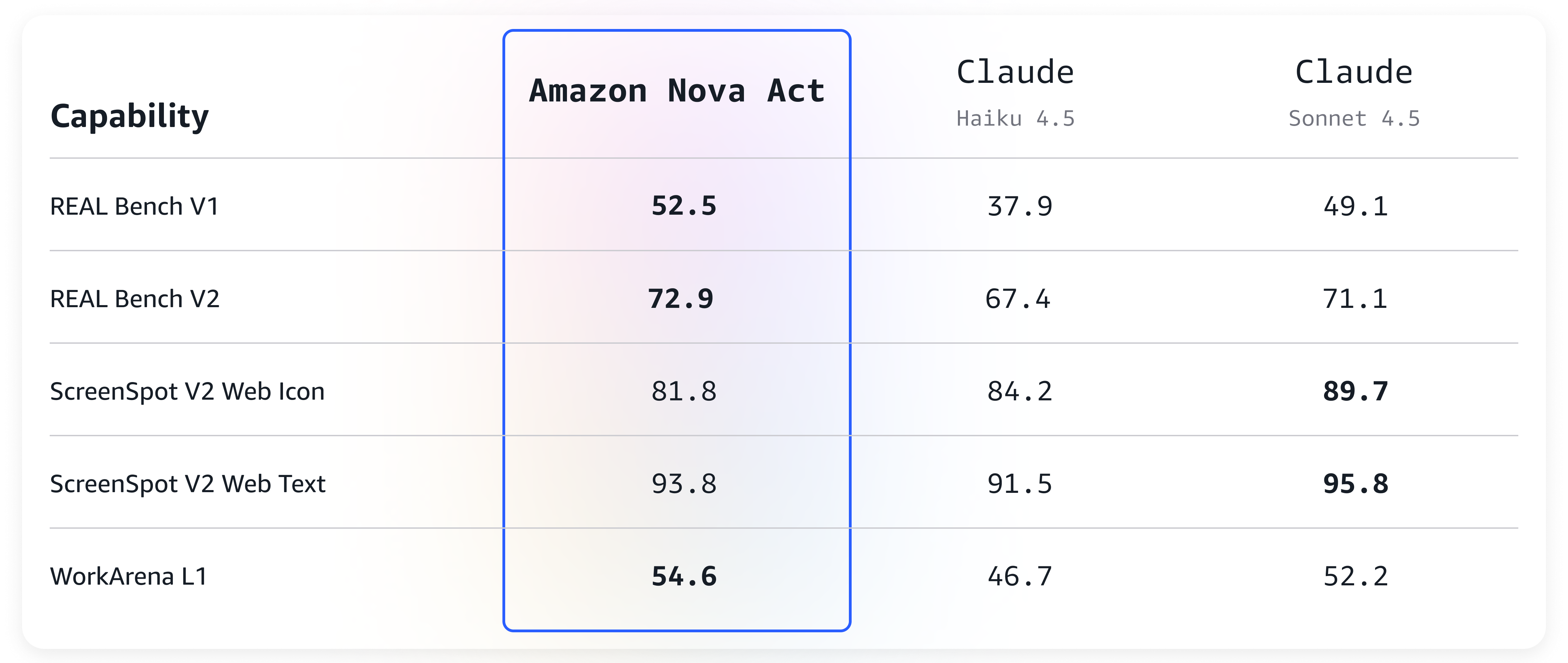
Getting started with Nova Act
Nova Act provides an integrated developer experience that takes you from prototype to production in hours. Let me walk you through the journey.
Start in the playground
We begin by visiting nova.amazon.com/act to access Nova Act Playground.There, we can quickly experiment and see Nova Act in action.
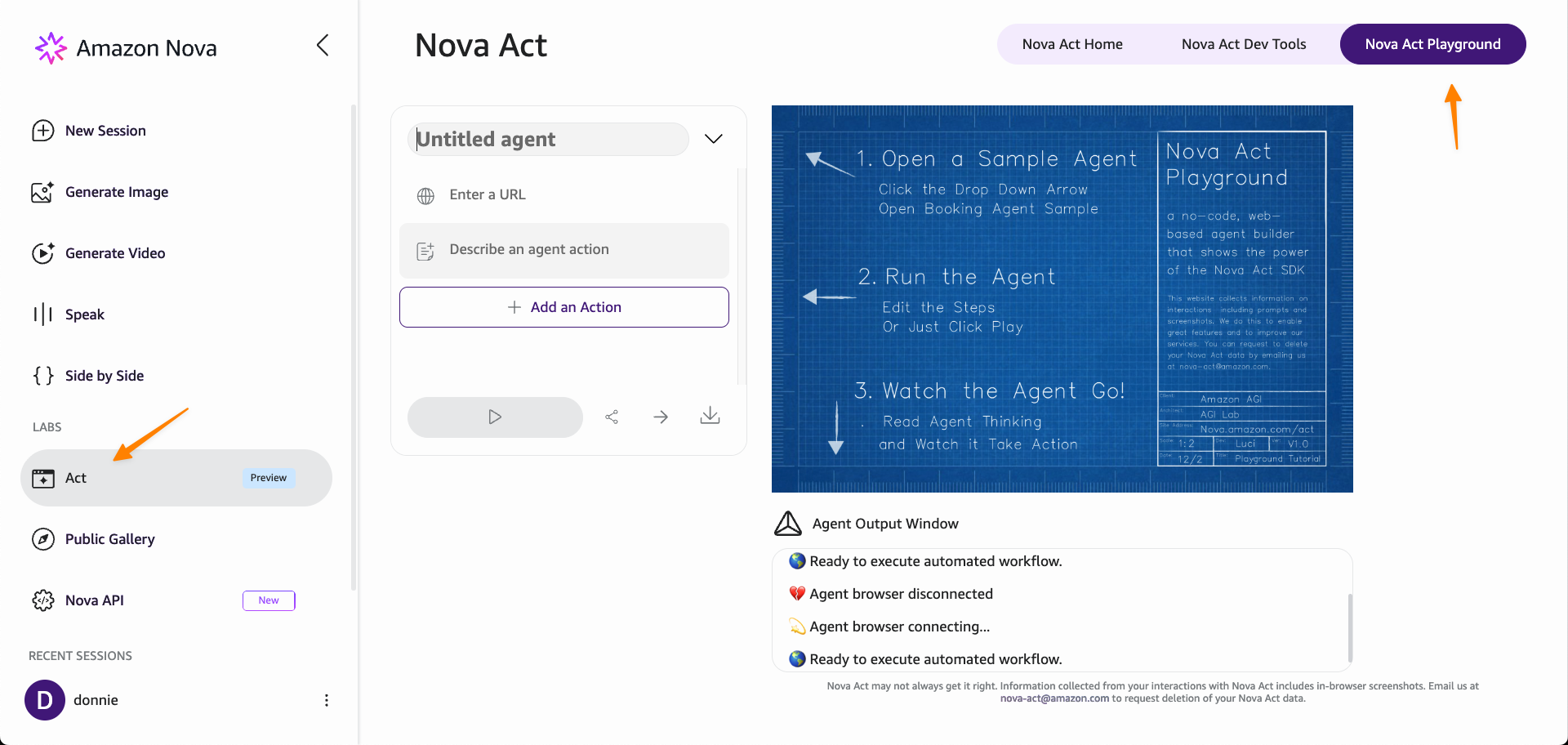
For these tests, we use Nova Act Gym, a simulated browser environment designed for testing Nova Act agents. We’re using a fictional travel booking website to terrestrial exoplanets.

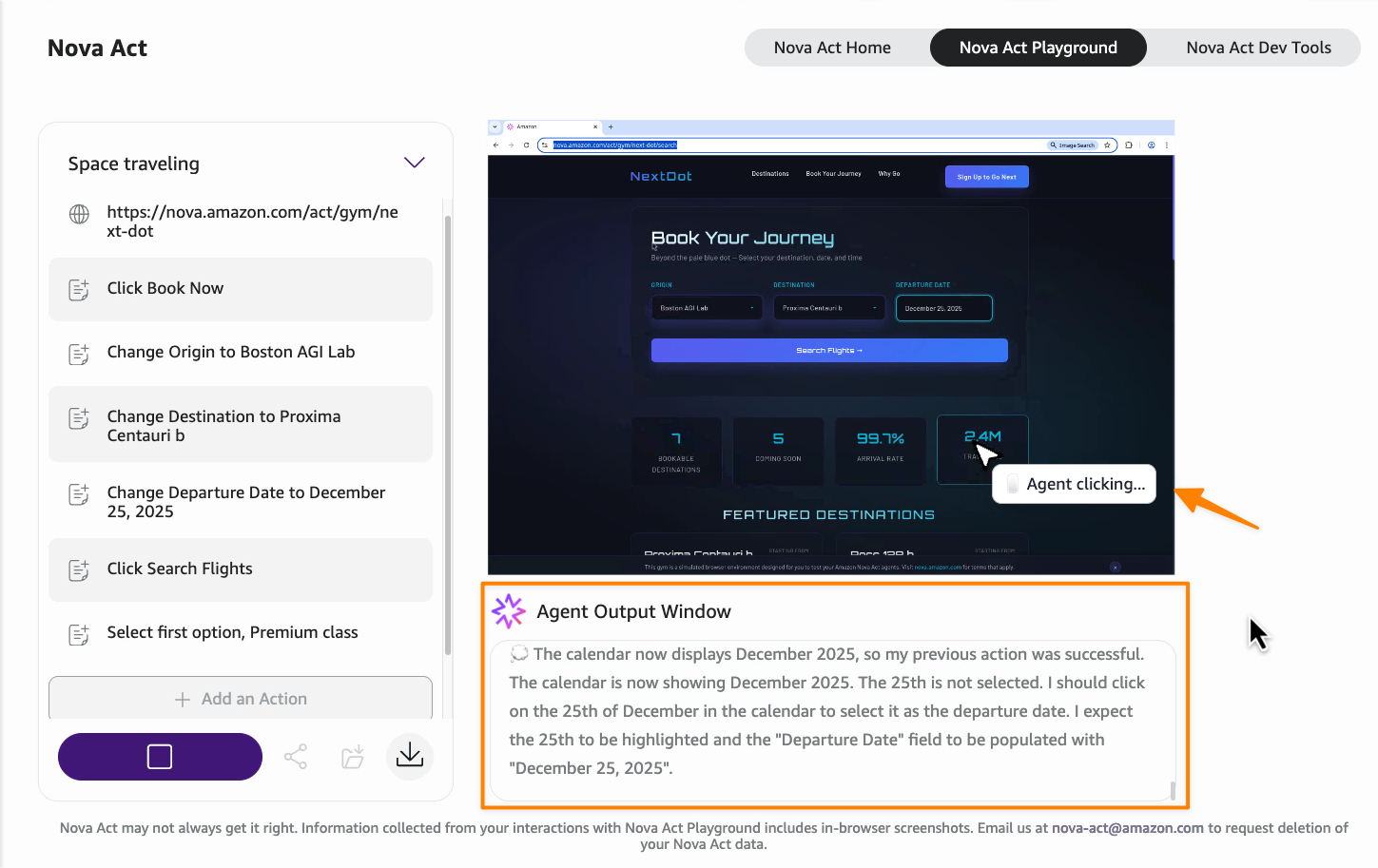
Here we can quickly prototype workflows using natural language commands without writing any code. We enter the URL to automate and describe the actions Nova Act needs to perform. We can add additional actions by choosing Add an action.
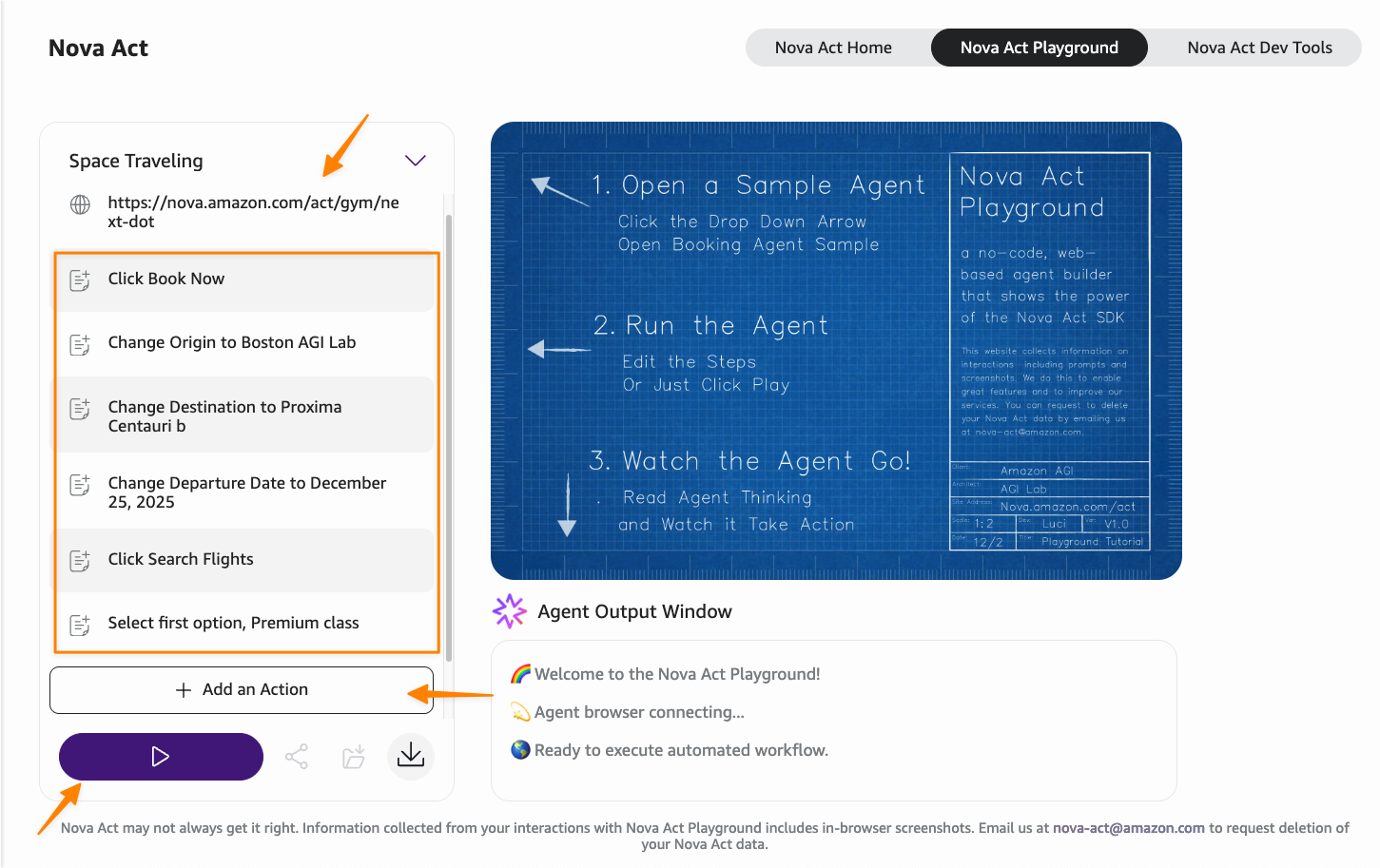
After defining the actions, we run the Nova Act agent in a live browser session. This way, we can validate that the automation approach works as expected.
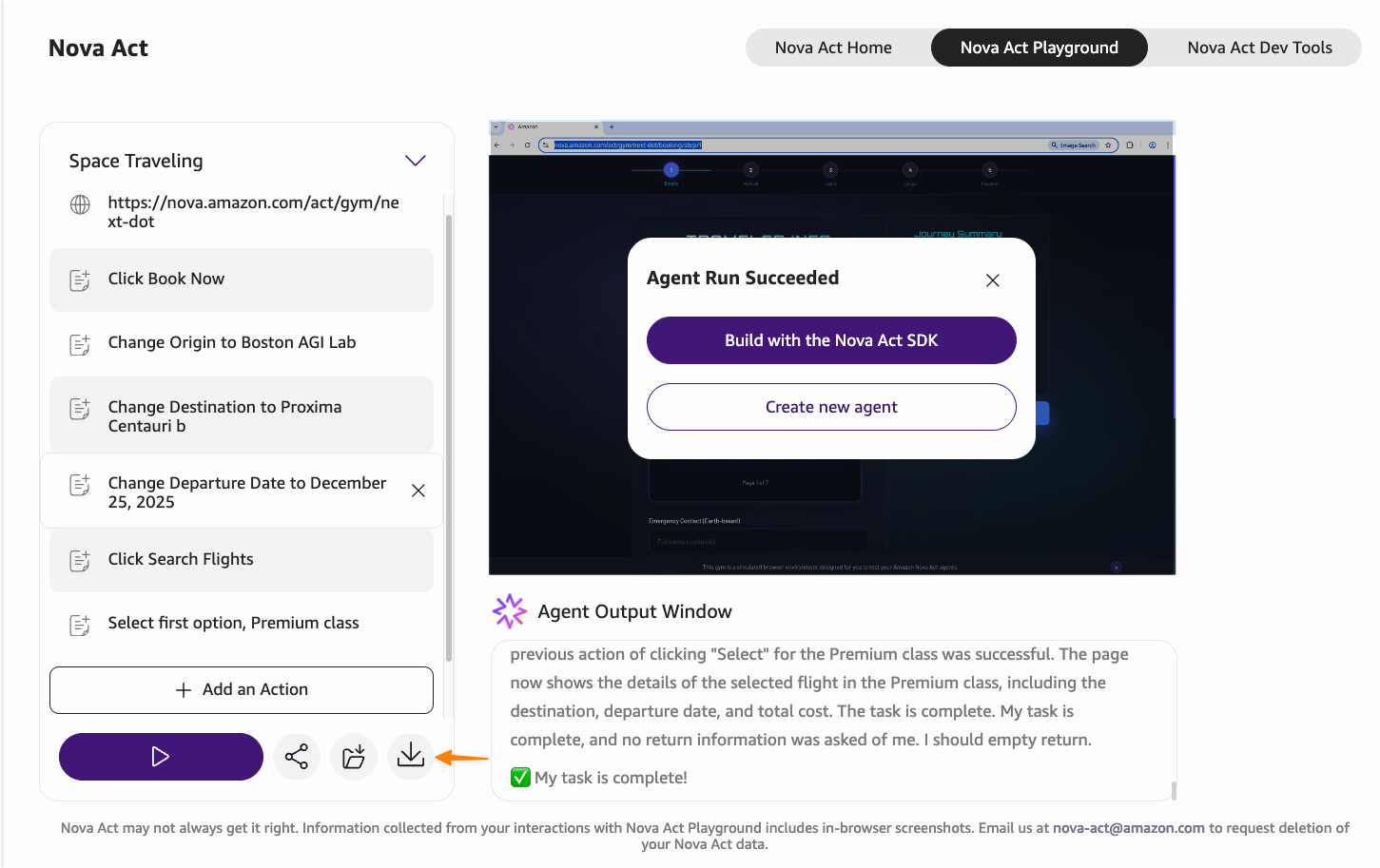
After we validate the workflow, we can export it to continue development in an integrated development environment (IDE) such as Visual Studio Code (VS Code), Kiro, and Cursor.
Refine in the IDE
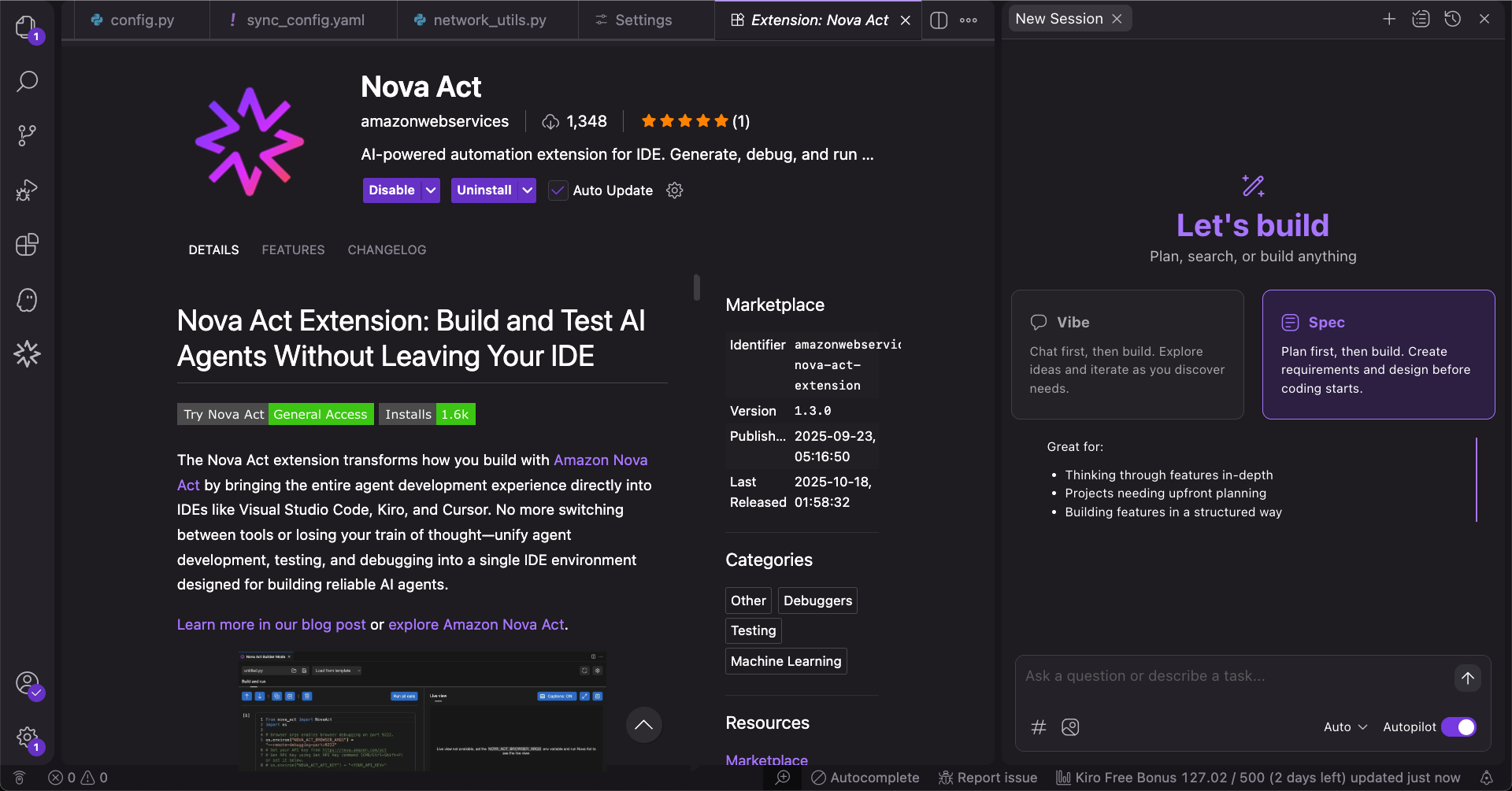
At this stage, we need to refine the automation in a supported IDE. We use Kiro and install the Nova Act extension plugin.
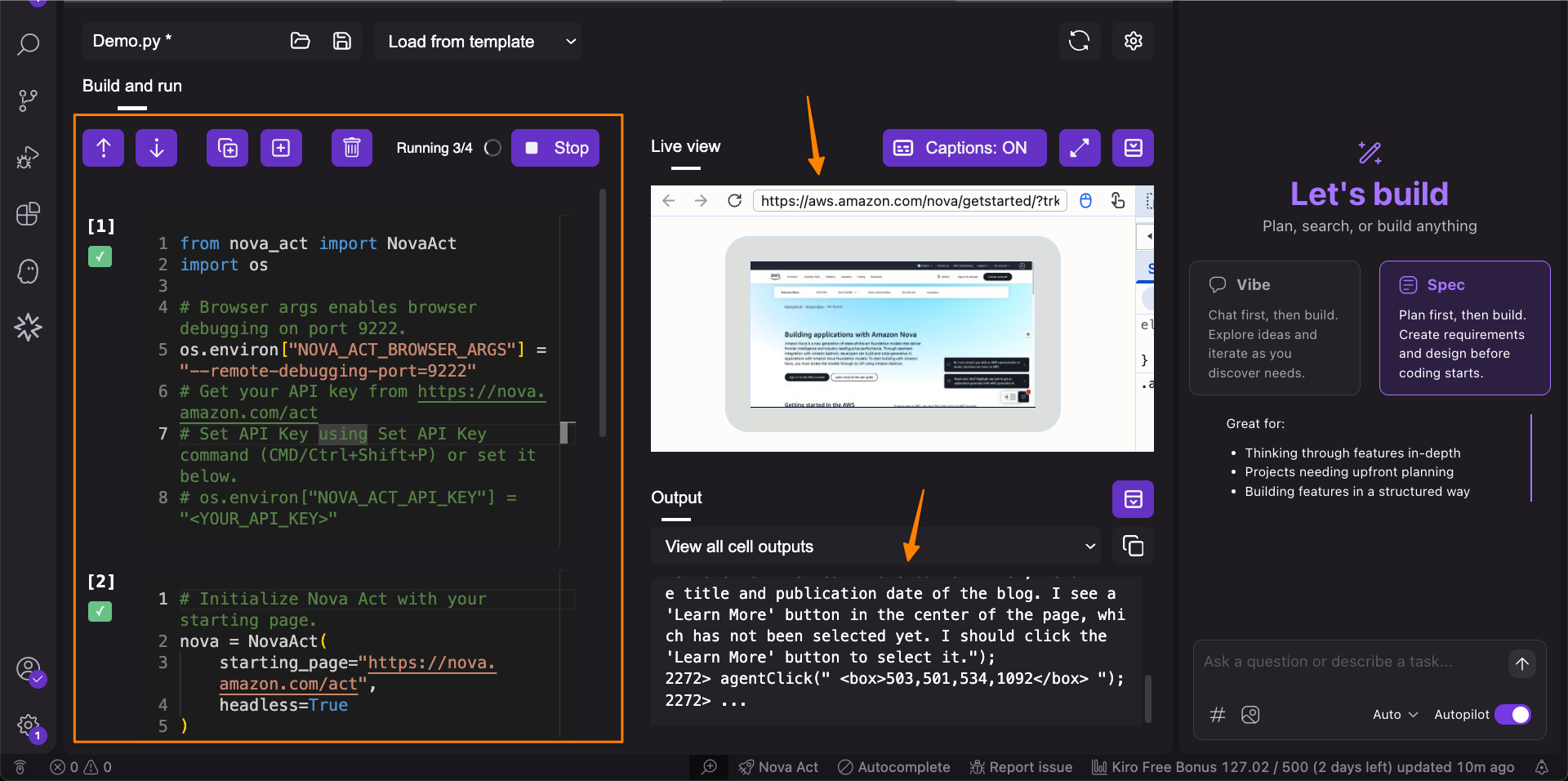
The extension provides a notebook-style builder mode where we can test and debug each step individually. The live browser views show exactly what the agent is doing, while execution logs reveal the model’s reasoning and actions. This makes it straightforward to refine the workflow and handle edge cases.
To learn how to use the Nova Act extension in your IDE, visit Accelerate AI agent development with the Nova Act IDE extension in the AWS News Blog. The Nova Act extension includes templates to help you get started quickly with common workflow patterns.
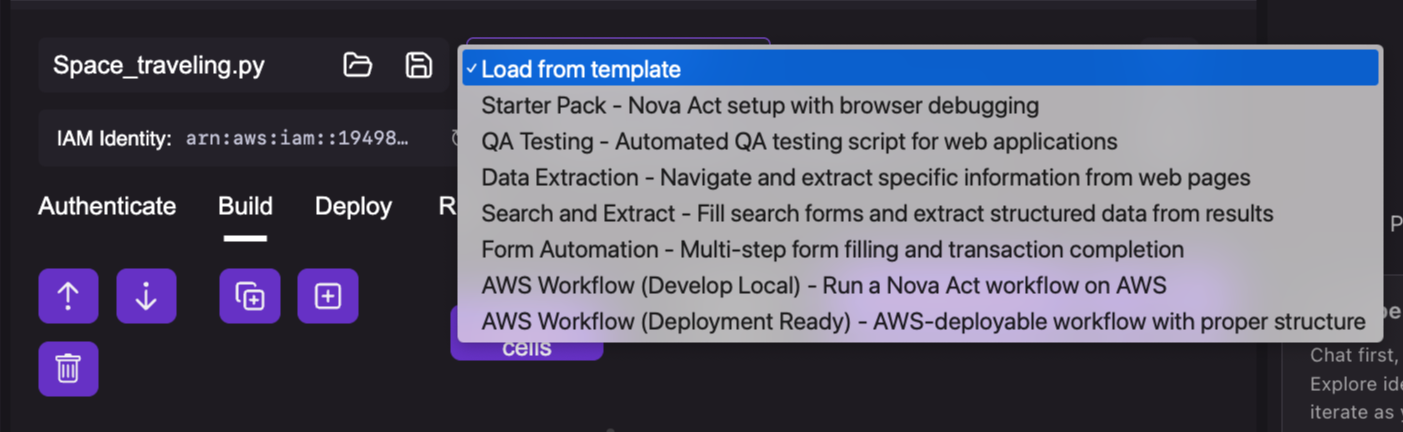
With this release, the Nova Act IDE extension introduces dedicated tabs for authentication, builder mode, deployment, and running workflows—bringing the complete development lifecycle into your IDE. While the extension provides the easiest path to production, developers can also use the Nova Act command line interface (CLI) or SDK directly for more advanced deployment configurations.
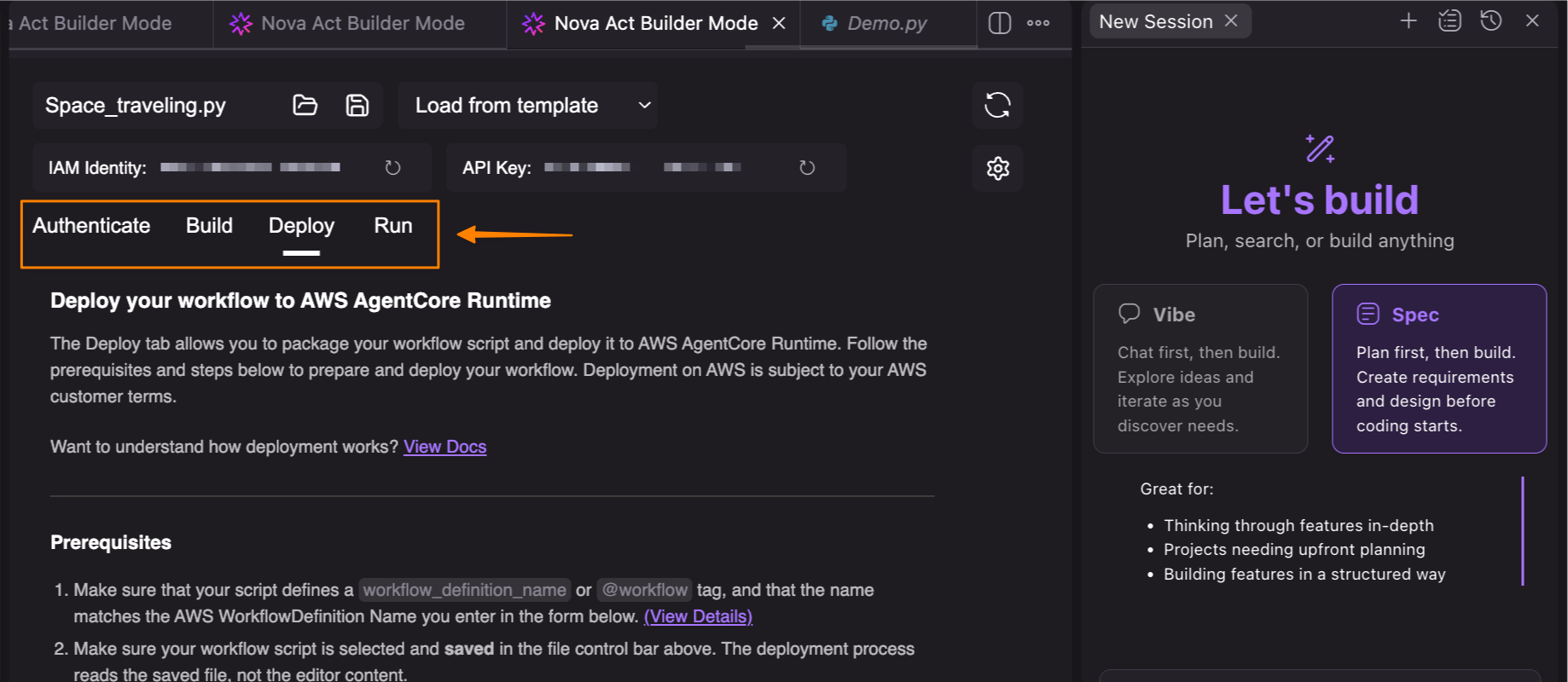
Deploy to AWS
When the workflow is ready for production, we navigate to the Deploy tab to deploy directly to AWS. We enter the workflow definition name (which must match the name in the script), select the AWS Region, and optionally provide an existing AWS Identity and Access Management (IAM) role Amazon Resource Name (ARN). The extension packages the workflow into a Docker container, pushes it to Amazon Elastic Container Registry (Amazon ECR), creates the necessary IAM roles and Amazon Simple Storage Service (Amazon S3) buckets, and deploys it to Amazon Bedrock AgentCore Runtime.
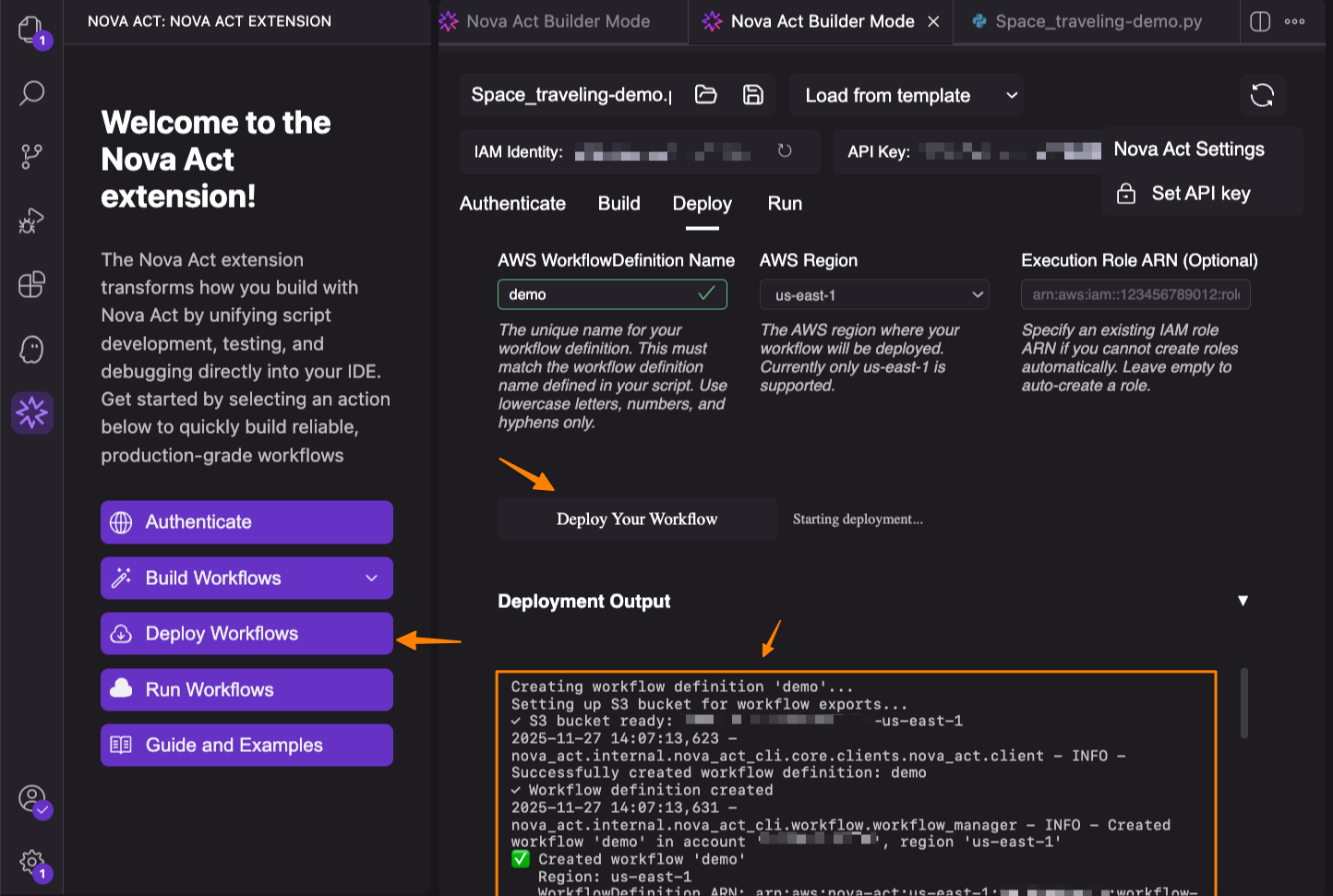
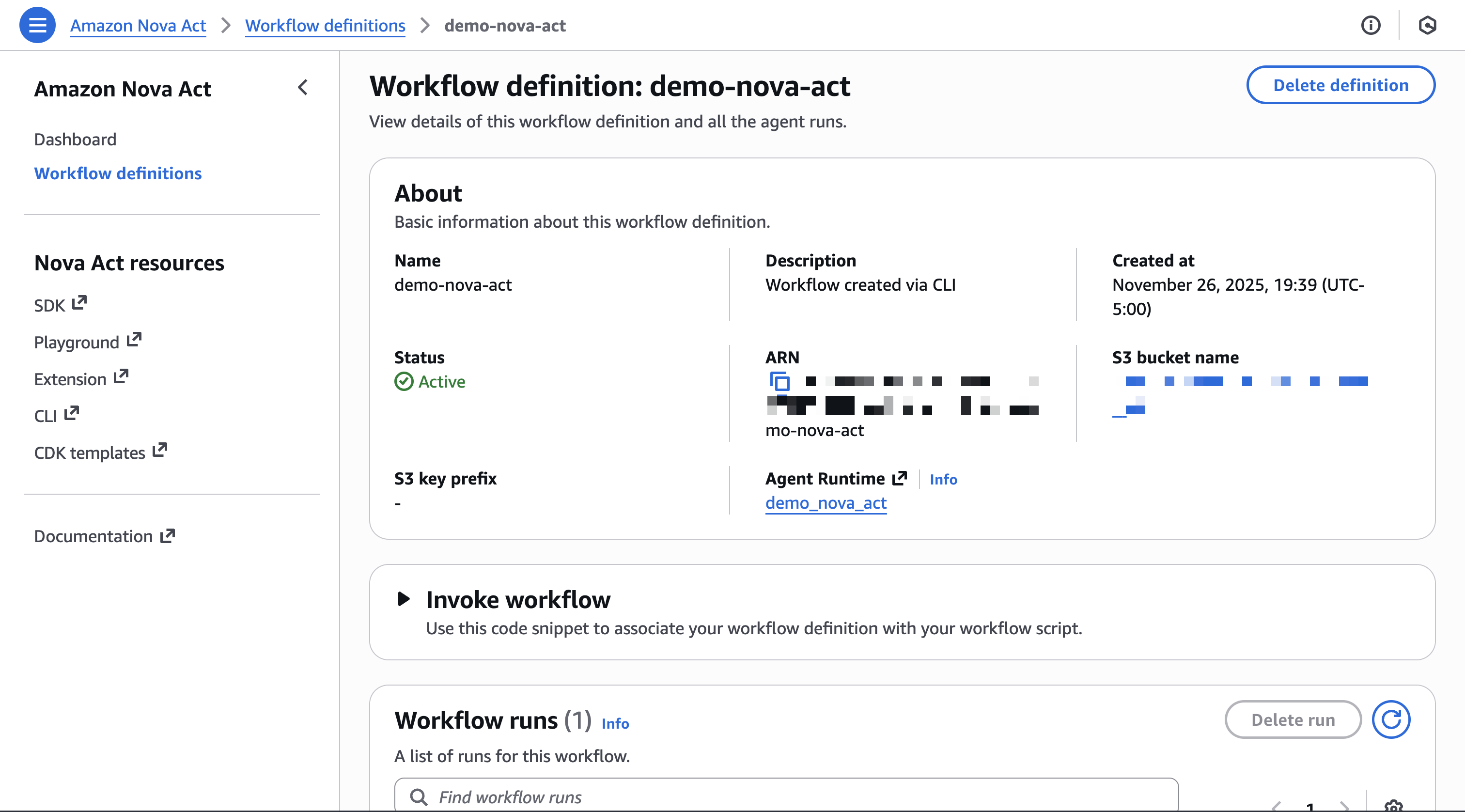
After it’s deployed, we can monitor the workflow execution through the Nova Act console. We navigate to Workflow definitions. The console provides observability dashboards, and when workflows need human input, we configure custom dashboards with notifications for supervisors to intervene.
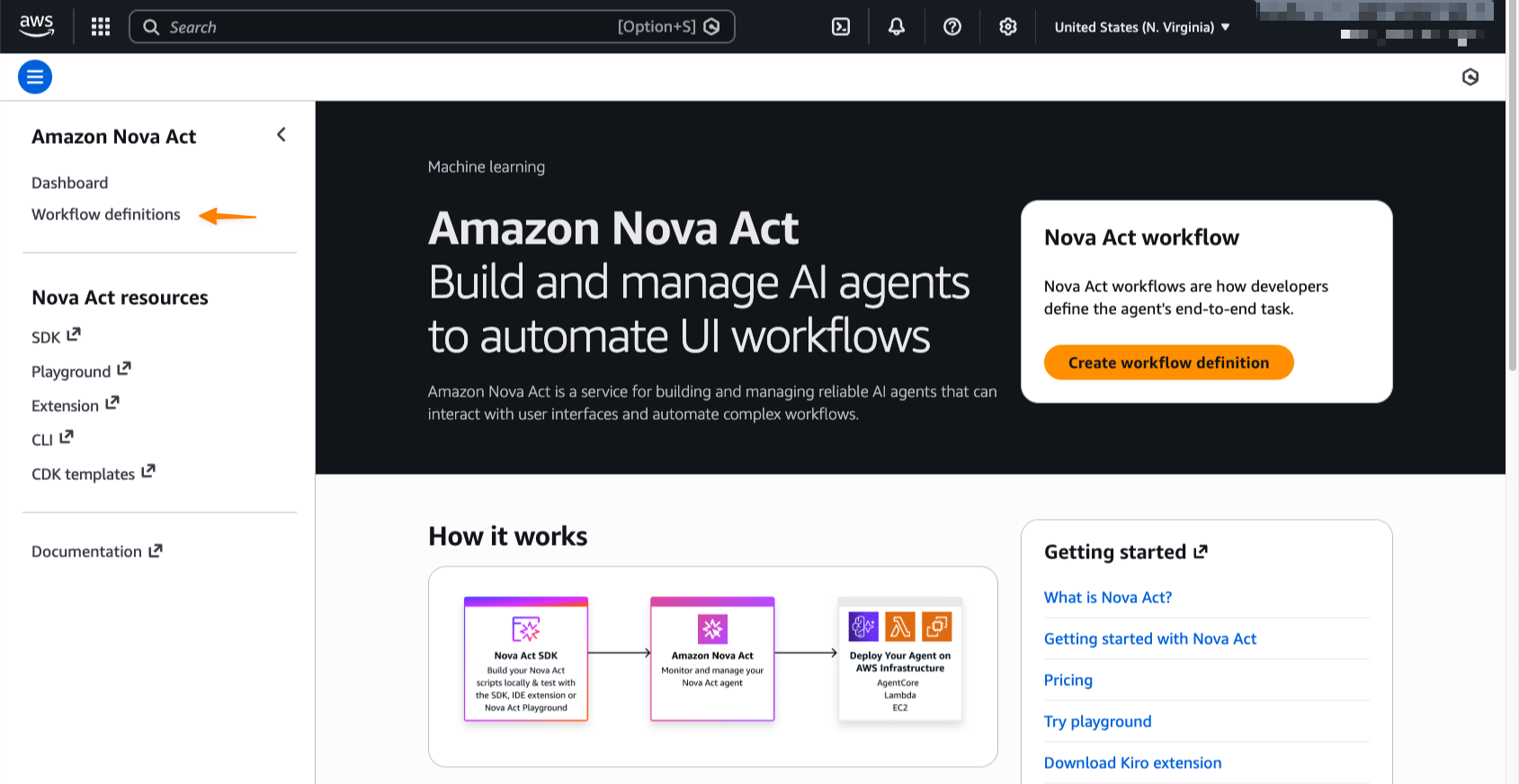
Then, to select the workflow definition, we scroll down to find the workflow run.
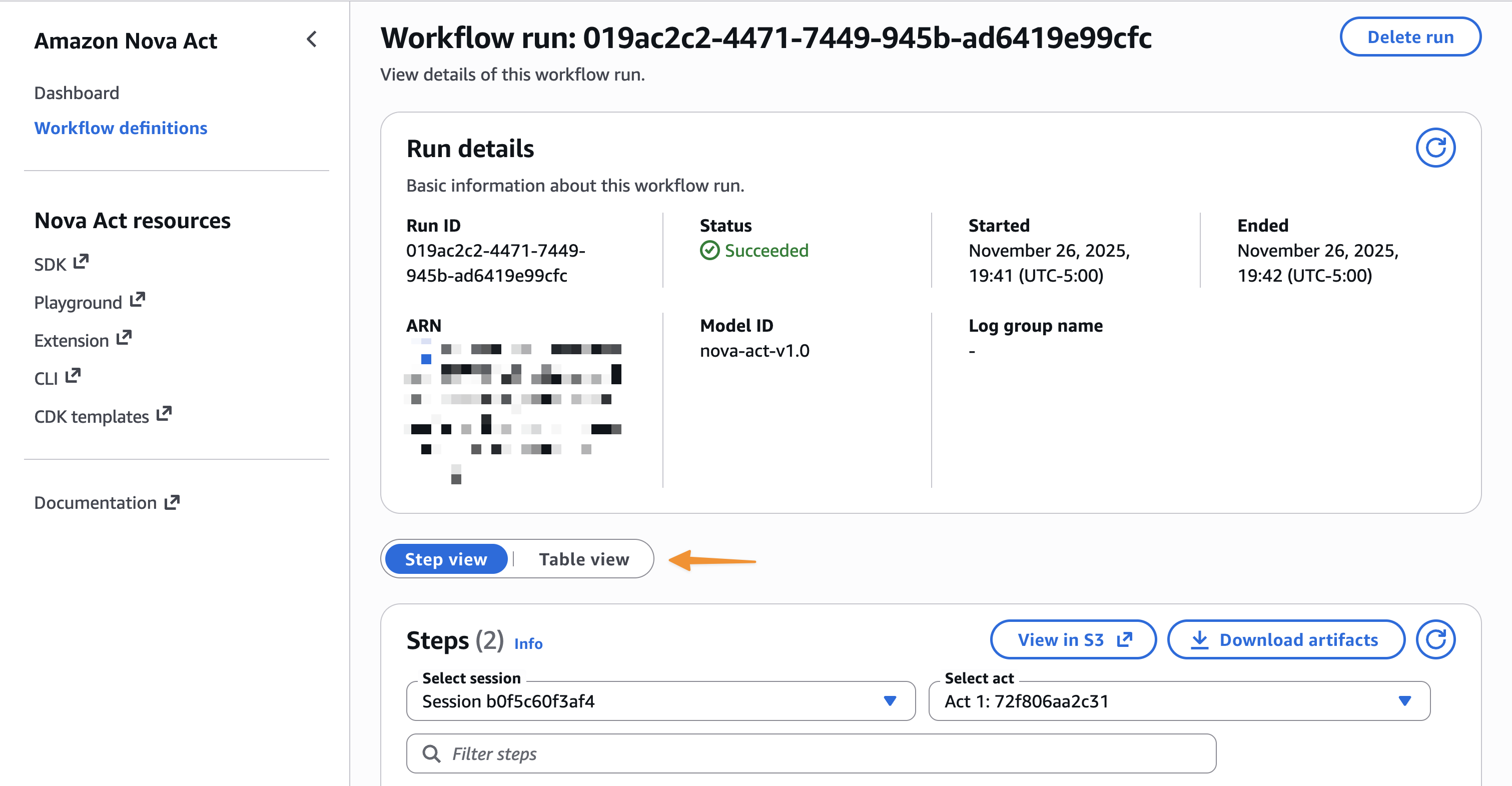
Here, we can see more information about the workflow run.
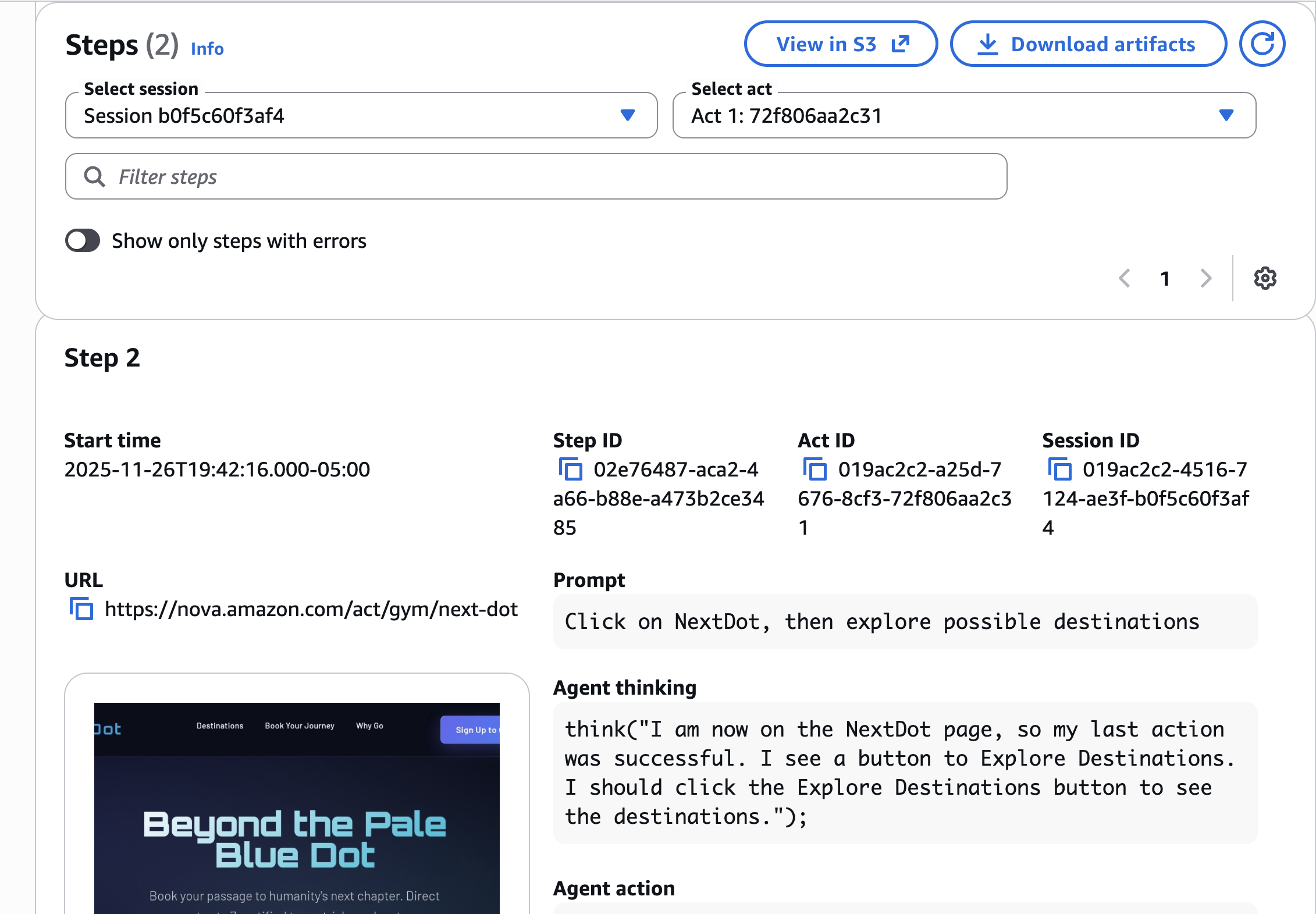
From here, we track the workflow progress and execution logs. Each step shows the agent’s reasoning, actions, and browser screenshots—the same level of visibility we had while developing in the IDE, now available for monitoring production executions at scale.
This straightforward progression from experimentation to production eliminates the weeks typically spent stitching together disparate tools and orchestration logic.
Better together: Nova Act and Strands Agents
As agent systems mature, the need for specialized agents to work together seamlessly becomes essential. Nova Act integrates naturally with the Strands Agents framework, so you can build comprehensive multi-agent workflows without custom integration work. Strands provides the orchestration layer for coordinating agent systems across domains, while Nova Act delivers specialized reliability for browser-forward UI automation. This out-of-the-box compatibility reflects how modern agent architectures should work—purpose-built components that integrate to solve complex business problems.
Developers can use Strands to coordinate complex workflows where Nova Act handles the browser automation components as specialized tools, combining them with other agents. Teams can use this architecture to harness Nova Act purpose-built UI automation capabilities within broader agent ecosystems orchestrated by Strands.
Things to know
Here are key points to note:
- Integration – Works with Strands Agents framework for building complex multi-agent workflows across domains.
- Pricing – Visit the Amazon Nova Act pricing page for details.
- Nova Act and responsible AI – Nova Act includes built-in safety controls and content moderation capabilities to promote responsible AI use, incorporating advancements in reasoning and agentic safety and robustness to adversarial attacks.
- Availability – Amazon Nova Act is now available in US East (N. Virginia) AWS Region. For the latest Region availability, visit the AWS Capabilities by Region page.
Get started with Nova Act by visiting nova.amazon.com/act to obtain your API key and explore the playground.
Happy automating!
Learn more
Amazon Nova main product page
More Amazon Nova launches:
Introducing Amazon Nova 2 Sonic: Our new speech-to-speech model for conversational AI
Introducing Amazon Nova 2 Lite, a fast, cost-effective reasoning model
Introducing Amazon Nova Forge: Build your own frontier models using Nova
Introducing Amazon Nova 2 Omni in Preview