AWS Security Blog

AWS becomes first CSP to complete the Cloud High profile assessment with 172 services and features in scope
We continue to expand the scope of our assurance programs at Amazon Web Services (AWS) and are pleased to announce the successful completion of our first ever Cloud High (PBHH) security assessment with 172 assessed services and features. Completion of this assessment, effective September 18, 2026, makes AWS the first cloud service provider (CSP) in […]

Part 3 – Cybersecurity journeys: The work behind the work
The most important work I’ve done in cybersecurity would make for terrible television. There were no countdown clocks and no frantic typing, just a lot of careful reading, a lot of hard conversations, and the occasional quiet moment where everything finally clicked. That’s the part I want to show you this week, because the three […]

Using AWS WAF to apply mitigations for PHP2Shell RCE vulnerabilities (CVE-2026-109618 and CVE-2026-109619)
October 23, 2026-2: The PHP project disclosed CVE-2026-115560, a separate remote code execution issue that the October 21 releases don’t fix. It affects only applications with an uncommon configuration that keeps session upload progress enabled. The PHP2Shell_BODY rule in the PHP application managed rule group, version 2.4 and later, already blocks POST requests that carry […]

Amazon Threat Intelligence identifies PHP2Shell exploitation prior to public disclosure in MadPot
Amazon Threat Intelligence identified a PHP2Shell exploitation attempt dating to Oct. 17, 2026, in MadPot telemetry, four days before public disclosure of CVE-2026-109618 and CVE-2026-109619. The exploit attempt originated from an IP address associated with a commercial anonymization network. While the vulnerability was under embargo, the targeting of a honeypot from an anonymized IP address […]
Best practices for integrating IAM Roles Anywhere with your PKI
Using temporary credentials is a security best practice to reduce the risk from credentials getting compromised. With AWS IAM Roles Anywhere, now your workloads outside of Amazon Web Services (AWS) will be able to access AWS resources by obtaining temporary security credentials in AWS Identity and Access Management (IAM). IAM Roles Anywhere relies on public […]

Managing identity source transition for AWS IAM Identity Center
October 20, 2026: This post was republished to reflect the new migration capability from Active Directory to an external identity provider (IdP) or the Identity Center directory, now available in IAM Identity Center. September 2, 2026: This post was republished to include Active Directory migration strategies and automation for permission sets. AWS IAM Identity Center […]
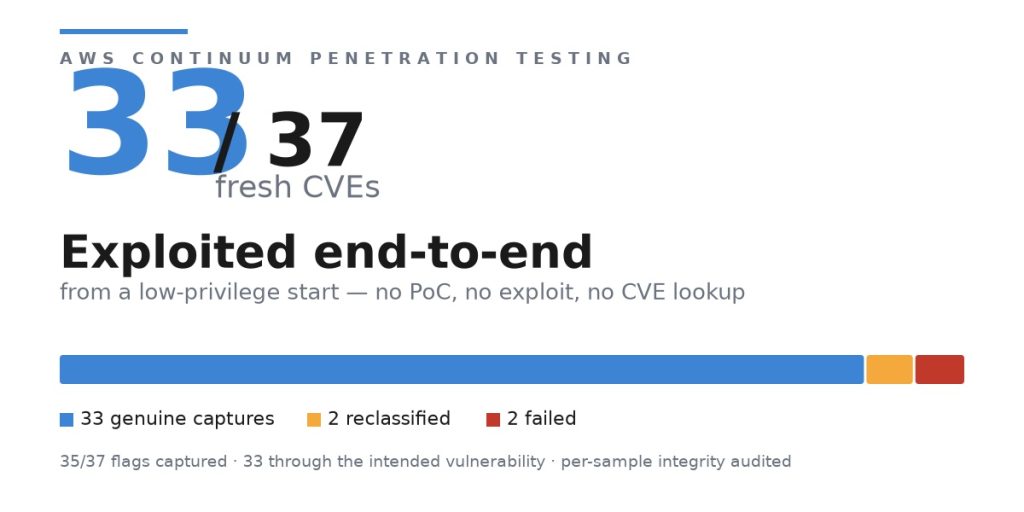
AWS Security Agent (now part of AWS Continuum) exploited 33 of 37 new real-world CVEs
We applied AWS Security Agent (now part of AWS Continuum), our autonomous penetration-testing agent, to 37 real, recently disclosed Common Vulnerabilities and Exposures (CVEs), each packaged as a live, containerized target with a flag hidden at the vulnerability’s intended sink. Starting from an unauthenticated or low-privilege position (an endpoint URL and a one-line hint, no […]
Penetration testing every deployment with AWS Continuum
Most security tooling that fits into a CI/CD pipeline—static analysis (SAST), software composition analysis (SCA), and dynamic scanners (DAST)—flags potential issues from patterns and signatures. A flagged pattern shows you where to look; penetration testing is what confirms whether something is actually exploitable. That confirmation has traditionally come from a periodic, out-of-band engagement that runs […]
Part 2 – Cybersecurity journeys: What even is this job?
If you’ve ever looked at a list of cybersecurity jobs and felt like none of them fit you, you might just be looking at a short list. Most career guides cover the same few roles, like the analyst watching alerts or the pen tester (penetration tester, someone hired to legally break into systems to find […]
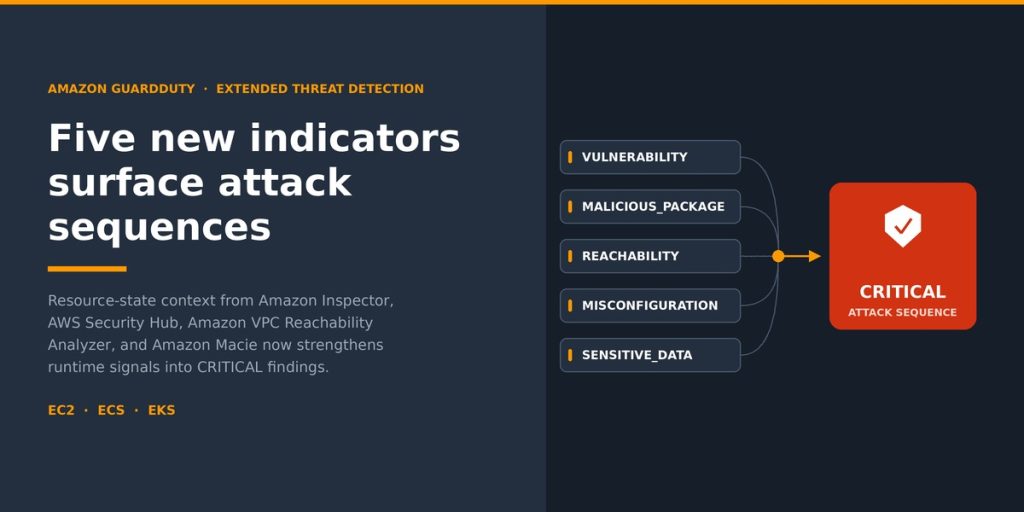
GuardDuty Extended Threat Detection has added five new indicators to surface attack sequences
Amazon GuardDuty Extended Threat Detection correlates weak GuardDuty signals into a single, critical-severity attack sequence finding when their composition crosses a threshold of credibility. On May 20, 2026, the service started attaching five new indicator types to those sequences: MALICIOUS_PACKAGE, MISCONFIGURATION, REACHABILITY, SENSITIVE_DATA, and VULNERABILITY. For more information, see Document history for Amazon GuardDuty and […]