AWS Security Blog
Category: Generative AI
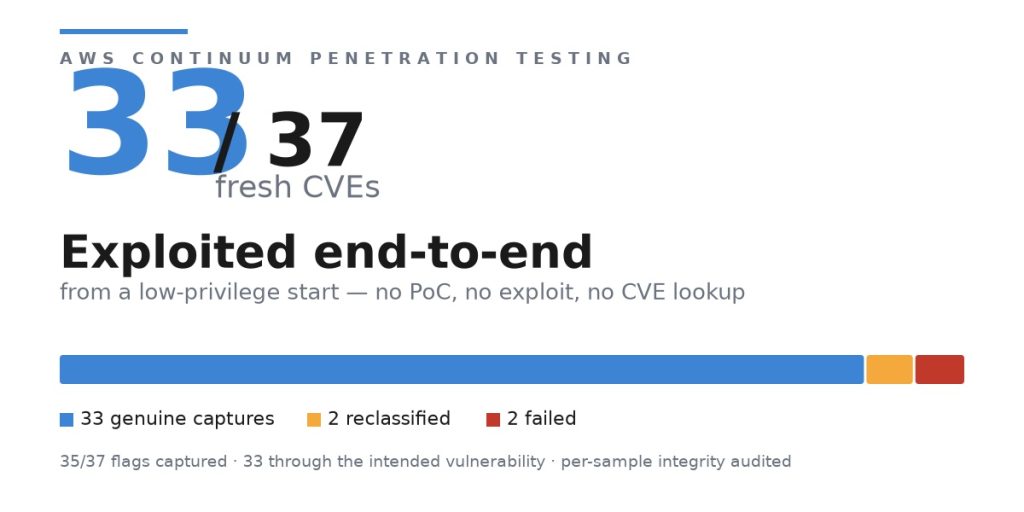
AWS Security Agent (now part of AWS Continuum) exploited 33 of 37 new real-world CVEs
We applied AWS Security Agent (now part of AWS Continuum), our autonomous penetration-testing agent, to 37 real, recently disclosed Common Vulnerabilities and Exposures (CVEs), each packaged as a live, containerized target with a flag hidden at the vulnerability’s intended sink. Starting from an unauthenticated or low-privilege position (an endpoint URL and a one-line hint, no […]

Penetration testing every deployment with AWS Continuum
Most security tooling that fits into a CI/CD pipeline—static analysis (SAST), software composition analysis (SCA), and dynamic scanners (DAST)—flags potential issues from patterns and signatures. A flagged pattern shows you where to look; penetration testing is what confirms whether something is actually exploitable. That confirmation has traditionally come from a periodic, out-of-band engagement that runs […]
Configuring your AI vulnerability harness, Part 2: The steering file
This post shows you how to configure an AI model to perform structured, evidence-based vulnerability triage with the consistency of a seasoned security analyst. You’ll learn the design decisions behind five configuration sections that enforce structural verification, evidence-based scoring, and infrastructure-aware prioritization across every analysis session. Our companion post—Building your AI vulnerability harness—covered the architecture; […]
Building your AI vulnerability harness, Part 1
Vulnerability scanners produce findings faster than manual triage can process them. Your developers ship more code with more dependencies, and the volume of candidate findings grows with it. Many findings a scanner produces are unlikely to be exploited. The ones that matter need to reach an engineer fast, with enough evidence that they can act […]

Run open weight models on Amazon Bedrock in AWS European Sovereign Cloud
European organizations can run AI workloads on Amazon Web Services (AWS) while keeping data within the European Union (EU) and meeting regulatory requirements. You can now run generative AI workloads on open weight models on Amazon Bedrock in the AWS European Sovereign Cloud. We’re excited to announce the general availability of the first open weight […]
The state of AI for security: Measuring what matters most for building trust
Security teams are starting to actively use AI for security work, including vulnerability triage, penetration testing, threat modeling, incident response, and code review. The promise is speed, but a security tool that moves fast and raises too many false alarms doesn’t save time. Engineers spend time on false alarms, on-call is noisier, and teams distrust […]

Extend Amazon Bedrock Guardrails to Tool Interactions Using the Strands Agents SDK
If you’re running AI agents in production, Amazon Bedrock Guardrails protects the model boundary. But your agents also invoke tools, fetch external data, and communicate with other systems. That data flows outside the model boundary, where model-level guardrails can’t reach. You can extend guardrail coverage to those interactions using three validation checkpoints built with the […]

AWS partners with Anthropic and OpenAI to bring AWS Continuum into developer workflows
Customers have access to models that are continuously getting better with each new generation bringing larger context windows, stronger reasoning, and lower token costs. Getting the strongest AI-powered security will come from tools that combine the most relevant models with deep knowledge of a customer’s specific environment. AWS Continuum for code vulnerabilities (Preview) is built […]

Balancing speed and safety: A control framework for AI coding agents
AI coding agents are part of the developer toolchain. Tools like Kiro and Claude Code generate features, tests, and code refactors from natural-language prompts. A single agent can open dozens of pull requests (PRs) across your repositories in an afternoon. That productivity comes with a trade-off: agents optimize for task completion at machine speed with […]

Amazon identifies North Korean hacker group behind open-source supply chain attacks
Amazon is sharing new findings about how a threat actor linked to the Democratic People’s Republic of Korea (DPRK) is targeting open source software libraries, the shared building blocks that companies around the world use to develop applications. Amazon Threat Intelligence has linked several recent compromises of popular Node Package Manager (NPM) libraries to the […]