What Is Cloud Cost Management?
Optimize cloud spend through budgeting, planning, and choosing the right cloud services for your business needs.
What is cloud cost management?
Cloud cost management is the process of optimizing cloud computing expenditure through budgeting, planning, and choosing appropriate cloud services that efficiently meet business requirements. Many organizations take a decentralized approach to decision-making in the cloud. Multiple teams use resources and services that they think are best suited for their applications, reducing overall expense visibility. Cloud cost management strategy includes services, tools, and resources to consolidate billing and centrally organize and track cloud usage. It involves practices like budgeting, forecasting, and billing data analysis to enhance control over cloud usage through planning and resource optimization.
What are the benefits of cloud cost management?
Cloud cost management will always be a productive business activity. Here are the main benefits.
Reduce operational costs
The main goal of cloud cost management is to reduce the running costs of cloud computing. It ensures resource optimization and control over cloud costs. With the right cloud cost management strategy, cloud computing expenses can be kept well under legacy pricing models.
Cost forecasting and budgeting
When cloud computing costs are unmanaged across the business, it is difficult to predict how much will be spent from quarter to quarter, especially if different projects and products have shifting requirements. Using cloud cost management, administrators can obtain a more accurate picture of cloud resource forecasts and budget accordingly.
Minimize waste
Unused cloud resources are a waste for the business and the wider community. If a fixed instance is only used 25% of the time at 70% capacity, then it would sit unused for 6,570 hours a year. In the hours that it is used, 30% of its running costs would be considered wastage. Not only is this financially unsound for the business, but if many cloud customers operate similarly, then cloud providers must offer more instances to serve the community. Ultimately, this leads to an increase in running hardware and is detrimental to the environment. Instead, with cloud cost management, you can choose different instance types and mix workloads to optimize resource capacity.
Obtain complete oversight into cloud resourcing
One of the main challenges for operations and finance teams is obtaining accurate, aggregate data across the business. When performing cloud cost management, businesses must account for all cloud resources across departments, projects, and products. In this process, you discover deeper insights into who is using the most resources, what they are using them to do, and whether they are using these resources optimally.
What are the key areas of cloud cost management?
Once businesses have conducted an organization-wide cloud resource discovery exercise, they can start with cloud cost management activities.
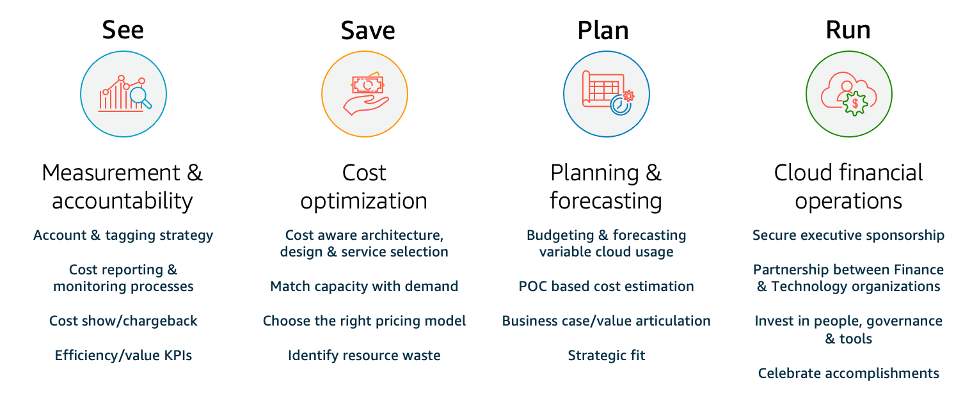
Cost and usage reporting
To be able to do cloud cost management, the first step is accurate, up-to-date, and retrospective cost and usage tracking. By viewing current and past costs and instance types, users can start to see where and when money is being spent. For example, at AWS, AWS Cost and Usage reports are available to all customers, with the ability to perform further analytics and view dashboards.
Billing consolidation
Across an organization, different users with different accounts may be in charge of billing for a department, project, or product. Each of these users may have separate types of billing methods, discounts, and purchase plans. By centralizing billing ownership, it’s possible to consolidate resources, optimize resource billing plans, and apply all relevant discounts at once.
Cost planning
Once resources and costs are known and billing is consolidated, it becomes possible to perform accurate cost planning and budgeting aligned to business goals. Cloud cost planning doesn’t need to involve manual spreadsheets; tools are available to help with these tasks based on live data. Within AWS, cloud cost management tools such as the AWS Cloud Value Framework, AWS Migration Evaluator, and AWS Pricing Calculator can assist in forward-planning cloud cost management.
Cloud cost optimization
Within cloud providers’ environments, numerous similar services may have slightly different usage and operational terms and varying pricing structures. Navigating the different products and cost options can be difficult without having all the information available in one place. AWS offers tools such as Savings Plan recommendations, AWS Instance Scheduler, Amazon EC2 Auto Scaling, AWS Compute Optimizer, and AWS Cost Explorer to assist.
What are some strategies in cloud cost management?
Once you have full oversight of the organization’s current cloud resources and their cost data, and have consolidated and optimized your billing practices, you can ensure costs stay down in the future by implementing the following practices.
Budget allocations
By allocating purchases to departments, projects, and products, it’s possible to restrict or alert for cloud spending based on new purchases that would run over budget. You can also limit the number of users who make purchasing decisions to ensure cloud spend is always controlled by people with insight into the effect on budgets.
Cloud services templates
Some business units within an organization may find they often need to use the same instance types and cloud infrastructure configurations for new projects. In this case, it can be useful to have optimized cloud service templates ready to deploy for controlled cloud spending.
Monitoring and alerting
Setting up controls and alerts based on cost and usage keeps cloud costs under budget. For instance, you can set alerts for when instances are almost at capacity or underutilized regularly. You can also automatically take elastic instances offline if their usage exceeds certain thresholds.
What are the best practices in cloud cost management?
Much like company budgets are audited quarterly and yearly, cloud cost management strategies should be examined regularly, too. We recommend some best practices below.
Assign responsibility
If someone within an organization doesn’t take responsibility, cloud costs just keep growing. Whether it’s a manager, a software architect, a finance team member, or a group of people, there must be delegated responsibility for effective cloud cost management.
Elastic scaling
Using elastic resources means that you only spend what you use. While elastic resources come with a higher price tag than fixed-cost instances, if your workloads are variable, you may find elastic resourcing more economical in the long run.
Plan for the future
You can decrease cloud costs by paying for services upfront years in advance. If you are sure you will need dedicated resourcing for the long term, these purchasing agreements can save you a lot of money. In some cases, you can also sell the long-term agreements in cloud marketplaces should you not require them anymore.
Resource scheduling
When do your workloads run? Do they typically run during the day when on-demand instances may attract a higher cost, or could they be scheduled for after hours? Examine which workloads are running and then compare these to time-based instance pricing—this can help you determine whether scheduling can impact cloud spend.
How can AWS help with cloud cost management?
AWS has various products, price points, and cost management tools to ensure your cloud costs stay within budget and align with your business goals. Cloud Financial Management With AWS supports you in transforming your business with cost transparency, control, forecasting, and optimization. Discover cloud cost management tools such as:
-
AWS Cost Explorer, a cloud cost management tool to visualize, understand, and manage your AWS costs and usage over time.
-
AWS Consolidated Billing to consolidate billing and payment for multiple AWS accounts.
-
AWS Cost Anomaly Detection for automated cost anomaly detection and root cause analysis.
-
AWS Budgets to improve planning and cost control with flexible budgeting and forecasting.
-
Instance Scheduler on AWS to manage costs by configuring start and stop schedules for your Amazon EC2 and Amazon RDS instances.
Get started with cloud cost management on AWS by creating a free account today.
Browse all cloud computing concepts
Browse all cloud computing concepts content here:
Did you find what you were looking for today?
Let us know so we can improve the quality of the content on our pages