What Is Encoding and Decoding in Software?
- What is Encoding and Decoding in Software?
- Why is encoding and decoding important?
- How does encoding and decoding work?
- How is encoding and decoding done in different programming languages?
- What is the difference between encoding-decoding and encryption-decryption?
- How can AWS support your encoding and decoding requirements?
What is Encoding and Decoding in Software?
Encoding and decoding is the process of changing data formats for efficient transmission and storage. Digital communication requires multiple diverse technologies to work together. Encoding and decoding allow data to be translated into a standard format that can be universally understood, regardless of the programming languages, operating systems, network technologies, or storage technologies involved. Encoding converts application-specific data to a standard format like binary code or a compressed file. Decoding is the reverse process of reverting the coded data to the application-specific format. For example, when you send an email, the text is encoded into a specialized format suitable for transmission over the internet. Once it reaches the recipient, their email system decodes the message back into readable text.
Why is encoding and decoding important?
For any application to work, it must exchange data with other applications and continuously store, update, and retrieve information from a data store. Encoding and decoding are critical processes in both data communications and storage.
Compatibility
The encoding and decoding process allows interoperability between diverse digital systems. Modern IT infrastructure uses different platforms, architectures, operating systems, hardware, and data formats. Encoding and decoding allow the various technologies to exchange data, ensuring that information flows freely across the global internet and within localized networks.
Efficiency
Encoding techniques like compression reduce data size without changing its meaning. Compressed data is easier and faster to transmit over networks and requires less storage space. Efficiency is crucial for handling large data volumes in use cases like streaming services, online gaming, and cloud computing. Encoding and decoding help minimize network and storage costs while enhancing application performance.
Data integrity
The two processes typically include error detection and correction codes to verify data integrity during transmission. The encoded data lets you detect if data was altered or corrupted in transit. In many cases, the decoding process can auto-correct errors without the need for retransmission. This reliability is crucial for maintaining data accuracy in communications, storage, and retrieval systems.
Internationalization
Internationalization requires that software can handle multiple languages, including those with non-Latin character sets like Arabic, Chinese, Japanese, Hindi, and many others. Standards like Unicode provide a comprehensive character set that supports virtually all languages used across the globe. By encoding text data in Unicode, your application can represent characters from any language consistently for worldwide use and to access global markets.
How does encoding and decoding work?
Encoding and decoding transform data from one format into another and back to its original format. Originally, data may be in any form, such as text, images, audio, or video.
Encoding process
The encoding process involves organizing the data, compressing it, and applying other required transformations. The output of the encoding process is encoded data, which is sent over a network or saved into storage. Common encoding tasks in programming include the following mentioned below.
Character encoding
Character encoding is the process of converting string data from human-readable form into a byte representation using character sets like ASCII, UTF-8, or UTF-16. This is essential for text processing, storing strings in files, or sending text over the internet.
Serialization
Serialization is converting complex data structures (like objects, lists, or dictionaries) into encoded formats—like converting an object into a JSON string. The process is necessary for data persistence, API requests, or distributing tasks between systems.
Audio encoding
The audio encoding process involves transforming audio data into different encoding schemes like MP3, WAV, and AAC. Each scheme comes with its own method of compressing audio data to reduce file size while aiming to preserve quality.
Video encoding
Video encoding entails converting video content into standards like H.264, MPEG, and AVI, each with different compression efficiency, quality, and compatibility for various devices and media players.
Image encoding
Image encoding is converting visual data into specific file formats like JPEG, PNG, and GIF for different types of images and use cases, from detailed photographs to simple graphics.
Binary encoding
As the name suggests, binary encoding involves encoding data into binary form. This enables the representation and manipulation of complex data in a format directly usable by computer hardware.
URL encoding
URL encoding is the process of converting special characters within URLs into ASCII encoding format that can be safely transmitted over the internet. For instance, spaces are encoded as %20 among other characters, ensuring that web addresses are interpreted correctly by web servers and browsers.
Decoding process
This involves transforming the encoded data into a format the receiving system can understand and use. The final output of the decoding process is the original data in its usable form, such as a readable text, viewable image, playable audio, or video file. Programmers typically build systems that can accept data in any encoded format and automatically decode it to meet their needs.
How is encoding and decoding done in different programming languages?
Encoding and decoding processes may vary across different programming languages, each with its own libraries and methodologies for handling data conversion. Here's how some popular programming languages approach the process.
Python
Python programming language uses the encode() and decode() methods for converting strings between different formats. For instance, a string can be encoded into binary data in a specific encoding scheme (like UTF-8) using encode(), and you can use decode() to convert encoded data. For serialization and deserialization of data structures, Python provides the json library and the pickle module.
JavaScript
In JavaScript, encoding and decoding for URI components are handled by encodeURIComponent() and decodeURIComponent() functions, which ensure special characters are properly formatted for URLs. For base64, the btoa() and atob() functions are used, while JSON format is native. For example, you can convert objects to JSON strings with JSON.stringify() and back with JSON.parse().
Java
Java provides a range of classes and methods for encoding and decoding. For example:
- java.util.Base64 methods for base64 encoding and decoding.
- String class methods for character encoding.
- java.net.URLEncoder and java.net.URLDecoder for URL encoding and decoding.
- Serializable interface, along with input and output stream classes, for serialization.
C#
In C#, encoding and decoding are handled through classes in the System.Text namespace. For example, Encoding.UTF8.GetBytes() and Encoding.UTF8.GetString() are used for converting between strings and bytes in UTF-8 encoding. C# also supports Convert.ToBase64String() and Convert.FromBase64String().
Ruby
Ruby handles encoding and decoding through its String class, which supports various methods like encode and force_encoding. Ruby also uses the URI.encode and URI.decode methods, plus the json library for JSON.generate and JSON.parse.
What is the difference between encoding-decoding and encryption-decryption?
Encryption scrambles data so that it can only be unscrambled or decrypted with an authorized key or password. Just like encoding, it changes data from one format to another. However, the purpose of encryption is security, so unauthorized users cannot access the data.
Encryption and encoding are not interchangeable terms. You use the term encryption when you refer to the process of securely encoding data. You use the term encoding only when talking about data that is not securely encoded. Encoded data may be accessible by unauthorized third parties. Encrypted data is fully secure and inaccessible to third parties.
How can AWS support your encoding and decoding requirements?
AWS services support a wide range of encoding and decoding requirements, so the process is largely automated and requires little developer input. For example:
- Amazon API Gateway is a fully managed service that makes it easy for developers to create, publish, maintain, monitor, and secure APIs at any scale. It supports a wide range of media encodings and compressions.
- AWS Step Functions makes it easy to coordinate distributed application components as a series of steps in a visual workflow. It provides several intrinsic functions to encode or decode data based on the Base64 encoding scheme.
- AWS IoT Core provides secure, bi-directional communication for internet-connected devices (such as sensors, actuators, embedded devices, wireless devices, and smart appliances) to connect to the AWS Cloud. It can handle payloads in both JSON and Protobuf formats.
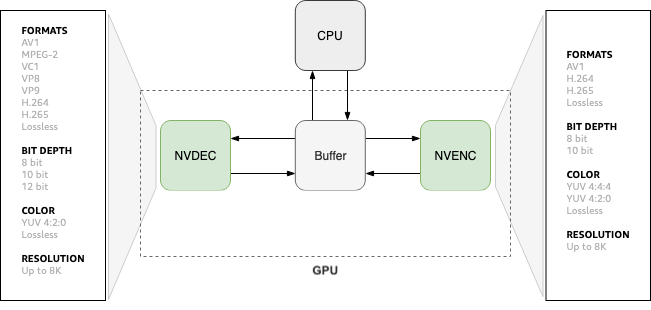
- Some Amazon EC2 instances contain Nvidia GPUs with built-in NVENC (encoding) and NVDEC (decoding) accelerator engines, which can be used for real-time video encoding/decoding with minimal impact on the performance of the CPU or GPU.
Get started with encoding and decoding on AWS by creating a free account today.
Browse all cloud computing concepts
Browse all cloud computing concepts content here:
Did you find what you were looking for today?
Let us know so we can improve the quality of the content on our pages