What Is SCADA?
What is SCADA?
SCADA (Supervisory Control and Data Acquisition) is an architecture used to manage and control industrial operations systems. SCADA involves data acquisition, communications, a centralized server, and interface components for real-time industrial systems and critical infrastructure. SCADA differs from other architectures due to its specialized hardware and software, including remote terminal units (RTUs) and programmable logic controllers (PLCs).
What are the benefits of SCADA?
Industrial organizations use Supervisory Control and Data Acquisition (SCADA) to gain the following benefits.
Operational logging and tracking
SCADA allows factories and other industrial facilities to monitor usage, status, and other operational indicators of machines more effectively. For example, the SCADA system ingests data from various sensor points and stores it on a centralized database. Users then analyze the historical data from the SCADA software. In some cases, modern SCADA systems store and process machine data using edge computing. Edge computing is a technology that enables data processing to take place at a location near the data source, such as a local SCADA control unit.
Automated process control
Industrial organizations can integrate SCADA software solutions with industrial control systems to automate industrial processes. Conventionally, many organizations use manual operations to control production processes.
With SCADA, you automate these control processes to improve operational efficiency and reduce reliance on human intervention. For example, you can configure a SCADA system to automatically log and analyze temperature data across multiple sensors in various facilities, with users setting control points remotely.
Cost efficiency
Industrial companies use SCADA to monitor potential machine failures, operational bottlenecks, and other issues that impact production rates and revenues. Any abnormal events are immediately communicated to the respective personnel for mitigative actions. For example, users are alerted to degrading motor performance and schedule preventive maintenance with technicians to prevent costly downtime.
Enhanced reliability and safety
Factories use SCADA systems to address risks that may impact operators’ well-being and equipment performance. By analyzing data generated by industrial machines, users can reduce accident risks, prevent human errors, and mitigate other operational risks.
How does SCADA work?
SCADA systems work by collecting data from various points of operation in production facilities. They use industrial protocols for data transmission between RTUs, PLCs, and SCADA servers. Depending on the networking technologies used, this data can be processed locally at an edge device or uploaded to a centralized server for processing. The data is then visualized with charts, tables, and diagrams, which operators can use to automate process flow, support decision-making, or monitor performance.
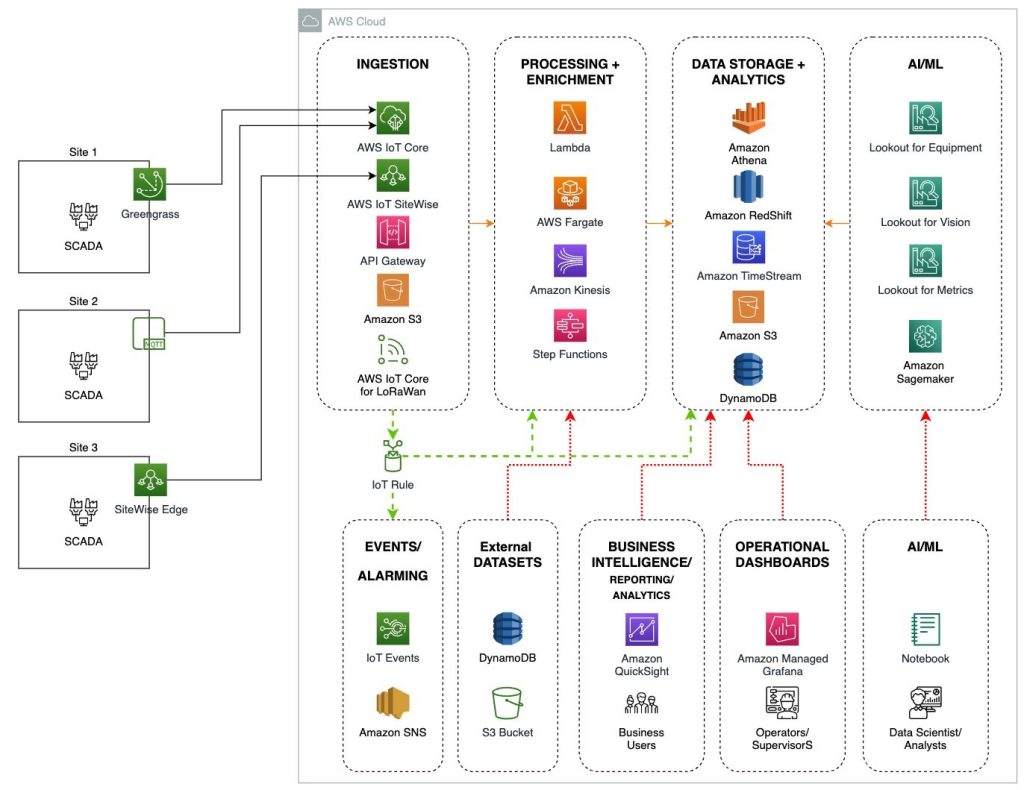
There are several types of SCADA systems with differing control capabilities and installation requirements.
- Monolithic SCADA systems are legacy, centralized systems that monitor industrial processes from a single computer.
- Networked SCADA systems use a distributed architecture and networking technologies to allow data exchange among multiple vendor devices.
- Web-based SCADA systems provide a user interface on browsers so that operators can monitor processes remotely.
- Hybrid SCADA systems perform real-time control at system sites while sending analytics and historical data to the cloud instead of on-premises servers.
Here are the key components of SCADA systems.
Data acquisition layer
PLC and RTU are control units that collect data in a SCADA system. PLC is a self-contained controller that coordinates the control of industrial logic and logs sensor data. Meanwhile, RTU is a specialized controller designed for data acquisition and issuing control commands. In a SCADA installation, users often deploy RTUs at remote locations where deploying cabled communication infrastructure is challenging, so the PLC is located on-site or very close to the site. Both PLC and RTU can ingest various types of data, including temperature, flow, pressure, and voltage.
Communication network
A communication network is a layer of interconnected channels that allows SCADA hardware to exchange data. There are two types of communication in a SCADA system:
- Between field devices and control units. Field devices, such as sensors and actuators, use digital or analog signals to transmit data to PLCs and RTUs.
- Between control units and servers. PLCs and RTUs exchange data with a centralized server using industrial protocols.
Central SCADA server
The SCADA server is the main computer that provides historical data logging and control capabilities. It consolidates all data sent by PLCs and RTUs in local storage. Operators use the server to remotely monitor industrial devices, manage control processes, and generate operational reports.
Human-machine interface (HMI)
HMI refers to human-machine interfaces, such as touch screens or computers, that enable operators to interact with field devices. They provide visual displays of real-time machine statuses and options to configure connected industrial equipment. In addition, operators can send control commands back to the SCADA server through the HMI. Typically, users install their HMIs near or on machines that operators want to control. In some installations, HMIs are in separate control rooms.
What are common SCADA protocols?
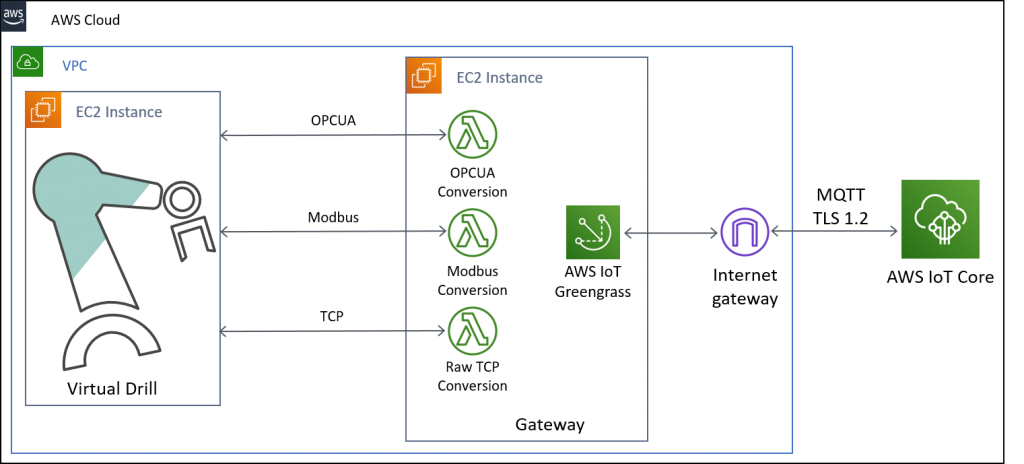
SCADA systems use various types of protocols for data transmission. The choice of protocol depends on specific technical requirements, such as distance, latency, and the types of data for transmission. Here are some common SCADA protocols.
Modbus
Modbus is a widely used communication protocol for controlling industrial processes. It enables PLCs, RTUs, and control servers to exchange data over serial or Ethernet connections. The protocol follows a server-client architecture. A designated server initiates communication, while client units respond to specific Modbus commands.
DNP3
Distributed Network Protocol 3.0 (DNP3) is an industrial protocol that enables reliable data exchange using a server-client or peer-to-peer architecture. It models the Open Systems Interconnection (OSI) architecture, but uses only the application, link, and transport layers. Like Modbus, a SCADA server can initiate communication. DNP-3 uses a request-response cycle.
IEC 60870-5-101/104
Both IEC60870-5-101 and IEC60870-5-104 are SCADA communication protocols commonly used in energy facilities. IEC60870-5-101 uses a serial cable for data transmission, whereas IEC60870-5-104 extends the standard to networked SCADA power systems using TCP/IP.
OPC UA
Open Platform Communications Unified Architecture (OPC UA) is a platform-independent data exchange protocol that supports SCADA, the Internet of Things (IoT), enterprise software, and other applications. When OPC UA is applied in SCADA, it overlays manufacturer-specific industrial protocols, providing a standard method for storing, retrieving, and updating information. OPC UA enables industrial organizations to scale SCADA systems and integrate with existing solutions.
What are the key challenges in SCADA deployment?
Although SCADA is in wide use across industrial applications, organizations still face challenges implementing these systems.
Legacy systems
Some organizations still operate with legacy control and data acquisition systems, which can complicate integration efforts. For example, conventional RTUs, which operate exclusively on serial connections, do not support cloud-based SCADA software. Often, organizations must develop middleware or replace the entire infrastructure to modernize their production facilities.
Security
When SCADA systems are connected to public and private networks, they are exposed to cybersecurity risks. Moreover, conventional SCADA hardware is not designed to manage modern security threats. Organizations should put considerable effort into security with adopting SCADA to avoid the risk of downtime that leads to operational disruptions and revenue loss.
Scalability
Industrial organizations can find managing a growing number of control equipment, data types, and vendor-specific protocols to be a challenging task. Every device needs to be configured differently based on its operating objective. Moreover, you might face vendor lock-in, which makes expansion technically challenging. Onboarding interoperable components should be a key activity in SCADA installations.
Skilled operators
Only qualified operators are authorized to install, operate, and maintain SCADA systems. Therefore, some industrial companies may face difficulties in hiring, training, and retaining the necessary workforce. Moreover, advancements in cloud-based SCADA solutions further exacerbate the skill gaps in implementing a functional and scalable SCADA system. Engaging the right team or outsourcing is critical.
What is the difference between SCADA and ICS?
An industrial control system (ICS) is a general term that encompasses various operational technologies. It includes SCADA, distributed control systems, and other systems that support industrial plants. For example, ICS can refer to conveyor belt systems, fire alarm systems, and robotic arms. Meanwhile, SCADA, as a subcategory of ICS, focuses on systems that process data from industrial equipment and use it intelligently for operational control.
What are SCADA security best practices?
SCADA implementations, particularly when they are integrated with complex cloud environments, require best practice configuration.
Network segmentation
Separate network zones based on their respective purposes, priorities, and data sensitivities. For example, a vital system connected to oil and gas pipelines should be on a self-contained SCADA network. Security teams can also apply defense-in-depth strategies by augmenting network segments with firewalls, role-based access control, and disaster recovery methods.
Least privilege access
Unmanaged access to SCADA systems can increase security risks, such as misconfigured systems and data loss. Apply least privilege access principles to limit the information, configuration, and data that operators need to perform their duties effectively. For example, you provide operations managers with permissions to modify SCADA configurations while limiting floor operators to only view machine status.
Encryption
SCADA systems generate vast amounts of data that require protection. Encrypt data at rest and in transit with strong encryption methods, especially when transmitting across the public internet. For example, use a virtual private network (VPN) to secure the communication channel that PLCs use to exchange data with cloud SCADA software.
Patch management
SCADA devices require ongoing security updates to prevent unauthorized access and operation. Similar to computers, some of these devices run on an operating system that requires regular updates to stay secure. Use a patch management tool to deploy security patch updates and automate vulnerability scans.
Intrusion detection
A large-scale distribution of SCADA devices across a vast region requires increased observability and protection. In most cases, they need an intrusion detection system. An IDS bridges the security gap by monitoring network traffic for suspicious activities. IDS must be specifically tuned for operational technology traffic patterns.
Incident response planning
Industrial plants must develop an incident response plan to quickly resume operations in the event of security incidents. Organizations should train their security teams to understand the security requirements of PLCs, RTUs, network gateways, and servers. They must be able to detect, respond to, and remove threats affecting SCADA systems using appropriate risk management frameworks.
How can AWS support your SCADA requirements?
AWS has a collection of services that allow you to collect, process, and monitor industrial equipment on-site or at the edge, using a SCADA architecture. Combine AWS partner solutions with our range of industrial process automation services, such as:
IoT Greengrass, a service that makes it easier to bring intelligence to edge devices, such as for anomaly detection in precision agriculture or to power autonomous devices.
AWS IoT SiteWise, a managed service that makes it easy to collect, store, organize and monitor data from industrial equipment at scale to help you make better, data-driven decisions.
AWS IoT Core, a service where you can connect, manage, and scale your device fleets easily and reliably without provisioning or managing servers.
Get started with hybrid SCADA on AWS by creating a free account today.
Browse all cloud computing concepts
Browse all cloud computing concepts content here:
Did you find what you were looking for today?
Let us know so we can improve the quality of the content on our pages