AWS Partner Network (APN) Blog
How the Managed Services Model on AWS Grows Up for Agentic AI
By: Brandon Pierce, Chief Technology Officer – Avahi
By: Anshu Kapoor, Sr Partner Solutions Architect – AWS
By: Bappaditya Dutta, WW Tech Lead, MSP – AWS
 |
 |
Enterprises spent $37 billion on generative AI in 2025, up from $11.5 billion the year before, the fastest scaling of any software category on record. Generative AI has left the lab, and the bills now come out of operating budgets.
What arrived with them is a different kind of workload. The systems going live in 2026 are increasingly agentic: they plan across steps, call tools and APIs, carry memory between sessions, and take consequential actions with limited human review. Gartner projects the average global Fortune 500 enterprise will run more than 150,000 AI agents by 2028, and predicts that more than 40% of agentic AI projects will be canceled by the end of 2027 due to escalating costs, unclear business value, or inadequate risk controls. These challenges make operational and business discipline central to an MSP’s role in supporting agentic workloads.
For organizations that already rely on a managed services provider (MSP) to run their AWS environment, agentic workloads expand the scope of that partnership. An AI-ready MSP needs to connect the existing cloud operations practice with evaluation of agent behavior and accountability for business outcomes. In this post, we examine the evolution of managed services on AWS for agentic AI, starting with Avahi’s use of agents in its own operations. We then explore the three operational pillars these workloads introduce and what customers should expect from an AI-ready MSP engagement, followed by questions leaders can use to assess readiness.
Why the MSP foundation still matters
An MSP partnership on AWS supports incident response, operational risk management, and cost discipline, helping the customer’s engineers dedicate more time to the business rather than the underlying infrastructure. That value comes from embedding with the customer’s engineers rather than running a remote ticket queue.
Consider Riptide, whose lean team juggled AWS operations and client dashboards. Avahi embedded on its data platform with automated health checks, a sub-two-hour critical-response Service-Level Agreement, and incident response. Before monitoring, issues could go unreported. When a schema change silently broke replication, the checks flagged the first failure, and Avahi traced the cause that morning. Riptide’s engineers run its AI assistant, Ripley. An AI-ready practice builds on that scoped foundation.
AI-first starts inside the MSP
Without agents, a project kickoff package takes two to three days of a project manager’s effort, spread across roughly a week of scheduling and review. At Avahi, agents now generate an initial package in under six minutes, and a reviewer completes it the same day. Agent-generated first drafts remove the wait on project manager availability and give the solutions architect and account manager more time to review. Related workflows follow the same pattern: a Jira backlog that takes four to eight hours to prepare generates in about fifteen minutes, and a case study draft is ready within a day instead of waiting two to four weeks in the post-project queue. Our agents draft statements of work and level-of-effort estimates, along with project delivery materials and case studies. They run on demand through Slack or in response to workflow events, with access limited to the systems each task requires. Agents may pass work to other agents, while human reviewers remain responsible for approving the resulting output. Operating these workflows has helped us identify where evaluation gates and approval checkpoints are needed, how to scope access, and what support teams need when an agent fails. That experience informs the controls we bring to customer engagements and the operational pillars described below.
What agentic workloads add to the mandate
Agentic workloads retain AWS foundations and operational disciplines, adding inference cost, output quality, and governance requirements summarized in Figure 1. An agent’s behavior depends on the model version, prompt, retrieved context, and available tools. Any of these can change without a code deployment. Behavior can drift without triggering an infrastructure alarm. An agent needs a defined scope, credentials sized to its job, supervision proportional to its autonomy, and regular review. Because retrieved context shapes an agent’s behavior, knowledge maintenance is part of this operating responsibility. An AI-ready MSP helps keep knowledge sources current, evaluates retrieval quality, and defines per-agent data access and memory retention rules with the customer.
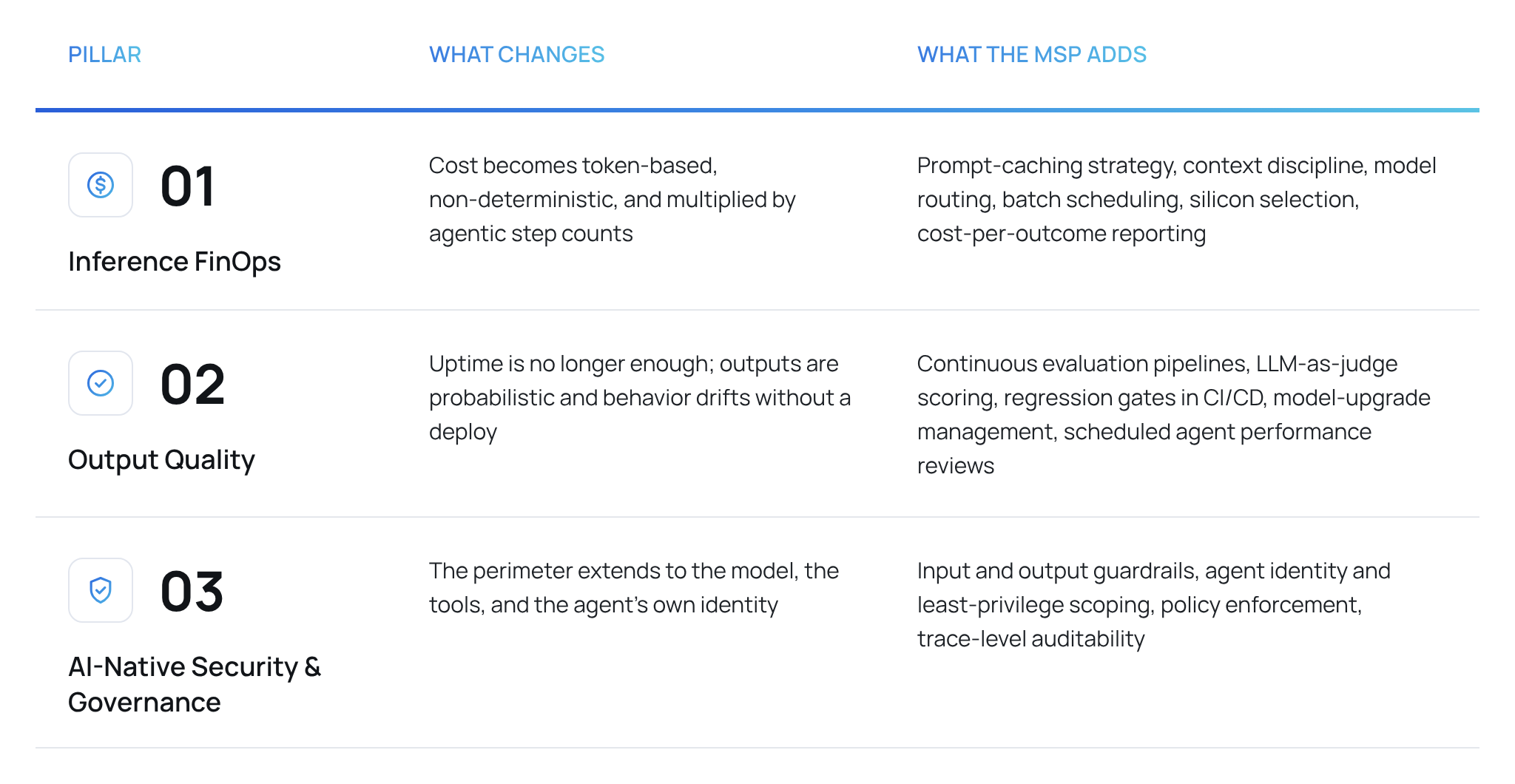 Figure 1 – Avahi’s Three Pillars for an AI-Ready MSP
Pillar 1: Inference FinOps
Traditional cloud cost management assumes predictable, resource-based spend. AI inference breaks that: spend is token-based and tied to prompt design, model selection, and retrieved context, making it non-deterministic. Agentic workloads sharpen the problem: a single request may fan out into a dozen model calls as the agent plans, retrieves, invokes tools, and retries. That spend has gone from niche to mainstream: 98% of organizations now manage AI spend, up from 31% two years ago, and the capability they most lack is granular monitoring of token, request, and GPU cost. An AI-ready MSP applies Figure 2’s cost controls: prompt caching, context trimming, suitable workload batching, and evaluation of model routing. Step limits help contain unbounded agent loops.
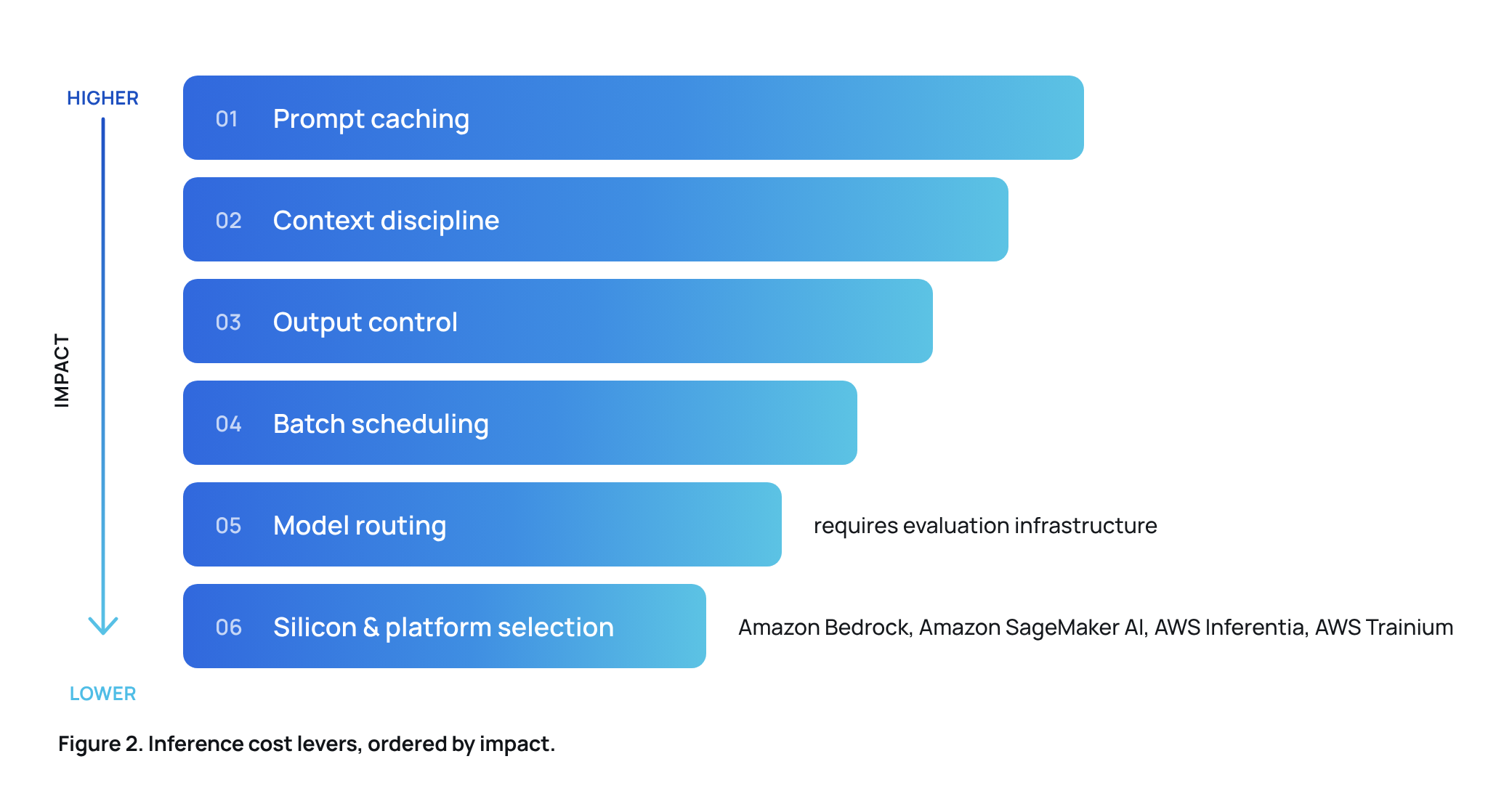 Figure 2 – Inference cost levers, ordered by impact
The most important change is the unit of measurement. Cost per token can improve while the number that matters gets worse; for example, in a support workflow, a cheaper model that fails more often raises the cost per resolved ticket. The metric an AI-ready MSP reports is cost per successful outcome, which requires cost and quality telemetry to be joined. That is why Pillars 1 and 2 cannot be run independently.
Pillar 2: Output quality
Every call can return HTTP 200 while an agent does the wrong thing. Output quality therefore needs monitoring alongside availability. Amazon Bedrock AgentCore Evaluations supports evaluation of agent behavior, while Amazon Bedrock AgentCore Observability provides traces and monitoring through Amazon CloudWatch. An MSP can use these signals to evaluate sampled production traffic and investigate failures after launch. Prompts, model versions, and tool definitions should be versioned artifacts, with changes gated on a regression suite. Incident procedures should define timeouts, escalation paths, and a way to suspend an agent that takes an authorized but incorrect action.
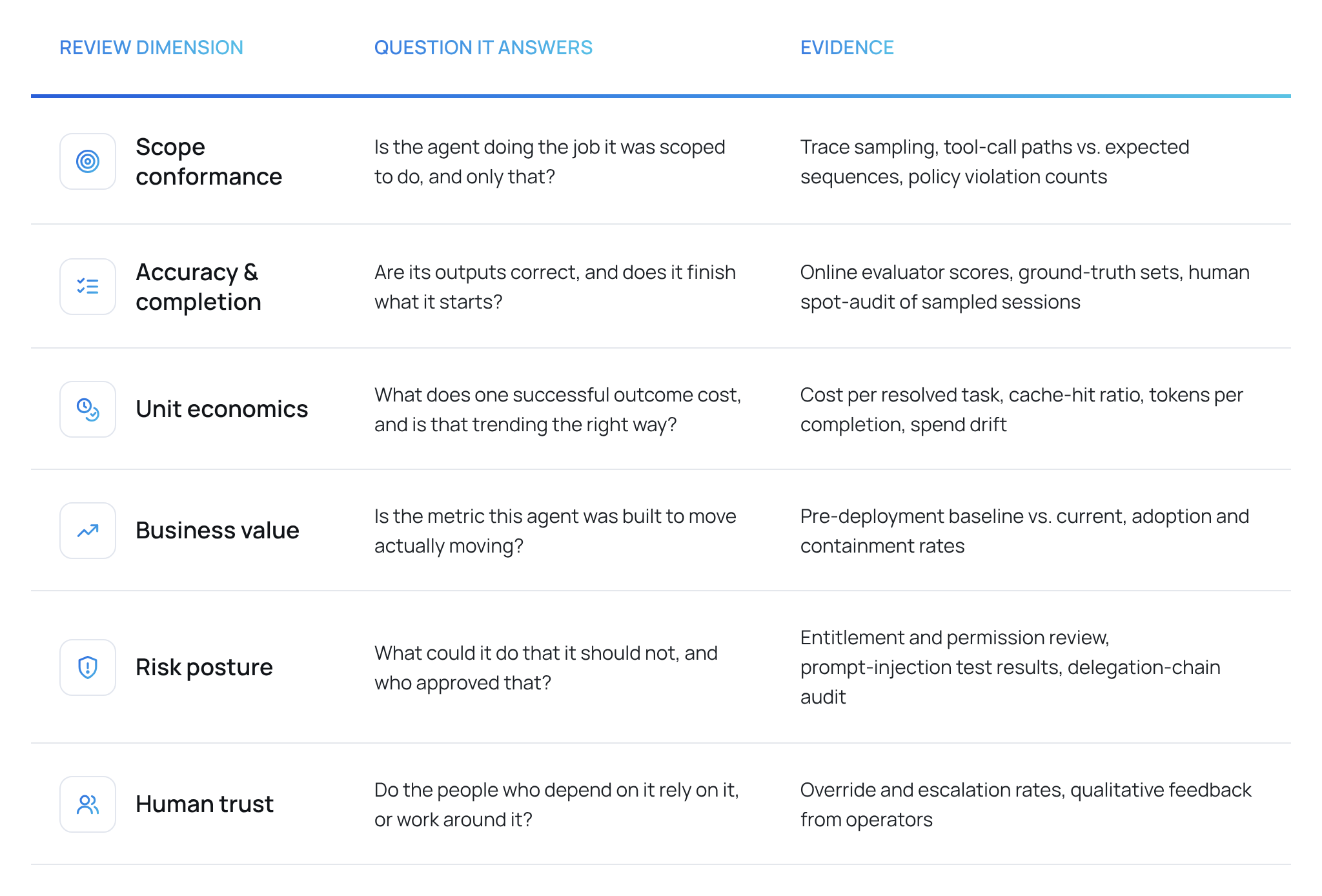 Figure 3 – Agent review dimensions
OOTB Education, a New York EdTech company, illustrates how evaluation can be built into a generative AI workflow. Avahi built a worksheet platform on Amazon Bedrock with an evaluation layer that validates generated content against rubrics before it reaches a student.
Each agent needs scheduled reviews against a pre-launch business baseline. Using Figure 3’s dimensions, a named owner decides whether to keep, retune, re-scope, or retire it based on quality, cost, risk, and its intended business metric.
Pillar 3: AI-native security and governance
AI workloads extend the security surface beyond infrastructure. Prompt injection, jailbreaking, and data exfiltration through model output require controls at the application and model layers. An agent also holds credentials, invokes tools, and may delegate to other agents. Amazon Bedrock Guardrails adds input and output safeguards. Amazon Bedrock AgentCore Identity supports credential management, Amazon Bedrock AgentCore Gateway centralizes tool access, and Amazon Bedrock AgentCore Policy enforces rules on tool calls. Assign a human owner and scoped permissions to each agent, with trace records and a revocation path.
What an AI-ready MSP engagement looks like
The engagement still depends on a team that works alongside the customer’s engineers, shares context, and remains accountable for outcomes. What expands is the surface it owns: token-level inference cost, ongoing evaluation, model-upgrade pipelines, and agent identity and governance. It shows up as new artifacts rather than a new org chart: an agent inventory with named owners, a golden evaluation dataset per agent, and reporting on cost per successful outcome in the monthly spend review. An existing MSP foundation provides continuity, shared context, and trust with the engineering team. AWS services provide the technical building blocks for extending that practice to AI operations. Avahi’s MSP engagement is validated through an independent third-party audit across the full cloud lifecycle, maintained through annual re-audit. For leaders assessing readiness, five questions cut to the core:
- Can your MSP tell you what one successful outcome costs, or only what last month’s bill came to?
- Do changes prompted by model deprecation or prompt updates pass regression tests before reaching users?
- Does every agent in production have a named owner, a scoped identity, and a documented review?
- Does your MSP use agents in its own operations, and what measurable improvement has that delivered?
- Can your MSP show the business metric each agent has improved against a baseline established before launch?
Conclusion
An AI-ready MSP engagement should make accountability explicit: who owns each agent, how changes are tested, and how business results are reviewed. Use the readiness questions in your next MSP review to identify gaps and agree on actions with your partner.
For further reading, explore the APN Blog’s perspectives on forward-deployed engineering for enterprise AI. To learn more about Avahi’s managed services, visit AWS Marketplace.

Avahi – AWS Partner Spotlight
Avahi is an AWS Premier Partner, a validated member of the AWS Managed Service Provider (MSP) Program, and holder of the AWS AI Services Competency with both Generative AI and Agentic AI designations, helping enterprises operate AI and agentic workloads in production on AWS.