AWS Marketplace
Private offer auto-renewals: Scale predictable revenue with AWS Marketplace
Private offer auto-renewals are now live in AWS Marketplace, in which a buyer and seller agree to the original offer terms and future auto-renewal terms one time, at offer creation. Each agreement then renews automatically without rebuilding offers or chasing approvals, with opt-out rights for both parties.
Most renewals aren’t a fresh decision: the buyer relies on the service and wants to keep it running, and the seller wants to retain and grow the account. Buyers also value a low-touch path for vendors they plan to keep. Neither side wants to walk away, yet renewal dates still might lapse. The friction can sit in the mechanics, and as your book of renewals grows, that overhead becomes a resourcing constraint.
In this post, we cover how auto-renewals for AWS Marketplace private offers work, the pricing options, and how to get started. The post is written for sellers, with buyers in mind.
How AWS Marketplace private offer auto-renewals work
Sellers and buyers can use low-touch renewals in AWS Marketplace. The seller sets the agreed terms, the buyer accepts, and AWS handles execution from there, notifying both parties of changes and generating each new agreement without anyone rebuilding an offer or clicking “Accept” again.
Each renewal cycle runs on the same parameters: pricing, duration, and renewal decision deadline carry forward automatically. If the original offer used an installment plan, each renewal must also include one, though the cadence can change between cycles (for example, monthly on the original, then quarterly on renewals). Currency, payment terms, and end-user license agreement attachments also persist. Renewal duration can be annual, quarterly, monthly, or custom. No further approvals, offer creation, or buyer action is required.
Renewal history is viewable on the respective buyer and seller consoles. Both parties see the full renewal history on a single timeline: the original offer, auto-generated renewal cycles, and upcoming renewals. This gives each side a clear record of where they are in the overall timeline and which agreement is currently active.
Building your offer
Choose the pricing scenario that fits the deal: no price uplift (flat renewal), fixed percentage uplift (pre-determined fixed uplift), or percentage range uplift. Regardless, the ability for either party to exit the agreement using the agreed opt-out deadline remains.
Flat renewal (no price uplift)
In this renewal configuration, the seller and buyer set a contract that renews exactly the same as the original terms. Sellers gain renewal revenue predictability and the buyer locks in consistent pricing terms. Configure one time as unlimited and run until opt-out, or set a definite number of auto-renewing cycles.
Uplift: Fixed percentage renewal (definite or unlimited)
For a price uplift, the seller and buyer set a single fixed percentage, applied uniformly across pricing dimensions and agreed up front. It compounds, so a 2 percent uplift on a $10,000 contract becomes $10,200 on the first renewal cycle and $10,404 on the second renewal cycle. This fits a traditional software as a service (SaaS) known uplift auto-renewal scenario: a multi-year agreement with an agreed annual uplift. For example, recurring 1-year deals you renew on similar terms each cycle. If you’re already rebuilding the same offer year after year, this configuration automates it.
Uplift: Percentage range renewal
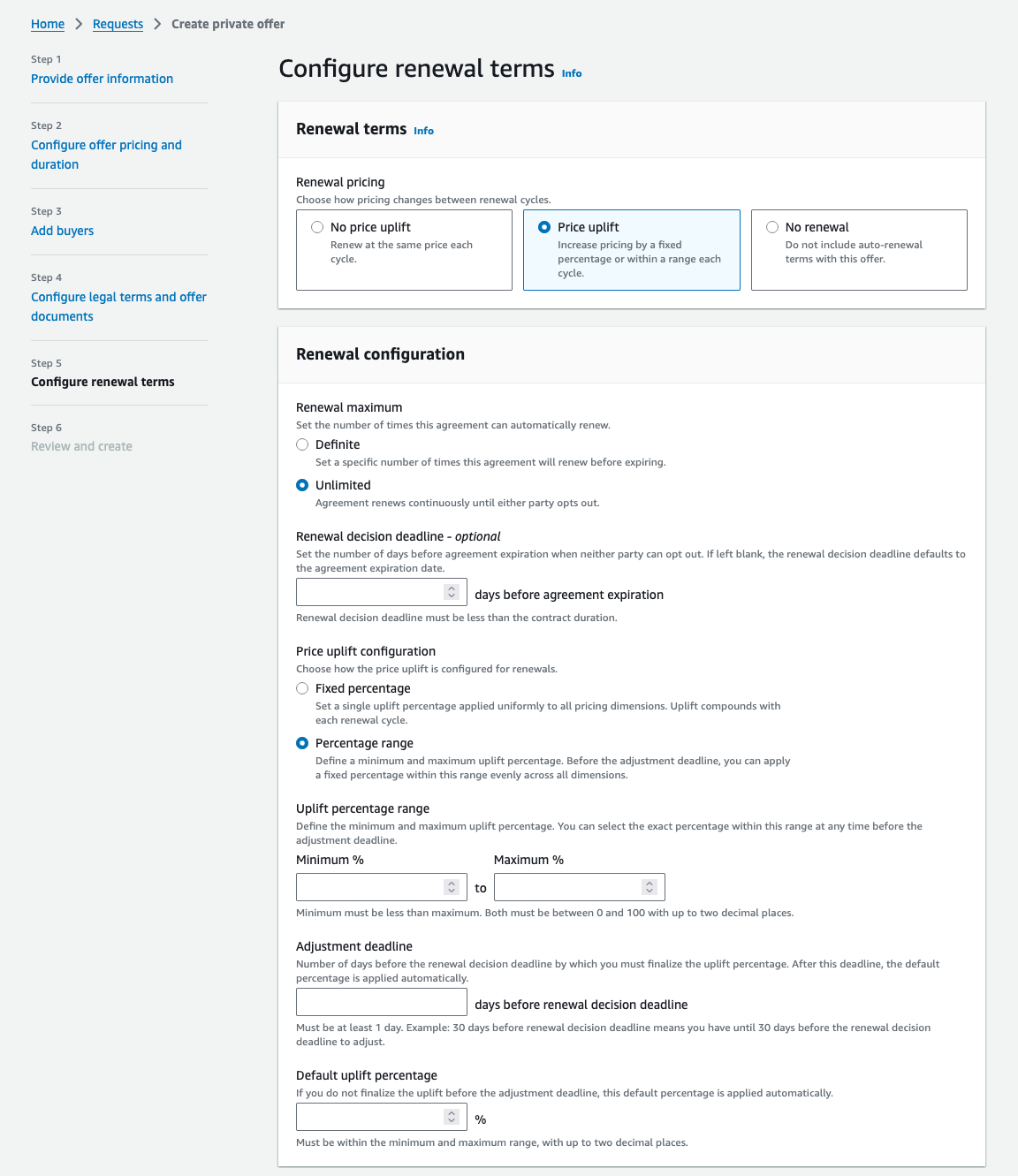
Use a percentage range if there is expected inflation, or index-linked pricing, such as the Consumer Price Index (CPI). In this scenario, the exact uplift isn’t known until closer to the renewal. The seller and buyer define and agree to a minimum and maximum uplift percentage range, and the seller finalizes the exact uplift percentage before the adjustment deadline. This deadline is the number of days ahead of the renewal decision deadline by which the seller must finalize the uplift. If the seller doesn’t finalize, the default uplift percentage (accepted by the buyer) applies automatically. Buyers get pricing certainty aligned to inflation and the seller gets more predictable revenue. Before the deadline, you can apply the uplift equally or set a different percentage per pricing dimension, as long as each stays within the approved range.
Renewal duration: Definite or unlimited
The renewal duration sets how many times an agreement can be renewed. With unlimited renewal cycles, the agreement renews continuously based on the originally set contract. For example, a month-to-month subscription with no determined endpoint. With definite renewals, you set a specific number of renewal cycles before the overall agreement expires. For example, a 1-year agreement with two renewals equals 3 total years, configured one time. This is ideal when both parties want a fixed multi-year term with a defined end date. Both definite and unlimited auto-renewal durations support opt-out rights and reduce overhead after initial configuration.
Renewal decision deadline
Each auto-renewal includes an optional, configurable renewal decision date: the deadline to cancel the next renewal cycle. This is a set number of days before the agreement auto-renews. If left blank, at the time of offer acceptance, it defaults to the agreement’s expiration date. Each party gets notified and the current agreement completes, with no renewal. If a buyer opts out, they can still opt back in before the renewal decision deadline passes.
Figure 1: Example of how to configure renewal terms, including uplift type, renewal duration, and decision deadlines.
Stay informed: Renewal notifications
AWS Marketplace notifies both parties at the key moments in a renewal’s lifecycle: upcoming renewals, the approaching adjustment deadline and renewal decision deadline, opt-outs, and completed renewals. These events are also available through Amazon EventBridge, so you can route them into your own systems, such as customer relationship management (CRM), billing, or internal alerting. This is useful for third-party integrations that key off the event detail-type.
To avoid missing renewal decision deadlines, set up AWS User Notifications to get renewal alerts delivered to your preferred channel: email, mobile, or directly in Slack or Microsoft Teams. Add a team distribution or messaging channel for multiple recipients to keep your procurement and finance teams in the loop.
What buyers gain
Buyers benefit from the following features:
- Service continuity – Software is designed to stay active through renewals, helping reduce the risk of gaps from a late purchase order or an offer not rebuilt in time. Purchase orders carry over.
- Consolidated procurement visibility – Buyers get a view across renewing products, with dates, terms, and pricing in one place.
- Predictable, agreed-upon pricing – This continues terms already agreed, not a new negotiation. Buyers know on day one what their renewal economics look like, with terms agreed up front.
- Committed-spend drawdown, even on smaller deals – If a buyer has a spend commitment with AWS, eligible AWS Marketplace transactions can count toward it, so both smaller and larger renewals help draw down that commitment with less renewal-time friction.
- Opt-out rights – Auto-renewals are an agreed commitment with a clear exit path for the buyer, including the ability to opt back in before the opt-out deadline passes.
Why this works at scale
For smaller deals, the time spent rebuilding and tracking renewals can outweigh the margin, so they lapse or never reach AWS Marketplace to begin with. Auto-renewals cut the per-deal overhead time, so the process works the same whether you’re renewing a $500 agreement or a $500,000 one.
Often, lapsed renewals aren’t a sign that buyers want to leave; the process just got in the way. Auto-renewals remove that friction.
They also support the transition play: bringing direct independent software vendor (ISV) renewals into AWS Marketplace for the first time. Configure one time, and each cycle executes automatically, making it practical to move even modest recurring agreements where buyers get procurement visibility and you get listing-fee economics and co-sell support.
Economic benefits
Private offer auto-renewals on AWS Marketplace deliver cost savings and operational benefits that are unique to AWS Marketplace users.
Customers purchasing from participating ISVs and sellers can earn AWS Promotional Credits through the AWS Marketplace Private Offer Promotion Program (MPOPP). Qualifying renewals also draw down against a customer’s existing committed spend with AWS, positioning the renewal as a budget line item rather than a new purchase decision.
Auto-renewals qualify for the same reduced listing fees as traditional AWS Marketplace renewals. And because sellers configure one time and manage programmatically, deal desk and procurement teams can support growing renewal volume without added headcount, freeing capacity for more deals—including smaller transactions that previously couldn’t justify the overhead, or prioritization of critical large-value deals.
Get started
To get started with private offer auto-renewals in AWS Marketplace, take the following next steps:
- Review your opportunities – Use the renewals dashboard to assess open AWS Partner Central Engagement (ACE) opportunities and find agreements to move to private offer auto-renewal terms.
- Configure a low-touch auto-renewal today – Follow the guidance in this post to set up auto-renewal on your next private offer.
- Learn more – See the private offers seller guide and buyer guide for more details.
Acknowledgements
Special thanks to:
- Asha Thoyakat, Senior Product Manager–Technical, AWS Marketplace: Product Owner
- Riva Fouzdar, Senior User Experience Designer, AWS Marketplace: UX Design Owner
- Leonardo Ladeira, Senior Manager, Software Development, AWS Marketplace: Lead, Software Development Team
- David Barba, Manager, Software Development, AWS Marketplace: Lead, Software Development Team
- Soumya Vanga, Senior Specialist Solutions Architect, AWS Marketplace: Solutions Architect, Product
- Simon Panek, AMER, Partner Solutions Architect, Strategic Partner Support
- Ai Wen Wong, Mgr, Support Engineering · Kyle Wallinder, Support Engineer · Mao Aoki, Support Engineer — AWS Marketplace Engineering, User Acceptance Testing (UAT)
© 2026, Amazon Web Services, Inc. or its affiliates. All rights reserved.