AWS Big Data Blog
Designing centralized and distributed network connectivity patterns for Amazon OpenSearch Serverless – Part 1
Amazon OpenSearch Serverless is a fully managed, serverless option for Amazon OpenSearch Service that removes the operational complexity of provisioning, configuring, and tuning OpenSearch clusters. When you run OpenSearch Serverless collections in a central account and need secure, private access from both on-premises environments and multiple AWS accounts, network architecture becomes critical. In this post, we explore two patterns to help you achieve this connectivity securely.
Solution overview
Working with customers implementing OpenSearch Serverless, we published blog posts addressing various network connectivity patterns to meet their evolving requirements:
- In Network connectivity patterns for Amazon OpenSearch Serverless, we covered foundational patterns such as public access via internet gateway, private access through interface VPC endpoints, multi-VPC connectivity, and on-premises access using Route 53 VPC Resolver inbound endpoints.
- In Designing centralized and distributed network connectivity patterns for Amazon OpenSearch Serverless, we introduced two advanced multi-account patterns: a centralized interface VPC endpoint model using Amazon Route 53 Profiles and a distributed endpoint model with centralized DNS management through a self-managed private hosted zone (PHZ).
In this post, we build on those patterns to address an additional enterprise requirement. When you manage many OpenSearch Serverless collections centrally but need access from multiple accounts and on-premises, you face several key challenges:
- Coordinating VPC endpoints across accounts: managing endpoint provisioning and lifecycle across many consumer accounts adds operational overhead
- Managing DNS configurations for each consumer: each new account or on-premises environment requires its own DNS setup, increasing complexity
- Separating networking responsibilities from application ownership: without clear boundaries, networking and application teams become tightly coupled, slowing down both
This architecture solves these challenges with a clear separation of responsibilities. The central networking account shares Route 53 Profiles to manage DNS propagation across spoke accounts. The OpenSearch Serverless account owner maintains full control over their VPC endpoint and the associated private hosted zones (PHZs). Application owners retain autonomy over DNS configuration and collection management.
A single VPC endpoint handles multiple OpenSearch Serverless collections in an AWS Region, which reduces complexity and cost. Your networking team manages connectivity infrastructure while your application teams independently manage their OpenSearch Serverless collections, data access policies, and collection-specific DNS configurations. This gives you connectivity from on-premises networks (through AWS Direct Connect or AWS Site-to-Site VPN) and from compute resources across multiple AWS accounts through a unified network path.
This separation means that your network administrators and application teams can work independently. The result is a governance model that scales with your organization. We cover two complementary patterns that together give you complete hybrid access coverage, Pattern 1 for on-premises access and Pattern 2 for multi-account access, both using centralized interface VPC endpoints and Route 53 Profiles.
Before proceeding, you should be familiar with OpenSearch Serverless interface VPC endpoint DNS resolution. When creating an OpenSearch Serverless interface VPC endpoint, AWS automatically provisions four private hosted zones. The zones are three visible private hosted zones (for collections, dashboards, and FIPS endpoints) and one hidden internal private hosted zone that work together to resolve collection endpoints to private IP addresses. For more details on this DNS resolution mechanism, customers can review our previous blog post.
Pattern 1: Accessing multiple OpenSearch Serverless collections from on-premises through a centralized VPC endpoint and Route 53 Profiles in a multi-account architecture
The architecture spans three components:
- A central OpenSearch Serverless account that hosts the collections and interface VPC endpoint.
- A central networking account that owns the Route 53 Profiles and Inbound Resolver.
- An on-premises environment connected using AWS Direct Connect or AWS Site-to-Site VPN.
The following diagram illustrates the architecture across these three components. It shows how DNS queries from on-premises clients are resolved through the Route 53 Profile and Inbound Resolver, and how data traffic reaches the OpenSearch Serverless collections using AWS PrivateLink.
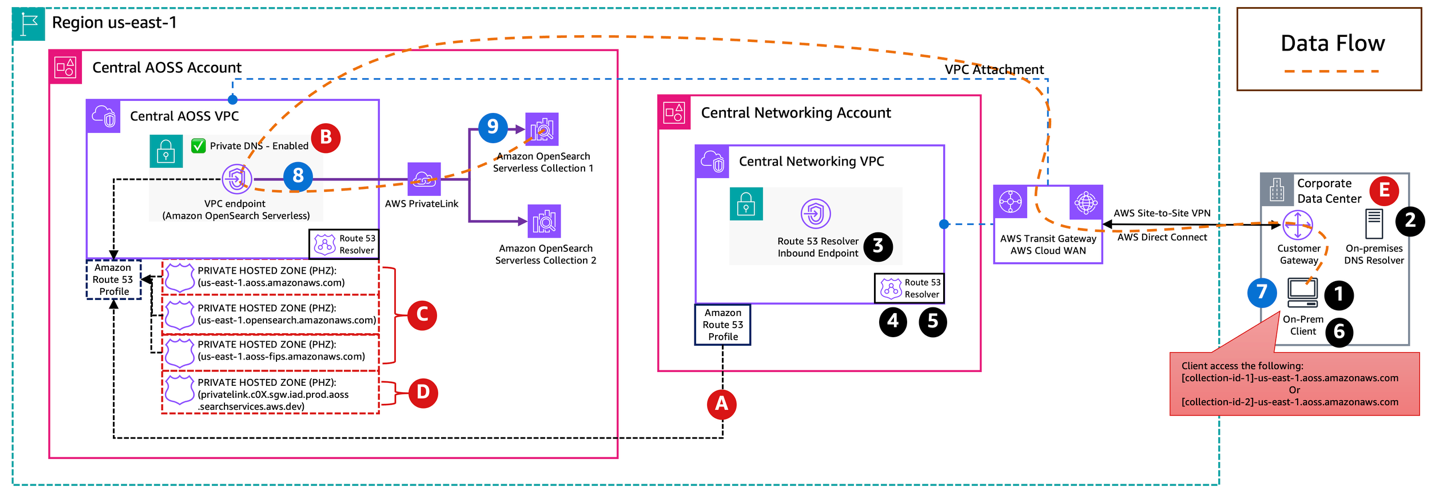
(A) The Route 53 Profiles are created in the central networking account and shared through AWS Resource Access Manager (AWS RAM) with the central OpenSearch Serverless account. The central OpenSearch Serverless account associates the PHZs and interface VPC endpoint association with the shared Route 53 Profiles because that’s needed for end-to-end private DNS resolution.
(B) The central AOSS VPC contains an interface VPC endpoint for OpenSearch Serverless with Private DNS enabled. There are four Private Hosted Zones (PHZs):
us-east-1.aoss.amazonaws.comus-east-1.opensearch.amazonaws.comus-east-1.aoss-fips.amazonaws.comprivatelink.c0X.sgw.iad.prod.aoss.searchservices.aws.dev
(C) The first three PHZs must be manually associated with the Route 53 Profile.
(D) The fourth is automatically associated when the VPC endpoint is associated with the profile.
(E) On the on-premises side, the DNS resolver is configured with conditional forwarding for us-east-1.aoss.amazonaws.com, directing queries to the Route 53 Resolver Inbound Endpoint in the central networking account.
DNS resolution flow
- Your on-premises client initiates a request to
collection-id-1.us-east-1.aoss.amazonaws.com. - The on-premises DNS resolver has a conditional forwarder for
us-east-1.aoss.amazonaws.comand forwards the query over AWS Direct Connect or AWS Site-to-Site VPN to the Route 53 Resolver inbound endpoint IPs in the central networking VPC. - The inbound resolver receives the query and passes it to the Route 53 VPC Resolver.
- The VPC Resolver checks the Route 53 Profiles associated with the central networking VPC. The Profiles provide access to the visible and hidden PHZs from the central OpenSearch Serverless VPC.
- The VPC Resolver uses the visible PHZ to match the wildcard CNAME
*.us-east-1.aoss.amazonaws.comto the interface VPC endpoint (VPCE) DNS name. It then uses the hidden PHZ to resolve the VPCE DNS name to the private elastic network interface (ENI) IP addresses of the interface VPC endpoint in the central OpenSearch Serverless VPC. - The private ENI IP addresses are returned through the inbound resolver endpoint to the on-premises DNS resolver and back to the on-premises client.
Data flow
- The on-premises client sends an HTTPS request to the resolved private ENI IP address with the TLS Server Name Indication (SNI) header set to
collection-id-1.us-east-1.aoss.amazonaws.com, over AWS Direct Connect or AWS Site-to-Site VPN through AWS Transit Gateway or AWS Cloud WAN. - Traffic reaches the interface VPC endpoint ENIs in the central OpenSearch Serverless VPC.
- The interface VPC endpoint forwards the request to the OpenSearch Serverless service, which routes to Collection 1.
To access Collection 2, the client follows the same flow using collection-id-2.us-east-1.aoss.amazonaws.com. The wildcard DNS resolves to the same interface VPC endpoint, and the OpenSearch Serverless service routes to the correct collection based on the hostname.
Pattern 2: Accessing multiple OpenSearch Serverless collections from spoke accounts using a centralized VPC endpoint and Route 53 Profiles
While Pattern 1 addresses on-premises access, you might also need to provide access from compute resources and distributed applications across multiple AWS accounts. With this pattern, any compute resource running within spoke account VPCs can privately access multiple OpenSearch Serverless collections hosted in a central OpenSearch Serverless VPC through a single shared interface VPC endpoint.
In the following example, we use an Amazon Elastic Compute Cloud (Amazon EC2) instance as a compute resource to illustrate the pattern. However, the same approach applies to any compute resource within the spoke VPC.
The following diagram illustrates this multi-account architecture, showing how spoke account VPCs resolve DNS and route data traffic to the central OpenSearch Serverless collections through the shared Route 53 Profile and AWS PrivateLink, alongside the on-premises access path from Pattern 1.
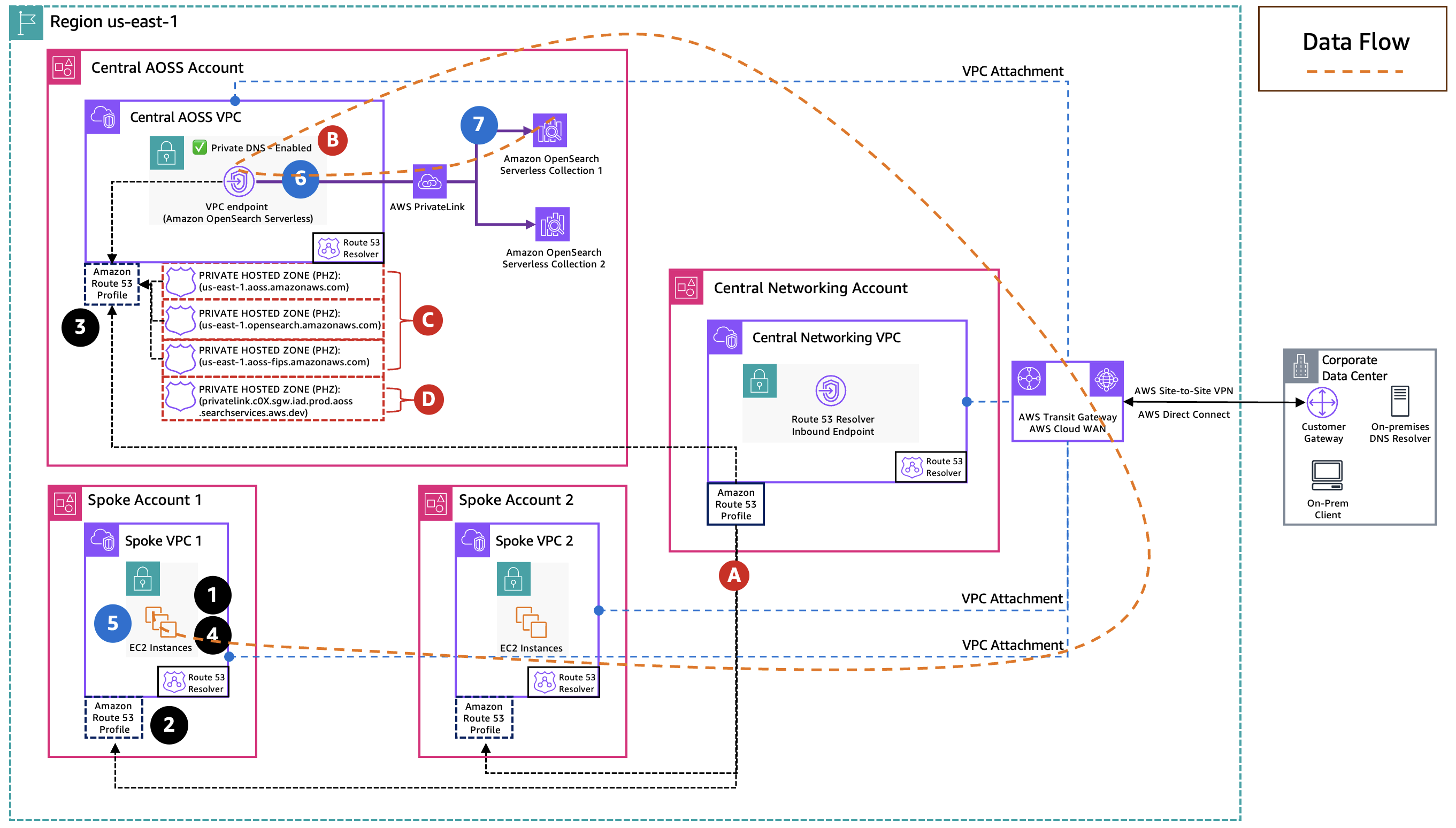
(A) The Route 53 Profiles, created in the central networking account, are shared via AWS RAM with both the OpenSearch Serverless account and the spoke accounts. The OpenSearch Serverless account associates its interface VPC endpoint and private hosted zones (PHZs) with the Profiles, while each spoke account associates the Profiles with its VPC. Spoke VPCs get full DNS resolution for OpenSearch Serverless collection endpoints without requiring their own interface VPC endpoints, PHZs, or manual DNS configuration.
(B) The central AOSS VPC contains an interface VPC endpoint for OpenSearch Serverless with Private DNS enabled. There are four Private Hosted Zones (PHZs):
us-east-1.aoss.amazonaws.comus-east-1.opensearch.amazonaws.comus-east-1.aoss-fips.amazonaws.comprivatelink.c0X.sgw.iad.prod.aoss.searchservices.aws.dev
(C) The first three PHZs must be manually associated with the Route 53 Profile.
(D) The fourth is automatically associated when the VPC endpoint is associated with the profile.
DNS resolution flow
- An Amazon EC2 instance in Spoke VPC 1 initiates a request to
collection-id-1.us-east-1.aoss.amazonaws.comand sends a DNS query to the Route 53 VPC Resolver. - The VPC Resolver finds the Route 53 Profiles associated with the spoke VPC, which carries the PHZs from the central OpenSearch Serverless account.
- The visible PHZ matches the wildcard CNAME
*.us-east-1.aoss.amazonaws.comto the VPCE DNS name. The hidden PHZ resolves the VPCE DNS name to the private ENI IP addresses of the interface VPC endpoint in the central OpenSearch Serverless VPC. - Route 53 returns the private ENI IP addresses to the Amazon EC2 instance.
Data flow
- Your Amazon EC2 instance sends an HTTPS request to the resolved private ENI IP address with the TLS SNI header set to
collection-id-1.us-east-1.aoss.amazonaws.com. This is routed through AWS Transit Gateway or AWS Cloud WAN to the central OpenSearch Serverless VPC. - The request arrives at the interface VPC endpoint ENIs in the central OpenSearch Serverless VPC.
- The interface VPC endpoint forwards the request to the OpenSearch Serverless service, which routes to Collection 1.
To access Collection 2, the same flow applies using collection-id-2.us-east-1.aoss.amazonaws.com. The same applies to resources in Spoke Account 2 or other spoke accounts with the Route 53 Profiles associated.
AWS RAM Permission Configuration for Resource Association
When the central networking account shares the Route 53 Profiles through AWS RAM, the default AWS managed permissions policy (AWSRAMPermissionRoute53ProfileAllowAssociationActions) only grants actions for associating and disassociating the Profile with VPCs, viewing Profiles details, and listing associations. It does not include the route53profiles:AssociateResourceToProfile or route53profiles:DisassociateResourceFromProfile actions required for the OpenSearch Serverless account to associate its interface VPC endpoint and PHZs with the shared Profiles.
To enable this, the central networking account must create a custom managed permission in AWS RAM with the following actions:
route53profiles:AssociateProfileroute53profiles:AssociateResourceToProfileroute53profiles:DisassociateProfileroute53profiles:DisassociateResourceFromProfileroute53profiles:GetProfileroute53profiles:GetProfileResourceAssociationroute53profiles:ListProfileAssociationsroute53profiles:ListProfileResourceAssociationsroute53profiles:ListProfiles
This custom permission must be attached to the RAM resource share before the central OpenSearch Serverless account can associate its PHZs and interface VPC endpoint with the Profiles.
Cost considerations
The architecture patterns described in this post use several AWS services that may contribute to your overall costs, including Amazon Route 53 (hosted zones, DNS queries, and Resolver endpoints), and Route 53 Profiles. We recommend reviewing the official AWS pricing pages for the most current rates:
For a full cost estimate tailored to your workload, use the AWS Pricing Calculator.
Conclusion
In this post, we showed how organizations can provide secure, private access to multiple OpenSearch Serverless collections from both on-premises environments and distributed AWS accounts using a single centralized interface VPC endpoint and Route 53 Profiles. This architecture centralizes OpenSearch Serverless collections and network infrastructure in a dedicated account, using Route 53 Profiles to propagate DNS across accounts. This eliminates per-account VPC endpoints, manual PHZ associations, and custom DNS configuration in spoke accounts.
This pattern is a good fit when a single team or business unit manages OpenSearch Serverless collections centrally. However, many enterprises have business units that need to independently manage their own OpenSearch Serverless collections in separate AWS accounts, each with their own interface VPC endpoints, security policies, and collection lifecycle. In Part 2, we explore how the architecture changes to support this distributed ownership model, where each business unit runs OpenSearch Serverless in their own account while still relying on centralized network connectivity and DNS management through Route 53 Profiles. We will cover how DNS resolution and the Route 53 Profiles configuration adapt when interface VPC endpoints and collections are spread across multiple accounts.
For additional details, refer to the OpenSearch Serverless VPC endpoint documentation and Route 53 Profiles documentation.