AWS Compute Blog
Category: Announcements

Understanding Amazon Machine Images for Red Hat Enterprise Linux with Microsoft SQL Server
This post is written by Kumar Abhinav, Sr. Product Manager EC2, and David Duncan, Principal Solution Architect. Customers now have access to AWS license-included Amazon Machine Images (AMI) for hosting their SQL Server workloads with Red Hat Enterprise Linux (RHEL). With these AMIs, customers can easily build highly available, reliable, and performant Microsoft SQL Server […]

Announcing migration of the Java 8 runtime in AWS Lambda to Amazon Corretto
Beginning July 19, 2021, the Java 8 managed runtime in AWS Lambda will migrate from the current Open Java Development Kit (OpenJDK) implementation to the latest Amazon Corretto implementation.

Register now for the Serverless Live virtual event
The AWS Serverless team is excited to bring you the second annual serverless-first event, Serverless Live, on May 19. We’ll be livestreaming technical deep dives, demos, and live Q&A to help you get the most out of the cloud. The event opens with a keynote by Adrian Cockcroft, VP of Sustainability Architecture. It’s followed by […]
Scaling your applications faster with EC2 Auto Scaling Warm Pools
This post is contributed by Scott Horsfield, Principal Solutions Architect for EC2 Scalability, Surabhi Agarwal, Senior Product Manager for EC2 Auto Scaling, and Chad Schmutzer, Principal Developer Advocate for Amazon EC2. Customers have been using EC2 Auto Scaling to architect sophisticated, scalable, and robust applications on the AWS Cloud for over a decade. Launched in […]
Optimizing AWS Lambda cost and performance using AWS Compute Optimizer
This post is authored by Brooke Chen, Senior Product Manager for AWS Compute Optimizer, Letian Feng, Principal Product Manager for AWS Compute Optimizer, and Chad Schmutzer, Principal Developer Advocate for Amazon EC2 Optimizing compute resources is a critical component of any application architecture. Over-provisioning compute can lead to unnecessary infrastructure costs, while under-provisioning compute can […]

Using self-hosted Apache Kafka as an event source for AWS Lambda
Lambda now supports self-hosted Kafka as an event source so you can invoke Lambda functions from messages in Kafka topics to integrate into other downstream serverless workflows. This post shows how to configure a self-hosted Kafka cluster on EC2 and set up the network configuration. I also cover how to set up the event source mapping in Lambda and test a function to decode the messages sent from Kafka.
Creating a cross-region Active Directory domain with AWS Launch Wizard for Microsoft Active Directory
AWS Launch Wizard is a console-based service to quickly and easily size, configure, and deploy third party applications, such as Microsoft SQL Server Always On and HANA based SAP systems, on AWS without the need to identify and provision individual AWS resources. AWS Launch Wizard offers an easy way to deploy enterprise applications and optimize […]
Introducing Spot Blueprints, a template generator for frameworks like Kubernetes and Apache Spark
This post is authored by Deepthi Chelupati, Senior Product Manager for Amazon EC2 Spot Instances, and Chad Schmutzer, Principal Developer Advocate for Amazon EC2 Customers have been using EC2 Spot Instances to save money and scale workloads to new levels for over a decade. Launched in late 2009, Spot Instances are spare Amazon EC2 compute […]
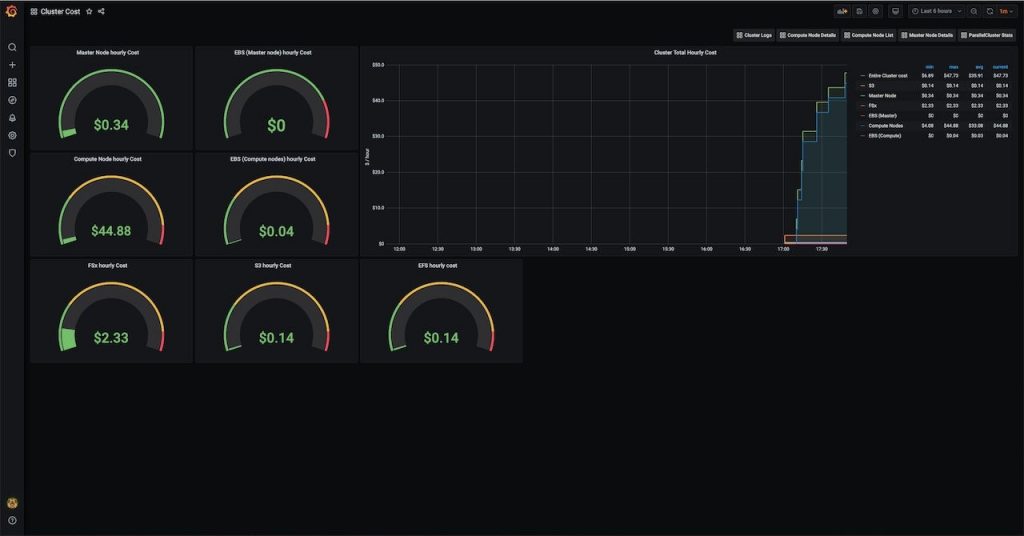
Monitoring dashboard for AWS ParallelCluster
This post is contributed by Nicola Venuti, Sr. HPC Solutions Architect. AWS ParallelCluster is an AWS-supported, open source cluster management tool that makes it easy to deploy and manage High Performance Computing (HPC) clusters on AWS. While AWS ParallelCluster includes many benefits for its users, it has not provided straightforward support for monitoring your workloads. […]

Using AWS Lambda extensions to send logs to custom destinations
You can now send logs from AWS Lambda functions directly to a destination of your choice using AWS Lambda Extensions. Lambda Extensions are a new way for monitoring, observability, security, and governance tools to easily integrate with AWS Lambda. For more information, see “Introducing AWS Lambda Extensions”. To help you troubleshoot failures in Lambda functions, […]