AWS Compute Blog

Processing geospatial IoT data with AWS IoT Core and the Amazon Location Service
This post is written by Swarna Kunnath (Cloud Application Architect), and Anand Komandooru (Sr. Cloud Application Architect). This blog post shows how to republish messages that arrive from Internet of Things (IoT) devices across AWS accounts using a replatforming approach. A replatforming approach minimizes changes to the core application architecture, allowing an organization to reduce […]

Introducing maximum concurrency of AWS Lambda functions when using Amazon SQS as an event source
This blog post is written by Solutions Architects John Lee and Jeetendra Vaidya. AWS Lambda now provides a way to control the maximum number of concurrent functions invoked by Amazon SQS as an event source. You can use this feature to control the concurrency of Lambda functions processing messages in individual SQS queues. This post […]

Building Sustainable, Efficient, and Cost-Optimized Applications on AWS
This blog post is written by Isha Dua Sr. Solutions Architect AWS, Ananth Kommuri Solutions Architect AWS, Dr. Sam Mokhtari Sr. Sustainability Lead SA WA for AWS, and Adam Boeglin, Principal Specialist EC2 Sustainability. Today, more than ever, sustainability and cost-savings are top of mind for nearly every organization. Research has shown that AWS’ infrastructure […]
Building a Cloud in the Cloud: Running Apache CloudStack on Amazon EC2, Part 2
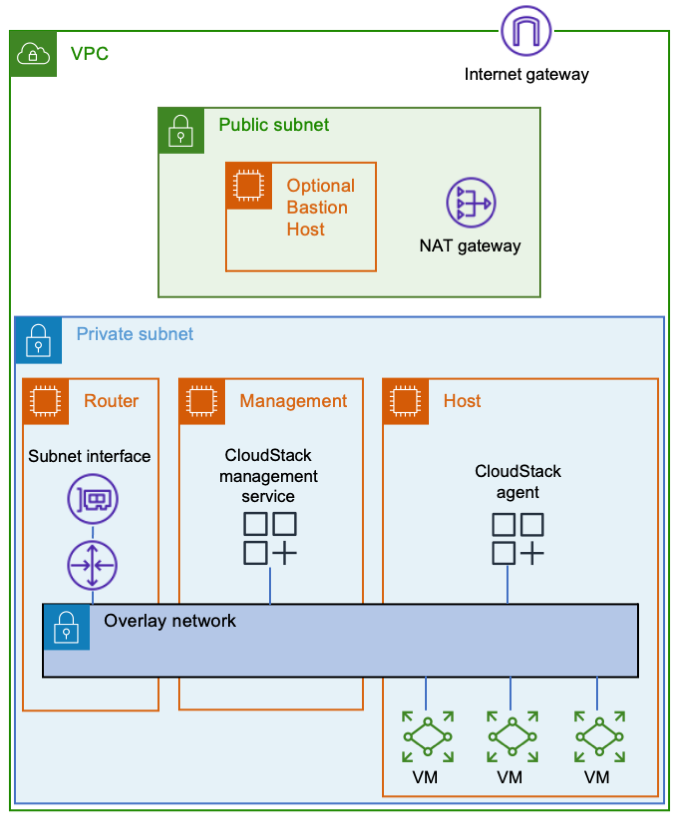
This blog is written by Mark Rogers, SDE II – Customer Engineering AWS. In part 1, I showed you how to run Apache CloudStack with KVM on a single Amazon Elastic Compute Cloud (Amazon EC2) instance. That simple setup is great for experimentation and light workloads. In this post, things will get a lot more […]

Building a Cloud in the Cloud: Running Apache CloudStack on Amazon EC2, Part 1
This blog is written by Mark Rogers, SDE II – Customer Engineering AWS. How do you put a cloud inside another cloud? Some features that make Amazon Elastic Compute Cloud (Amazon EC2) secure and wonderful also make running CloudStack difficult. The biggest obstacle is that AWS and CloudStack both want to manage network resources. Therefore, we must […]
Serverless ICYMI Q4 2022
Welcome to the 20th edition of the AWS Serverless ICYMI (in case you missed it) quarterly recap. Every quarter, we share all the most recent product launches, feature enhancements, blog posts, webinars, Twitch live streams, and other interesting things that you might have missed!In case you missed our last ICYMI, check out what happened last […]

Enabling load-balancing of non-HTTP(s) traffic on AWS Wavelength
This blog post is written by Jack Chen, Telco Solutions Architect, and Robert Belson, Developer Advocate. AWS Wavelength embeds AWS compute and storage services within 5G networks, providing mobile edge computing infrastructure for developing, deploying, and scaling ultra-low-latency applications. AWS recently introduced support for Application Load Balancer (ALB) in AWS Wavelength zones. Although ALB addresses […]

Architecture patterns for consuming private APIs cross-account
This blog written by Thomas Moore, Senior Solutions Architect and Josh Hart, Senior Solutions Architect. Amazon API Gateway allows developers to create private REST APIs that are only accessible from a virtual private cloud (VPC). Traffic to the private API uses secure connections and does not leave the AWS network, meaning AWS isolates it from […]

Chaos experiments using AWS Step Functions and AWS Fault Injection Simulator
This blog post describes how to use Step Functions to orchestrate Fault Injection Simulator (FIS) experiments for EC2 and ECS workloads. Using the workflow in this post as an example, you can build state machines for more AWS FIS experiments.
Scaling AWS Outposts rack deployments with ACE racks
This blog post is written by Eric Vasquez, Specialist Hybrid Edge Solutions Architect, and Paul Scherer, Senior Network Service Tech. Overview AWS Outposts brings managed, monitored AWS infrastructure, compute, and storage to your on-premises environment. It provides the same AWS APIs, and console experience you would get within the AWS Region to which the Outpost […]