AWS Compute Blog
Testing Step Functions workflows: a guide to the enhanced TestState API
AWS Step Functions recently announced new enhancements to local testing capabilities for Step Functions, introducing API-based testing that developers can use to validate workflows before deploying to AWS. As detailed in our Announcement blog post, the TestState API transforms Step Functions development by enabling individual state testing in isolation or as complete workflows. This supports mocked responses and actual AWS service integrations, and provides advanced capabilities. These capabilities include Map/Parallel states, error simulation with retry mechanisms, context object validation, and detailed inspection metadata for comprehensive local testing of your serverless application.
The TestState API can be accessed through multiple interfaces such as AWS Command Line Interface (AWS CLI), AWS SDK, LocalStack. By default, TestState API in AWS CLI and SDK runs against the remote AWS endpoint, providing validation against the actual Step Functions service infrastructure. We’ve partnered with LocalStack to offer an additional testing endpoint for the TestState API. Developers can use LocalStack for unit testing their workflows by changing the AWS SDK client endpoint configuration to point to LocalStack: http://localhost.localstack.cloud:4566/ instead of AWS endpoint. This approach provides complete network isolation when needed. For a streamlined development experience, you can also use the LocalStack VSCode extension to automatically configure your environment to point to the LocalStack endpoint. This approach is detailed in the AWS blog post.
This blog post demonstrates building test suites to unit test your Step Functions workflows using the AWS SDK for Python using the pytest framework. The complete implementation is available in the GitHub repository.
Building test cases using the TestState API
This example workflow implements a real-world ecommerce order processing system using JSONata for advanced data transformations. It incorporates complex Step Functions patterns including distributed Map states, Parallel execution, and waitForTaskToken callback mechanisms. The process validates orders through AWS Lambda functions, distributes order item processing with configurable failure tolerance, runs parallel payment and inventory updates, handles human approval workflows using task tokens, then persists orders in Amazon DynamoDB with notification delivery. This workflow demonstrates advanced error handling with multiple Catchers and Retriers, exponential backoff for Lambda throttling and DynamoDB limits, and sophisticated state transitions that were previously challenging to test locally. This makes it the recommended choice for demonstrating the use of enhanced TestState API’s local testing features.
The complete workflow is available in the GitHub repository, where you can examine the full state machine definition and see how JSONata expressions handle data transformation throughout the execution flow.
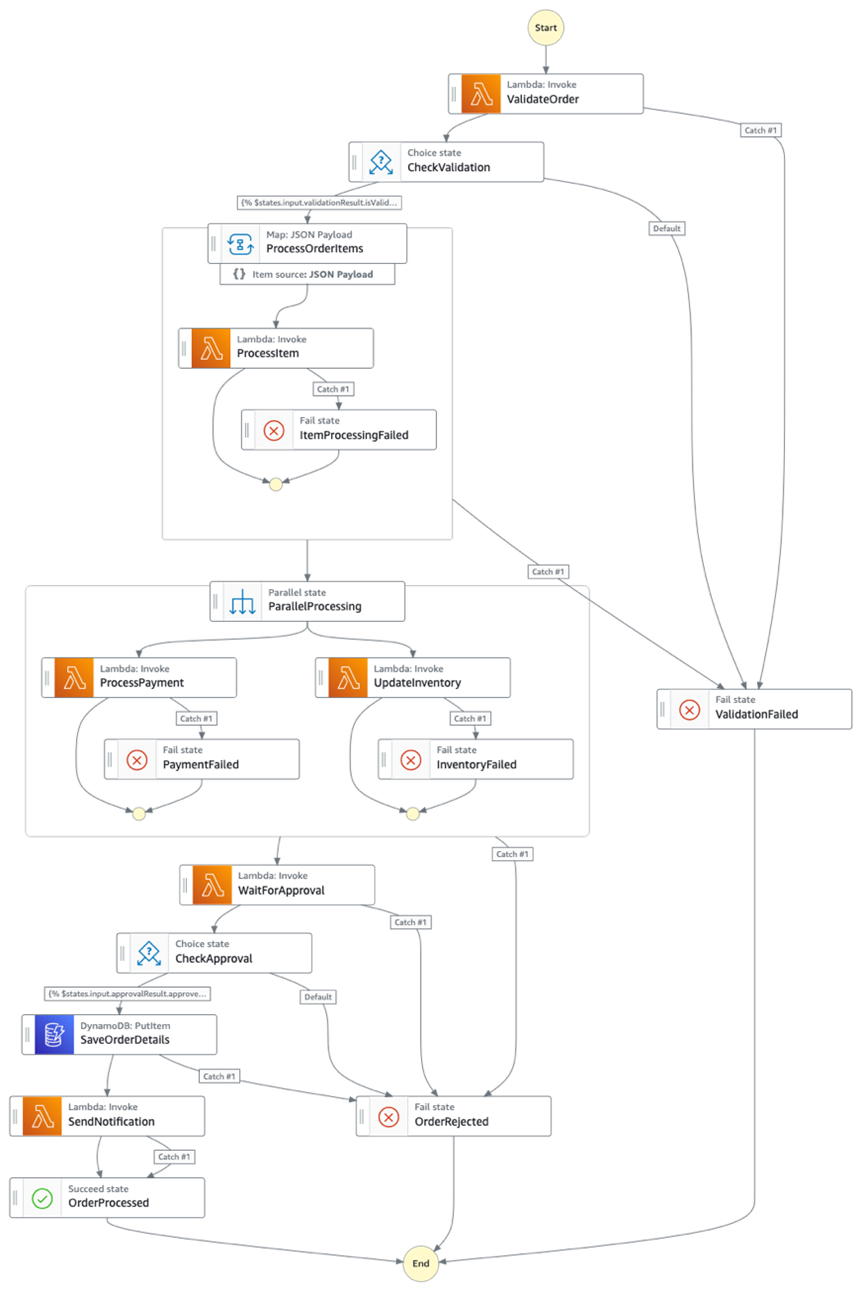
Figure 1: State machine workflow that demonstrates a real-world ecommerce order processing system.
Effective Step Functions testing requires a systematic approach to TestState API integration that provides state validation, error simulation, and assertion capabilities. The testing framework is built using Python’s pytest framework, using fixtures to automatically provide pre-configured runner instances that handle TestState API client initialization and state machine definition loading. This eliminates repetitive setup code and provides consistent test environments. The enhanced TestState API supports both mock integrations and actual integrations with AWS services, providing flexibility in testing strategies. For this demonstration, you use mock integrations to showcase how a complete local testing can be achieved without having any resources deployed to AWS accounts.
This framework is built for demonstration purposes, and you can similarly build your own testing frameworks using other programming languages like Java, Node.js. The testing framework uses method chaining patterns to create readable test cases with comprehensive assertion methods, automatic output chaining between state executions, and error simulation for testing retry mechanisms, backoff intervals, and catch blocks across AWS service error conditions.
The following test implementations demonstrate the testing capabilities that are achievable with the enhanced TestState API in local development environments. The test cases are run against the preceding Statemachine.
Test Case 1: Lambda throttling and retry mechanism testing
Service integrations with Statemachines like AWS Lambda, Amazon DynamoDB may face throttling depending on their usage. A key capability of the enhanced TestState API is its ability to simulate retry mechanisms with control over retry counts and backoff intervals. This test demonstrates the enhanced TestState API’s retry testing capabilities through the stateConfiguration.retrierRetryCount parameter and inspectionData.errorDetails response fields. This response field provides retryBackoffIntervalSeconds for validating exponential backoff calculations, retryIndex for tracking retry attempt sequences, and catchIndex for identifying which error handler processed the exception. These enhanced inspection capabilities enable validation of retry logic, backoff strategies, and error propagation patterns across complex state machine workflows.
Test Case 2: Map state testing with tolerance thresholds
Distributed Map states present unique testing challenges due to their parallel processing nature and failure tolerance capabilities. The enhanced TestState API provides specialized configuration options for testing these complex scenarios.
This test demonstrates the enhanced TestState API’s Map state testing capabilities through the stateConfiguration.mapIterationFailureCount parameter for simulating iteration failures. The API provides comprehensive inspection data including inspectionData.afterItemSelector for validating ItemSelector transformations, inspectionData.afterItemBatcher for batch processing validation, inspectionData.toleratedFailureCount and inspectionData.toleratedFailurePercentage for threshold verification. When the specified failure count exceeds the configured tolerance, the API correctly returns States.ExceedToleratedFailureThreshold, enabling testing of Map state resilience patterns.
Test Case 3: WaitForCallback pattern testing
The waitForCallback integration requires context object construction to simulate realistic execution environments, particularly for human approval workflows.
This test demonstrates the enhanced TestState API’s support for waitForCallback integrations through the `context` parameter for realistic Context object simulation. The API enables comprehensive testing of JSONata expressions that reference $states.context.Task.Token, $states.context.Execution.Id, and other context fields. The inspectionData.afterArguments response field validates that JSONata expressions correctly processed the context data, while the API automatically handles the complexity of task token embedding in service integration payloads for waitForCallback testing scenarios.
Test Case 4: Happy path testing – complete workflow validation
Happy path testing validates that workflows execute correctly under normal operating conditions. The enhanced TestState API allows you to chain state executions together, automatically passing outputs between states to simulate a complete workflow execution.
This test demonstrates how the TestState API maintains state context between executions, enabling realistic workflow simulation. The get_output() method retrieves the processed output from one state to use as input for the next, mimicking actual Step Functions execution behavior.
Note: The code snippet above shows only the first two states of the complete workflow test for brevity. The full test code with all states (ProcessOrderItems, ParallelProcessing, WaitForApproval, CheckApproval, SaveOrderDetails, and SendNotification) can be viewed in the complete GitHub repository, demonstrating end-to-end workflow validation using the same method chaining pattern.
Integration with modern CI/CD pipelines
In this section, we will explore how to integrate the previous unit tests in a CI CD pipeline to enable local testing.
The sample repository includes a GitHub Actions workflow that demonstrates how TestState API testing integrates into continuous integration and continuous delivery (CI/CD) pipelines. The workflow (.github/workflows/test-and-deploy.yml) provides a two-step process that validates before any AWS resources are deployed using AWS Serverless Application Model (AWS SAM).
The CI/CD pipeline follows the following pattern:
- Unit Tests: Executes the complete TestState API test suite using
pytest tests/unit_test.py -v - SAM Deploy: Deploys AWS resources using sam build and sam deploy
To enable the GitHub Actions workflow to deploy resources to your AWS account, configure these AWS credentials in your GitHub repository settings. For detailed setup instructions, see the AWS blog post.
Following are the required secrets to be configured in GitHub repository settings:
AWS_ACCESS_KEY_IDAWS_SECRET_ACCESS_KEYAWS_REGION
In production environments, you can typically extend this basic pipeline to include additional stages. The enhanced pipeline often begins with deploying to a development account first, followed by integration testing against deployed resources. The final stage involves moving to production with proper approval gates and security scanning compliance checks.
Conclusion
The enhanced TestState API enables testing Step Functions workflows locally without requiring AWS deployments that accelerated development cycles, and reduce testing times. This post demonstrates how to implement testing for state types including Map states with tolerance thresholds, retry mechanisms with exponential backoff, and waitForTaskToken patterns with context object simulation using mock integrations for isolated testing.
By integrating TestState API testing into CI/CD pipelines, you can validate workflow logic before deployment, reducing the risk of production issues. The GitHub Actions workflow example demonstrates an implementation that runs tests and deploys resources in a controlled sequence. The complete code examples and testing framework are available in the GitHub repository to implement similar testing practices for Step Functions workflows.