AWS Database Blog
Aurora serverless: Faster performance, enhanced scaling, and still scales down to zero
Amazon Aurora Serverless is an on-demand, auto scaling configuration for Aurora that scales up to support your most demanding workloads and down to zero when you don’t need it. It automatically adjusts database capacity in increments as small as 0.5 Aurora Capacity Units (ACUs), closely following your application workload’s needs. There’s no overprovisioning, no capacity planning required and you only pay for what you actually use. It’s especially well-suited for agentic AI applications, which typically have bursts of activity, long idle windows, and unpredictable patterns. Aurora serverless handles all of it automatically, scaling capacity with your agents. When not in use, the database automatically scales down to zero to save cost. The latest improvements deliver up to 30% better performance and enhanced scaling that understands your workload. These enhancements are available at no additional cost for a better price-performance ratio.
In this post, we’ll share recent performance and scaling improvements with benchmark results, showing how Aurora Serverless can now scale up to 45.0% faster with a 32.9% faster workload completion time.
Better performance out of the box
With this new announcement, Aurora Serverless offers up to 30% better performance compared to the previous platform version (platform version 3). Aurora continues to improve performance to help you do more while managing costs. These performance improvements are offered as part of platform version 4. Aurora serverless uses platform versions to provide more information about performance and scaling baseline of your database. These build on the performance improvements introduced in platform version 3 in August 2025. All new clusters, database restores, and new clones are launched with the latest platform version available in the selected AWS Region. Existing clusters on prior platform versions can be upgraded directly to the latest platform version by using pending maintenance action, stopping and restarting the cluster or using blue/green deployments.
The following graphs show the results of a HammerDB TPROC-C benchmark highlighting incremental performance improvements for three serverless platform versions at 1,024 virtual user counts. We calculate the percentage difference in New Orders per Minute (NOPM) for each platform version relative to its previous platform version. Data was collected from running the TPROC-C workload against 1,024 warehouses on three serverless DB clusters with different platform versions, each configured with 128 ACU for both minimum and maximum capacity.
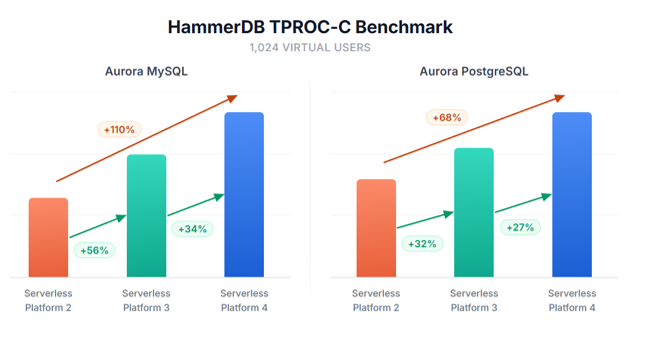
The above graph shows a clear pattern of progressive performance improvements as Aurora launches new versions. For both database engines supported on serverless, Aurora MySQL and Aurora PostgreSQL, platform version 4 delivers 27-34% higher NOPM compared to platform version 3.
Faster and smarter autoscaling
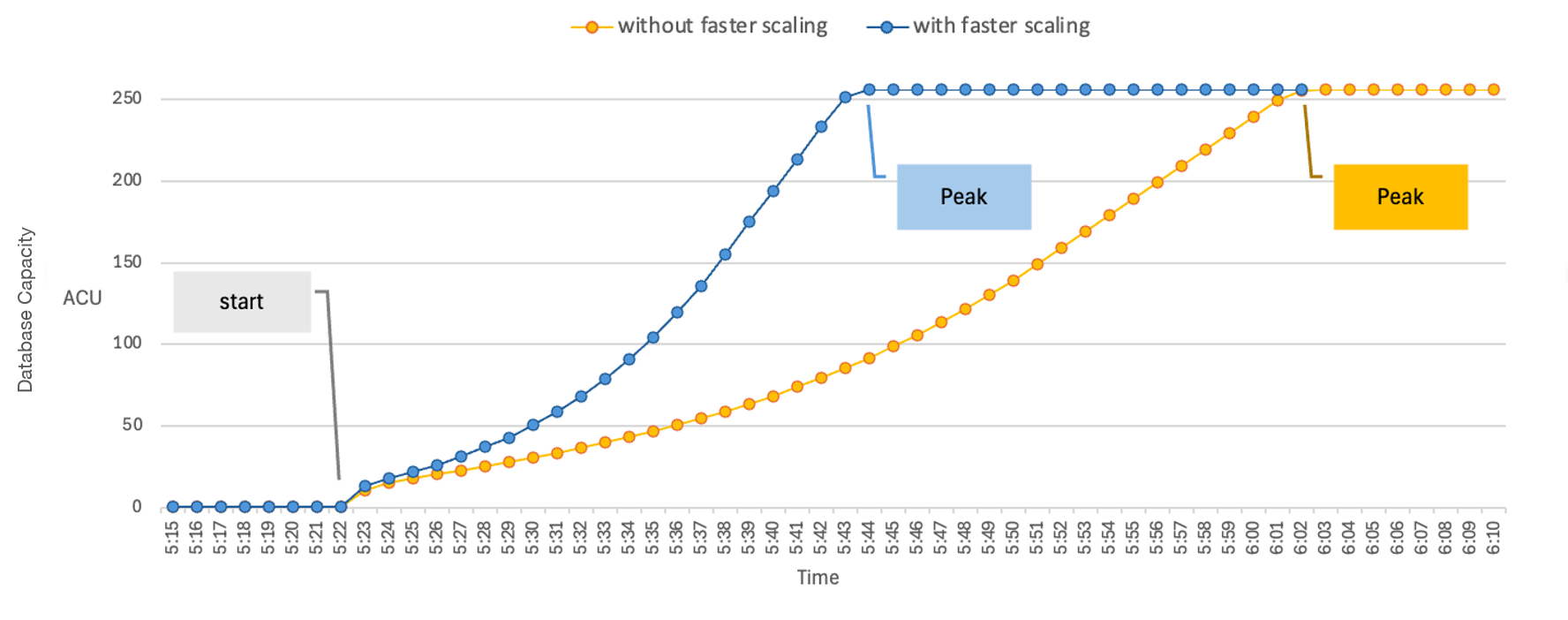
Aurora serverless automatically allocates CPU and memory resources when workloads begin and efficiently releases them when workloads complete. This autonomous, demand-driven scaling eliminates the need for manual capacity planning. Aurora serverless recently doubled its default scaling rate across all serverless clusters and platform versions, with no configuration changes required. The following graph shows the time to scale from 0.5 ACU to 256 ACU, comparing the previous scaling behavior with the current faster scaling behavior. Fast scaling (blue line) reached the maximum capacity of 256 ACU in 22 minutes, while the previous scaling behavior (yellow line) took 40 minutes. This shows that Aurora serverless now scales 45% faster from 0.5 ACU to 256 ACU. Faster scaling enables your database to deliver maximum performance sooner and reduces workload completion time, providing better performance without higher costs.
Combining the latest platform version with faster scaling delivers both better performance and lower costs. The following graph shows the results of a Sysbench workload comparing three Aurora serverless clusters running on platform versions 2, 3, and 4. All clusters had faster scaling enabled by default and were configured with identical capacity settings (0.5 ACU minimum and 256 ACU maximum). We compared the Amazon CloudWatch metric ServerlessDatabaseCapacity of clusters after we loaded 250 tables totaling 16 GB and ran the Sysbench read heavy workload (oltp_read_only.lua) executing 50 million queries with 512 threads.
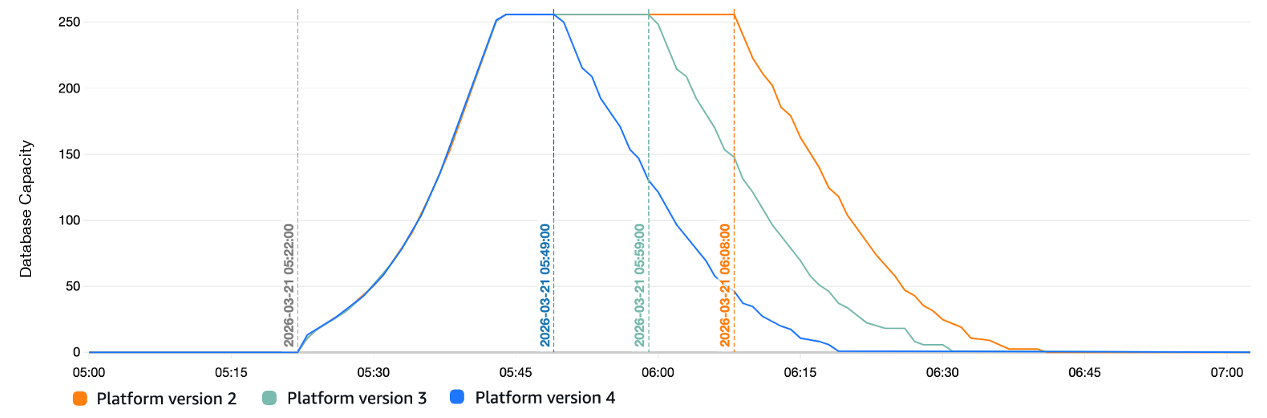
This example demonstrates that the platform version 4 cluster (blue line) finished the workload fastest in 27 minutes using 109 ACUs total. The platform version 3 cluster (green line) took 37 minutes and used 151 ACUs. The platform version 2 cluster (orange line) took 46 minutes and used 187 ACUs. Platform version 4 delivers 27% faster completion with 28% lower cost than platform version 3, and 41% faster completion with 42% lower cost than platform version 2.
Now with platform version 4, Aurora is further enhancing the scaling algorithm by taking additional metrics as signals for scaling decisions. With these enhancements Aurora serverless can intelligently respond to resource competition among concurrent tasks, such as busy web applications and reporting services. New clusters can automatically benefit from these improvements as they will be launched directly on platform version 4. Existing clusters will need to upgrade to platform version 4 to update the scaling behavior.
The following graph illustrates the benefits of these enhancements. This test used three serverless clusters with identical settings. One cluster ran platform version 4 with new scaling algorithm, while the other two clusters ran platform versions 2 and 3 without it. All clusters ran the same Sysbench write workload (oltp_write_only.lua) executing 50 million transactions with 256 threads.
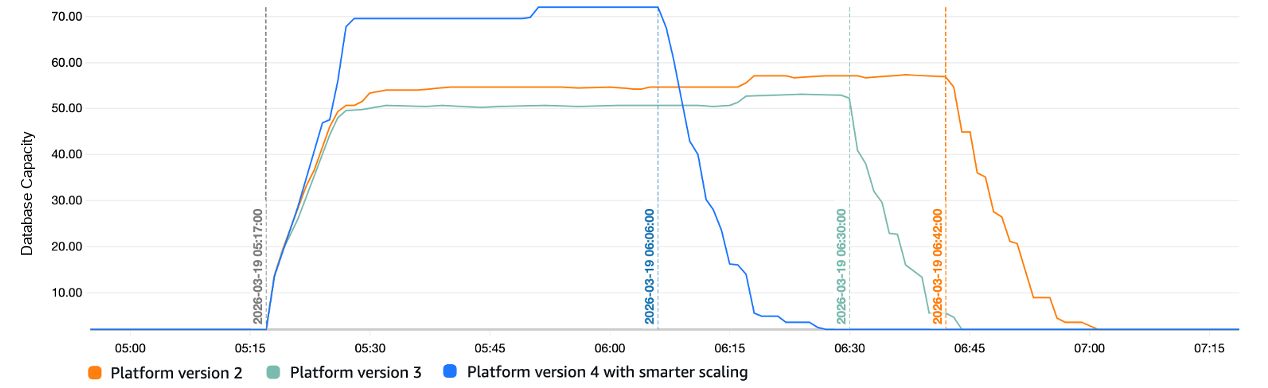
The graph captures how the enhanced scaling algorithm improves database performance. Platform version 4 (blue line) scaled rapidly to higher peak capacity using the new algorithm, completing the workload in the fastest time at 49 minutes while consuming 63 ACUs. In contrast, platform version 3 (green line) required 73 minutes and 66.4 ACUs, while platform version 2 (orange line) needed 85 minutes and 83.6 ACUs. Platform version 4 achieved 32.9% faster completion with 5.1% lower ACU consumption than version 3, and 42.4% faster completion with 24.6% lower ACU consumption than version 2.
Find your platform version
To find your platform version, complete the following procedures.
Using the Amazon RDS console
Follow these steps to check your platform version.
- Navigate to the Amazon RDS console
- Select your Aurora Serverless cluster
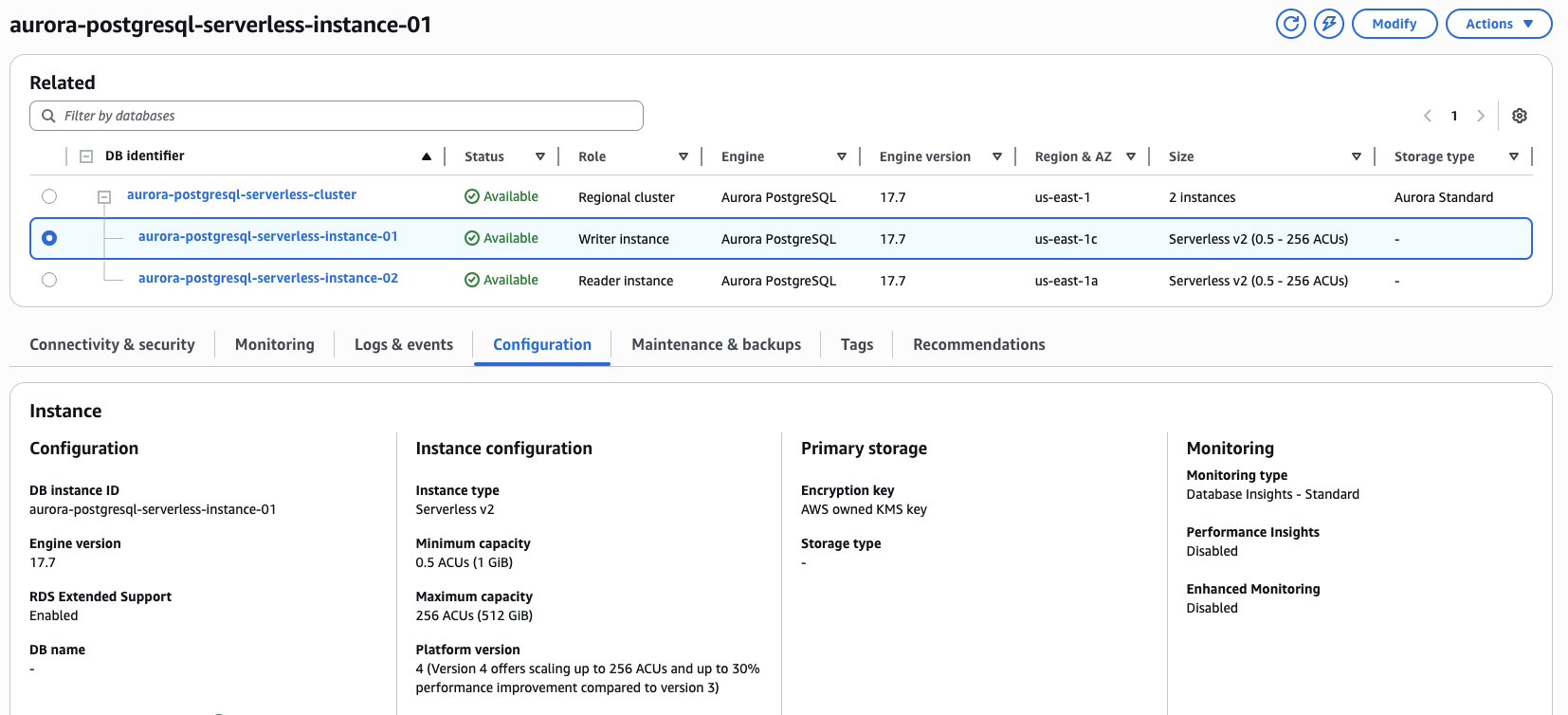
- In the Configuration tab, look for Instance configuration
- The Platform version field displays the current serverless platform version
Using AWS CLI
You can use AWS CLI to retrieve the platform version using the describe-db-clusters command.
Summary
In this post, we shared recent improvements in Aurora serverless: up to 30% better performance and smarter scaling with platform version 4, and up to 45% faster scaling by default. Together, these improvements mean your database can handle more demanding workloads, respond faster under load, and complete work sooner, all without increasing costs. Combined with core capabilities like scaling to zero, granular autoscaling, and Multi-AZ deployments, these enhancements make Aurora serverless suitable for all manner of workloads, from development environments and applications with unpredictable traffic to the most demanding business-critical applications requiring high scale and availability. All new clusters automatically launch on platform version 4, and existing clusters can upgrade by using pending maintenance action, stopping and restarting, or by using blue/green deployments.
Get started by creating an Aurora Serverless cluster.
About the authors
Special thanks
Special thanks to Jason Pedreza, Lei Zeng, and Rinisha Marar for their contributions to this work.