AWS Database Blog

Building a blockchain application in Java using Amazon Managed Blockchain
This post demonstrates how to set up a blockchain application written in Java to read and write data to Managed Blockchain using the Fabric Java SDK. The Java SDK allows customers with applications written in Java to integrate blockchain support with their existing codebase. This makes it easier to handle rich data structures and complex business logic before writing records to the blockchain. You can also integrate Managed Blockchain using the Fabric Node.js SDK. For more information, see Building serverless blockchain application with Fabric Node.js SDK.
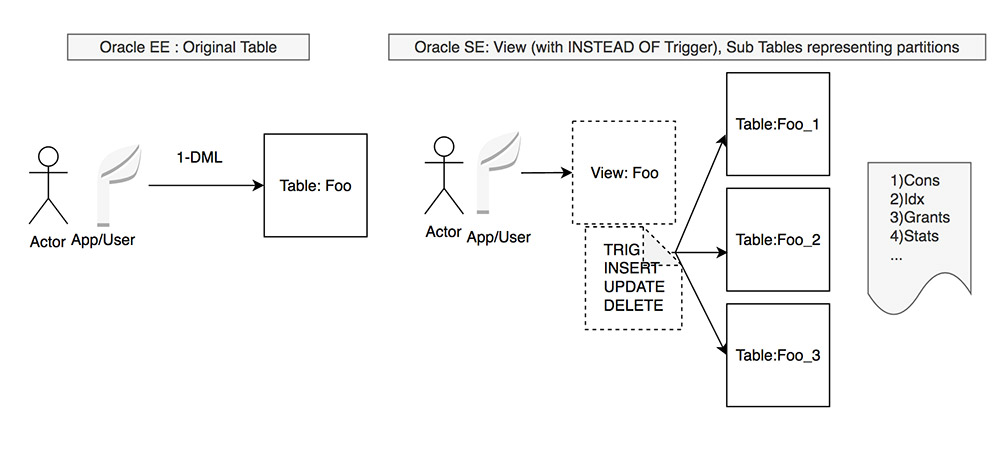
Implementing table partitioning in Oracle Standard Edition: Part 1
Oracle table partitioning is a commonly used feature to manage large tables and improve SELECT query performance. Oracle partitioning is only available in the Oracle EE Extra cost option. This post demonstrates how to implement a partitioning feature for tables in Oracle Standard Edition (Oracle SE) using a single view accessing multiple sub-tables and the INSTEAD OF trigger.

Analyzing performance management in Oracle SE using Amazon RDS for Oracle
Organizations are aggressively adopting cloud as a standard and actively evaluating their database needs. Amazon RDS for Oracle is a managed service that makes it easy to quickly create Oracle Database instances, enabling you to migrate existing on-premises workloads to the cloud. Migration from on-premises Oracle Database to Amazon RDS for Oracle is quick because […]

Managing your SQL plan in Oracle SE with Amazon RDS for Oracle
Organizations are aggressively adopting the cloud as the standard and actively evaluating their database needs. Amazon RDS for Oracle is a managed service that makes it easy to quickly create Oracle Database instances, enabling you to migrate existing on-premises workloads to the cloud. Migration from on-premises Oracle Database to Amazon RDS for Oracle is quick […]

Profiling slow-running queries in Amazon DocumentDB (with MongoDB compatibility)
Amazon DocumentDB (with MongoDB compatibility) is a fast, scalable, highly available, and fully managed document database service that supports MongoDB workloads. You can use the same MongoDB 3.6 application code, drivers, and tools to run, manage, and scale workloads on Amazon DocumentDB without having to worry about managing the underlying infrastructure. As a document database, Amazon DocumentDB makes it easy to store, query, and index JSON data. AWS built Amazon DocumentDB to uniquely solve your challenges around availability, performance, reliability, durability, scalability, backup, and more. In doing so, we built several tools, like the profiler, to help you run analyze your workload on Amazon DocumentDB. The profiler gives you the ability to log the time and details of slow-running operations on your cluster. In this post, we show you how to use the profiler in Amazon DocumentDB to analyze slow-running queries to identify bottlenecks and improve individual query performance and overall cluster performance.
Migrating from SAP ASE to Amazon Aurora PostgreSQL
Enterprise customers often have legacy applications running on an older variant of databases, which impedes the applications’ scalability. In this high-speed cloud computing world, businesses are anxiously looking for solutions to migrate these databases to the cloud. Amazon Aurora is a highly available and managed relational database service with automatic scaling and high-performance features. The […]

Accessing Amazon Managed Blockchain services from blockchain applications running in shared Amazon VPCs
Many AWS customers use AWS Organizations and shared virtual private clouds (VPCs) to reduce operational costs and optimize the use of shared resources. For example, shared VPCs allow you to segregate ownership between systems management and application development teams. For more information, see VPC sharing: A new approach to multiple accounts and VPC management. Using […]

Effectively migrating LOB data to Amazon S3 from Amazon RDS for Oracle with AWS DMS
In this post, I walk through an effective way to migrate and continuously replicate tables with LOB columns from Amazon RDS for Oracle to Amazon S3 using AWS Database Migration Service (AWS DMS). This service helps you migrate on-premises databases to AWS quickly and securely. In this post, we explore its heterogeneous replication feature.

How Contura Energy built a letter of credit application on Amazon Managed Blockchain
This is a guest post from Sammy Jordan, Assistant Treasurer at Contura Energy, in partnership with Emile Baizel, Sr. Blockchain Architect at AWS. In their own words, “Contura Energy is a Tennessee-based coal supplier with affiliate mining operations across major coal basins in Virginia, West Virginia, and Pennsylvania. We export metallurgical coal, a key raw material in steelmaking, to customers on five continents and approximately 25 countries.” Contura chose to run the blockchain network on Amazon Managed Blockchain because it’s a fully managed service that scales automatically, as needed, and removes a lot of the heavy lifting needed to operate a blockchain network. Additionally, you can easily integrate Managed Blockchain with other AWS services, and Managed Blockchain simplifies growing and administering the blockchain network. Network governance and inviting new members can be done via the AWS Management Console, and each member is billed separately based on their own usage.
How Minted scaled their online marketplace on Cyber Monday 2019 by migrating to AWS cloud and Amazon Aurora
This is a guest post by Minted. In their own words, “Minted is an online marketplace for independent artists. Connecting a global creative community directly to consumers, Minted uses technology that enables products to be shared by independent artists who typically lack access to traditional retail outlets. Products available on Minted include works of art, […]