AWS for Games Blog
AAA games on a $35 stick: How Luna removes the hardware barrier with AWS
Over 230 million Americans identify as gamers. Yet most will never buy a $500 console or a $1,500 PC, not because they don’t want to play, but because the cost of entry keeps climbing: hundreds (sometimes thousands) in hardware, hundreds of gigabytes in downloads, and frustrating maintenance just to keep things running.
And even those who own capable hardware aren’t always free to use it. Some share a console with family. Others travel without their setup. And while many prefer to game on their TV—the screen where entertainment actually happens—they aren’t going to deal with the hassle of connecting a PC. Whether the barrier is cost, convenience, or being on the wrong screen, the result is the same: people who want to play can’t.
This is a distribution problem disguised as a content problem. The games exist. The players exist. The barrier lies in the process between.
The solution: Luna bypasses hardware
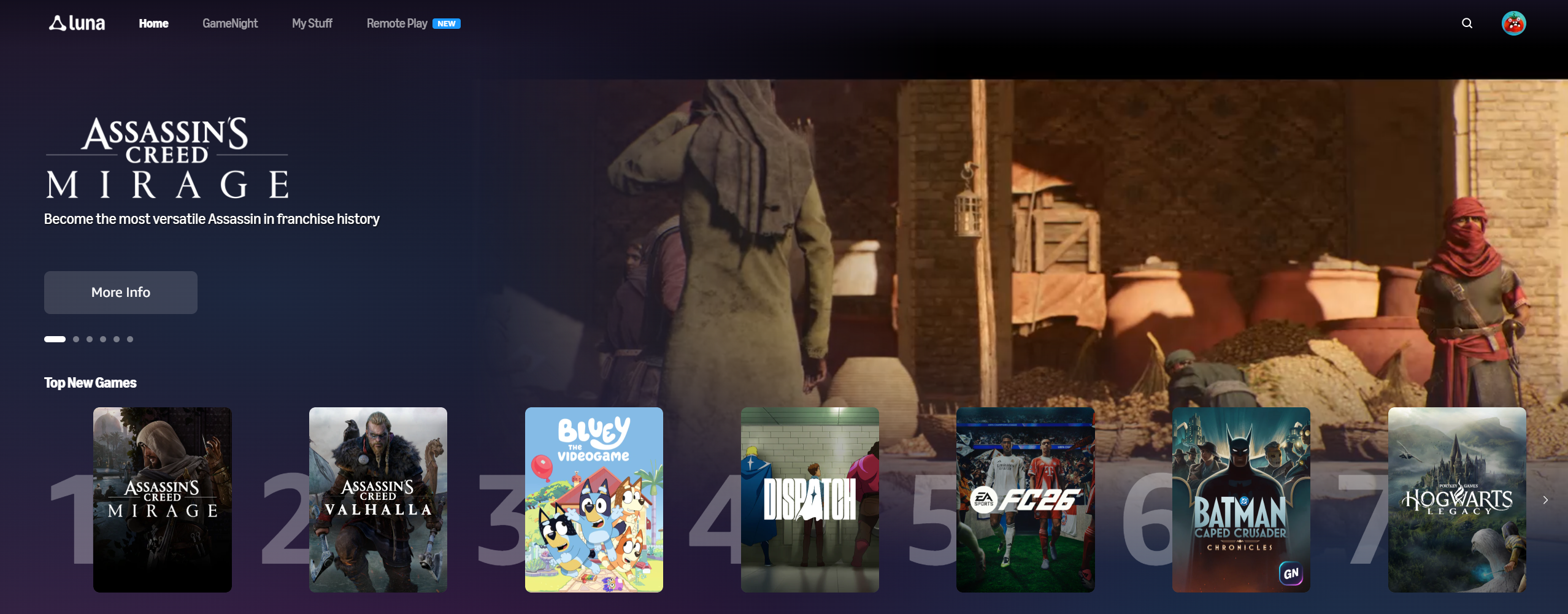
Figure 1: The Luna start screen displaying a selection of games
Luna, the Amazon cloud gaming service, reduces the hardware barrier. A customer with a Fire TV Stick ($35), a Samsung smart TV, or any web browser can play hundreds of AAA titles (the industry’s highest-budget, blockbuster games from major publishers), streamed at 1080p resolution, 60 frames per second (fps), all without downloading a single byte.
Included with Amazon Prime, Luna removes the cost of entry for over 200 million members and has the potential to create new players. People who would have never considered themselves gamers can now explore AAA titles with zero commitment beyond the Prime membership they already pay for.
How it works: AWS from button press to rendered frame
When a player starts a game on Luna, here’s what happens to deliver graphically complex gameplay to their device.
- Geographic instance selection: The global fleet of AWS GPU-accelerated Amazon EC2 instances spans dozens of AWS Regions. When a player presses play, the nearest available instance is selected based on network latency, minimizing the distance data travels between player and game, enabling a responsive game experience.
- GPU-powered game rendering: The selected instance, equipped with a GPU designed for real-time graphics, launches the game inside a lightweight Linux container, or, in rare cases, as a Windows instance. The heavy lifting that would normally require an expensive gaming PC happens in a data center: processing game logic, rendering frames, and managing memory. The environment is optimized for the specific game for smooth gameplay. The player’s device only displays the result.
- Frame delivery at 1080p/60fps: Rendered frames are encoded and streamed at 1080p/60fps, even to low-end devices. Player inputs travel back asynchronously from the game stream for lowest latency. With a Luna Controller, this path is even faster. As a dedicated Wi-Fi device, the controller sends inputs directly to the cloud, bypassing the display device. No Bluetooth overhead, no contention with the TV’s pipeline. Amazon peering helps ensure low IP latency, keeping the round trip fast enough that gameplay can feel local, not remote.
- Save, sync, and recycle: When a game is saved, progress syncs to a player’s Amazon account across every device. For most titles, players can export saves to continue on a local PC. Luna doesn’t lock progress to the cloud. Play on a Fire TV tonight and continue on a laptop tomorrow. Behind the scenes, completed sessions reset instantly, making the instance available to serve another player. No idle hardware, no wasted capacity.
Inside the engineering: How Luna achieves 60fps at scale
Streaming AAA games at scale requires more than compute capacity. It requires an architecture that maximizes every GPU without sacrificing the player experience.
- Luna doesn’t dedicate one GPU per player in most cases. The engineering team developed a multi-tenancy model that runs four or more simultaneous game sessions on a single GPU, each locked at a certified 60fps.
- Every title in the Luna catalog undergoes certification to validate it can maintain target frame rates within its allocated GPU slice under peak load. Games that can’t hold 60fps don’t ship until the bottleneck is resolved or are fit to configurations that provide the best customer experience.
- This provides 76% active-time utilization across the Luna GPU fleet, a density metric that makes AAA streaming economically viable at Prime-included pricing.
The business model that unlocks the audience
Luna isn’t a standalone subscription competing against other services; it’s included with Amazon Prime. That changes the dynamics for players, publishers, and developers:
- For players: The barriers disappear. No purchase decision. No hardware investment. No commitment. Any household with a Fire TV, compatible smart TV, or browser is already a gaming household. Customers try genres they’d never spend $60 to explore and some discover they’re gamers for the first time.
- For publishers: Luna solves reach, discovery, and risk simultaneously. Games are surfaced to more than 200 million Prime members across multiple touchpoints, including the Prime Video app, appearing alongside entertainment customers are already browsing, not buried in a separate storefront. When trying a title comes at no extra cost, players experiment with studios they’ve never heard of and genres they’d normally scroll past. Publishers aren’t just reaching existing gamers through a new channel. They’re accessing an audience that didn’t exist in their funnel before.
Why this matters for developers
Luna is a proof of concept for what happens when you remove the barriers between a player and a game. It collapses the hardware, cost, and commitment problems that have previously limited game distribution:
- Distribution no longer requires an installed base: When rendering moves to the cloud, the game goes wherever a browser goes. The addressable market shifts from who owns the right hardware to who has internet access.
- Latency is managed, not eliminated: Luna isn’t focused on eliminating latency, but on making it unnoticeable. Regional GPU provisioning, purpose-built input hardware, and adaptive bitrate encoding—stacked together—push the round trip below what players can perceive. Millions of sessions every night prove it works: when infrastructure is managed well enough, nobody notices it. They just play.
Conclusion
As games continue to grow in complexity, reaching diverse audiences through frictionless channels becomes critical. Luna lowers the cost of entry for players while expanding the scope of who game publishers can reach.
The future of gaming isn’t about selling a title tied to a specific piece of hardware. It’s about whether a game can capture interest on its own merit. Luna handles the heavy lifting through player acquisition, device accessibility, and distribution at scale, allowing publishers to focus on making great games. The result isn’t just reaching existing gamers through a new channel; it’s paving the way for an entirely new generation of players who never had a way in before.
Ready to get started? Try Luna today on your Fire TV, smart TV, or web browser. It’s already included with your Prime membership. To learn how you can build a custom storefront to stream your game catalog and expand your reach, explore Amazon GameLift Streams, the same game streaming service from AWS that powers the Luna infrastructure. Have questions or want to share your experience? Let us know in the comments below.
Learn more
- Amazon Luna — Cloud gaming included with Prime
- Amazon GameLift Streams — Stream games at up to 1080p/60fps to any browser
- Creating new opportunities for gameplay with Amazon GameLift Streams