AWS for Industries
Leading FMEG Player Builds Manufacturing Control Tower on AWS
Manufacturers operating multi-plant environments struggle with a common challenge: production data trapped in isolated systems across facilities, preventing teams from detecting anomalies early or responding to disruptions before they cascade. In this post, you will learn how to build a Manufacturing Control Tower on AWS that unifies plant-floor data streams, applies Agentic AI for autonomous anomaly detection and guided remediation, and delivers persona-based dashboards—so operators, plant managers, and executives each get the real-time insights they need without requiring specialized technical expertise.
This post is intended for solutions architects, manufacturing IT leaders, and operations technology (OT) teams evaluating cloud-based approaches to multi-plant visibility. We walk through the architecture using AWS IoT Core, AWS IoT SiteWise, Amazon S3, Amazon Bedrock, and Amazon Quick, and show how a leading Fast Moving Electrical Goods (FMEG) manufacturer in India implemented this pattern to consolidate data from multiple facilities into a single operational view.
By the end of this post, you will understand how to:
- Ingest and normalize heterogeneous plant-floor data using AWS IoT services
- Deploy an Agentic AI Operations Assistant with Amazon Bedrock for natural language queries and autonomous anomaly response
- Build role-specific dashboards in Amazon Quick that surface the right metrics to the right persona
- Design the architecture to scale across additional plants without redesigning
The challenge: Fragmented operations across plants
Operational Impact. Without unified visibility, plant teams cannot detect issues proactively. Response times to operational disruptions remain more than 24 hours. Quality challenges persist with incomplete, outdated, and inaccurate data across QA system, LIMS and MIS reports. These gaps result in increased downtime, higher costs, and missed optimization opportunities.
Data Silos and Disconnected Systems. The Leading FMEG player manages manufacturing facilities across multiple states. Each plant operates heterogeneous equipment from different vendors with incompatible protocols. These incompatible systems create isolated data silos across the organization. Manufacturers struggle to achieve end-to-end transparency needed for data-driven decisions.
Delayed Decision-Making and Limited Visibility. The frontline management teams grappled with internal data silos that limit collaboration. Management wants greater visibility but making data analytics-ready requires significant resources. The path to OT-IT integration faces security, integration, and data management challenges.
Project scope and expectations
In response to these challenges, the delivery them identified a project with five core expectations that would define the Manufacturing Control Tower’s scope, integration model, and delivery boundaries:
Modular Functional Coverage. The Manufacturing Control Tower scope encompasses four core operational modules: production monitoring, quality management, maintenance optimization, and energy management. Each module delivers end-to-end visibility within its domain while contributing to the unified data model. The solution unifies enterprise data across ERP, MES, CRM, supply chain systems, and IoT telemetry into a single data foundation. This modular approach enables phased deployment while delivering immediate value within each functional area.
Multi-Plant Phased Rollout. The Leading FMEG player operates approximately 15 state-of-the-art manufacturing units across India. The rollout follows a phased approach starting with pilot plants. AWS IoT SiteWise enables management across multiple industrial facilities with edge gateway deployment. This supports monitoring of all production lines and individual gateway health remotely or on premises.
Integration Points. The solution defines clear integration boundaries with existing enterprise systems. A vendor-agnostic, edge-first architecture captures shop floor data and securely forwards harmonized time-series and asset-model data to AWS. Key integration points include ERP systems for production planning data, MES for execution tracking, SCADA and historians for real-time process data, and OPC-UA sources for equipment telemetry. The architecture bridges physical devices and edge systems with cloud-based analytics and generative AI capabilities.
Product Categories in Scope. The manufacturing operations span diverse product categories including cables and wires, switchgear, home appliances, lighting, fans, modular switches, water heaters, and industrial circuit protection devices. Each product category presents unique monitoring requirements that the Control Tower addresses through configurable asset models and tailored dashboards hence increasing the overall complexity and scope for modelling constraints in the platform.
Defined Boundaries and Deliverables. The scope includes data ingestion infrastructure, cloud-based processing and storage, AI-powered analytics, and persona-based visualization layers. The solution extends visibility into predictive intelligence, decision execution, and agent-driven orchestration. Deliverables encompass edge gateway configuration, cloud service provisioning, dashboard development, AI model training, and integration testing across all defined plant locations.
Functional requirements
Real-Time Monitoring and Data Integration. The Manufacturing Control Tower requires continuous real-time monitoring of industrial equipment across all plant locations. The architecture operates across five functional territories: data ingestion, event processing and state management, query and analytics, exception detection and alerting, and integration surface AWS IoT SiteWise collects, stores, organizes, and monitors data from industrial assets at scale. The system models industrial equipment and processes using asset models and assets, defining relationships among these assets under ISA-95 hierarchies.
Alerting and Exception Detection. The platform must detect anomalies and trigger alerts in near real-time when operational parameters deviate from acceptable thresholds. Key analytics capabilities include anomaly detection, equipment degradation scoring, predictive maintenance forecasting, and prescriptive guidance via generative AI. The system combines real-time metric data with the organization’s knowledge base for automatic issue assessment and research. AWS IoT SiteWise uses machine learning to detect subtle anomalies, preventing costly downtime.
AI and ML-Driven Intelligence. Amazon Bedrock provides operators with step-by-step instructions to address identified anomalies. Together, the trio of services processes asset data, identifies anomalies, and prescribes efficient repairs. The Agentic AI Operations Assistant must decompose user requests into queries for operational systems and return actionable insights. Knowledge Bases for Amazon Bedrock provide managed retrieval-augmented generation for accurate, context-aware responses grounded in operational documentation.
Reporting and Persona-Based Dashboards. The solution requires role-based operational dashboards delivering real-time KPIs, trend visualization, and configurable alerting via Amazon SNS. Each persona—operator, plant manager, and executive—receives tailored visualizations relevant to their responsibilities. Amazon Quick delivers these dashboards with drill-down capabilities from enterprise-level summaries to individual equipment metrics.
Data Unification Across OT and IT Systems. The platform must unify enterprise data across ERP, MES, CRM, supply chain systems, and IoT telemetry into a single data foundation. A vendor-agnostic, edge-first architecture captures shop floor data, models and preprocesses it with AWS IoT SiteWise Edge, and securely forwards harmonized data to AWS for analytics and ML workflows. Standard IIoT connectivity protocols supported include OPC-UA, MQTT, Modbus, PROFINET, and EtherNet/IP.
Non-functional requirements
Scalability. The Manufacturing Control Tower must scale to support the full manufacturing footprint without architectural redesign. AWS IoT SiteWise supports up to 1,000 asset models per Region, 10,000 assets per model, and 5,000 properties per asset model, all as adjustable soft limits. The AWS Well-Architected Modern Industrial Data Lens recommends implementing request queuing with Amazon SQS, Auto Scaling, and cross-Region redundancy to handle peak production periods. A comprehensive quota management strategy must consider both steady-state operations and peak production periods to prevent disruptions to critical manufacturing processes.
Availability and Disaster Recovery. The solution targets high availability aligned to business criticality. AWS supports designs ranging from 99.9% to 99.999% availability, with RPO and RTO aligned to operational requirements. The architecture differentiates data plane operations (real-time monitoring requiring higher availability) from control plane operations. Critical system components are backed up across multiple, isolated Availability Zones, each engineered to operate independently with high reliability.
Security and Compliance. The platform adheres to the ISA/IEC 62443 standard, which provides a risk-based, defense-in-depth approach to improve safety, availability, integrity, and confidentiality of industrial automation systems. This standard builds on the ISO/IEC 27000 series while addressing differences present in industrial automation and control systems. Manufacturing environments require industrial-grade security including TLS encryption, certificate-based authentication, and network segmentation. AWS IoT Core provides mutual authentication and encryption at all points of connection.
Performance. The system must deliver near real-time data processing from plant floor to dashboard. AWS IoT SiteWise supports near real-time monitoring with tiered storage architecture. The hot tier retains recent data for immediate access while historical data moves to a cost-optimized storage tier based on defined policies. Event-driven processing through AWS Lambda ensures minimal latency for critical operational alerts.
Data Retention. The solution implements tiered data retention policies aligned to operational and compliance requirements. Recent operational data remains in the hot tier for immediate querying and real-time dashboards. Historical data transitions to cost-optimized cold storage based on configurable retention policies. This approach balances performance requirements with long-term storage economics across the entire manufacturing data estate.
Solution approach and architecture
End-to-End Connected Intelligence. The Manufacturing Control Tower delivers a complete, end-to-end implementation of connected intelligence that bridges physical devices and edge systems with cloud-based analytics and generative AI capabilities on AWS. The architecture follows a four-layer design pattern that separates concerns across data ingestion, processing and storage, AI and analytics, and visualization and action. This layered approach enables independent scaling, technology evolution, and modular deployment across manufacturing facilities.
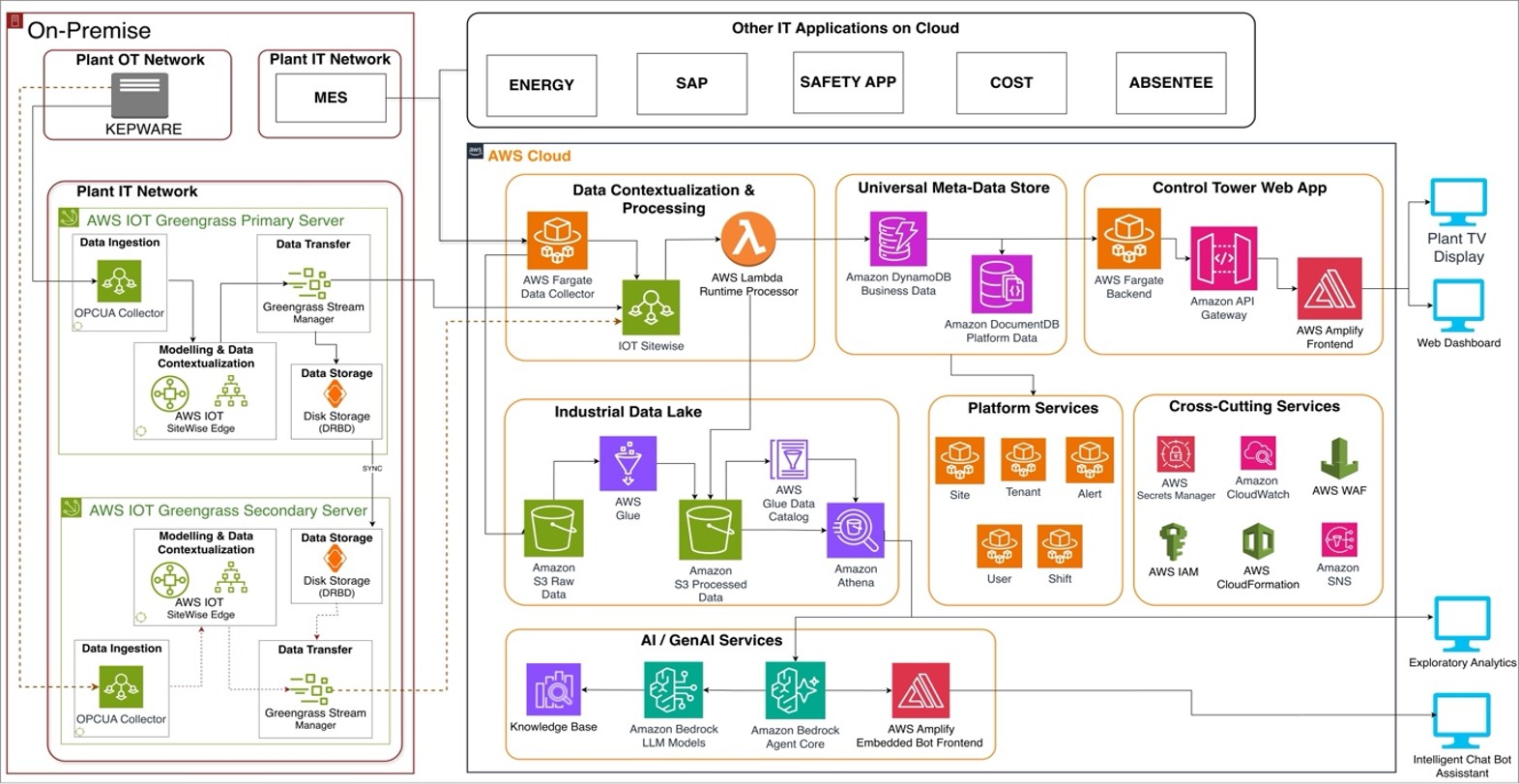
Figure 1: Manufacturing Control Tower Technical Architecture
Layer 1: Data ingestion — Capturing data at the source
Everything begins on the shop floor. This layer reliably acquires data from manufacturing assets and transports it securely to the cloud—ensuring low-latency collection and resilient operation even during intermittent connectivity.
Built for high availability. A dual-server redundancy model—an Edge Primary Server and an Edge Failover Server—runs identical software stacks with DRBD (Distributed Replicated Block Device) providing real-time block-level storage replication between servers, orchestrated through AWS IoT Greengrass.
How the data flows in:
- KEPWARE, within the Plant OT Network, acts as the industrial connectivity hub—a universal translator for diverse shop-floor equipment and protocols.
- OPC-UA Collectors ingest machine telemetry from diverse shop-floor equipment via Kepware.
- AWS IoT SiteWise Edge models and contextualizes data locally.
AWS IoT Greengrass Stream Manager reliably transfers high-volume data streams to the cloud—persisting data to local disk storage for zero data loss during connectivity interruptions or server failover.
Beyond machines, the platform listens to the whole business: Plant systems (MES) and Cloud applications—Energy, SAP, Safety App, Cost, and Absentee—integrate over REST/HTTPS for a complete 360° dataset. In the cloud, AWS IoT Core provides the AWS IoT Greengrass device management, while AWS Fargate handles high-throughput collection.
Layer 2: Data processing and storage — Turning noise into knowledge
Raw machine signals are just noise on their own. This layer transforms them into structured, query-ready datasets, the single source of truth across the enterprise.
AWS IoT SiteWise manages cloud-side asset models, while AWS Lambda enriches, aggregates and generates meaningful KPIs in a serverless manner.
The Industrial Data Lake provides the analytics foundation:
- Amazon S3 stores both raw and processed data.
- AWS Glue performs ETL, cataloging schemas in the AWS Glue Data Catalog.
- Amazon Athena enables serverless SQL querying directly over the lake.
A Universal Meta-Data Store gives every data point meaning, combining Amazon DynamoDB for low-latency business data and Amazon DocumentDB for semi-structured platform metadata.
Layer 3: AI and analytics — Intelligence that speaks your language
This is where data becomes insight—and where operators can simply ask questions instead of hunting through dashboards. Powered by Amazon Bedrock:
- Foundation models deliver natural language understanding and generation.
- Amazon Bedrock AgentCore orchestrates agentic workflows, turning complex requests into structured actions.
- A Knowledge Base grounds AI responses in operational docs, maintenance manuals, and incident history via Retrieval-Augmented Generation.
- An Intelligent Bot, built on AWS Amplify, surfaces the conversational experience.
Exploratory Analytics capabilities enable data scientists and engineers to perform ad-hoc analysis, uncover hidden correlations, and validate AI model outputs against historical production data.
The payoff: an operator can ask “Why did Line 3 slow down last night?” and get a clear, grounded answer in seconds—no specialized data skills required.
Layer 4: Visualization and action — Putting insights to work
Insight only matters if people can see it and act on it.
- On the shop floor, a Plant TV Display shows live KPIs right where the work happens.
- The Control Tower Web App—built with AWS Fargate, Amazon API Gateway, and an AWS Amplify dashboard—delivers a single pane of glass across every plant from any browser.
- Amazon SNS escalates anomalies to the right stakeholders the moment they matter, while built-in constructs—Site, Tenant, Alert, User, and Shift—enable role-based, multi-site action management.
Cross-cutting platform services — Security and governance, everywhere
Spanning all four layers, these services ensure security, governance, and operational excellence:
- AWS IAM — fine-grained identity and access management
- Amazon CloudWatch — observability, logging, and monitoring
- AWS WAF — web application firewall protection
- AWS Secrets Manager — secure credential storage
- AWS CloudFormation — Infrastructure-as-Code, spinning up an entire plant’s stack in minutes rather than months
A roadmap built for what’s next
The layered design is intentionally extensible to accommodate next-generation capabilities:
- Predictive Maintenance: Integrate Amazon SageMaker to forecast equipment failures before they strike.
- Digital Twins: Extend AWS IoT TwinMaker for full 3D plant visualization.
- Autonomous Control: Evolve from monitoring to AI-driven control actions fed back to the OT layer.
- Advanced Gen AI Agents: Progress from Q&A bots to autonomous Agents on Amazon Bedrock AgentCore that detect anomalies and orchestrate remediation.
- Sustainability Analytics: Incorporate energy and carbon data for ESG reporting and optimization.
Bringing it all together
By layering purpose-built AWS services across four clean tiers, this leading FMEG manufacturer turned fragmented, siloed data into a single, trustworthy source of truth—surfaced through role-based dashboards and a conversational AI assistant that puts expert-grade insight in everyone’s hands.
The factory floor has always generated the data. Now, finally, that data can speak—across every plant, from a single screen.
Agentic AI operations assistant powered by Amazon Bedrock
For Command Control Center, Agentic AI transforms plant operations from reactive troubleshooting into autonomous, intelligence-driven decision-making. It reduces unplanned downtime, accelerates anomaly resolution, and enables operators across all factories to access real-time insights through natural language, without specialized technical expertise. Additional pointers for Agentic AI operations are:
- Autonomous Reasoning and Multi-Step Orchestration. Agents for Amazon Bedrock leverage high-performing models to orchestrate multi-step tasks efficiently AI agents’ reason, adapt, and make decisions based on dynamic operational inputs. They integrate with existing plant systems through API calls to automate interactions. Knowledge Bases for Amazon Bedrock provide managed retrieval-augmented generation for accurate responses.
- Natural Language Interface for Plant Operations. Generative AI-powered interfaces provide natural language access to real-time asset information. Operators can query complex industrial systems without specialized technical knowledge. For example, a user can ask about equipment status without writing code. This simplifies data retrieval through conversational interactions across the organization.
- Anomaly Detection and Guided Remediation. The Agentic AI handles anomaly detection and alerting within predictive maintenance scenarios. It processes sensor readings from equipment across manufacturing facilities. Amazon Bedrock provides operators with step-by-step instructions to address identified anomalies. This trio of capabilities processes asset data, identifies anomalies, and prescribes efficient repairs.
- Proactive Alerts and Operational Intelligence. Amazon Bedrock provides AI-powered anomaly interpretation alongside natural language recommendations. Amazon Quick delivers real-time KPIs with configurable alerting via Amazon SNS. Operators spend less time gathering data and more time optimizing industrial productivity. The system enables proactive decision-making rather than reactive troubleshooting.
Benefits and results
The Manufacturing Control Tower delivers measurable improvements across key operational metrics. These results demonstrate the transformative impact of unified data and AI-driven insights to the customer.
Reduced Downtime and Faster Response: Organizations deploying unified control tower architectures with AI-driven anomaly detection typically observe up to 36% reduction in unexpected downtime and up to 30% improvement in mean time to repair (MTTR). For a manufacturer at this FMEG’s scale operating 15 facilities, reducing unplanned downtime by this magnitude represents an estimated USD 5–8 million per year in recovered production value. This improvement stems from three capabilities the architecture enables:
- Real-time anomaly detection – AWS IoT SiteWise continuously monitors equipment telemetry and surfaces deviations before they escalate into unplanned stops.
- AI-guided remediation — Amazon Bedrock Agentic AI provides operators with step-by-step resolution workflows in natural language, reducing dependency on specialized expertise and compressing MTTR.
- Unified visibility — Amazon Quick dashboards consolidate plant-floor status across all facilities, enabling managers to prioritize interventions based on production impact rather than alert volume.
Conclusion
The Leading FMEG player’s Manufacturing Control Tower represents a shift in decision making post downtime from more than 24 hours to less than 2 hours. This is a 30% improvement in mean time to repair (MTTR). By integrating AWS IoT Core, AWS IoT SiteWise, Amazon Bedrock, and Amazon Quick, the solution eliminates data silos. The Agentic AI Operations Assistant empowers teams with natural language access to insights. Persona-based dashboards deliver a single source of truth for every stakeholder. Organizations report that scaling from 2 to 15 plants using this architecture requires less than 20% incremental engineering effort per additional plant, compared to 80–100% incremental effort for traditional on-premises expansions.
The results speak clearly: reduced downtime, lower costs, and improved forecast accuracy. AWS serves as the trusted technology and innovation partner enabling this transformation. The Manufacturing Control Tower establishes a foundation for continuous operational improvement. Future expansions will leverage additional AI capabilities as Amazon Bedrock evolves.
Organizations seeking similar transformation begin with a focused pilot — Select a single facility or production line to validate data ingestion patterns with AWS IoT Core and AWS IoT SiteWise, establish baseline KPIs, and demonstrate value within weeks.
Engage with AWS — Connect with your AWS account team or an AWS Partner with manufacturing domain expertise to accelerate architecture design and implementation. Explore the services — Review AWS IoT SiteWise for industrial data collection, Amazon Bedrock for building AI agents, and Amazon Quick for interactive dashboards.