AWS for Industries
Santos’s journey to cloud-based subsurface computing on AWS
Oil and gas producers worldwide depend on subsurface computing—seismic processing, reservoir simulation, and geological modeling—to make critical exploration and production decisions. Yet many organizations continue to run these demanding workloads on aging on-premises infrastructure that limits scalability, increases operational overhead, and constrains time-to-insight. As data volumes grow and the industry embraces advanced analytics and artificial intelligence and machine learning (AI/ML), the gap between what legacy infrastructure can deliver and what geoscientists need is widening.
Santos, one of the top 20 global oil and gas producers with operations spanning Australia, Papua New Guinea, and North America, faced this challenge firsthand. With 4.5 PB of mission-critical subsurface data and a growing need for compute-intensive workflows, Santos partnered with Amazon Web Services (AWS) to modernize its subsurface computing environment: migrating from a distributed operating model with constrained on-premises systems in multiple geographic locations, to a centralized cloud-based architecture built for performance, scalability, and future innovation.
In this post, we show how Santos modernized its subsurface computing environment on AWS: moving from distributed on-premises infrastructure to a centralized, cloud-based platform that delivers high performance computing (HPC), high performance storage, and secure remote visualization for more than 200 geoscientists across Australia.
The challenge: Outgrowing on-premises infrastructure
Santos’s subsurface teams—geophysicists, reservoir engineers, and geoscientists—rely on HPC and virtual desktop infrastructure (VDI) to interpret seismic data, run reservoir simulations, and visualize complex 3D geological models. These workloads are characterized by:
- Massive data volumes – 4.5 PB of seismic surveys, well logs, and simulation outputs requiring high-throughput storage—a volume that continues to grow.
- Intensive compute demands – Reservoir simulations consuming thousands of core-hours per run, with individual jobs executing across hundreds of CPU cores or dedicated GPU accelerators over days. Santos’s geoscientists routinely run multiple concurrent simulation scenarios to evaluate subsurface uncertainty—making queue delays on any single job a bottleneck for the entire decision workflow.
- GPU-intensive visualization – More than 200 geoscientists needing real-time interaction with 3D seismic volumes, structural geological models, and reservoir simulation outputs—datasets routinely measured in terabytes that underpin prospect evaluation, well placement, and field development planning decisions.
- Strict data governance – As a critical infrastructure operator under Australia’s Security of Critical Infrastructure (SOCI) Act, Santos operates under obligations that demand rigorous control over data residency, access, and risk management—requirements that modern platforms must be designed to meet from the ground up.
Santos’s existing on-premises environments were reaching end-of-life, presenting a decision point: reinvest in another generation of physical infrastructure, or fundamentally rethink how subsurface computing is delivered. The traditional refresh cycle would perpetuate the same limitations—fixed capacity, long procurement lead times, and an inability to rapidly adopt emerging technologies like AI/ML and cloud-based analytics.
“At Santos, we’re disciplined about where we invest—and that applies to technology just as much as it does to our upstream portfolio,” says Steve Trench, Executive Vice President, Operations and Technical Services, at Santos. “Modernizing our subsurface computing on AWS wasn’t just an infrastructure refresh; it was about building a platform that supports the way our geoscientists need to work today and positions us for advanced analytics and AI in the future. The result is a more efficient, scalable, and future-ready operation.”
The solution: A cloud-based subsurface computing platform on AWS
Rather than lifting and shifting its legacy environment, Santos opted for a greenfield build on AWS, designing a cloud-based architecture purpose-built for upstream subsurface workflows. The migration was executed in phases across Santos’s three primary office locations (Brisbane, Adelaide, and Perth), providing continuity of operations while progressively onboarding teams to the new platform.
The project commenced in August 2025 and reached full cutover in April 2026, more than halving the original 18-month timeline. Santos transitioned from aging on-premises infrastructure across three geographies to a fully operational cloud-based subsurface computing environment, avoiding a multi-million dollar on-premises hardware refresh in the process.
High-performance compute with Amazon EC2
At the core of Santos’s subsurface computing platform is Amazon Elastic Compute Cloud (Amazon EC2), providing access to a broad range of HPC-optimized instance types. Santos uses EC2 instances powered by the latest generation processors and accelerators for:
- Seismic processing – CPU-intensive workloads such as pre-stack depth migration and FWI running across hundreds to thousands of cores
- Reservoir simulation – Memory-intensive compositional and thermal simulation models requiring high-bandwidth interconnects
- Machine learning – GPU-accelerated training for seismic interpretation models and production optimization algorithms
Santos runs three dedicated Amazon EC2 P5e instances as always-on HPC resources for its most demanding workloads—GPU-accelerated reservoir simulation (SLB Intersect) and ML model training. These complement CPU-optimized instances that support traditional simulation (SLB Eclipse) and other compute-intensive processing tasks. With this dedicated capacity approach, compute-intensive jobs run without queuing, with early simulations executing up to 90 percent faster on current generation GPU infrastructure provided by Nvidia H200 GPUs + NVLink + EFA fabric for tightly-coupled Intersect simulation, reducing the delays that previously constrained exploration and development timelines.
Santos selected dedicated, always-on GPU capacity rather than an elastic burst model because subsurface simulation workloads at this scale demand consistent access to high-bandwidth GPU interconnects—and because queue latency on decision-critical models directly impacts exploration and development timelines. This architecture reflects a deliberate trade-off: predictable performance and zero queue time in exchange for the cost variability that elastic scaling would offer for less time-sensitive workloads.
High-performance storage with Amazon FSx for NetApp ONTAP
Subsurface workflows demand storage that combines high throughput, low latency, and enterprise data management capabilities. Santos selected Amazon FSx for NetApp ONTAP as the primary storage tier for active subsurface data. FSx for ONTAP provides:
- Highly available storage platform for resilient workload access – File system spans multiple Availability Zones with synchronous block level replication to support high-availability SLAs and near-zero Recovery Point and Recovery Time Objectives (RPO/RTO)
- Multi-protocol access – NFS and SMB support for Linux HPC nodes and Windows visualization workstations simultaneously
- Automatic tiering – Intelligent data movement between SSD and capacity storage tiers, optimizing cost without manual intervention
- Snapshot and cloning – Near-instant space-efficient copies for simulation scenario management
- Data protection – Built-in replication and backup capabilities for regulatory compliance
Scalable object storage with Amazon S3
For Santos’s complete 4.5 PB subsurface data archive, Amazon Simple Storage Service (Amazon S3) provides virtually unlimited, durable storage with intelligent tiering to optimize costs across frequently accessed and archival datasets. Amazon S3 serves as the long-term repository and data lake foundation, enabling direct analytics and integration with AI/ML services.
Santos used AWS DataSync to migrate its 4.5 PB dataset to AWS, orchestrating high-speed, automated data transfers from on-premises storage into Amazon S3 and FSx for ONTAP without disrupting active workflows. This migration ran in parallel with ongoing production operations. Geoscientists continued working on the legacy environment while data was validated and promoted to the new platform, providing zero downtime and full data integrity throughout the transition.
Secure and compliant by design
As an operator of critical infrastructure under Australia’s SOCI Act, Santos’s cloud architecture was designed with compliance as a first-class requirement. By anchoring the entire platform within the Asia Pacific (Sydney) AWS Region, subsurface data, including commercially sensitive seismic surveys and reservoir models, remains within Australian jurisdiction, satisfying data sovereignty obligations. AWS IRAP-assessed services and ISO 27001 certification provided Santos with the assurance baseline required for a workload of this sensitivity. To meet these requirements, Santos employed a layered approach to application of security controls including, but not limited to: identity-based access control, end-to-end network encryption, and network segmentation preventing data from traversing the public internet.
Secure remote visualization with Amazon WorkSpaces Core
More than 200 geoscientists across Santos’s Brisbane, Adelaide, and Perth offices need GPU-powered workstations to interact with seismic volumes and 3D geological models in real time. Amazon WorkSpaces Core Managed Instances provide the VDI for Santos’s environment, powered by G6 GPU instances and Amazon DCV, a secure, high-performance remote display protocol that delivers low-latency streaming without additional licensing costs when used with Amazon EC2.
Santos uses the Leostream Remote Desktop Access Platform as the orchestration layer to manage provisioning, user connections, and resource allocation across the WorkSpaces Core environment. This combination helps Santos organize resources into purpose-built pools tailored to different workloads: a dedicated geoscience pool running Petrel for subsurface interpretation, a GIS pool for ArcGIS and MapInfo workflows, and resources for geoscientists running custom Linux and Python-based scripts. The pool-based architecture helps Santos hard-assign GPU-enabled compute to always-on users running continuous simulations, while placing less-frequent users into shared pools, optimizing cost without compromising performance. This delivers:
- GPU-accelerated desktops – High-performance graphical workstations accessible from any location using Amazon DCV.
- Intelligent resource management – Pool-based allocation matched to workload type and user access patterns.
- Centralized data access – Direct connection to FSx for ONTAP, co-locating desktops with data to reduce latency.
- Enterprise application compatibility – With WorkSpaces, you can bring your own Microsoft 365 licenses if they meet Microsoft’s licensing requirements. This facilitates a critical requirement for upstream geoscience workflows where tools like Petrel depend on the Office suite. Santos migrated its existing license investments to the cloud without duplication costs, maintaining full compatibility across its geoscience software stack.
With visualization centralized on WorkSpaces Core Managed Instances, Santos’s geoscientists in Australia/New Zealand (ANZ) office locations can access the same high-performance environment with identical proximity to the underlying data, regardless of their physical location.
Solution overview
The following diagram illustrates the solution architecture.
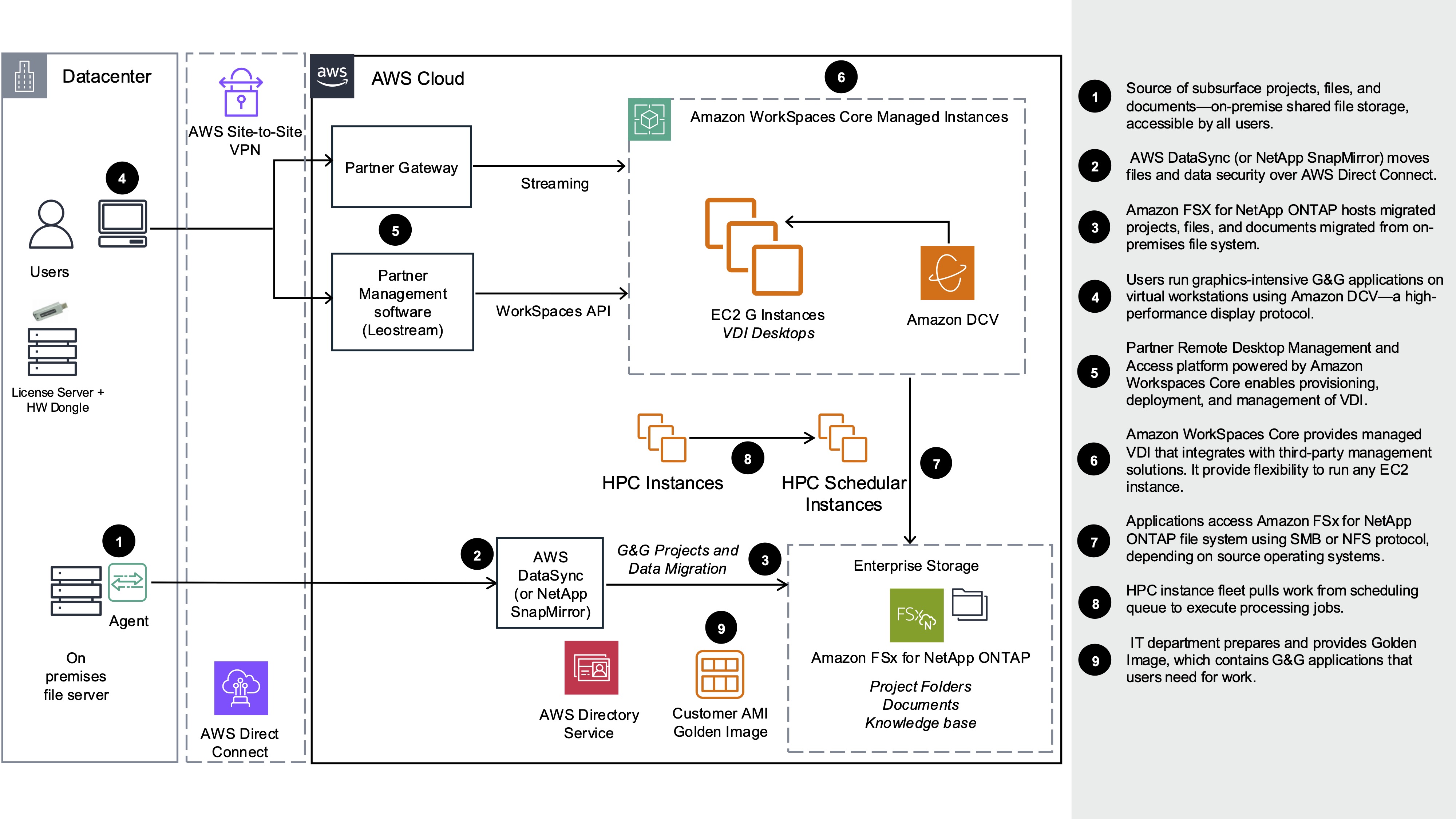
Figure 1: Santos subsurface computing architecture on AWS, showing the integration of EC2 HPC clusters, FSx for ONTAP high-performance storage, and WorkSpaces Core Managed Instances with Leostream orchestration
The architecture follows a hub-and-spoke model with the following key stages:
- Data ingestion – Field data, seismic surveys, and third-party datasets land in Amazon S3 and are promoted to FSx for ONTAP for active processing
- HPC processing – EC2 P5e instances process workloads, accessing data through FSx for ONTAP high-throughput NFS exports
- Visualization – Geoscientists access results through WorkSpaces Core Managed Instances with direct FSx for ONTAP mount points, orchestrated by Leostream
- Analytics and AI/ML – Processed results feed back into Amazon S3 for advanced analytics, ML model training, and business intelligence
For more information, see Review Guidance for Deploying VDI for Subsurface Oil and Gas on AWS.
“Our geophysicists and reservoir engineers work with petabytes of data and need compute that scales on demand without compromise,” says Simon Roberts, Chief Information Officer at Santos. “With Amazon EC2 for HPC, FSx for ONTAP for high-performance shared storage, and WorkSpaces Core for GPU-accelerated visualization, our teams can run the largest jobs without queuing and iterate faster than was ever possible on-premises—while we’ve shifted our IT focus from keeping infrastructure running to enabling geoscience outcomes.”
Architecting for enterprise scale: Design patterns
The following design patterns illustrate how a cloud-based subsurface platform fits together to sustain enterprise-scale HPC, storage, and visualization workloads. They describe the architectural approach and the reasoning behind key trade-offs, the same patterns other upstream operators can apply.
- Compute and networking – At the HPC tier, job scheduling is handled by a dedicated scheduler (such as OpenPBS), with a queue-server instance from which the HPC fleet pulls work, a pattern that scales cleanly from hundreds to thousands of cores. GPU-optimized HPC instances for tightly coupled simulation are provisioned as always-on capacity with Elastic Fabric Adapter (EFA) enabled in a cluster placement group, sustaining up to 3200 Gbps of inter-node bandwidth per instance, the low-latency fabric that GPU reservoir simulators (such as SLB Intersect) depend on. The network follows a centralized networking pattern, with subnets shared across workload accounts and dedicated private connectivity back to corporate environments in capital cities around Australia. This prioritizes operational familiarity, so infrastructure teams operate the cloud environment using established patterns while meeting performance and compliance outcomes.
- Migration at petabyte scale – As part of the migration, AWS Professional Services transferred 2.7 PB of the 4.5 PB dataset using six parallel DataSync agents over approximately 8–10 weeks, before handing over to an AWS Partner to finalize the remaining waves. Migration ran in parallel with live production, with transfer rates actively managed against storage tier headroom so ingest never outpaced the platform. Throughout migration, the dataset was simultaneously replicated to a disaster recovery environment, demonstrating that a workload of this size can be moved with zero downtime and full data integrity.
- High-performance storage – The primary storage tier (FSx for ONTAP) delivers high-throughput performance, on the order of 12 GBps, with automatic tiering between SSD and capacity pools. A useful pattern here: tiering can be tuned to the workload phase. A shorter promotion window during high-ingest migration preserves headroom, then a longer window in steady state lets deduplication, compression, and compaction operate effectively across the larger dataset.
- Security and governance – The security architecture applies defense-in-depth using AWS Organizations for account-level guardrails, federated single sign-on integrated with the customer’s corporate identity provider, and centralized logging, monitoring, and threat detection delivered through a managed account framework. Governance is built in as a first-class requirement rather than added on.
- Secure remote visualization – A connection broker (Leostream) orchestrates user sessions to WorkSpaces Core instances. The pattern balances experience and cost: most users receive a dedicated always-on workspace to avoid boot-time latency, complemented by a small shared pool kept warm for as-needed access, an approach that scales to more than 200 concurrent geoscientists.
Results and business outcomes
Santos’s migration to cloud-based subsurface computing has delivered measurable business value:
- Avoided capacity constraints – No more queuing for HPC resources—geoscientists can run jobs when needed, accelerating decision-making.
- Accelerated decision cycles – With simulations executing up to 90 percent faster and zero queue time for compute resources, Santos’s subsurface teams can evaluate more reservoir scenarios per decision cycle. In an environment where every week of delay between seismic acquisition and drill commitment carries material holding cost, this compression of the technical workflow directly supports the disciplined capital allocation framework that underpins Santos’s investment strategy. The platform also enables workloads (such as FWI) that were previously infeasible, expanding the range of subsurface questions Santos can answer before committing drill capital.
- Operational efficiency – Avoiding the overhead of managing on-premises hardware, freeing IT staff to focus on enabling geoscience outcomes.
- Future-ready platform – Cloud-based architecture enables rapid adoption of new AWS services, AI/ML capabilities, and emerging technologies without infrastructure constraints.
Lessons learned
Santos’s journey offers valuable insights for other upstream organizations considering a similar transformation:
- Start with the data strategy – Understanding data access patterns, performance requirements, and governance needs early informed architecture decisions that avoid costly rearchitecting later.
- Engage geoscientists from day one – End-user adoption depends on delivering an experience that meets or exceeds what users had on-premises. Santos ran performance benchmarks against real production workloads during the build phase, validating that simulation runtimes and visualization responsiveness matched or exceeded the legacy environment before migrating any team. This evidence-based approach converted potential resistance into advocacy. Geoscientists became champions of the new platform because they could see the performance delta firsthand.
- Think platform, not project – Building a reusable, self-service platform rather than migrating individual workloads one at a time created compounding value across the organization, setting the stage for future workload transformation in a centralized operating model.
- Use managed services – Using FSx for ONTAP, WorkSpaces Core Managed Instances, and Leostream rather than self-managed alternatives reduced operational burden and freed Santos to focus on its core business.
Looking ahead
With its cloud-based subsurface computing foundation in place, Santos is positioned to accelerate innovation across its upstream operations. The centralized architecture, with subsurface data co-located alongside scalable GPU compute and a modern analytics layer, removes the infrastructure barriers that have historically prevented operators from deploying AI at production scale. For Santos, this means the solution can support workloads such as AI-assisted seismic facies classification, automated reservoir history matching, and real-time well production optimization without requiring further infrastructure transformation. The foundation is in place; the focus now shifts from platform building to workload innovation.
Conclusion
Santos’s modernization of subsurface computing on AWS demonstrates that even the most demanding upstream workloads—previously considered too specialized for the cloud—can be successfully migrated to deliver superior performance, agility, and cost-efficiency. By combining Amazon EC2 for HPC, Amazon FSx for NetApp ONTAP for high-performance storage, Amazon S3 for scalable data management, and Amazon WorkSpaces Core Managed Instances with Leostream for secure remote visualization, Santos has built a platform that meets today’s subsurface computing needs and is ready for the AI-driven future of exploration and production.
To learn how AWS can help your organization modernize subsurface computing infrastructure, visit AWS for Energy & Utilities or contact your AWS account team to schedule a subsurface workload assessment.