AWS Messaging Blog
How Fanatics Commerce built a scalable email platform on Amazon SES
Fanatics Commerce is a leading designer, manufacturer, and retailer of licensed consumer products, including fan gear, jerseys, lifestyle and streetwear products, headwear, and hardgoods. Whether it’s a championship jersey or a last-minute gift, fans trust Fanatics to deliver and that trust extends to every digital touchpoint along the way.
Every order confirmation, shipping notification, and account update represents a moment of connection with a fan. Fans check their inbox after buying a jersey, track a package before game day, and verify their account when they sign up. These emails are the backbone of the fan experience.
The Fanatics Commerce engineering team built a modern, scalable email platform on Amazon Simple Email Service (Amazon SES), designed from the start for high deliverability, operational efficiency, and seasonal scale that comes with serving more than 100 million fans. When events like Super Bowl, NBA Finals, or World Series drive a surge in orders, the platform has to keep up without missing a beat.
This post walks through what drove the decision, the platform architecture, migration, the key engineering decisions, and what comes next for a large transactional email platform running on Amazon SES.
The case for change
As Fanatics Commerce grew, the engineering team saw an opportunity to elevate their email infrastructure by using Amazon SES capabilities purpose-built for operating at scale.
- Dedicated IP addresses for full reputation control. With dedicated IPs in Amazon SES, Fanatics Commerce could own their sending reputation entirely removing dependency on shared infrastructure and gaining direct control over deliverability outcomes.
- Granular traffic segmentation. Amazon SES offered the ability to treat transactional and marketing email as distinct, independently managed streams each with its own configuration sets, sending identities, and performance tuning rather than routing everything through a single pipeline.
- Real-time deliverability visibility. At the scale of millions of fans, the team needed domain-level insight into open rates, bounce rates, and complaint rates in real time. The built-in analytics and Virtual Deliverability Manager in Amazon SES gave them the detail to diagnose shifts quickly and act decisively.
- Domain-level isolation and authentication. SES enabled the team to assign dedicated subdomains and authentication policies (DKIM, SPF, DMARC) per email type ensuring high-priority transactional messages maintain protected, independent reputations.
- Operational automation at scale. IP warming, reputation monitoring, and sending pattern adjustments could be managed programmatically through SES rather than requiring manual intervention keeping pace with Fanatics Commerce’s volume growth.
The team recognized the opportunity to move beyond incremental fixes. Rather than continuing to adapt an existing system, they set out to build a purpose-built transactional email platform on AWS that addressed all of these needs from the ground up.
Why Fanatics Commerce chose Amazon SES
After evaluating their requirements against several email service providers, the Fanatics Commerce team chose Amazon SES for its combination of reputation control, native observability, and tight integration with their existing AWS infrastructure. Several capabilities stood out during their evaluation.
The priority was reputation control. SES supports dedicated IP pools with separate pools for high-priority transactional, account, and lower-priority traffic, ensuring noisy streams cannot contaminate critical flows.
Visibility was equally important. As Rajat Banerjee, Fanatics’ engineering leader, explains:
“SES emits detailed JSON events for every send, delivery, bounce, complaint, open, and click into S3, and we model that data directly in our warehouse. Tagging each event with order, site, and mailbox provider, plus the user agent SES captures on opens and clicks, lets us slice deliverability at the level we need to run at Fanatics Commerce scale. That granularity is what let us refine our NPS survey email, power order attribution reporting, and debug real production issues over the last few months.”
The team also valued owning the full delivery path, from provider through messaging queue, internal processing, and status store, with rendered email HTML stored in-house. This end-to-end visibility strengthens support and debugging workflows.
The migration scope is strictly transactional, service, and survey email with high but predictable baseline volume and large event-driven spikes. SES is purpose-built for this pattern, with configurable IP warm-up strategies and the flexibility to choose between standard and managed dedicated IPs.
Finally, SES integrates natively with AWS metrics, notifications, queues, and storage, allowing monitoring, alerting, and failure handling to follow the same patterns used elsewhere in the Fanatics stack.
“If SES works for Amazon at scale, I figured it would work for us. We had also seen SES handle our load before, during a failover from our primary provider on a shared IP setup. That gave us the confidence to commit early and design around it.”
Platform architecture
The Fanatics Commerce team designed their email platform with the same engineering rigor they apply to their commerce systems. The architecture reflects a technology first approach to email operations.
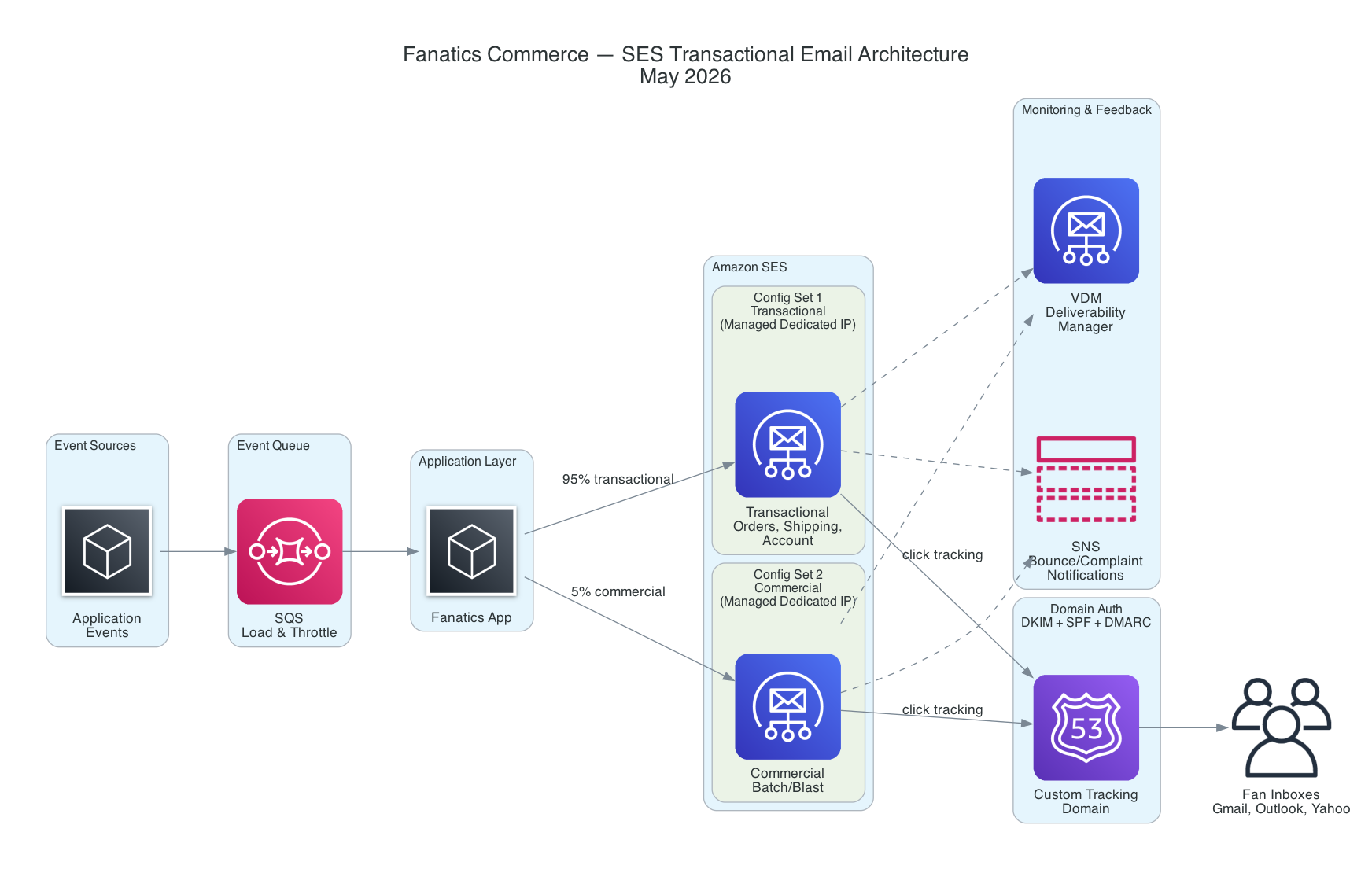
Figure 1 — Fanatics Commerce transactional email platform on Amazon SES
Application layer
The Fanatics application connects to Amazon SES through IAM role-based authentication, with no stored credentials anywhere in the pipeline. This approach simplified security management and eliminated credential rotation as an operational concern.
Managed dedicated IPs
Fanatics started with dedicated IPs and pivoted to managed dedicated to let SES handle IP warming and management. Managed IPs let Amazon SES handle reputation optimization automatically, adjusting sending patterns, warming new IPs, and responding to reputation signals without manual intervention. This was a deliberate engineering decision: the team wanted to invest their time building great fan experiences, not managing IP reputation.
“We started with standard dedicated IPs and managed warming ourselves. Reputation management at our scale became more challenging than we wanted to own, so on AWS architects’ recommendation we moved to managed dedicated IPs. We would rather have our engineers enhancing the fan experience than tuning IP reputation.”
Domain and subdomain strategy
The domain architecture reinforces sender reputation through isolation. Transactional email sends from a dedicated subdomain with its own DKIM signing, SPF records, and DMARC policy. This ensures mailbox providers evaluate transactional email reputation independently, protecting the deliverability of order confirmations and shipping notifications regardless of what other email streams do.
Multi-tenant email design
The team designed a multi-tenant architecture that separates email streams into distinct tenants with independent configuration sets, dedicated IPs, and domain strategies. Each tenant maintains its own reputation, its own IP warming schedule, and its own deliverability metrics. If one tenant has reputation challenges, that specific tenant will be paused without disrupting other tenants.
This isolation is a core design principle. Transactional email, the email fans depend on, runs in its own tenant with dedicated infrastructure. Commercial email operates in a separate tenant. The architecture ensures each stream scales independently and maintains its own deliverability profile.
Real-time observability
Amazon SES Virtual Deliverability Manager (VDM) gives the Fanatics Commerce team a real-time, centralized view of key deliverability metrics including open rates, bounce rates, and complaint rates at the tenant or configuration set level. With VDM, the team is able to spot deliverability shifts early, diagnose issues with confidence, and take action before fans ever notice a problem in their inbox.
Scaling with the seasons
Sports merchandise is inherently seasonal. The platform needed to handle volume swings, from baseline traffic to peak holiday and playoff demand, without degrading deliverability.
During the 2025 holiday season, the platform scaled sending volume by 48x in five months, from initial rollout to full peak capacity across Black Friday, Cyber Monday, and the holiday gifting season. The architecture handled this surge while preserving deliverability, demonstrating that the multi-tenant design and managed dedicated IPs absorb seasonal spikes while maintaining consistent inbox placement rates.
The team phased their rollout by email type and volume, monitored deliverability metrics at each stage, and adjusted sending patterns based on real time feedback from mailbox providers. As the volume scales rapidly, this methodical approach ensured deliverability remained high.
The partnership model
This platform succeeded because of the partnership between Fanatics Commerce and AWS. The engagement brought together an account team TAM, a Solutions Architect, and a Worldwide Specialist SA, each contributing a different perspective.
The TAM coordinated the engagement by connecting Fanatics Commerce engineering with AWS specialists and driving architecture reviews from initial planning through peak holiday season scale.
Rajat Banerjee, Senior Manager of Engineering at Fanatics Commerce, led this initiative end to end from platform design all the way through production rollout. He and his team designed the domain and subdomain strategy that protects sender reputation across brands and ran a phased migration that scaled sending volume to full peak capacity without any disruption to delivery. SES built real-time analytics and reporting pipelines that give team visibility into delivery rates, bounces, and engagement. That visibility transformed incident response and helped the team optimize sending behavior at scale.
This model, customer engineering plus a cross-functional AWS team, accelerated decisions and shortened the feedback loop between architecture questions and production answers. The team had direct access to SES product expertise whenever they needed it, which enabled them to make timely informed decisions.
What’s next
Tenant-level isolation within SES – Handling each tenant’s sending, reputation, and operational signals independently end to end.
Deep linking from transactional emails into the Fanatics mobile app so fans can tap a link in an order or shipping email and land directly on the right screen in the app instead of the web.
Conclusion
Fanatics Commerce set out to build an email platform that matches the speed and reliability fans expect from the brand. By choosing Amazon SES and investing in purpose-built architecture, multi-tenant isolation, managed dedicated IPs, domain-level reputation control, and real-time observability, the team eliminated the operational trade-offs that come with scaling large email systems.
The results speak for themselves: the platform scaled sending volume 48x in five months, maintained high inbox placement rates through peak holiday and playoff demand, and gave the engineering team the visibility to diagnose and resolve deliverability issues in minutes rather than days.
More importantly, this platform frees the Fanatics Commerce team to focus on what matters most, building great fan experiences rather than managing IP reputation and chasing deliverability problems. Every order confirmation that lands in a fan’s inbox on time is a moment of trust earned.
Whether you’re sending millions of emails or only beginning to outgrow your current setup, the patterns in this post apply at any scale. Start by identifying where your current email infrastructure makes you choose between deliverability and growth. Amazon SES is built so you don’t have to.
To learn more about Amazon SES, visit the Amazon SES product page. To explore the Fanatics Commerce AWS journey, read Migration at Scale: The Fanatics Commerce AWS Journey.