AWS Cloud Operations Blog
Category: Advanced (300)
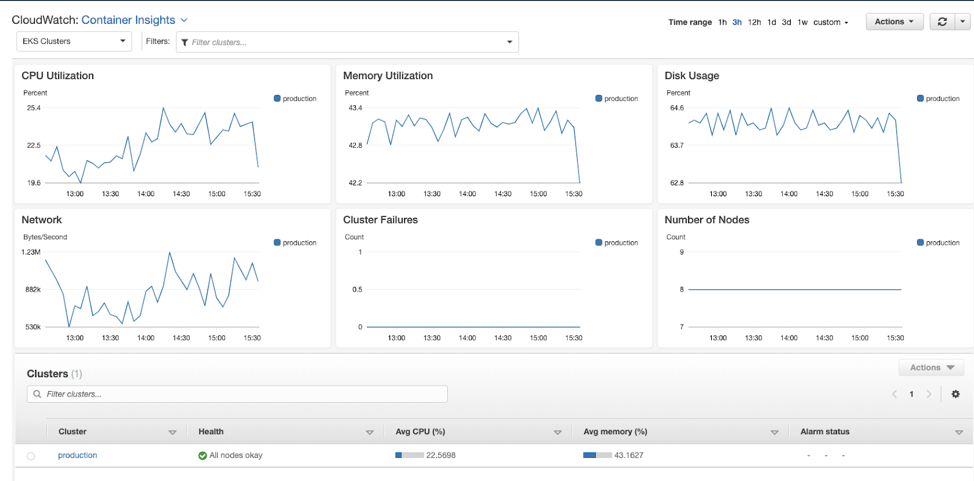
Education site ApplyBoard monitors their mission-critical EKS environment using CloudWatch Container Insights
This guest blog post is contributed by Jayat Markan, a DevOps engineer at ApplyBoard. Jayat helps developer teams build and run a stable and highly available application platform. ApplyBoard’s online platform enables international students to apply to educational institutions across the United States and Canada. This blog post discusses how ApplyBoard set up monitoring on […]

Comcast adds CloudWatch metrics aggregation when monitoring Kinesis Video Streams
This post walks through how Comcast Corporation set up monitoring for Amazon Kinesis Video Streams. To support their business requirements and performance SLAs, they added additional aggregated metrics vended by the Kinesis Video Stream service into Amazon CloudWatch. Comcast Corporation is a global media and technology company that offers a home security solution called Xfinity […]

Using AWS Systems Manager Run Command to submit Spark/Hadoop jobs on Amazon EMR
Many customers use Amazon EMR with Apache Spark to build scalable big data pipelines. For large-scale production pipelines, a common use case is to read complex data from a variety of sources. This data must be transformed to make it useful to downstream applications, such as machine learning pipelines, analytics dashboards, and business reports. Such […]

Simplifying setup for new accounts using Service Quotas
Service Quotas enables you to view and manage your quotas for AWS services from a central location. You can currently view and manage over 100 services, such as Amazon VPC, Amazon DynamoDB, and Amazon RDS. Recently, we made it easier to manage quotas for Amazon EC2 with vCPU-based On-Demand Instance limits, which reduce the number […]

How to set up automatic failover for AWS OpsWorks for Chef Automate
Creating a resilient configuration management system comes with a variety of challenges. The goal of this post is to solve an important component of this: failing over to a standby AWS OpsWorks for Chef Automate server when a primary server is unavailable. With the procedure described in this post, if the main OpsWorks for Chef […]
Controlling your AWS costs by deleting unused Amazon EBS volumes
Customers across industries and verticals consider cost management as one of their top priorities. Limited visibility into a volume’s lifecycle can result in costs for unutilized resources. AWS builds cost-management products to access, organize, understand, control, and optimize costs on AWS. Unused and overlooked Amazon EBS volumes contribute to AWS costs. The lifecycle of EBS […]

How to Detect and Mitigate Guardrail Violation with AWS Control Tower
Many companies that I work with would like to innovate fast in the cloud by adopting a self-service infrastructure provisioning model in a multi-account environment. However, maintaining security and governance in such a model is an organizational challenge. Without structured guardrails and baseline configuration enforcement, troubleshooting and mitigating risk can be cumbersome. AWS Control Tower […]

How to self-service manage AWS Auto Scaling groups and Amazon Redshift with AWS Service Catalog Service Actions
Some of the customers I work with provide AWS Service Catalog products to their end-users to enable self-service for launching and managing Amazon Redshift, EMR clusters or web applications at scale using AWS Auto Scaling groups. These end-users would like the ability to self-manage these resources, for example, be able to take a snapshot of […]

Introducing Amazon CloudWatch Container Insights for Amazon ECS
Amazon Elastic Container Service (Amazon ECS) lets you monitor resources using Amazon CloudWatch, a service that provides metrics for CPU and memory reservation and cluster and services utilization. In the past, you had to enable custom monitoring of services and tasks. Now, you can monitor, troubleshoot, and set alarms for all your Amazon ECS resources using […]
Managing Amazon WorkSpaces by integrating AWS Service Catalog with ServiceNow
As enterprises adopt Amazon WorkSpaces as their virtual desktop solution, there is a need to implement an ITSM-based self-service offering for provisioning and operations. In this post, you will learn how to integrate AWS Service Catalog with ServiceNow so users can request their own WorkSpace instances inclusive of all business-level approvals and auditing. You will […]