Networking & Content Delivery
Category: *Post Types

AWS Site-to-Site VPN and eero make remote connectivity for distributed sites simpler
Amazon Web Services (AWS) is working with eero to make it simpler and more convenient for organizations to establish secure connectivity between their remote sites and AWS in just a few clicks. The integration of AWS Site-to-Site VPN with eero’s devices enables organizations to scale site connectivity across many locations faster and more efficient, without requiring […]

Drive application performance with Application Load Balancer Target Optimizer
AWS Application Load Balancer is an HTTP request load balancer designed to provide scalability through load distribution and high availability through target health detection and unhealthy target isolation. Today, we are excited to introduce ALB Target Optimizer, a powerful new feature through which ALB delivers optimal concurrency to each target. In this post, we will […]

Introducing flat-rate pricing plans with no overages
Today, Amazon Web Services (AWS) is launching flat-rate pricing plans with no overages for website delivery and security. The pricing plans, available with Amazon CloudFront, combine global content delivery (CDN) with multiple AWS services and features into a monthly price with no overage charges, regardless of whether your website or application goes viral or faces […]

Scaling AWS VPN maintenance with tunnel endpoint lifecycle automation
Amazon Web Services (AWS) Site-to-Site VPN is a fully managed service that can create a secure connection between your data center or branch office and your AWS resources using IP Security (IPSec) tunnels. A Site-to-Site VPN connection consists of two VPN tunnels for redundancy. As a managed service, Site-to-Site VPN periodically applies updates to your […]
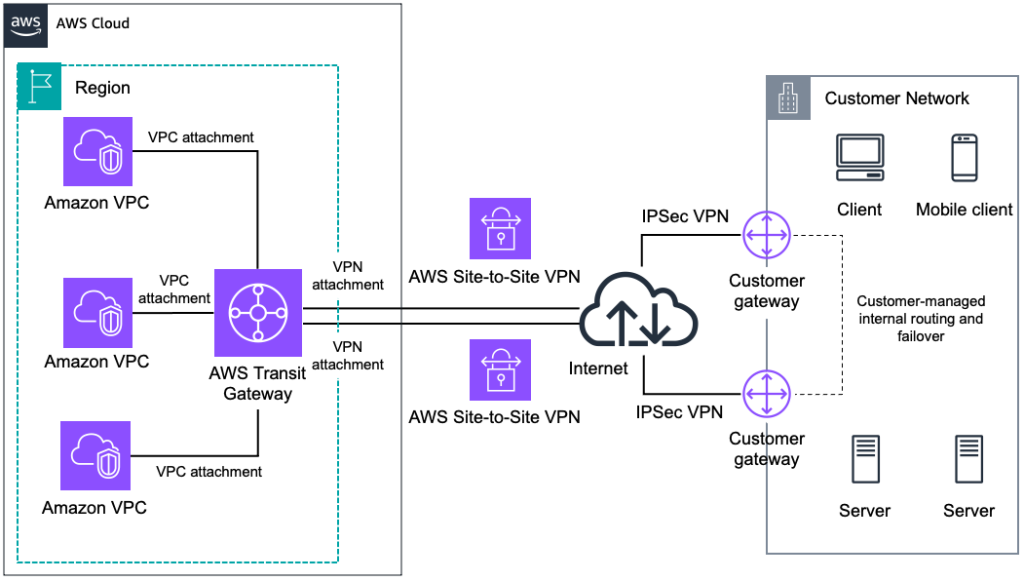
Introducing AWS Site-to-Site VPN 5 Gbps Tunnels to support high throughput workloads
AWS Site-to-Site VPN now supports VPN connections with up to 5 Gbps bandwidth per tunnel, a 4x improvement from existing limit of 1.25 Gbps. This increased bandwidth benefits customers who require high-capacity connections for bandwidth-intensive hybrid applications, big data migrations, and disaster recovery architectures. AWS Site-to-Site VPN is a fully managed service that allows you […]
Custom domain names for VPC Lattice resources
Amazon VPC Lattice is a fully managed application networking service that lets you connect, secure, and monitor communication between your services and resources within and across VPCs and accounts. Today, we announce custom domain names for Lattice resources. In this post, we will examine this feature in detail. Resource owners can now specify an Fully […]
Introducing cross-account support for Amazon CloudFront Virtual Private Cloud (VPC) origins
In November 2024, Amazon CloudFront introduced CloudFront Virtual Private Cloud (VPC) origins, a security feature that allowed customers to deliver content from applications hosted in private subnets. In addition, we are now introducing cross-account support for Amazon CloudFront VPC origins, enabling network traffic flow between Amazon CloudFront and Application Load Balancers (ALBs), Network Load Balancers […]
Configuring the AWS WAF Anti-DDoS managed rule group for your resources and clients
Users wanting to protect themselves from Layer 7 (HTTP) DDoS threats can use the AWS WAF L7 Anti-DDoS managed rule group to detect and mitigate DDoS events in single digit seconds. The Anti-DDoS managed rule group has a default configuration that is appropriate for many applications and clients. However, there are clients that need special […]

Introducing URL and host header rewrite with AWS Application Load Balancers
Today we’re announcing the general availability of rewriting URLs and host headers natively on Amazon Web Services (AWS) Application Load Balancers (ALB). You can use this new feature to implement regex matches based on request parameters and rewrite both host headers and URLs before routing to your targets. Operating at Layer 7 (application layer) of […]

How Silverflow modernized network operations by combining AWS Cloud WAN and DevOps
In this post, we dive into how at Silverflow we adopted AWS Cloud WAN and how we used standard DevOps practices, to manage our global network in a compliant and secure way. At Silverflow, our mission to bring payments into the modern era also necessitated that we rethink our network from the ground up. Every […]