Networking & Content Delivery
Category: AWS Site-to-Site VPN
Implementing encryption in transit across connectivity patterns with VPC Encryption Controls
Security and compliance teams managing modern cloud environments often ask us: “How do we enforce encryption in transit across every network path? Can we put in place policies that restrict teams from sending unencrypted traffic between any two nodes?”. Your environment likely includes a mixed fleet of Amazon Elastic Compute Cloud (Amazon EC2) instances across […]
Phased AWS Transit Gateway to AWS Cloud WAN Migration with Terraform and Network MCP Server
Migrate from AWS Transit Gateway to AWS Cloud WAN across multiple Regions using a six-phase Terraform approach with AWS Network MCP Server validation
Intelligent VPN observability: Decoding AWS Site-to-Site VPN logs
When an AWS Site-to-Site VPN connection degrades, you sift through hundreds of log entries, correlate Border Gateway Protocol (BGP) state transitions with Internet Key Exchange (IKE) phase changes and decide whether the cause is a prefix quota violation, an autonomous system (AS) path loop, or a hold timer expiry. That repetitive manual work prolongs recovery. […]
Private connectivity patterns for Amazon Bedrock AgentCore Gateway Targets
Private connectivity from AgentCore Gateway to your targets reduces compliance scope and simplifies auditing making it a common requirement in regulated environments. Whether your targets run inside an Amazon Virtual Private Cloud (Amazon VPC), across AWS accounts, in other AWS Regions, on-premises, or in multicloud environments, you need connectivity patterns that keep traffic off the public internet […]
Migrate from Static Routing to Dynamic BGP Routing on AWS Site-to-Site VPN
Introduction AWS Site-to-Site (S2S) VPN is a fully managed service that enables you to establish secure connections between your on-premises networks and AWS using IP Security (IPSec) tunnels. When configuring these connections AWS Site-to-Site (S2S) VPN offers two routing options: static and dynamic routing with Border Gateway Protocol (BGP). While static routing offers simplicity for […]
Selecting the Right AWS VPN Solution: A Decision Framework
Introduction This post is intended for networking engineers and architects evaluating AWS VPN options (200-level content). It assumes familiarity with basic AWS networking concepts such as virtual private clouds (VPCs), virtual private gateways (VGWs), and transit gateways (TGWs). If you are new to AWS VPN, the AWS VPN User Guide provides foundational context. Organizations implementing […]

LexisNexis Risk Solutions success story: Enhancing global connectivity with AWS Cloud WAN
In this post, we review how LexisNexis Risk Solutions modernized their Amazon Web Services (AWS) network by migrating from a legacy Transit Virtual Private Cloud (Transit VPC) architecture to a highly resilient global backbone network built with AWS Cloud WAN. We also dive deep into how AWS Cloud WAN helped LexisNexis Risk Solutions achieve streamlined […]

AWS Site-to-Site VPN and eero make remote connectivity for distributed sites simpler
Amazon Web Services (AWS) is working with eero to make it simpler and more convenient for organizations to establish secure connectivity between their remote sites and AWS in just a few clicks. The integration of AWS Site-to-Site VPN with eero’s devices enables organizations to scale site connectivity across many locations faster and more efficient, without requiring […]

Scaling AWS VPN maintenance with tunnel endpoint lifecycle automation
Amazon Web Services (AWS) Site-to-Site VPN is a fully managed service that can create a secure connection between your data center or branch office and your AWS resources using IP Security (IPSec) tunnels. A Site-to-Site VPN connection consists of two VPN tunnels for redundancy. As a managed service, Site-to-Site VPN periodically applies updates to your […]
Introducing AWS Site-to-Site VPN 5 Gbps Tunnels to support high throughput workloads
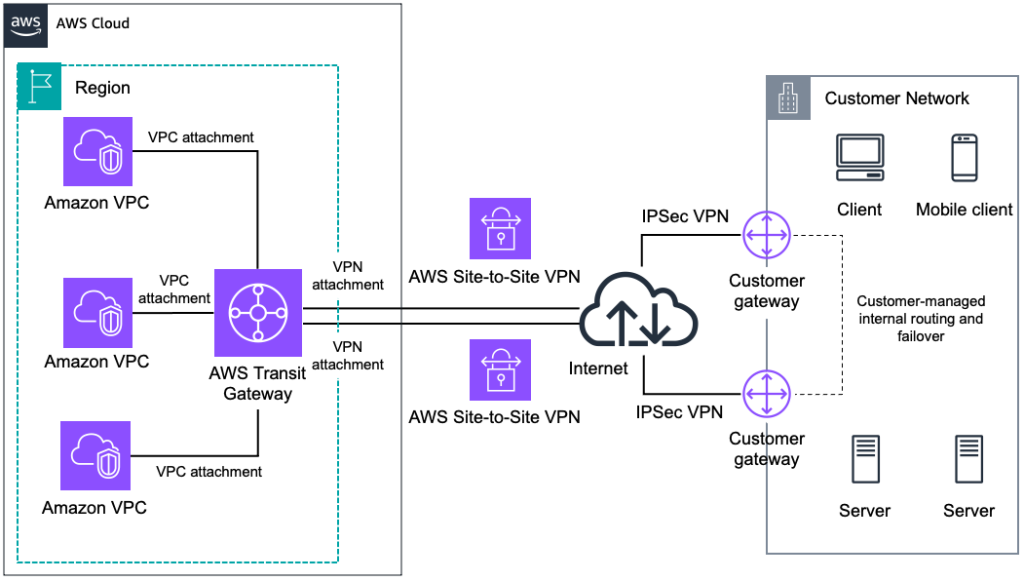
AWS Site-to-Site VPN now supports VPN connections with up to 5 Gbps bandwidth per tunnel, a 4x improvement from existing limit of 1.25 Gbps. This increased bandwidth benefits customers who require high-capacity connections for bandwidth-intensive hybrid applications, big data migrations, and disaster recovery architectures. AWS Site-to-Site VPN is a fully managed service that allows you […]