Networking & Content Delivery
How Amazon CloudFront helped deliver Grand Theft Auto VI to players
Some launches are big. After 13 years of anticipation, Grand Theft Auto VI (GTA VI) was one of the biggest ever, and Amazon CloudFront helped deliver it. When the game unlocked at midnight on November 19, 2026, in Auckland, New Zealand, it ended one of the longest waits in gaming. Over the next 18 hours, as midnight moved west across Asia, the Middle East, Europe, and the Americas, millions of consoles unlocked a game of more than 200 GB. Most had pre-loaded it and took the day-one patch, and the rest started the full download. It became one of the largest download events the internet has seen. Internet service providers (ISPs) and internet exchanges reported all-time traffic highs. This post shows what that looked like from inside CloudFront.
CloudFront helped deliver the game to those players at every step. It carried the pre-load in the days before release. It carried the full-game downloads and the day-one patch on launch night. It still carries the downloads from every new player who buys the game. At its busiest, game-download traffic on CloudFront ran at four times its normal daily peak. At the launch-day peak, game downloads made up more than a third of all CloudFront traffic, about three times their share in a normal week. A day after that peak, Prime Video’s Thursday Night Football kicked off while game downloads were still running high. Players saw a progress bar that kept moving.
At the launch-day peak, at 21:07 UTC on November 18, CloudFront delivered 122 terabits per second (Tbps) of gaming traffic: game downloads plus video on Twitch and Amazon Interactive Video Service (Amazon IVS). In that same minute, the CloudFront network carried more than 250 Tbps across all of its customers.
GTA VI was one of the most anticipated game releases in years. Its publisher, Rockstar Games, called it the biggest entertainment launch in history, and the industry watched it closely. The RIPE Network Coordination Centre (RIPE NCC) published a measurement of which networks delivered GTA VI (RIPE Labs).
From pre-load to launch day, and after
A game launch of this size doesn’t arrive as one spike, and the pre-load is only the start. CloudFront delivered the game through three phases.
The first phase was the pre-load. Starting at local midnight on Tuesday, November 10, 2026, players who had pre-ordered started to download the game. At the peak on November 10, game downloads on CloudFront ran at 3.6 times their normal daily peak. They held at around two to two and a half times normal for the rest of the week, as players who missed the first night caught up. Traffic rose again on November 12, the day boxed copies went on sale (they contain a download code, not a disc).
The second phase was launch. The game became playable at local midnight on November 19, so every region had its own launch moment. New Zealand unlocked first, at 11:00 UTC on November 18, and North America last, at 05:00 UTC on November 19. Players who hadn’t pre-loaded downloaded the full game. Everyone who had pre-loaded received the day-one patch. Launch day didn’t step up at each midnight the way the pre-load did. Demand was already running at one and a half times the normal daily peak when New Zealand unlocked, and it climbed through the day as players in Asia, Europe, and South America bought the game. It peaked at 4.1 times the normal daily peak at about 21:00 UTC on November 18, higher than anything in the pre-load. That was midnight in the Middle East and evening in Europe, a couple of hours before continental Europe unlocked. By the time the United States and Canada unlocked, about eight hours later, traffic was easing from that high, and the North American midnight added no new surge.
The third phase is still running. Every player who buys the game after launch downloads it in full, and each update goes out to every player who owns the game.
Two days stood out across the launch period: the first pre-load day and launch day. Between them, and after launch, game downloads stayed well above a normal day.
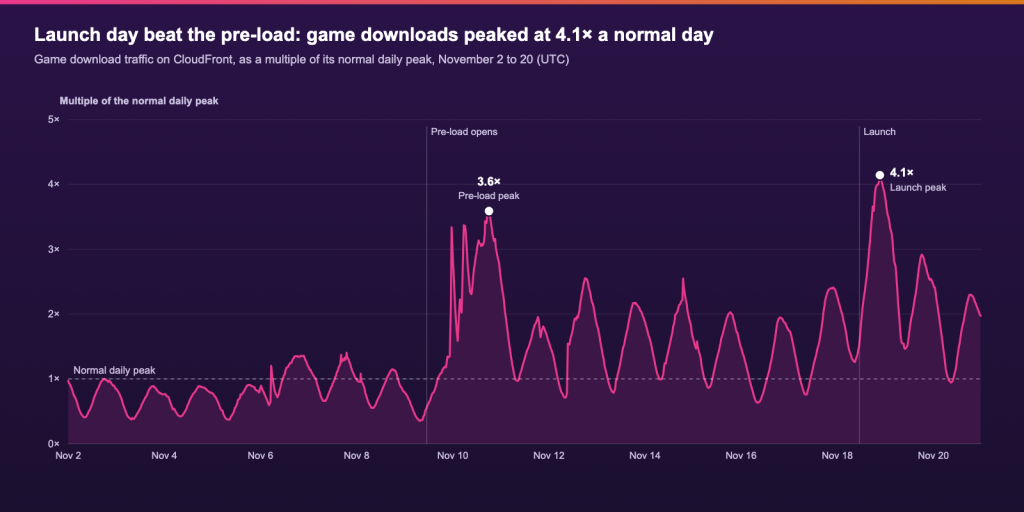
Figure 1. Game download traffic on CloudFront, November 2 to 20, as a multiple of its normal daily peak.
Each region unlocked at its own midnight
The release followed local midnight, not a single global moment. That turned one large peak into a series of regional peaks, and each landed on a different part of the CloudFront network.
During the pre-load, the jump at each local midnight was sharp. In Spain, game downloads on CloudFront were running at just over half their normal daily peak just before midnight. Five minutes later they had passed six times their normal peak, and half an hour after midnight they reached nearly 10 times. In the same half hour, CloudFront’s total traffic in Spain reached twice its normal daily peak.
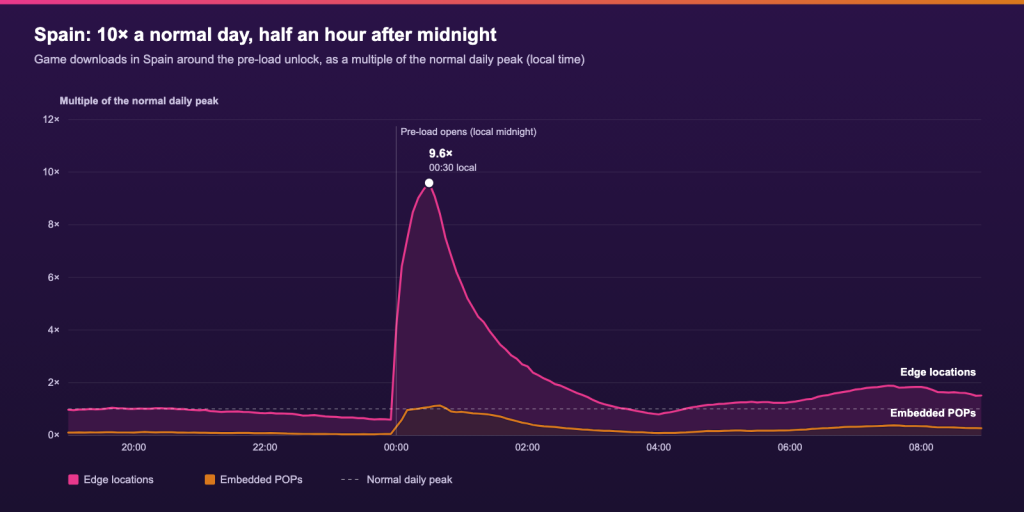
Figure 2. Game download traffic on CloudFront in Spain around the pre-load unlock, local time.
The ISPs saw it too. Virgin Media O2 in the UK set records for peak traffic and daily data volume on the first day of the pre-load, with broadband traffic up 51.6% in the first hour compared with the week before (Virgin Media O2). Openreach saw total traffic about a third above an average Tuesday (TechSpot). In the United States, Comcast said the first 48 hours of pre-loads were the largest standalone event in its network’s history (Yahoo Tech), and Charter called the game the largest download event ever on its Spectrum network (The Desk). At the DE-CIX internet exchanges, traffic set records in Frankfurt and worldwide (DE-CIX).
Launch night looked different. In the UK, Hyperoptic reported no launch surge at the midnight unlock because most players had already pre-loaded, and the rural network Gigaclear saw only a small bump (ISPreview). The records fell the evening before: Virgin Media O2’s traffic between 8 and 10 pm was 9.4% above its pre-load record (Virgin Media O2), BT and EE recorded the biggest broadband peak in their history (Telecoms.com), Australia’s NBN reached an all-time high of 36.54 Tbps overnight (Canstar), and DE-CIX set a worldwide record of 33.03 Tbps at 20:20 CET (DE-CIX).
How delivery held up
For players whose ISP hosts CloudFront caches, much of the surge was served from inside their own network. CloudFront has more than 750 edge locations in major metro areas. It also has more than 1,550 embedded points of presence (POPs) inside ISP networks. For a launch download, the embedded POP matters most: a game chunk already cached inside the console’s own ISP network reaches the player without crossing a peering link, a transit link, or an internet exchange point, and with minimal use of the ISP’s own backbone, so there’s more room for everything else its subscribers do.
Inside the ISPs, the jump was just as sudden. On the night the pre-load opened, one embedded POP inside a Brazilian ISP in São Paulo went from 18% of its capacity to 89% in the four minutes either side of midnight. It held there for about half an hour, then eased back as the first wave of downloads finished. It wasn’t alone: within 15 minutes of midnight, 26 embedded POPs across five Brazilian ISPs went from under a third of their capacity to more than 80%. At several of the largest European ISPs, nearly all game-download traffic in their busiest hour came from embedded POPs inside their own networks.
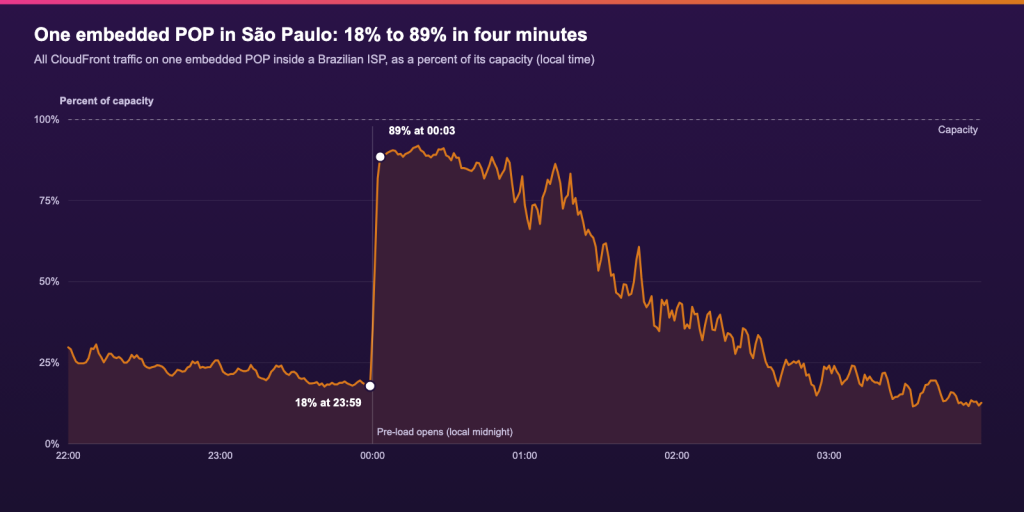
Figure 3. Total traffic on one embedded POP inside a Brazilian ISP in São Paulo, for game downloads and other CloudFront customers, on the night the pre-load unlocked, local time.
Serving from inside the ISP also made downloads faster to start and kept them reliable. Comparing the same game downloads in the first day of launch, CloudFront’s internal measurements showed that embedded POPs:
- served 99.5% of requests from cache, against 98.4% from edge locations
- had a median time to first byte about 18% lower
- kept error rates at normal levels, even at peak.
A 200 GB download is thousands of separate chunk requests, and each one waits for its first byte before data starts to flow. Lower latency on every chunk adds up over the whole download, which is why serving it from an embedded POP inside the player’s own ISP makes such a difference.
Business as usual for CloudFront
The rest of the internet doesn’t pause for a game launch. North America unlocked on a Thursday, and Thursday Night Football started on Prime Video that evening while US players were still downloading. Other sports and live events on CloudFront kept their normal load. Video on Twitch and Amazon IVS also rose to the highest viewership for a game launch with the release, as players streamed themselves playing the game. On CloudFront it peaked on the evening of November 18, the same evening that game downloads peaked.
CloudFront runs all of these, all the time, at the quality its customers expect:
- Large file downloads: Long-lived HTTPS sessions that each pull hundreds of gigabytes and use all the throughput a home connection has.
- Live sports: Millions of short segment requests every few seconds. A late segment means a rebuffer on screen.
- Interactive live video: Low-latency streams where a delay of a few seconds is visible to the audience.
The game-download peak came on the evening of November 18, as the Middle East unlocked and Europe headed toward its own midnight. Thursday Night Football kicked off the next evening while game downloads were still high, and live streams of people playing the game added a third kind of demand on top of the downloads and the football. CloudFront’s traffic management steers each new session to the best location as demand moves between workloads and regions, so players, football fans, and stream viewers each got the experience they expect from CloudFront on any other night.
How CloudFront absorbs a launch without pre-warming
CloudFront doesn’t require pre-warming before a big release: no pushing files to every location ahead of time. Its cache fills on demand at internet scale, and a new object becomes available everywhere as the first requests arrive. Pre-warming isn’t the same as a pre-load: a pre-load copies the game to the player’s console before release day, and pre-warming copies content into a CDN’s caches before a traffic spike.
A reference architecture for a large game launch puts these building blocks together. It’s a complete, resilient example, not the exact setup behind GTA VI. The console requests a chunk over HTTPS with a signed URL. Each cache tier passes only its misses to the next tier. Origin Shield sends the remaining misses to Amazon S3 Multi-Region Access Points, which route each one to the nearest available bucket.
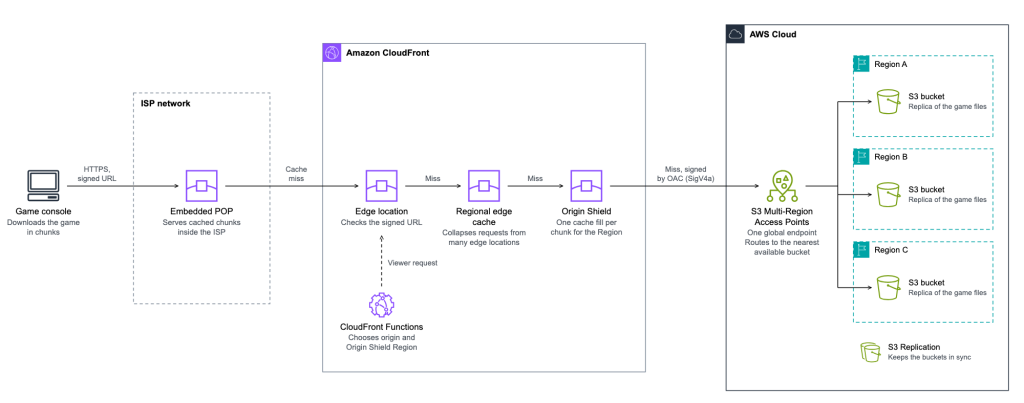
Figure 4. A reference architecture for delivering a large game download on CloudFront.
The architecture draws many lines, but you don’t build or run them. For you as the operator of the distribution, every tier and connection in it is a native, integrated part of CloudFront. You turn the features on in the distribution configuration, and CloudFront runs the paths between them.
Authorizing every download at the edge
Paid game content must reach only the players who own it. With CloudFront, you can check access at the edge with signed URLs, signed cookies, or token validation in CloudFront Functions. The edge validates each request before it serves any bytes, these checks add no round trip to the origin, and they scale with the edge. CloudFront can also use the authentication you already have. With network calls, a CloudFront Function can call an authentication service over the network, such as your own service on your infrastructure or Amazon Cognito, and wait for its answer before CloudFront serves the request. That call adds a round trip to the authentication service, so for a large download, check the player once and then issue a signed cookie for the chunks. For examples, see the CloudFront Functions network call patterns on GitHub, including a pattern that validates Amazon Cognito access tokens.
Embedded POPs and edge locations serve each request
Once a request is authorized, CloudFront serves it from the best location for that player: an embedded POP inside the player’s own ISP where there is one, or a nearby edge location. At the moment of unlock, the first request for each file fills the cache from the next tier, and every later request in that ISP is served locally.
Tiered caching absorbs a new object on demand
If an edge location doesn’t have a chunk yet, it requests it from a regional edge cache, a larger cache layer that serves many edge locations in one geographic area. If the regional edge cache doesn’t have it either, it can request it from Origin Shield, an extra cache layer in front of the origin.
Request collapsing protects the origin before anything is cached
When a region unlocks, its newest chunks aren’t cached anywhere yet. Thousands of consoles request the same chunk in the same second. CloudFront doesn’t forward each of those requests. When an edge location receives several requests for the same object it hasn’t cached yet, it sends one request to the next tier. The others wait for the response, and when it arrives, CloudFront caches it and serves every waiting request from that copy. This is called request collapsing.
Each tier collapses requests in the same way, so the savings multiply. With illustrative numbers, 10,000 requests for one new chunk reach 40 edge locations. Each edge location forwards one request, the 4 regional edge caches each forward one to Origin Shield, and Origin Shield forwards one to the origin.
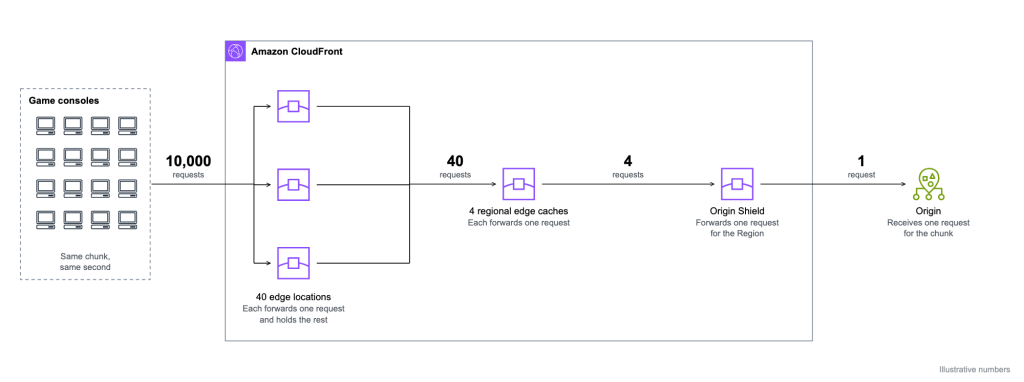
Figure 5. Request collapsing for one uncached chunk, with illustrative numbers.
With Origin Shield, the origin receives as few as one request for each chunk, even for the first requests of the launch, before the cache holds anything. Request collapsing works for requests that share a cache key and for content CloudFront can cache, so keep the cache key small: each query string, header, or cookie you add splits identical requests into different objects that CloudFront can’t collapse. For more information, see Simultaneous requests for the same object.
Choosing the origin with S3 Multi-Region Access Points and CloudFront Functions
In the reference architecture, the origin is an Amazon S3 Multi-Region Access Point: one global endpoint in front of replicated buckets in several AWS Regions. On a cache miss, the access point routes the request to the available bucket closest to the CloudFront location that sends it, which with Origin Shield on is the Origin Shield Region. Because a CloudFront Function can set the Origin Shield Region for each request, a player in Tokyo and a player in Frankfurt can still fill the cache from different Regions. If one Region becomes unavailable, the access point routes requests to a bucket in another.
Since August 2026, CloudFront signs requests to Multi-Region Access Point origins with origin access control (OAC). Before that, you needed to compute the AWS Signature Version 4A (SigV4a) Authorization header in a Lambda@Edge function. Now the access point accepts requests only from the CloudFront distributions you choose, with no signing code. For more information, see Restricting access to an Amazon S3 Multi-Region Access Point origin.
For large-object distributions, you also don’t need to fix the origin and Origin Shield settings for the whole distribution. With a CloudFront Function on the viewer request, you can choose the origin for each request, and whether to use Origin Shield and in which AWS Region. A distribution can send rarely requested files straight to the nearest origin, and keep frequently requested launch files behind Origin Shield, with no change to the distribution configuration. For more information, see Helper methods for origin modification.
What builders can take from this launch
The same building blocks apply when you plan a large launch on CloudFront, such as a game, an operating system update, or a media release. They also apply when you run a large content or retail site. You don’t need a launch of this size to get them. The same internet-scale network, cache tiers, and request collapsing are available to a small shop on a CloudFront flat-rate pricing plan and to a launch like this one (CloudFront pricing).
- Plan the cache hierarchy, not a pre-warm. Turn on Origin Shield in the Region closest to your origin for launch-day objects.
- Split files into chunks of a cacheable size. With range requests and chunked manifests, every tier can cache and collapse requests efficiently. Keep the cache key small so identical requests collapse.
- Authorize at the edge. Check access with signed URLs or signed cookies, or token checks in CloudFront Functions. Access checks never reach your origin.
- Choose the origin for each request. With CloudFront Functions, you can set the origin and the Origin Shield Region when one setting doesn’t fit every file.
- Put the origin behind S3 Multi-Region Access Points. Turn on origin access control so only your distribution can read the buckets. Cache misses then fill from the nearest Region.
- Match the origin to the content. Amazon S3 and S3 Multi-Region Access Points are the go-to origin for files such as game builds. For dynamic content, such as entitlement checks or download manifests, an AWS Lambda Web Function with a MultiRegion endpoint gives CloudFront one global origin. Lambda replicates your code to each Region that you choose, routes each request to the Region with the lowest latency, and scales with demand. CloudFront signs its requests to the endpoint with origin access control.
- Talk to your AWS account team early. For a launch of this size, CloudFront and networking engineers model regional demand with you. On pay-as-you-go pricing, also request increases to your distribution’s data transfer rate and requests-per-second quotas well before launch day.
The last download
From the first pre-load on November 10 to the latest patch, CloudFront helped deliver GTA VI to players. The launch moved through six regions in 18 hours. It overlapped with a primetime football game, and game downloads ran at four times their normal peak. Players didn’t think about the network. They were busy playing.
The next big launch is already on someone’s calendar. If it’s yours, get started with Amazon CloudFront.
Learn more
For more on the features in this post, see the following resources:
- Bringing delivery closer to end users with Amazon CloudFront Embedded POPs
- Use Amazon CloudFront Origin Shield
- Restrict access to an Amazon S3 Multi-Region Access Point origin
- Restrict access to an AWS Lambda Web Function origin
- Customize at the edge with CloudFront Functions
- Helper methods for origin modification
- Serve private content with signed URLs and signed cookies
- How CloudFront delivers content
Key terms
These terms appear throughout this post.
- Embedded POP: A CloudFront point of presence inside an ISP’s network. Cached content reaches subscribers without crossing the ISP’s peering links, and with minimal use of its backbone.
- Regional edge cache: A CloudFront cache tier between edge locations and the origin. It keeps less popular content longer and collapses requests from many edge locations.
- Origin Shield: An optional CloudFront cache layer in one AWS Region in front of the origin. It reduces origin load and improves the cache hit ratio.
- S3 Multi-Region Access Point: One global Amazon S3 endpoint in front of replicated buckets in several Regions. It routes each request to the closest available bucket.
- Origin access control (OAC): A CloudFront feature that signs requests to the origin, so the origin accepts requests only from your distribution.
- Pre-load: A download a console runs before the release date, so the game is playable the moment it unlocks.
- Pre-warming: Pushing content into a CDN’s caches before an expected traffic spike. CloudFront doesn’t require it.