AWS Physical AI Blog
3D Gaussian Splatting in practice: Industry use cases
Gaussian Splatting is dramatically lowering the cost and complexity of photorealistic 3D, making once impractical use cases like near real time capture, robotics, and simulation viable across media, construction, manufacturing, and real estate.
AWS Physical AI | Blog #2 in the 3D Gaussian Splatting Series
From Research Breakthrough to Business Advantage
When we introduced 3D Gaussian Splatting (3DGS) in an earlier blog, the story was fundamentally about a technical leap: photorealistic, real-time 3D scenes rendered from ordinary photos and video, at a fraction of the cost and complexity of traditional workflows. This post shows how industry teams are implementing Gaussian Splat technologies within their businesses using the Open Source 3D Reconstruction Toolbox for Gaussian Splats on AWS (the “Splat Toolbox”) – including how the pipeline works, costs, and what it unlocks across five industry verticals.
It focuses on the practical: what 3DGS unlocks, for whom, and why the open source foundation matters as much as the technology itself.
In short: 3DGS has evolved beyond an experimental technology into a production capability available and running on AWS today.
The Splat Toolbox: Open Source, Modular, Production-Ready
The Splat Toolbox is a fully open source, cloud-native pipeline available as guidance in the AWS Solutions Library that turns raw captures into production-ready 3D Gaussian Splat assets. Every component is public on GitHub with no licensing fees or vendor lock-in, giving your team full ownership of the pipeline, the data, and the pace of innovation. Community-driven development means open access, faster iteration, and broad ecosystem compatibility.
The Splat Toolbox pipeline is deliberately designed to be modular with five distinct stages; each independently configurable and swappable. Teams can adopt the components they need without replacing existing workflows.
The Five-Stage Pipeline

Figure 1: Five-Stage Pipeline for Gaussian Splatting
| Stage | Step | Description |
|---|---|---|
| 1 | Input & Capture Management | Ingest media and sensor metadata from any supported source including mobile phone video, drone footage, LiDAR-assisted rigs, or multi-camera arrays. Archives are unpacked, jobs registered, and per-capture metadata surfaced to all downstream stages. |
| 2 | Pre-Processing | Prepare frames for reconstruction. Automated blurry-frame removal, object removal, and background removal clean the source imagery. Spherical camera and panorama pre-processing handles 360° capture modalities. Output is a consistent, high-quality frame set ready for Structure from Motion (SfM). |
| 3 | Reconstruction | Recover the 3D structure of the scene. COLMAP-based Spatial SfM establishes camera poses; a transformer-based alignment stage accelerates smaller datasets while hierarchical localization sharpens accuracy on larger ones. Pose-prior support accepts GPS or IMU data to guide reconstruction. |
| 4 | Training & Models | Fit Gaussians to the reconstructed scene. Four open source engines are available: Splatfacto, Splatfacto-in-the-Wild, 3D Gaussian Ray Tracing and Unscented Transform (3DGRUT), and GSplat. Training strategies include Bilateral Grid, Physically-Plausible Image Signal Processing (PPISP), and Markov Chain Monte Carlo (MCMC) for adaptive densification. |
| 5 | Post-Processing & Output | Finalize the asset for delivery. Coordinate conversion, crop, and outlier removal clean the scene boundary. Output formats span PLY, SPZ, SOG, USDZ, MP4 (rendered video), and JPEG (thumbnail). Quality is measured via PSNR, SSIM, and LPIPS metrics. |
Cloud Architecture
The Splat Toolbox is built on an event-driven AWS architecture designed for both single-asset experimentation and large-scale batch production:
- AWS Step Functions: Orchestrates the end-to-end pipeline, handles retries and error states, and surfaces job status.
- AWS Lambda: Drives event handling, lightweight transformation, and inter-stage routing.
- AWS Batch / Amazon Elastic Container Service (Amazon ECS): Runs compute-intensive reconstruction and training on GPU-accelerated instances. Amazon Elastic Compute Cloud (Amazon EC2) Spot Instance support delivers significant flexibility in cost-performance.
Deployment Flexibility
Because the Splat Toolbox is open source, teams are not locked into a single deployment model. The pipeline can run:
- Locally on a development workstation
- Via CDK or Terraform deployment to any AWS account
- On Amazon SageMaker for ML-integrated workflows
- On AWS Batch or Amazon ECS for production-scale burst processing with On-Demand or Spot Instances
The Economics of Photorealistic 3D
Traditional 3D capture workflows including LiDAR scanning, structured-light rigs, and professional photogrammetry typically require expensive hardware and are operationally heavy. A single scanned environment can be costly and take days of post-processing. This high-cost structure has historically kept high-quality 3D out of routine business workflows.
3DGS changes the economics. Running the full Splat Toolbox pipeline on GPU-accelerated AWS EC2 Spot Instances brings the all-in cost of a completed, production-quality 3D Gaussian Splat asset to pay-as-you-go infrastructure at a discounted rate of up to 50% cost savings on compute versus on-demand pricing. With this lowered barrier to entry, the conversation shifts from “Is 3D feasible?” to “How many 3D assets do we want to process today?”
What 3DGS on AWS unlocks:
- Batch-process entire property portfolios, product catalogs, or facility equipment at scale
- Create 3D assets on tight production schedules without specialized capture hardware
- Iterate quickly: re-capture and re-process as environments change
- Open source = no licensing fees: total cost of ownership stays predictable and under your control, reducing long-term technical debt
Industry Use Cases
With the economics established, here’s the what: the same core technology — millions of tiny Gaussians reconstructed from images and rendered in real time — takes on a different role in every industry it touches. Below is a glimpse into how five verticals are applying it today.
Media & Entertainment
- Pre-visualization: Directors and production designers scout locations and build shot plans in photorealistic 3D before a single camera rolls. Expensive location trips become optional; creative decisions happen earlier and with better spatial information.

Figure 2: Drone footage converted to a 3D Gaussian Splat scene (left), zoomed in view of splat (right)
- Pre-set location logistics: Production crews use 3D captures of shooting locations to plan equipment placement, lighting rigs, crew movement, and safety egress – all remotely, without requiring everyone on-site simultaneously.
- Post-production & VFX: Visual effects teams pull real-world 3D captures directly into compositing and environment-building pipelines. Gaussian Splat environments can augment traditional matte paintings and digital set extensions, and because the full scene is captured in 3D, artists can create new camera angles or reshoot shots in post without ever returning to set.
- Virtual production: LED volume stages powered by photorealistic Gaussian Splat environments deliver in-camera VFX that would previously require weeks of 3D modeling. Real locations become virtual backdrops, captured in hours.
Robotics & AI
- Fine-tune AI on realistic 3D data: Gaussian Splat reconstructions provide photorealistic 3D environments that can be rendered from arbitrary viewpoints, dramatically expanding the synthetic training data available for model fine-tuning and validation – this has been a persistent bottleneck in simulation for robotics programs.
- Sim-to-real transfer: The gap between simulated training environments and the real world is a known problem in robotics. 3DGS captures of actual deployment environments close that gap: robots train in spaces that look, and spatially behave, like the environments they will operate in.
- Navigation & path planning: Reconstructed spaces provide accurate 3D maps for path planning, obstacle avoidance algorithm development, and spatial reasoning benchmarks – without requiring continuous physical access to the target environment.
Construction & Infrastructure
- Compare point clouds over time: Periodic 3D captures of a construction site produce a time-series of spatially accurate 3D states. Teams can compare captures across weeks or months to verify schedule adherence, track installed quantities, and document as-built conditions without deploying surveyors.
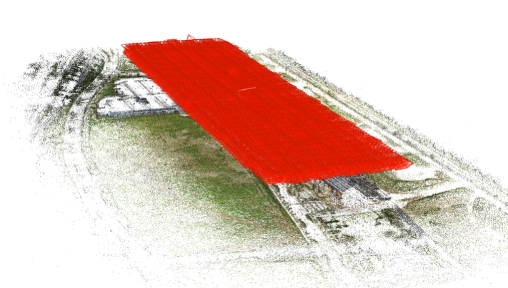
Figure 3: Construction site showing aerial drone capture coverage above in red and point cloud below
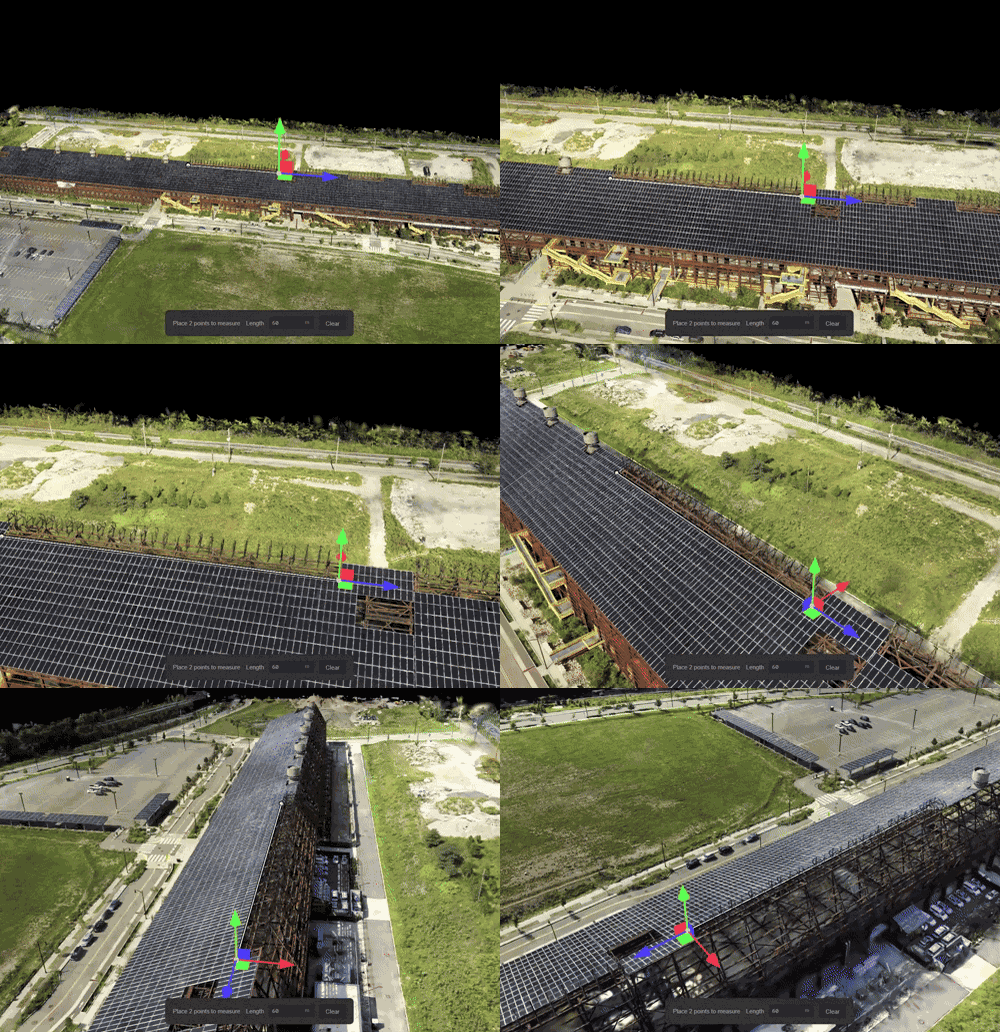
Figure 4: Gaussian Splat of above construction site using metrically grounded point cloud
- 3D overlay to visualize anomalies: Overlaying the as-built 3D capture against the original design model surfaces deviations visually – misaligned structural elements, incorrect placements, out-of-tolerance dimensions – before they become costly rework. The 3D spatial context makes anomalies obvious in a way flat drawings cannot.
- Facility digital twins: For completed assets, regular 3DGS captures support an ongoing digital twin: an always-current 3D record that supports facility management, maintenance planning, and capital project scoping.
Manufacturing
- Product engineering: Physical prototypes and components can be digitized into photorealistic 3D in minutes from standard photography. Design review, variant comparison, and documentation workflows that previously required CAD access or physical samples can operate on 3D captures instead.
- Workforce training: Immersive 3D environments of actual assembly lines, equipment, and workspaces give new employees and contractors a realistic, spatially accurate training environment. Assembly procedures, equipment operation, and safety protocols can be practiced in 3D before hands-on access.
- Quality inspection: Comparing 3D captures of finished products against reference captures or design specifications provides a spatial, visually grounded quality record. Deviations difficult to detect in 2D photography become clear in 3D overlay views.
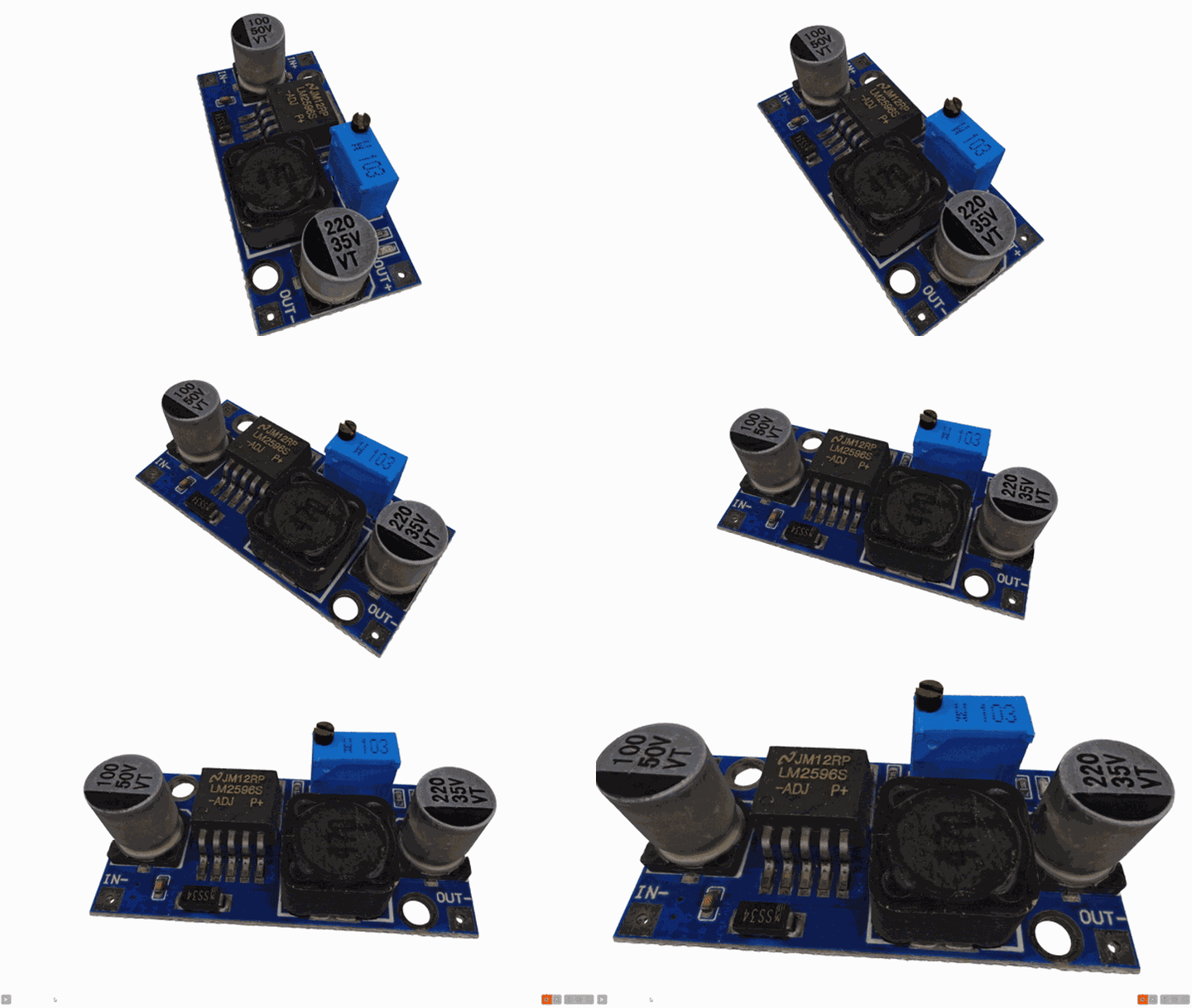
Figure 5: High-quality Gaussian Splat of a printed circuit board (PCB) that can be used for visual inspection in 3D. The output size of the 3D object is 2MB.
Real Estate
- First-person navigable 3D virtual tours: Gaussian Splat tours deliver a fundamentally different experience from 360° photo tours or stitched-image walkthroughs. Visitors navigate freely through a photorealistic 3D space in first person. Because the format is compact and web-native, the tour loads and runs in a standard browser without downloads or plugins.
- Portfolio-scale digitization: The barrier to creating assets has been commoditized, enabling the digitization of an entire property portfolio into interactive 3D that is now operationally viable. Each property can be re-captured as it is renovated or as conditions change, keeping the digital inventory current.
- Remote viewing that feels like being there: Out-of-market buyers, international investors, and remote teams gain a spatial understanding of properties that static photography cannot provide. This compresses decision cycles and reduce the need for in-person visits.

Figure 6: Input sequence of images
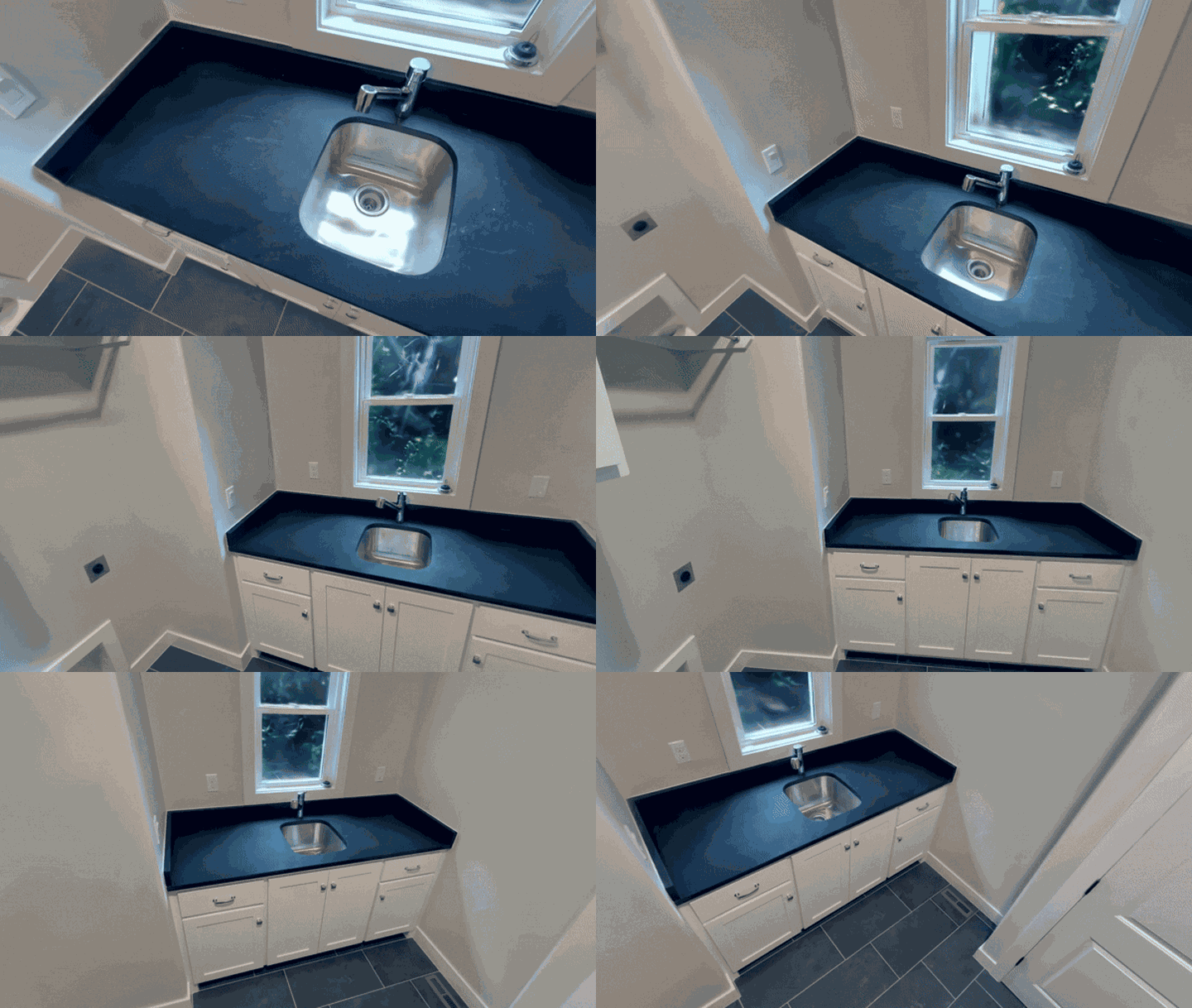
Figure 7: Output rendered 3D Gaussian Splat
From Capture to Delivery: The End-to-End Flow
Connecting capture hardware to downstream industry applications requires a reliable, scalable processing backbone. The Splat Toolbox handles the cloud processing and delivery of the assets.
Source imagery from smartphones, drones, LiDAR-assisted rigs, or multi-camera arrays is ingested, pre-processed for quality, reconstructed into 3D structure, trained into a Gaussian Splat model, and post-processed for delivery. Capture hardware ranges from a phone in your pocket to purpose-built rigs. For example, ATLAS is an open source scanner built from off-the-shelf components (LiDAR, 360° camera, and a compact compute module) for roughly $1,100, proving that high-quality 3D acquisition doesn’t require a five-figure investment. The output is a compact, web-ready 3D asset that streams to browsers and native applications without specialized viewers.
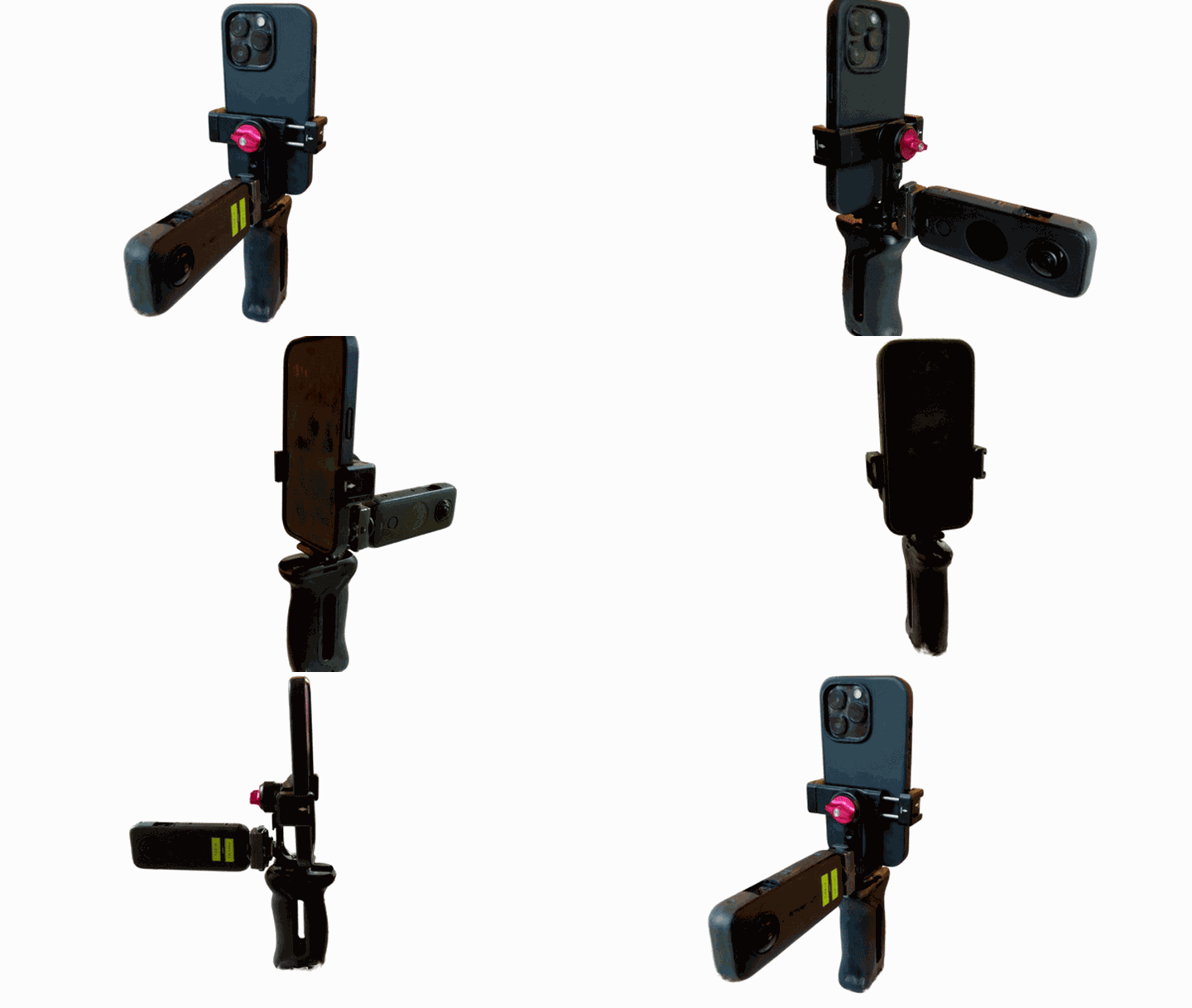
Figure 8: Gaussian Splat of a Handheld Scanner Prototype
Downstream integrations extend the pipeline into your existing toolchain:
- AWS Visual Asset Management System (VAMS): Catalog, tag, and distribute completed splat assets alongside the rest of your digital asset library.

Figure 9: VAMS Gaussian Splatting viewer
- Spatial AI connectors: Supply 3D assets into computer vision and machine learning workflows for object detection, scene understanding, and AI training pipelines.
- Digital Content Creation, game engines, and 3D tools compatibility: Export-ready for interactive applications, virtual production, and XR experiences.
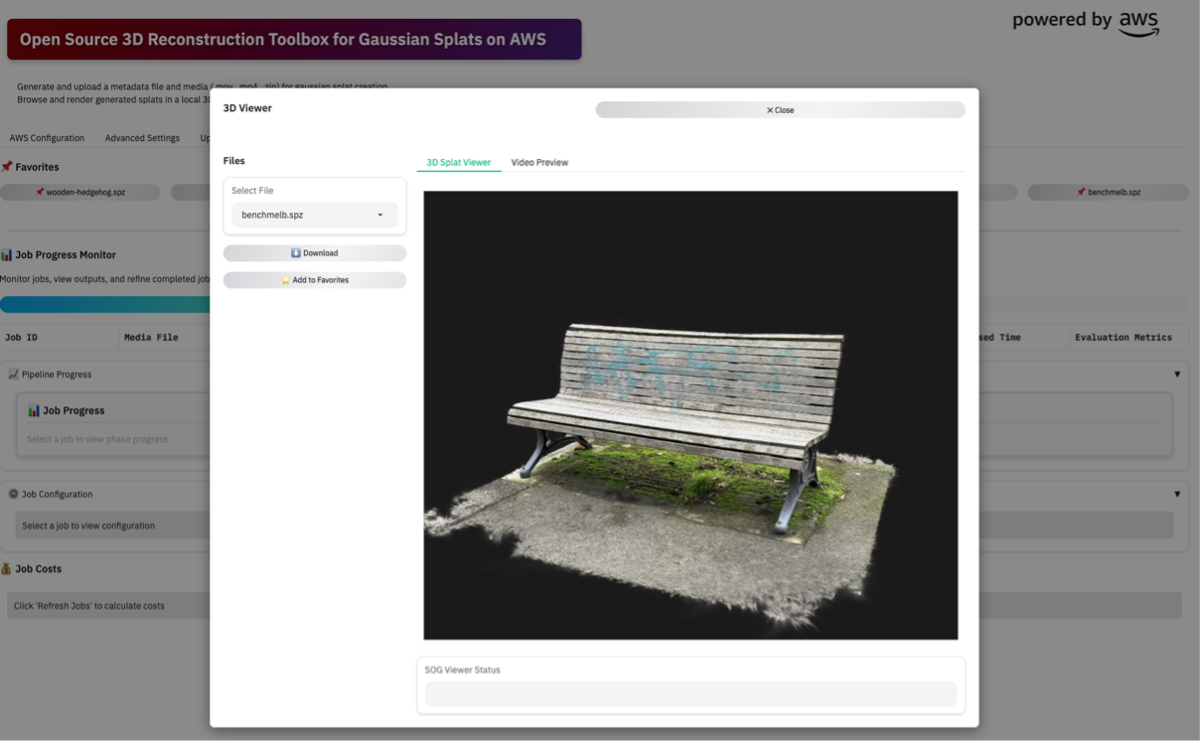
Figure 10: Web App 3D Viewer
What’s on the Horizon
The Splat Toolbox today produces 3D static assets – fully photorealistic, spatially accurate, and ready for real-time rendering at scale. The open source, modular architecture is what makes the solution extendable, with the following improvements on the roadmap:
- 4D Dynamic Assets: Today the Splat Toolbox captures the world in three dimensions. On the horizon: 4D – adding time as a fourth dimension to produce compact 3D volumetric animations. Think construction sites that play back month-by-month, assembly lines captured in motion, virtual production environments that shift and animate. For every industry covered in this post, 4D unlocks a new tier of capability: animated walkthroughs, temporal inspections, and motion-accurate AI training environments. The modular, open-source architecture of the Splat Toolbox is designed to absorb exactly this kind of evolution.
- Diffusion-assisted reconstruction: Hybrid models pair Gaussian Splatting with generative diffusion priors to reconstruct occluded regions and improve quality on sparse captures.
- Faster training strategies: Reduced GPU hours per asset enabling larger batch workloads and tighter production schedules.
- 3D Segmentation and Tagging Pipeline integration: Automatic segmenting and tagging of spatial features within a splat – enabling search, annotation, and downstream AI applications at scale.
Get Started
The Splat Toolbox is open source and available today. Because it is open source, getting started does not require a commercial agreement, a vendor evaluation, or a procurement cycle. Clone the repository, choose your deployment model, and have your first asset rendering in a browser in under an hour.
Resources:
- GitHub Repository – Open Source 3D Reconstruction Toolbox for Gaussian Splats on AWS: Full pipeline source code, deployment guides, and sample datasets.
- AWS Blog – 3D Gaussian Splatting: Performant 3D Scene Reconstruction at Scale: The introduction to 3DGS and why it represents a step-change in spatial computing.