AWS Physical AI Blog
Teaching Robots to See: How Luminous Robotics Is Accelerating Energy Infrastructure Construction with Vision-Action AI
The clean energy transition demands an unprecedented pace of solar farm deployment. But there is a bottleneck that rarely makes headlines: the physical installation of solar panels is still overwhelmingly manual, labor-intensive work. Each panel must be precisely placed onto racking structures, a process requiring careful alignment with centimeter-level accuracy.
Luminous Robotics, a current MassRobotics resident based in Boston, is addressing this problem directly with 4,000-pound industrial robotic systems deployed at active solar farm construction sites. Operating under a robots-as-a-service (RaaS) model, Luminous brings heavy-duty robotic arms equipped with multi-camera perception systems to the field. The robots handle the repetitive, intensive task of lifting and placing solar panels onto steel infrastructure which the industry calls “torque tubes”, the horizontal rails that form the backbone of solar panel arrays.
But pickup is the easy part. Placement remains stubbornly reliant on human operator confirmations. To place the solar panel on the torque tube, the LUMI robots need to perfectly align themselves with the next available empty slot on the tube where the panel needs to be placed. The Physical AI Fellowship program, an 8-week collaboration powered by Amazon Web Services (AWS), NVIDIA, and MassRobotics, helps robotics startups solve exactly this kind of problem. AWS brings cloud infrastructure and applied AI expertise, while NVIDIA brings its robotics hardware and software stack. Together they worked directly with Luminous to develop a multi-purpose AI pipeline, initially for autonomous placement.
The Operator Bottleneck
Previously, each LUMI robot required a dedicated human operator armed with a controller. The operator watched camera feeds and made real-time corrective adjustments to guide the panel into its mounting notches. A single placement typically required some manual corrections before the LUMI’s chassis slotted into position.
The math is unforgiving: under this paradigm, 3 robots require 3 operators to install thousands of panels in a typical deployment within an 8-hour shift. The 1:1 robot-to-operator ratio creates a hard ceiling on throughput and cost efficiency. To make autonomous solar installation commercially viable at scale, Luminous needs to fundamentally rethink that ratio, targeting 2 or more robots managed by a single shared operator who intervenes only when the AI requires human input
The question is: how do you teach a robot to make those corrective adjustments on its own?
Learning from Human Expertise
The answer was already sitting in Luminous’ operational data. Every time an operator interacts with the controller, that correction is recorded alongside synchronized feeds from the robot’s six onboard RGBD cameras: two front-facing cameras, two side-facing cameras, and two arm-mounted cameras. Luminous has recorded tens of thousands of these corrective episodes on active construction deployment sites across the United States and Australia.
That data makes imitation learning possible. Rather than programming explicit rules for how the robot should align to place each panel, the system learns directly from watching what skilled operators do. No explicit specification of where the panel needs to go. No hard-coded pose targets. By watching camera feeds, the system learns to make small directional nudges that guide the panel into place. But there is a catch: raw correction data is not clean enough to learn from as-is. Operator recordings are full of noise, like long pauses or small movements that do not contribute to correction. Before the data can train a model, it needs to be cleaned up to isolate the actual corrective motion. As shown in the following Figure 1, once those idle stretches are compressed out, the model can focus on learning the real correction behavior instead of accidentally imitating human pauses and hesitations.
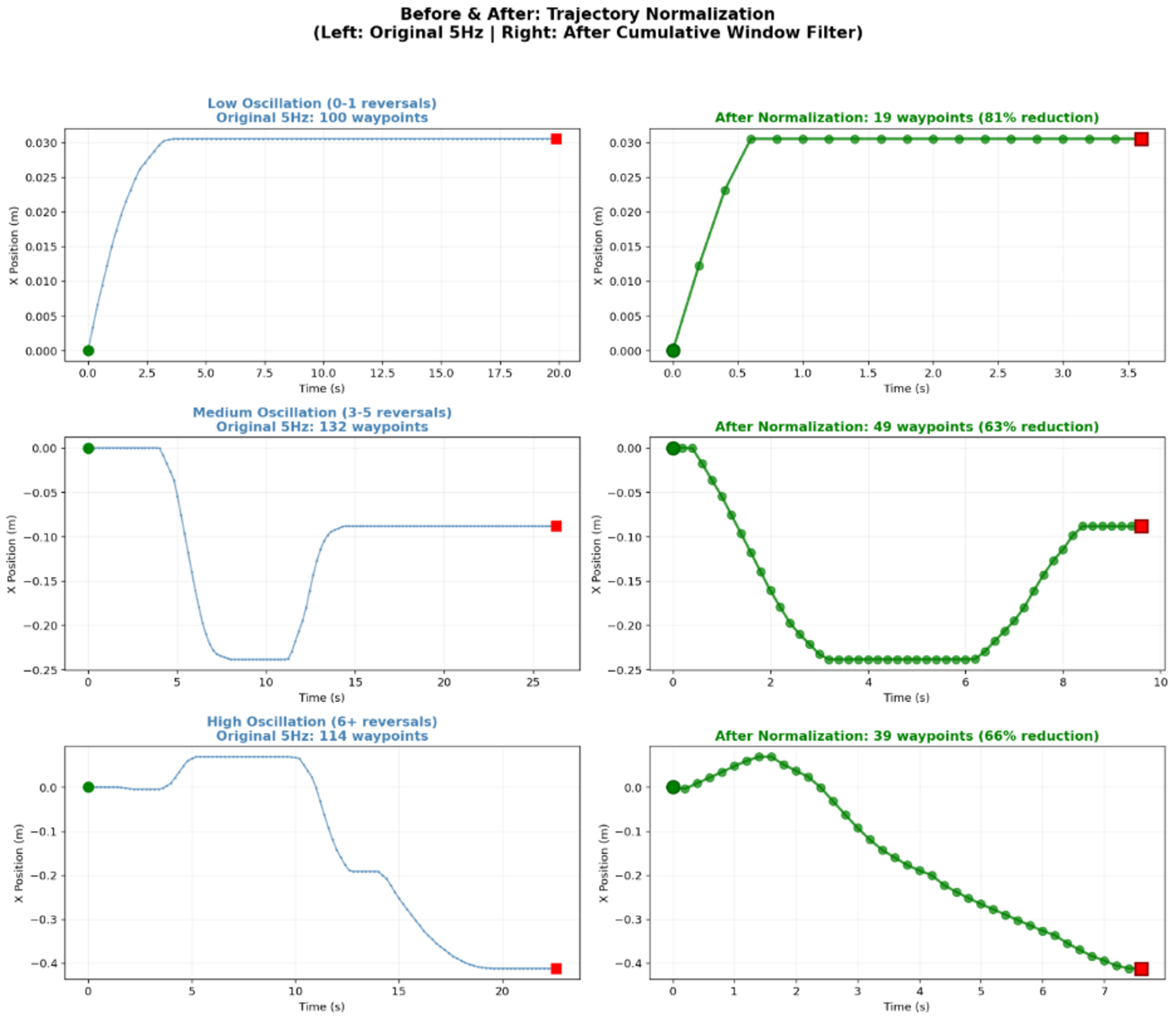
Figure 1: Smoothed vs. raw correction trajectory; stationary segment compression
Building a Vision-Action Policy Pipeline
To develop this infrastructure, Luminous partnered with the AWS Generative AI Innovation Center (GenAIIC) and NVIDIA as part of the Physical AI Fellowship program. Luminous worked with AWS scientists and solution architects to develop the pipeline, and NVIDIA provided NVIDIA Isaac Sim for generating synthetic training data and testing policies end to end. The goal was not to produce a single optimized model, but to establish a complete, repeatable pipeline that Luminous could continue building on long after the fellowship program. Finding the right alignment (achieving sub-5cm navigation endpoint error) aligns well with visuomotor policy learning—models that translate what a camera sees directly into robotic movements. Given the current camera view, the model predicts exactly how the robot should move next.
The team evaluated three progressively more capable approaches to learn corrective placement from approximately 1,000 logged operator episodes. The progression illustrates a practical methodology for robotics teams: start simple to validate the signal, then scale model complexity only where the baseline falls short.
Direct regression established whether the visual signal was learnable at all. When it revealed that single-frame predictions could not capture the sequential nature of corrections (the robot needs a trajectory, not a single displacement), the team moved to two state-of-the-art trajectory prediction architectures. The comparison between them yielded a practical insight: sensor input design mattered 3× more than model architecture choice.
Direct regression with DINOv2 treats each correction as an independent supervised prediction, one image pair in, one displacement out. A frozen DINOv2 vision transformer extracts rich visual features from the scene, which feeds into an MLP head that regresses corrective displacements. The model learns by minimizing the L2 distance between predicted and actual operator corrections. This confirmed the visual signal is learnable, achieving a median endpoint error of 2.76 cm (approximately 16% relative error on typical 17 cm trajectories), but exposed the core limitation: real corrections unfold over 1.6 seconds of coordinated motion that a single prediction cannot express.
Action chunking with transformers (ACT) learns to predict 16-step action sequences (1.6 seconds of control) in a single forward pass. It uses a conditional variational autoencoder (CVAE) to capture the distribution of possible action chunks, paired with a transformer decoder that attends over visual features to generate the full action sequence at once. A ResNet-18 encoder processes each camera view independently, and the model is trained end-to-end with direct L1 loss on actions, meaning every prediction error is penalized proportionally, which prevents the systematic biases that compound into trajectory drift. Inference takes approximately 12 ms, making it suitable for real-time 10Hz control. The best ACT configuration achieved a median endpoint error of 1.67 cm (approximately 10% relative error on displacement), with a steering MAE of 0.096 rad/s.
Diffusion policy learns the distribution of expert actions through a denoising process inspired by diffusion models in image generation. Starting from random noise, a 1D temporal U-Net iteratively refines action predictions over multiple denoising steps, conditioned on visual features extracted by a frozen DINOv2 backbone. The model is trained to predict the noise added at each diffusion step, effectively learning what “clean” expert actions look like from any point in noise space. This enables it to represent multiple valid correction paths, which is important when the same visual state could warrant different but equally valid trajectories. The tradeoff is latency: 16 denoising steps at inference vs. ACT’s single pass. Diffusion policy achieved a median endpoint error of 1.65 cm (approximately 10% relative error), converging to comparable accuracy as ACT and proving that both architectures reach the same performance ceiling once given the right sensor inputs.
Both ACT and diffusion policy are designed to learn effectively from small demonstration datasets, a critical advantage for industrial robotics where data collection requires expensive robot time. The choice between them comes down to deployment constraints and task characteristics. Diffusion policy excels when the task admits multiple valid solutions for the same observation (inherent multimodality), as its denoising process naturally represents a distribution over action sequences. ACT is preferable when the task has low action variability and the control loop demands minimal latency, a single forward pass at approximately 12 ms versus 16 iterative denoising steps.
For Luminous Robotics, the correction trajectories are highly consistent across operators. Combined with the 10Hz real-time control requirement, this made ACT the recommended production architecture. With the training and evaluation pipeline now validated, Luminous has a complete development loop: generate new episodes in Isaac Sim, train and evaluate candidate policies offline, and promote the best model to real-robot testing—only deploying hardware time on models that have already proven themselves in simulation. In the team’s experience this sim-to-real workflow accelerates iteration from weeks to hours and provides a clear path to expanding the dataset, testing new sensor configurations, and systematically improving placement accuracy as the fleet scales.
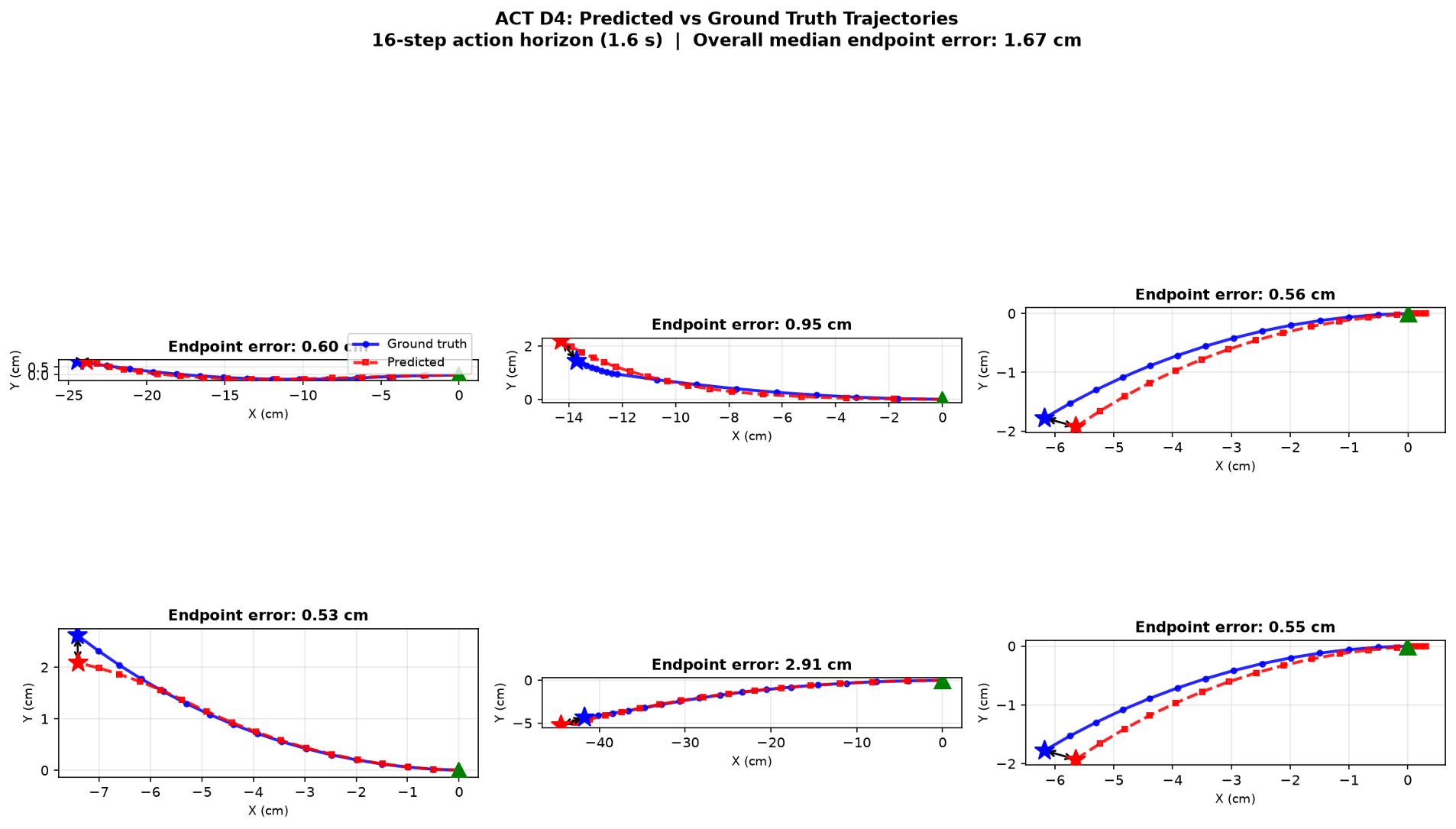
Figure 2: Original vs. model-predicted trajectory across six different chunks
The Technical Architecture
The architecture combines AWS cloud infrastructure for compute and storage with NVIDIA Isaac Sim for simulation. The key components include:
- Perception and inference: YOLO-based models handle panel and racking detection, feeding bounding box regions into the visuomotor policy network, which processes cropped multi-view images through its vision encoder to predict displacement corrections.
- Training infrastructure: Amazon Elastic Compute Cloud (Amazon EC2) GPU instances accelerated by NVIDIA support training runs and hyperparameter sweeps across the three policy approaches. Amazon Simple Storage Service (Amazon S3) stores multi-camera datasets, model checkpoints, and deployment artifacts across sites.
- Simulation: NVIDIA Isaac Sim generates synthetic training data and tests policies end to end, providing the means to close the training and testing loop faster.
A key design constraint was that the initial scope focuses exclusively on directional positioning corrections. This keeps the action space manageable while targeting the most common failure mode in current operations: lateral misalignment during the final placement phase. This architecture forms a solid foundation for expansion.
Why This Matters Beyond Solar
The approach Luminous is developing reflects a broader shift underway in industrial robotics, from hand-engineered control logic to learned policies that improve continuously with operational data. Every panel placed, whether autonomously or with human correction, generates a training signal that makes the next placement more likely to succeed without intervention.
The business implications extend well beyond immediate productivity gains.
Scaling economics change fundamentally when robots do not need dedicated operators. A 2:1 robot-to-operator ratio significantly reduces labor costs and makes it economically practical to deploy larger robot fleets against aggressive solar installation timelines and labor shortages.
Site adaptability improves with each deployment as the policy accumulates experience across diverse racking configurations, weather conditions, and panel types across deployments. Unlike rule-based systems that require manual re-tuning for each new site, a data-driven policy generalizes from accumulated operational experience.
Continuous improvement becomes structural once the pipeline exists. New data from field operations flows back into training, updated policies can be pushed to the fleet, and each deployment makes the next more capable, a flywheel dynamic that fixed-logic automation cannot replicate.
What’s Next
The next milestone is validating these results on the full production fleet, measurably reducing the number of human interventions required per panel placement. Success here establishes the technical foundation for Physical AI at gigawatt-scale across Luminous’ growing robot fleet.
Longer term, the pipeline will expand to handle more advanced corrections, adapt to new racking types, and support multi-site model generalization. The vision is a solar installation operation that scales not by hiring more operators, but by deploying smarter robots at massive fleet scales that compound learning from every panel they place.
For the renewable energy industry, this kind of automation is not incremental progress. It is a prerequisite. Meeting projected global energy demand may require solar deployment capacity that manual labor alone cannot provide at scale. Luminous Robotics, in collaboration with AWS GenAIIC and NVIDIA, is building and deploying the intelligent systems to close that gap and reimagine the energy layer that ultimately powers an AI-driven future.
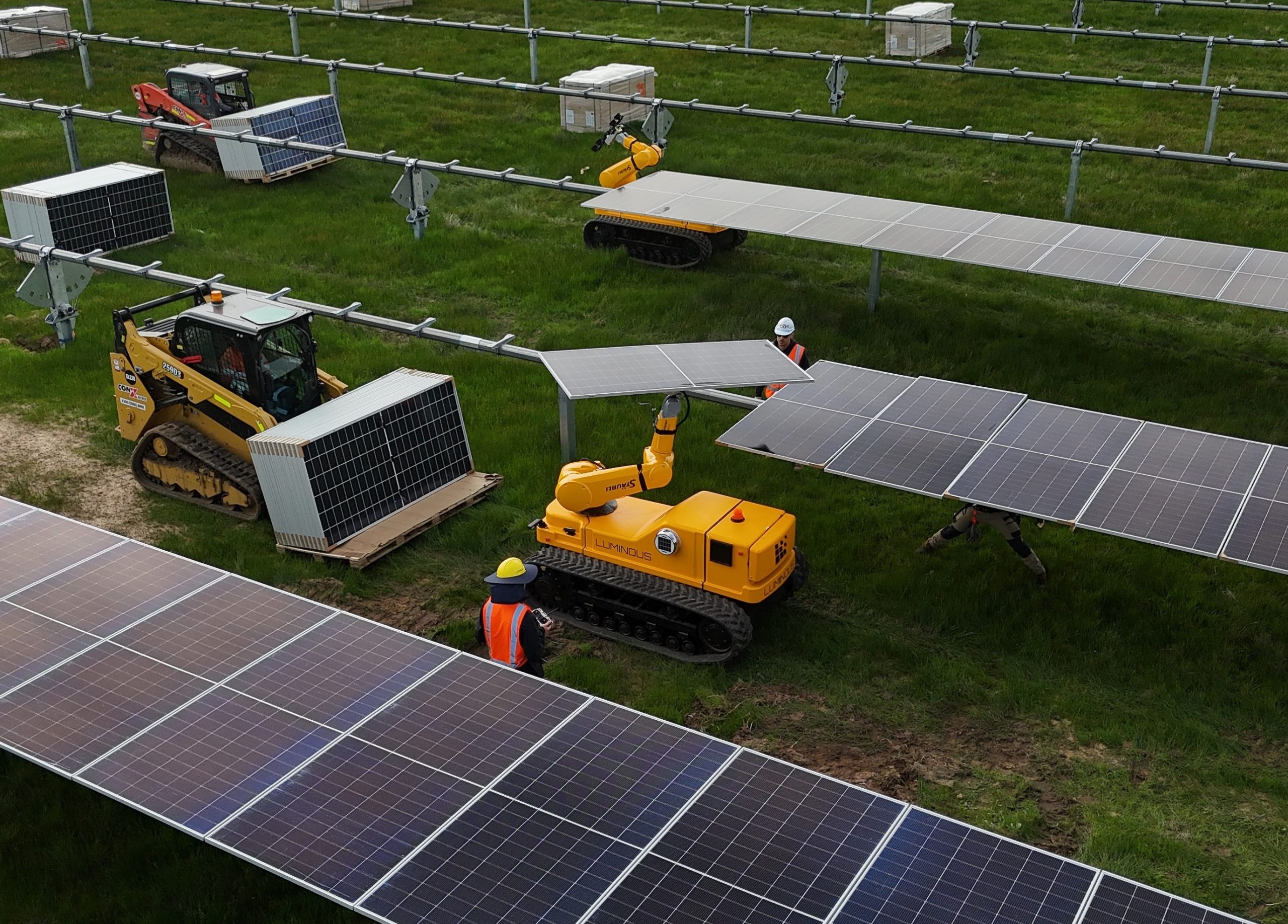
Lumi autonomous solar panel installation system
Get Started
- Learn more about Luminous Robotics and their robots-as-a-service deployment model
- Explore the AWS Generative AI Innovation Center and how AWS partners with customers on applied AI development
- Learn about the AWS and NVIDIA Physical AI Fellowship program
- Read more from the AWS Physical AI blog