AWS Public Sector Blog
How universities can collaborate with AWS to design technology experiences that deliver student success
Last year, 75 students at a science, technology, engineering, and mathematics (STEM) mentorship organization serving first-generation and low-income college students spent 4 hours building generative AI applications from scratch. They didn’t merely learn AI fundamentals, they developed business cases, presented functional prototypes, and left with portfolio projects ready for job interviews. That outcome didn’t happen by accident. It happened because we asked one question before designing a single slide: What do these students actually need?
That question is the foundation of how Amazon Web Services (AWS) approaches university collaborations. Technology companies visit campuses every week with standard presentations and product demos. Students sit through information sessions that don’t connect to their coursework, career goals, or lived experiences. Faculty miss opportunities to blend current industry practices with academic exploration. Universities miss the chance to direct student creativity toward real-world challenges where there are no predetermined answers.
AWS takes a different approach. Instead of presenting what we want to show, we start by understanding what your students need to succeed—and then we build the experience around that. In this post, we present a framework for universities to maximize educational outcomes from industry engagements.
Working backwards from student needs
The AWS Working Backwards methodology starts with the customer. In a university context, the customer is the student. When you tell us what your students need, we design the experience to deliver it:
- When computer science students need portfolio projects for job interviews, we design hands-on workshops where they build real applications.
- When business students are studying digital transformation, we bring customer case studies and strategic frameworks they can analyze.
- When engineering students need capstone project ideas, we provide real-world technical challenges they can solve.
- When graduate business students are learning strategic planning, we share our Working Backwards methodology they can apply to their own ventures.
- When community college students need industry certifications for immediate employment, we create certification preparation workshops.
- When graduate students are conducting research, we connect them with our technical teams for collaboration opportunities.
- When liberal arts students want to understand technology’s business impact, we design case studies that blend humanities perspectives with technical innovation.
The key principle is that students leave with something tangible, such as a working application, a certification, a portfolio project, or a strategic framework they can apply immediately. We can host these experiences at AWS offices for industry exposure or on your campus as faculty-sponsored learning events that align with your university’s mission and academic culture.
What we need from you
To design the most valuable experience for your students, we need to understand your specific context. The more you can share with us up front, the better we can tailor the content, format, and delivery.
Student demographics and academic focus:
- Are we working with first-year students who need foundational concepts or advanced students ready for complex technical challenges?
- Which departments and majors would benefit most, and what is their technical background?
- Are students primarily focused on technical careers, business roles, or interdisciplinary opportunities?
Curriculum integration:
- Can our event align with existing coursework requirements, giving students practical application opportunities for concepts they are learning in class?
- Are there specific skills gaps or learning objectives we can address that would strengthen your program outcomes?
- Can students earn academic credit or create portfolio pieces from their participation?
Institutional culture and values:
- What matters most to your university community, and how can we align our presentation style, examples, and interaction with your educational philosophy?
If serving underrepresented students is a priority, we want our content and speakers to reflect those values and create meaningful opportunities for all students
Your definition of success:
- What outcomes would make this collaboration valuable for your students, faculty, and institution?
- How can we measure and demonstrate the educational impact of our work together?
- What would make you want to engage with us again?
Equity and accessibility
Designing for student success means designing for all students. When we plan together, we address equity and accessibility from the start:
- How do we create experiences that all students can participate in, regardless of technical background, financial resources, or prior experience?
- What accommodations might be needed for students with disabilities?
- What technology access do students have, and do we need to provide equipment or accounts?
- How do we create examples and speakers that reflect the diversity of your student population?
These aren’t afterthoughts—they’re design requirements. AWS is committed to creating experiences that serve every student in the room.
Sustaining value beyond the event
A single workshop is a starting point, not an endpoint. When we plan together, we think through what comes next:
- Will students retain access to the tools, platforms, or resources we introduce?
- What continued access do they need to learning materials, documentation, or mentorship opportunities?
- Are there any costs to students for certifications, accounts, or materials that we should plan for?
AWS offers a range of resources that can extend the value of our collaboration, including AWS Educate for foundational cloud learning, AWS Academy for curriculum-integrated cloud education, and AWS re/Start for workforce development. Understanding your students’ ongoing needs helps us connect them to the right resources after our event ends.
Implementation keys
Several aspects of your implementation will help determine how successful it is. For the best chance of success, elements such as preparation, faculty involvement, follow-up activities, and assessment and feedback need to be fleshed out in detail prior to the start of the program.
Preparation makes all the difference in the success of your student experience. When you brief us on your student context and learning objectives, we customize our content and examples for maximum relevance. The more you can tell us about your students’ backgrounds, current coursework, and career aspirations, the better we can tailor the experience to meet their specific needs.
When faculty participate in our events and connect our content to ongoing coursework, students see clearer relationships between industry practices and academic learning. Faculty feedback also helps us improve our educational contributions over time, creating a continuous improvement cycle that benefits future collaborations.
The real value often comes after the event. When universities create follow-up opportunities for students to apply what they have learned, pursue additional certifications, or connect with our team for ongoing mentorship, the impact grows significantly. We’re always ready to support these extended learning opportunities when you help us understand how to contribute most effectively.
Assessment and feedback drive improvement. When you share student feedback, learning outcome data, and suggestions for improvement, we refine our approaches and create more valuable experiences for future collaborations. This cycle of feedback and iteration is how we move from good events to great ones.
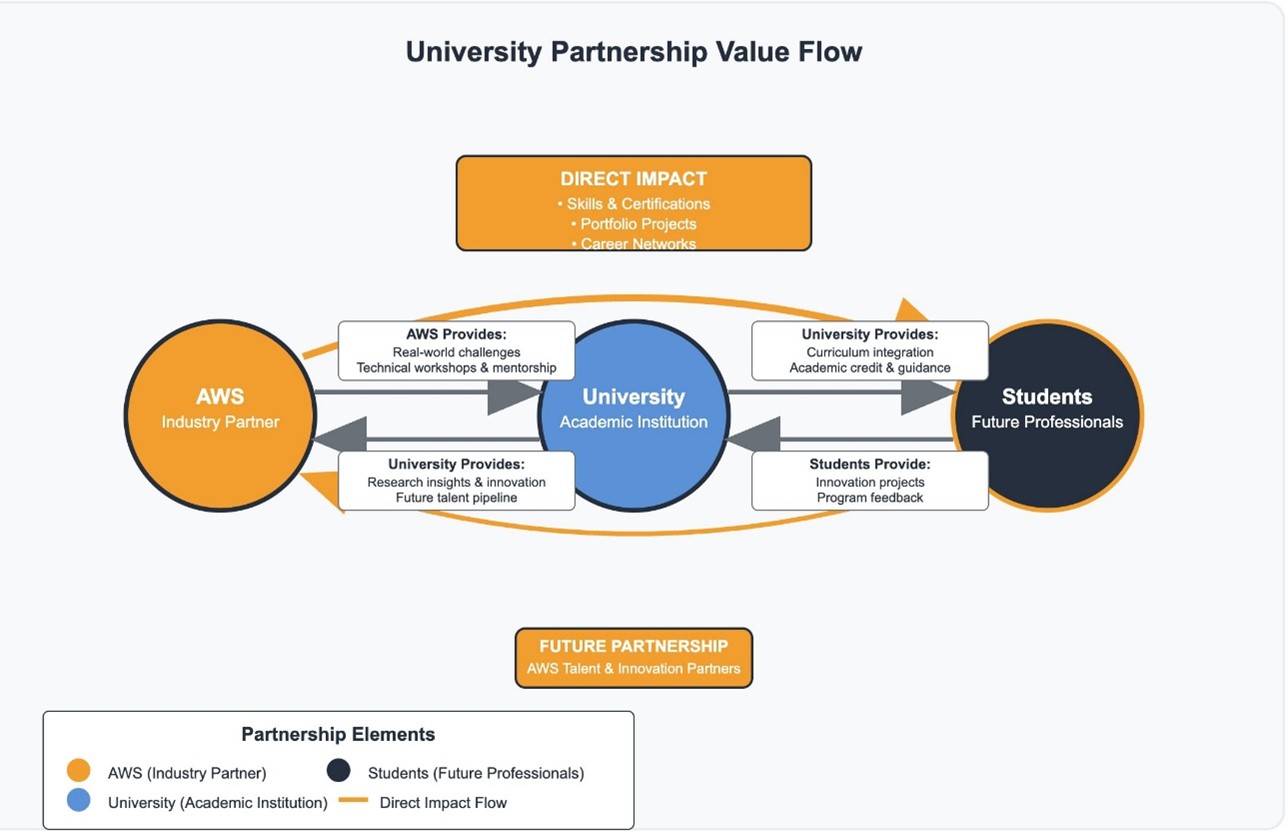
These collaborations create meaningful value for everyone involved. Students gain practical skills, industry exposure, portfolio projects, and professional networks that strengthen their career readiness. Faculty benefit from current industry insights they can integrate into their teaching, curriculum development opportunities, and professional connections that keep them engaged with evolving industry practices. Universities strengthen industry relationships, enhance program offerings, and improve student outcomes that demonstrate their commitment to practical, career-focused education. AWS gains the opportunity to contribute meaningfully to the educational institutions that shape the next generation of builders while building relationships with emerging talent and gaining insights that inform our product development and educational resource creation.
This value is reciprocal, flowing continuously between students and the university, the university and AWS, and back. The following graphic illustrates the flow of value between the university, students, and AWS.
Getting started
The conversation starts with your students. Tell us about their backgrounds, their goals, and what success looks like for your institution. From there, we work together to design an experience that serves your educational mission and delivers genuine value—not another generic industry presentation. To begin a conversation about your specific student needs and collaboration opportunities, reach out to your AWS account team or the AWS Public Sector team. Visit AWS Educate to explore AWS education programs and resources.
We’re committed to creating experiences that serve all students and support lasting educational impact. Together, we can build something worth coming back for.