AWS Quantum Technologies Blog
Combating quantum noise with AWS: University of Washington Capstone Project
Quantum computers promise to solve problems beyond the reach of classical machines, but they share a stubborn adversary: noise. Quantum bits (qubits) are exquisitely sensitive to their environment, gates are imperfect, measurements introduce bias, and these errors accumulate as circuits grow. Learning to combat noise is one of the central scientific and engineering challenges standing between today’s devices and practical quantum computing. To study complex quantum phenomena like decoherence induced by noise requires both advanced tools and skilled practitioners.
To train the next generation of quantum technologists, the Accelerating Quantum-Enabled Technologies (AQET) program at the University of Washington (UW) offers a multidisciplinary curriculum spanning physics, chemistry, materials science, engineering, and computer science. As part of the program, students complete a 10-week industry mentorship project. Last year, students working with AWS mentors modeled a nitrogen-vacancy center with NVIDIA CUDA-Q; this year’s team turned the spotlight onto noise itself.
In this post, we’re excited to share the results of the 2026 AQET capstone project, sponsored by AWS. Working on Amazon Braket and scaling through AWS infrastructure, the students built a hands-on laboratory for combating quantum noise. It progresses through three complementary strategies: suppressing noise at the source, mitigating its effects in post-processing, and correcting it with encoded logical qubits. They further showed how each stage maps naturally onto AWS services.
Project Implementation
The team began with noise suppression, characterizing how quickly qubits decay through their T1 and T2 (coherence) times. They then applied dynamical decoupling, timed pulse sequences that average away environmental noise, to keep qubits coherent for longer. These experiments were carried out on both a noisy simulator and the Rigetti Cepheus-1 superconducting quantum processing unit (QPU), accessed through Amazon Braket.
Where suppression reduces noise at the hardware level, mitigation attacks what survives, in the measured results themselves. The team explored zero-noise extrapolation (ZNE): running a circuit at several amplified noise levels and extrapolating back to the zero-noise limit. To obtain stable extrapolation results, ZNE usually requires running many circuit variants many times. The team employed a noisy simulator and used AWS Batch to fan the executions out in parallel from a pre-built containerized environment.
The most demanding layer is error correction, where a logical qubit is encoded across many physical qubits, so errors can be detected and corrected. Earlier this year, Amazon Braket announced expanded collaboration with QuEra to bring Libra by 2028, the first fault-tolerant quantum computer capable of tackling scientifically relevant problems to AWS customers. Understanding what different codes can achieve, and at what physical-qubit cost, is a prerequisite for using the fault-tolerant devices now on the horizon. What’s more, simulating QEC codes provide researchers with insights to these problems. The computation for simulating QEC codes grows costly with code size, so the team chose AWS Parallel Computing Service (PCS) to perform scaled computation. The rotated surface code was studied on PCS using the Stim and PyMatching libraries for circuit simulation and error syndrome decoding.
The progression from suppression to correction is as much a computing story as a physics one, with Amazon Braket, AWS Batch, and AWS PCS each carrying respective workloads as schematically represented in Figure 1.
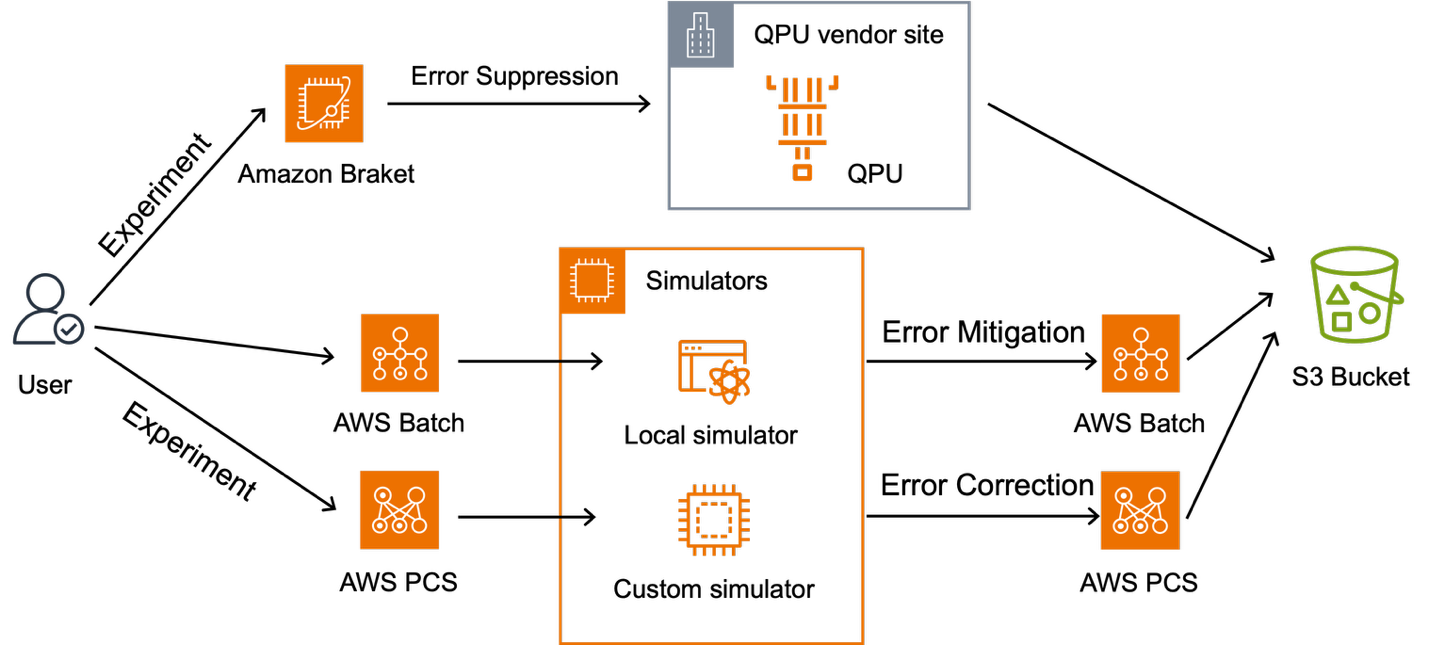
Figure 1 – End-to-end workflow in studying quantum noise on AWS. Quantum circuits are dispatched to the appropriate backend by task: circuits with error-suppression protocols run on a third-party QPU via Amazon Braket; circuits for zero-noise extrapolation are fanned out on noisy simulators using AWS Batch, which also performs the mitigation post-processing; and circuits for quantum error correction are simulated at scale on AWS PCS with Stim and PyMatching, which also handles syndrome decoding and correction. Final results persisted to shared S3 storage.
Conclusion
Over ten weeks, the University of Washington capstone team built a working laboratory for combating quantum noise and showed how each stage scales naturally across Amazon Braket, AWS Batch, and AWS PCS. The same services and workflow can be reused to design and scale novel noise experiments of your own. To quickly set up the infrastructure, start with notebook1, which deploys resources via CloudFormation templates stored here. To explore the full noise suppression, mitigation, and correction story, see the other three notebooks in project repository for details. And if you’re at an accredited institution, the AWS Cloud Credit for Research program can help you get started.
Acknowledgement
The AQET traineeship program at the University of Washington is sponsored in part by NSF award DGE-2021540.