AWS Storage Blog

Author: Abhishek Shukla
Abhishek is a Senior Technical Account Manager at AWS specializing in data analytics, object storage, and cloud operations. He helps organizations design and implement modernization and migration strategies to AWS Cloud, enabling them to scale efficiently and securely. His work focuses on building resilient architectures that balance performance, cost optimization, and long-term sustainability.
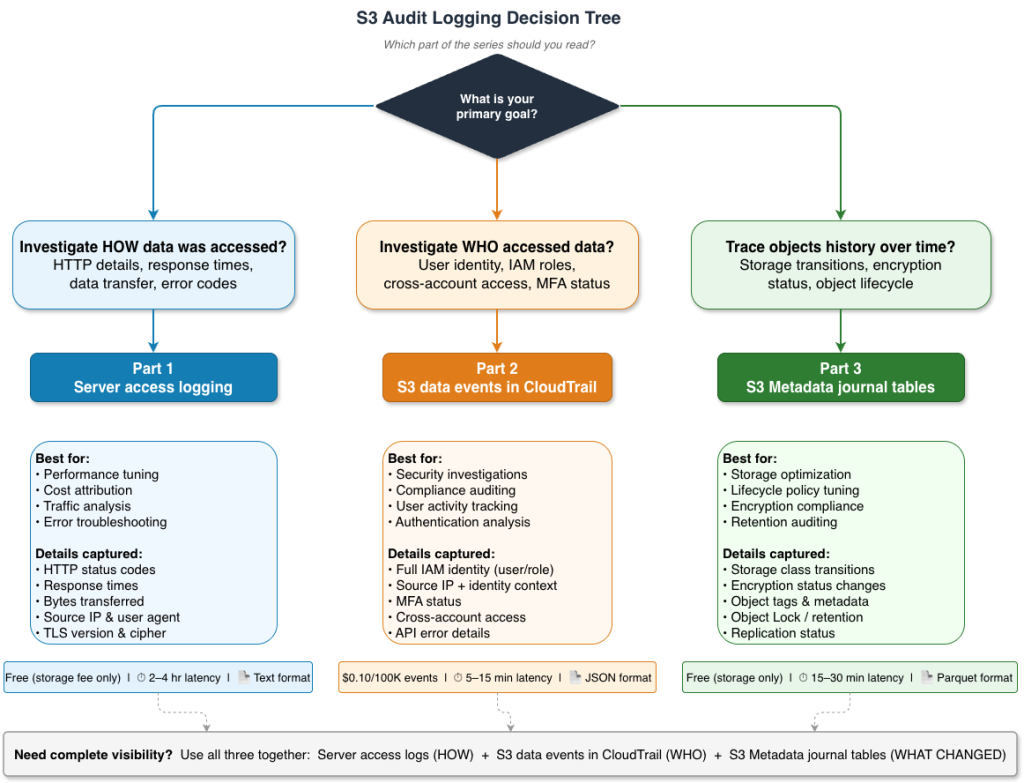
Amazon S3 audit logging, Part 3: Analyzing S3 Metadata journal tables for object lifecycle tracking
This is Part 3 of our three-part series on Amazon S3 audit logging. In Part 1, we covered server access logs for HTTP-level requests and performance analysis. In Part 2, we covered S3 data events in AWS CloudTrail for identity-focused security investigations. As data volumes grow and storage costs become a significant line item, organizations […]
Amazon S3 audit logging, Part 2: Centralized logging and analysis of S3 data events in AWS CloudTrail for security and compliance
This is Part 2 of our three-part series on Amazon S3 audit logging, focusing on identity-driven security investigations. In Part 1, we covered S3 server access logs for HTTP-level performance analysis and cost attribution. When a security incident occurs—an unauthorized download, a bulk deletion, or suspicious access from an unfamiliar location—the first question is always, […]
Amazon S3 audit logging, Part 1: Analyzing server access logs with Amazon Athena for performance insights
Organizations storing sensitive data must maintain complete visibility into how it’s accessed, by whom, and what changes occur over time. Regulatory frameworks demand detailed audit trails, security teams need rapid answers during investigations, and finance teams require granular cost attribution. Yet as data grows from terabytes to petabytes, the scale that makes centralized storage attractive […]

Cross-account Amazon S3 bulk transfers with enhanced AWS KMS support
Cross-account Amazon S3 bulk transfers with enhanced AWS Key Management Service (AWS KMS) support become increasingly critical as organizations grow and accumulate vast amounts of digital assets across their enterprise. Managing millions or even billions of files presents unique challenges, especially when these files need to be moved securely between different AWS accounts. Operations such […]

Accelerating Amazon S3 Batch Operations at scale with on-demand manifest generation
Modern enterprises routinely manage billions of objects across their cloud storage environments, needing efficient bulk operations for disaster recovery, compliance management, data transfer, and cost optimization. Performing these operations manually or through custom scripts becomes impractical at scale, often creating operational bottlenecks when time-sensitive actions are necessary. Organizations frequently need to identify and process specific […]