AWS Security Blog

Beyond DKIM key rotation: understanding email replay attacks
As the email administrator for your organization’s domain, you receive a Domain-based Message Authentication, Reporting, and Conformance (DMARC) aggregate report showing email passing DomainKeys Identified Mail (DKIM) verification as though it came from your domain, sent from IP addresses you don’t recognize to recipients you didn’t contact. To clear the issue, you rotate your DKIM […]

Inside a successful AWS European Sovereign Cloud exercise to demonstrate independent operation
On Saturday, October 24, 2026 we conducted a successful exercise demonstrating that the AWS European Sovereign Cloud can operate without depending on any infrastructure outside the European Union (EU). This was the first public technical exercise demonstrating the independence of a sovereign cloud Region. The AWS European Sovereign Cloud is a new, independent cloud partition […]
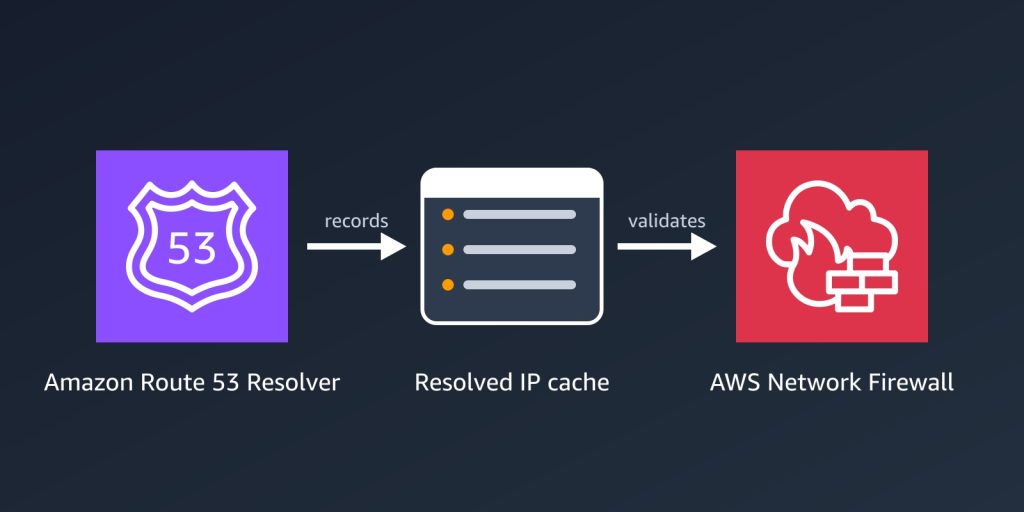
Introducing Route 53 Resolved IP Validation for AWS Network Firewall
Your workloads reach most destinations by domain name, but a firewall can only act on what it sees in the traffic. For HTTP and HTTPS, AWS Network Firewall domain rules match the name that the client puts in the request, and the client chooses that name. The connections for protocols such as SSH and SSH […]

AWS becomes first CSP to complete the Cloud High profile assessment with 172 services and features in scope
We continue to expand the scope of our assurance programs at Amazon Web Services (AWS) and are pleased to announce the successful completion of our first ever Cloud High (PBHH) security assessment with 172 assessed services and features. Completion of this assessment, effective September 18, 2026, makes AWS the first cloud service provider (CSP) in […]

Part 3 – Cybersecurity journeys: The work behind the work
The most important work I’ve done in cybersecurity would make for terrible television. There were no countdown clocks and no frantic typing, just a lot of careful reading, a lot of hard conversations, and the occasional quiet moment where everything finally clicked. That’s the part I want to show you this week, because the three […]

Using AWS WAF to apply mitigations for PHP2Shell RCE vulnerabilities (CVE-2026-109618 and CVE-2026-109619)
October 29, 2026: We added guidance for end-of-life PHP versions (8.1 and earlier), including the source backports that the PHP security team published for PHP 7.4, 8.0, and 8.1. October 23, 2026 (update 2): The PHP project disclosed CVE-2026-115560, a separate remote code execution issue that the October 21 releases don’t fix. It affects only […]

Amazon Threat Intelligence identifies PHP2Shell exploitation prior to public disclosure in MadPot
Amazon Threat Intelligence identified a PHP2Shell exploitation attempt dating to Oct. 17, 2026, in MadPot telemetry, four days before public disclosure of CVE-2026-109618 and CVE-2026-109619. The exploit attempt originated from an IP address associated with a commercial anonymization network. While the vulnerability was under embargo, the targeting of a honeypot from an anonymized IP address […]
Best practices for integrating IAM Roles Anywhere with your PKI
Using temporary credentials is a security best practice to reduce the risk from credentials getting compromised. With AWS IAM Roles Anywhere, now your workloads outside of Amazon Web Services (AWS) will be able to access AWS resources by obtaining temporary security credentials in AWS Identity and Access Management (IAM). IAM Roles Anywhere relies on public […]

Managing identity source transition for AWS IAM Identity Center
October 20, 2026: This post was republished to reflect the new migration capability from Active Directory to an external identity provider (IdP) or the Identity Center directory, now available in IAM Identity Center. September 2, 2026: This post was republished to include Active Directory migration strategies and automation for permission sets. AWS IAM Identity Center […]
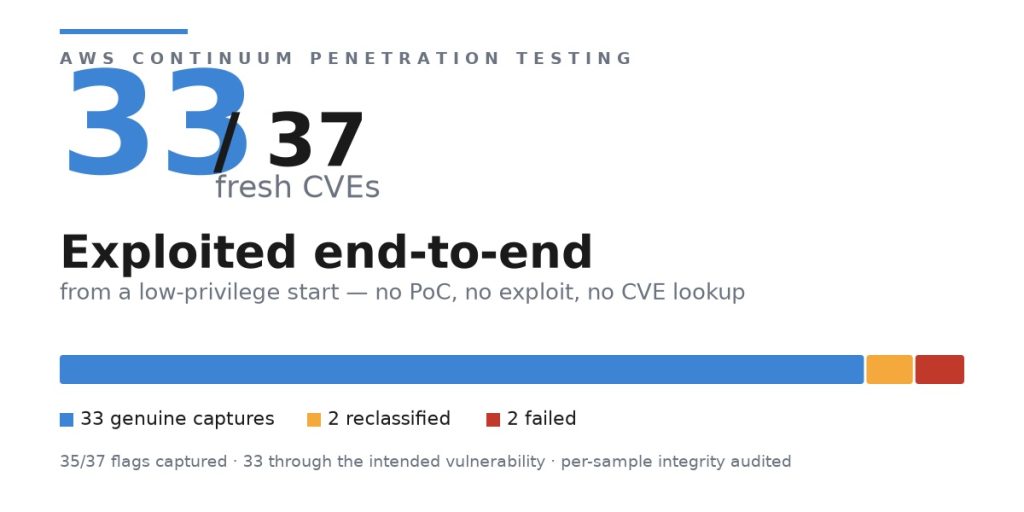
AWS Security Agent (now part of AWS Continuum) exploited 33 of 37 new real-world CVEs
We applied AWS Security Agent (now part of AWS Continuum), our autonomous penetration-testing agent, to 37 real, recently disclosed Common Vulnerabilities and Exposures (CVEs), each packaged as a live, containerized target with a flag hidden at the vulnerability’s intended sink. Starting from an unauthenticated or low-privilege position (an endpoint URL and a one-line hint, no […]