Building the future’s contact center using agentic AI on AWS with Omilia
Learn how voice AI company Omilia rebuilt its contact-center stack around autonomous AI agents on AWS.
Benefits
- of calls resolved automatically
-
90%
- rise in task completion rate for one customer
- 40%
- faster time to go live
- 10x
Overview
Omilia has spent more than 2 decades building its agentic customer experience (CX) platform, processing interactions for enterprises across banking, insurance, telecommunications, and quick-service sectors. The company owns every layer of its stack, from speech recognition to reasoning models, and runs it live in regulated environments. When frontier models made fully agentic conversations possible, Omilia needed to experiment faster than its on-premises GPUs could support. On Amazon Web Services (AWS), the company rebuilt its stack around autonomous AI agents, improving automation, accuracy, and deployment speed.
About Omilia
Omilia is an enterprise agentic CX company that powers over 3 billion conversations per year in 30 languages. Based in Cyprus, the company serves more than 200 customers across four continents.
Opportunity | Using AWS to accelerate AI experiments for Omilia
Regulated contact centers need uptime, speed, accuracy, and cost control. Most AI systems weren’t built for real-time data. Enterprises often choose between legacy platforms with AI bolted on and agentic tools that weren’t tested on live calls, where latency, interruptions, and imperfect audio leave no room for error.
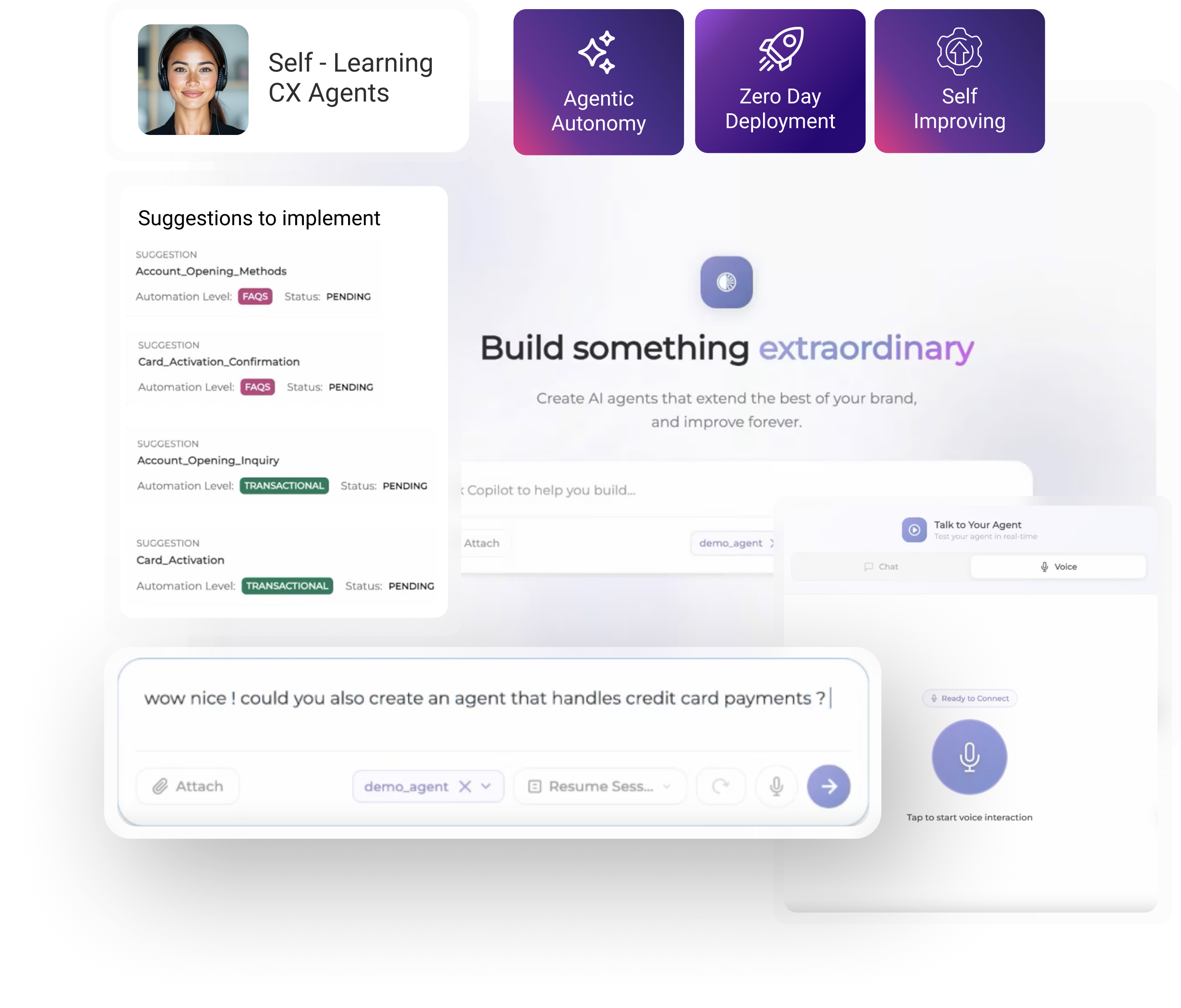
Omilia takes a different approach: It owns its entire AI stack. The company’s self-learning agentic CX platform orchestrates proprietary automatic speech recognition, reasoning models, dialogue management, and neural text to speech into a single certified environment.
Instead of one general-purpose model, Omilia trains dozens of small, task-specific models. Each is optimized for a single contact-center function, such as verifying identity, processing a payment, or tracking a shipment. Every release of an open source model raises the same question: Does it outperform what is already in production?
Omilia couldn’t prove that because every GPU was busy on live calls. Capacity waits stretched evaluations from weeks into months. To train and run models at scale, Omilia turned to AWS for a high-performance, cost-efficient infrastructure that could match the pace of AI research while maintaining stability in production.
Solution | Building a self-learning agentic architecture
Omilia set out to build the agentic contact center of the future: Autonomous AI agents resolve most customer requests, and people handle only what agents shouldn’t. To test ideas and benchmark models at speed, the company uses Amazon Bedrock, a service for building generative AI applications and agents at production scale. This fully managed service provides access to leading foundation models, such as Anthropic’s Claude, through a single API. Using Amazon Bedrock, Omilia can quickly prototype, evaluate, and compare models, bringing in a frontier model when a task calls for it.
After Omilia identifies the right approach, the company turns to Amazon SageMaker AI, an integrated experience for analytics and AI. This fully managed service supports the entire machine learning (ML) lifecycle, from data preparation to deployment. Using purpose-built tools in Amazon SageMaker AI, Omilia’s data scientists and ML engineers build and refine proprietary conversational AI models without managing ML infrastructure.
As its models and inference demands grow, Omilia uses Amazon SageMaker HyperPod, a service for scaling and accelerating generative AI model development. The service provides purpose-built infrastructure for large-scale distributed training and high-throughput inference, plus resilient, optimized compute clusters with built-in fault tolerance and automatic recovery. Omilia now trains large models faster and serves them at production scale with low latency.
The company can now re-train its many small models as call traffic and customer intents shift. “We need to evolve, experiment, and deliver value at scale,” says Claudio Rodrigues, chief product officer at Omilia. “The availability of GPUs, along with the experimentation tools and efficiency that SageMaker HyperPod offers, has been critical.”
With that foundation, the company closed the loop between production and research. Every call becomes training data. The system transcribes conversations, identifies where agents succeeded or fell short, and feeds that signal back into the models. Enterprises don’t need to organize data before deployment because Omilia’s software analyzes live calls and produces the training data itself.
“By off-loading infrastructure management to AWS, we can create immediate business impact,” says Rodrigues. “A team member can transform a good idea into value in a fraction of the time, without running around asking when the GPU is going to be available.”
Outcome | Resolving most calls automatically at enterprise scale
In banking and insurance, Omilia’s agents resolve up to 90 percent of inbound calls automatically, with 97 percent intent accuracy and subsecond response times. Specialized models also reduce hallucinations in high-stakes, regulated conversations. One large financial institution uses the agentic CX platform to handle over 1 million calls per day, with the majority resolved automatically.
Another customer raised its task completion rate by 40 percent, reaching 98 percent voice accuracy. In quick-service restaurants, drive-through voice agents increased upsell revenue by 21 times compared with human operators, while reducing order times and easing the workload that drives employee turnover.
Now, enterprises go live in days rather than weeks, an acceleration of 10 times, because the self-learning pipeline generates its own training data from early interactions. Customer-satisfaction scores rise across deployments because callers get answers right away.
The platform positioned Omilia as a Visionary in the 2025 Gartner Magic Quadrant and a Leader in the Forrester Wave: Conversational AI Platforms for Customer Service, Q2 2026. Next, the company plans to use AWS to bring its platform to new industries and regions.

By off-loading infrastructure management to AWS, we can create immediate business impact. A team member can transform a good idea into value in a fraction of the time.
Claudio Rodrigues
Chief Product Officer, OmiliaAWS Services Used
More Customer Stories


Did you find what you were looking for today?
Let us know so we can improve the quality of the content on our pages